
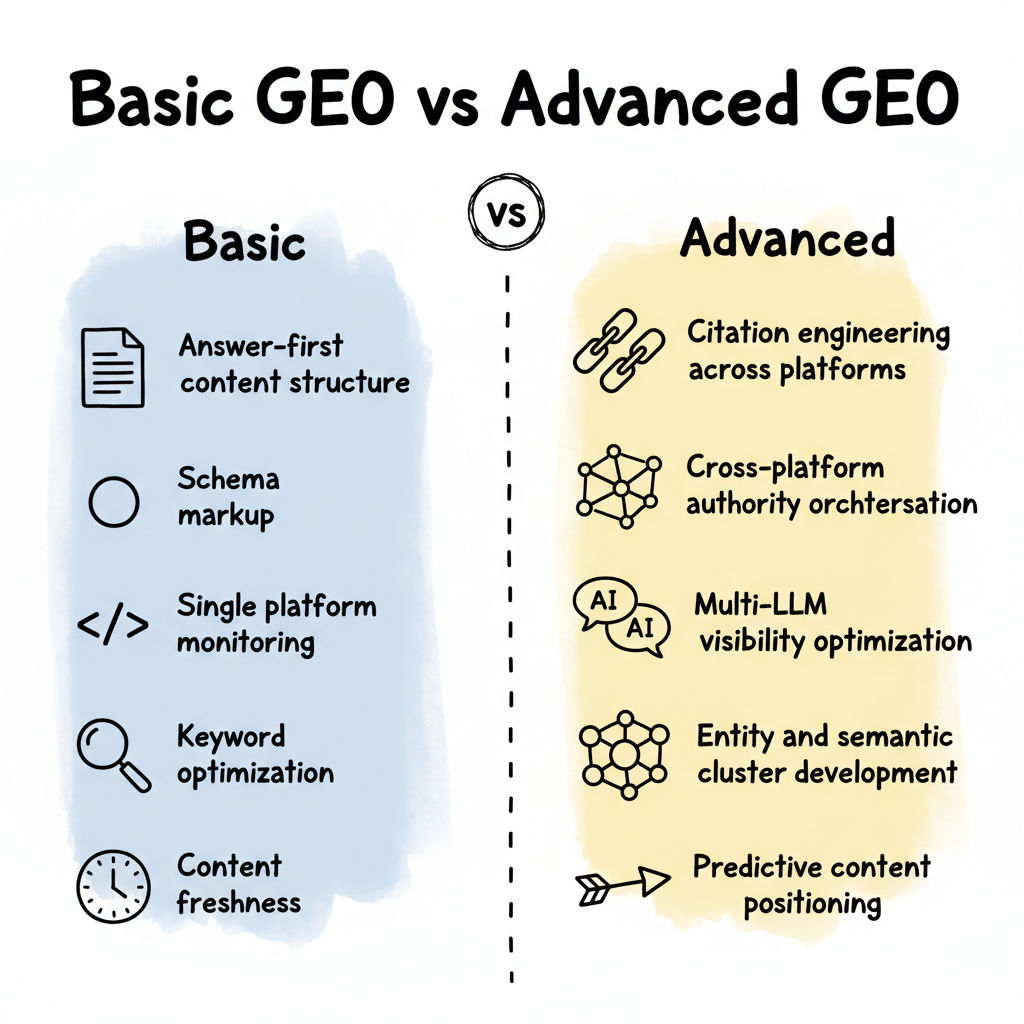
Basic GEO optimization gets brands mentioned by AI systems. Advanced GEO optimization ensures brands become the go-to authority that AI consistently cites, recommends, and trusts across platforms. Moving beyond foundational tactics requires sophisticated approaches to citation engineering, entity development, and cross-platform optimization.
According to Omnius's GEO agency analysis, top agencies employ comprehensive GEO strategies with 22+ specialized techniques, including AI crawler optimization, strategic keyword placement, and schema markup that go far beyond basic content optimization.
What Separates Advanced GEO from Basic Optimization
Basic GEO focuses on making content AI-accessible. Advanced GEO focuses on making your brand the authoritative source AI systems prefer to cite.
According to Wellows' citation research, across ChatGPT, Perplexity, and Google AI Overviews, brands are surfaced based on citation eligibility, source overlap, and entity signals rather than backlink volume. Platforms surface sources based on structure, authority signals, entity clarity, and cross-platform consensus.
The urgency for advanced GEO tactics is clear: ChatGPT now serves over 800 million weekly active users, and Google AI Overview SEO impact continues to grow with AI Overviews appearing in more than 16% of searches.
Basic vs advanced GEO:
Basic GEO | Advanced GEO |
Answer-first content structure | Citation engineering across platforms |
Schema markup implementation | Cross-platform authority orchestration |
Single platform monitoring | Multi-LLM visibility optimization |
Keyword optimization | Entity and semantic cluster development |
Content freshness | Predictive content positioning |
Writing for AI Extractability: Self-Contained Content Strategies
Content extractability determines how effectively AI systems chunk, vectorize, and retrieve passages from web content during retrieval-augmented generation (RAG). When large language models answer user queries, they extract individual passages from indexed sources -- meaning each paragraph must convey a complete idea without requiring surrounding context.
Self-contained paragraphs are the foundation of AI-extractable content. Each paragraph should open with a definition-style sentence or core claim, embed supporting statistics or attributable data points, and close within 40-80 words. Front-loaded information is critical: lead sentences must contain the primary insight, not bury it mid-paragraph.
Research from the arxiv GEO study demonstrates that pages incorporating direct quotes and statistics achieve 30-40% higher visibility in AI-generated responses compared to pages relying on narrative prose alone. This finding underscores the importance of embedding verifiable data points throughout content rather than concentrating them in summary sections.
A practical formatting checklist for AI extractability includes: definition-style paragraph openings that establish context immediately, embedded statistics with clear attribution, concise paragraph length between 40 and 80 words, and claims structured as standalone assertions that AI systems can extract and cite independently.
Advanced Citation Engineering
Citation engineering goes beyond hoping AI mentions your brand—it systematically increases citation probability through strategic content positioning.
According to Xponent21's citation analysis, AI SEO is the practice of structuring a brand's information ecosystem—content, architecture, semantic clusters, and workflow-level expertise—so generative AI systems like Google's AI Overviews and LLMs such as ChatGPT, Perplexity, and Gemini can accurately retrieve, interpret, and cite it.
Citation engineering tactics:
Tactic | Implementation | Impact |
Citation overlap analysis | Study which sources AI cites together | Position alongside trusted sources |
Semantic cluster coverage | Build comprehensive topic ecosystems | Establish topical authority signals |
Cross-reference density | Include verifiable facts with sources | Pass AI verification checks |
Quote-ready passages | Create extractable authoritative statements | Increase direct citation probability |
Entity disambiguation | Clarify brand identity across web | Reduce citation confusion |
According to Nick Lafferty's AI SEO tools review, citation volume varies dramatically by platform—Google AI Overviews cites approximately 7.7 domains per response while ChatGPT only cites approximately 5.0 domains, meaning brands have 50% fewer opportunities for inclusion in ChatGPT answers.
Real-world results demonstrate the revenue impact of citation engineering. Tally, the form-building platform, reports that ChatGPT became their number one referral traffic source after optimizing their content for AI citation. Similarly, Vercel attributes 10% of new signups to ChatGPT recommendations. These cases illustrate how systematic citation engineering translates directly into measurable business outcomes -- not just visibility, but acquisition and revenue growth.
Multi-Platform Authority Optimization
Different AI platforms evaluate authority differently. Advanced GEO requires platform-specific optimization strategies that align with how each system evaluates and ranks content for generative engine optimization.
According to The Ad Firm's 2026 AI data analysis, businesses measuring AI SEO report a 527% increase in AI search traffic, with top performers exceeding that mark through structured content and consistent citation signals.
Platform-specific authority signals:
Google AI Overviews
├── Prioritizes existing SERP authority
├── Values structured data heavily
├── Cites based on topical clusters
└── Responds to freshness signals

ChatGPT
├── Values encyclopedic comprehensiveness
├── Prefers balanced perspectives
├── Cross-references training data
└── Cites fewer sources per response

Perplexity
├── Heavy emphasis on recency
├── Real-time web search integration
├── Values direct source attribution
└── Frequent re-crawling of sources

Claude
├── Values nuanced expertise
├── Prefers well-reasoned arguments
└── Cross-platform source validation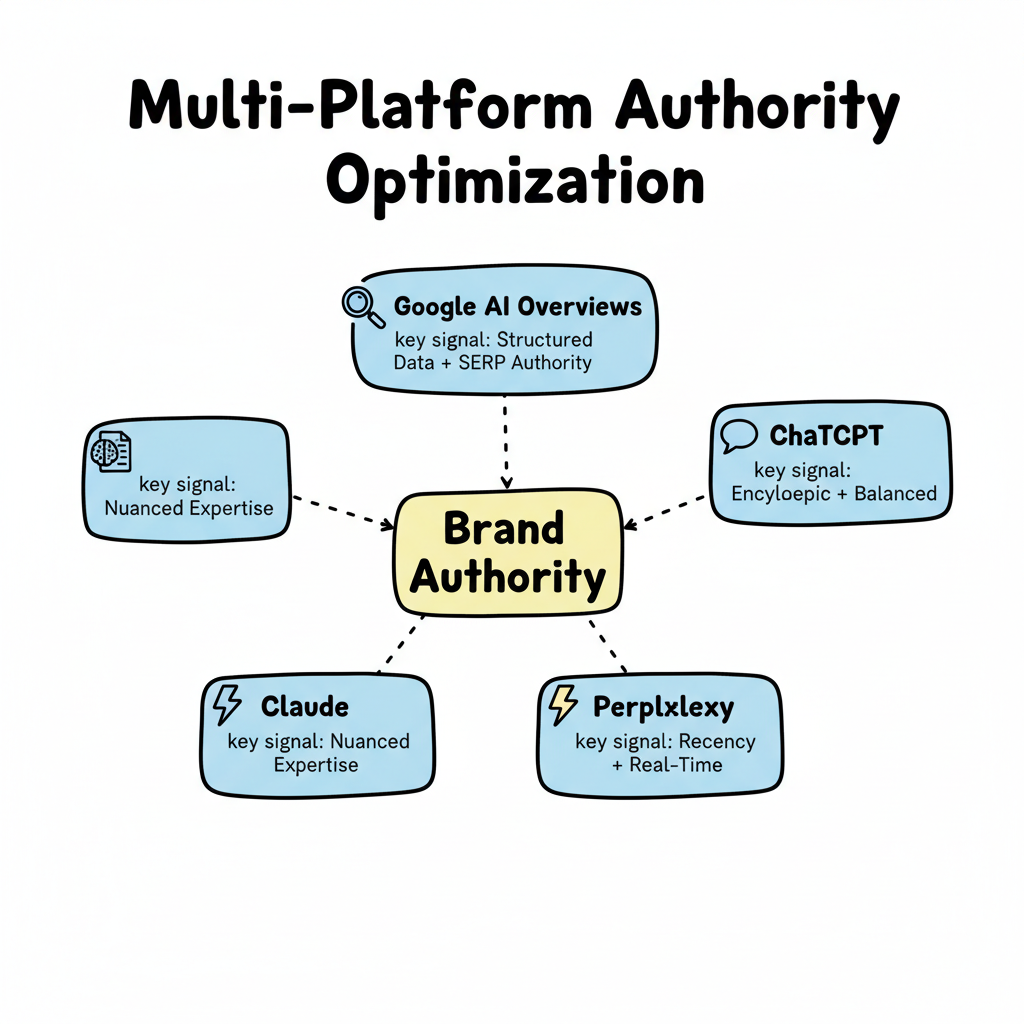
Beyond the major AI platforms, user-generated content platforms serve as critical data sources for AI systems. Reddit, YouTube, and LinkedIn function as discovery and validation channels where AI models find and cross-reference brand information. Distinguishing between owned content on your channels and earned mentions in community discussions, reviews, and forums is essential. AI systems increasingly use these UGC platforms as both training data and real-time retrieval sources, making active participation and reputation management across these communities a core component of multi-platform authority.
Entity Development Strategies
AI systems recognize and trust entities—distinct concepts with consistent identity across the web. Advanced GEO requires systematic entity development.
According to Exaalgia's LLM visibility guide, LLM visibility is the ability of a large language model to refer to your brand, product, or content in their responses with the desired level of frequency, accuracy, and sentiments. When a user asks an AI a question, the AI returns a response, and your brand needs to be in that response for high visibility.
Entity optimization framework:
Element | Purpose | Implementation |
Consistent NAP+E | Name, Address, Phone, Entity type | Identical across all platforms |
Knowledge graph signals | Machine-readable entity data | Schema, Wikipedia, Wikidata |
Entity associations | Connect to related authoritative entities | Co-mentions, partnerships, citations |
Brand search demand | Create search volume for brand terms | PR, advertising, content marketing |
Sentiment management | Maintain positive entity associations | Review management, PR response |
How E-E-A-T Signals Influence AI Source Selection
Experience, Expertise, Authoritativeness, and Trust (E-E-A-T) signals directly influence which sources large language models select for citation. AI systems evaluate author credentials, the presence of original research, and first-hand experience indicators when determining citation priority. Content demonstrating genuine expertise -- such as proprietary data, case studies, or practitioner insights -- receives higher citation probability than generic summaries.
Wikipedia presence serves as a powerful entity development tactic for AI visibility. Wikipedia content comprises a significant portion of LLM training data, and brands with well-maintained Wikipedia entries benefit from stronger entity recognition across AI platforms. Establishing and maintaining accurate Wikipedia and Wikidata profiles strengthens the knowledge graph signals that AI systems rely on for entity disambiguation.
Microsoft's official GEO and AEO guidelines reinforce the importance of expertise-based content strategies, recommending that brands publish authoritative, well-sourced content with clear author attribution and structured data for AI search to maximize visibility in generative AI responses.
Technical Advanced GEO
Beyond basic schema and site structure, advanced technical GEO addresses AI crawler behavior and content accessibility. Understanding these technical elements provides the foundation for maximizing generative engine optimization benefits.
According to PageTraffic's AI optimization guide, LLMS.txt will become a common standard for helping AI models understand how to explore, read, and use content from websites. This standardization helps content creators and AI developers work together better.
AI crawlers such as GPTBot and ClaudeBot often cannot execute client-side JavaScript, which means content rendered exclusively via JavaScript frameworks remains invisible to these systems. Server-side rendering or static pre-rendering is essential for ensuring AI discoverability alongside the LLMS.txt configuration described below.
Advanced technical implementations:
- LLMS.txt configuration - Provide AI-specific crawling instructions
- AI crawler allowances - Configure robots.txt for AI indexing
- Semantic HTML optimization - Help AI parse content structure
- API accessibility - Enable programmatic content access
- Cross-origin citation linking - Maintain attribution chains
Technical priority matrix:
Implementation | Effort | Impact | Priority |
Comprehensive schema | Medium | High | 1 |
LLMS.txt deployment | Low | Medium | 2 |
AI crawler configuration | Low | Medium | 3 |
API endpoints | High | Medium | 4 |
Semantic markup refinement | Medium | Medium | 5 |
Predictive Content Positioning
Advanced GEO anticipates what AI systems will need to answer, not just what they currently cite.
According to LSEO's State of SEO report, advanced engine optimization encompasses a more advanced understanding of search engine algorithms, user intent, and personalization, requiring predictive and personalized SEO strategies.
Predictive positioning tactics:
- Query anticipation - Research emerging questions in your space
- Content velocity - Publish authoritative answers before competitors
- Trend response - Quickly address industry developments
- Seasonal preparation - Pre-build content for predictable cycles
- Competitive gap filling - Address topics competitors haven't covered
Measurement for Advanced GEO
Advanced optimization requires advanced measurement beyond basic citation counting, similar to how AEO metrics and KPIs provide comprehensive performance insights.
According to PR News Online's GEO guide, advanced GEO tools increasingly provide insight into which journalists, outlets, and websites shape AI understanding of a brand. Reports that place GEO metrics alongside SEO metrics provide a more complete view of brand visibility.
Advanced GEO metrics:
Metric | What It Measures | Why It Matters |
Citation velocity | Rate of new citations over time | Growth trajectory |
Platform distribution | Coverage across AI engines | Reach breadth |
Citation context quality | Accuracy and favorability of mentions | Brand representation |
Competitive citation share | Your citations vs competitors | Market position |
Attribution chain depth | How sources cite you citing others | Authority positioning |
GEO Tools and AI Visibility Metrics: Measuring What Matters
Reference rate and share of voice are the primary metrics for generative engine optimization measurement. Reference rate tracks the percentage of relevant prompts where your brand is cited by AI systems. Share of voice measures your citation percentage compared to competitors for a given topic cluster. These metrics differ fundamentally from traditional SEO rank tracking because they measure inclusion in generated responses rather than position on a results page.
Prompt-level tracking represents the next evolution in GEO measurement. This approach monitors which specific queries trigger brand mentions across AI platforms including ChatGPT, Perplexity, Gemini, Claude, and Copilot. By mapping citation patterns at the prompt level, practitioners identify which content assets drive citations and which topic gaps need addressing.
Generative engine optimization tools fall into three categories. AI citation tracking tools monitor brand citations across AI platforms over time, establishing baseline visibility and tracking growth. Audit tools perform one-time readiness assessments, evaluating content structure, entity clarity, and schema completeness for AI extraction. Attribution tools bridge the gap between AI mentions and site traffic, connecting AI-sourced visits to conversions in analytics platforms. For a comprehensive comparison, see our guide to AI search tools and software.
The scale of AI search adoption underscores why these measurement capabilities are essential. ChatGPT serves over 800 million weekly active users. AI Overviews appear in more than 16% of Google searches. AI assistants now handle an estimated 56% of total search volume. Brands without dedicated AI visibility measurement are operating blind in a channel that already rivals traditional search in reach.
An important distinction in GEO measurement is earned versus owned brand mentions. AI systems may weight unlinked brand mentions from reviews, press coverage, and community discussions differently than traditional link-based signals. Monitoring both owned mentions from your content channels and earned mentions from third-party sources provides a complete picture of AI visibility.
Key Takeaways
Advanced GEO optimization requires systematic expertise development:
- Beyond basics - Advanced GEO focuses on becoming the preferred authority, not just being visible
- Citation engineering - Systematically increase citation probability through strategic positioning
- Platform-specific tactics - Different AI systems require different optimization approaches
- Entity development - Build consistent, recognizable brand identity across the web
- Technical sophistication - Implement LLMS.txt, AI crawler configuration, and semantic optimization
- Predictive positioning - Anticipate AI information needs, don't just respond to them
- Advanced measurement - Track citation velocity, platform distribution, and competitive share
According to Dashspert's optimization guide, technical optimization for AI and LLM-driven search is no longer just about canonical tags and fast load times—it's about translating your on-page expertise into machine-readable language that empowers search algorithms to understand, distill, and present your content as authoritative answers.
Frequently Asked Questions About Generative Engine Optimization
What Is Generative Engine Optimization (GEO)?
Generative engine optimization is the practice of optimizing content to appear in AI-generated responses from platforms like ChatGPT, Perplexity, Google AI Overviews, and Claude. Unlike traditional SEO that targets search result rankings, GEO focuses on citation engineering, entity authority, and content extractability so that large language models select and reference your content when answering user queries.
How Is GEO Different from Traditional SEO?
GEO differs from SEO in what it optimizes for. SEO targets ranking positions in search result pages, while GEO targets citation inclusion in AI-generated answers. GEO emphasizes self-contained paragraphs, structured data, entity authority, and cross-platform brand mentions. The measurement frameworks also differ -- GEO tracks reference rate and share of voice across AI platforms rather than click-through rates from search results.
What Tools Are Available for Generative Engine Optimization?
Several categories of GEO tools have emerged in 2026. AI visibility monitoring tools track brand citations across ChatGPT, Perplexity, Gemini, and other platforms over time. Audit tools assess your content's readiness for AI extraction. Attribution tools connect AI-sourced traffic to conversions in analytics platforms. The market is growing rapidly, with new tools launching monthly as generative engine optimization becomes a standard marketing discipline. See our guide to the best generative engine optimization tools for detailed reviews.
How Do You Measure Success in Generative Engine Optimization?
The primary GEO metrics are reference rate (how often AI systems cite your brand for relevant queries) and share of voice (your citation percentage compared to competitors). Advanced practitioners also track citation velocity, attribution chain depth, and prompt-level coverage -- which specific query clusters trigger your brand mentions. These metrics require dedicated AI visibility tools since traditional analytics platforms do not capture AI citation data natively.