
Last Updated: March 2026
Answer Engine Optimization (AEO) agencies help businesses appear in AI-generated responses from ChatGPT, Perplexity, Google AI Overviews, and voice assistants. As AI search handles an increasing percentage of informational queries, AEO has become essential for maintaining visibility.
This guide covers what AEO agencies do, the services they offer, and how to evaluate providers for your needs.
What Does an AEO Agency Do?
An AEO agency optimizes your content to be cited by AI systems when they generate answers. Unlike traditional SEO agencies focused on rankings in search results, AEO agencies focus on selection—ensuring your content is the source AI platforms choose to reference.
The shift matters because AI search changes user behavior. Instead of clicking through multiple links, users receive synthesized answers directly. Brands not appearing in these answers lose visibility to competitors who do.
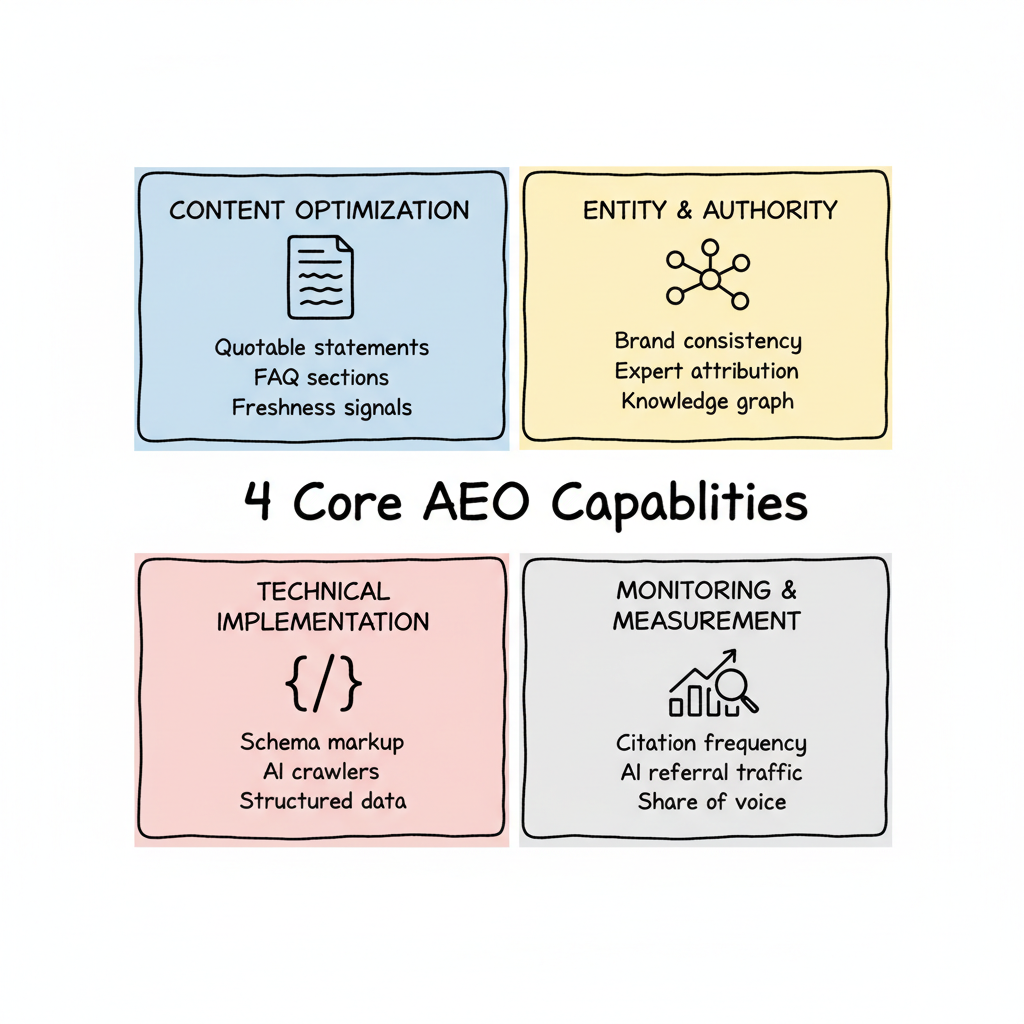
Core AEO Capabilities
Effective AEO agencies combine several disciplines:
Content Optimization
Making content extractable by AI systems:
- Restructuring content into quotable, standalone statements
- Front-loading key information after every heading
- Creating FAQ sections matching how users query AI
- Adding specific data points with clear attribution
- Maintaining content freshness with regular updates
- Content clustering and semantic relationship mapping—grouping related content around core entities to build topical authority that AI models recognize. See our guide on AEO optimization examples for practical implementations of this approach.
Entity and Authority Building
Establishing trustworthiness that AI systems recognize:
- Consistent brand information across all platforms
- Expert author positioning and attribution
- Cross-platform visibility development
- Knowledge graph optimization
- Wikipedia/Wikidata presence where applicable
Technical Implementation
Ensuring AI crawlers can access and understand content:
- Schema markup deployment (FAQ, HowTo, Article, Organization)—implementing structured data for AI search is critical for how AI platforms parse and cite your content
- AI crawler access configuration
- Structured data implementation and validation
- Server-side rendering optimization
- Site architecture for AI comprehension
Monitoring and Measurement
Tracking visibility that traditional SEO tools miss:
- Citation frequency monitoring across AI platforms
- AI referral traffic analysis
- Share of voice reporting versus competitors
- Citation accuracy verification
- Performance trend analysis
AI search is fragmenting across multiple platforms, and a capable agency must optimize for all of them—including ChatGPT, Perplexity, Google AI Overviews, Grok, DeepSeek, Claude, and Microsoft Copilot. Each platform weighs content signals differently, making multi-platform optimization essential.
AEO vs SEO vs GEO: Understanding the Differences
As AI transforms search, three distinct but overlapping disciplines have emerged: SEO, AEO, and GEO. Understanding how they differ helps you evaluate what services an agency should provide.
SEO (Search Engine Optimization) focuses on improving organic rankings in traditional search engines like Google and Bing. AEO (Answer Engine Optimization) targets AI answer platforms—ChatGPT, Perplexity, voice assistants—to get your content cited in AI-generated responses. GEO (Generative Engine Optimization) specifically targets generative search experiences like Google AI Overviews and SearchGPT, optimizing for how your content appears within AI-generated search results pages.
Discipline | Primary Goal | Target Platforms | Key Tactics |
SEO | Organic rankings | Google, Bing | Keywords, backlinks, technical SEO |
AEO | AI answer citations | ChatGPT, Perplexity, voice assistants | Entity optimization, structured data, content extraction |
GEO | Generative search visibility | Google AI Overviews, SearchGPT | Source authority, citation signals, SERP feature optimization |
Where these disciplines overlap matters most. Strong SEO foundations support both AEO and GEO performance, since AI platforms heavily reference content that ranks well organically. Meanwhile, AI platforms like ChatGPT, Perplexity, Google AI Overviews, Grok, DeepSeek, Claude, and Microsoft Copilot each weight these disciplines differently—making integrated optimization essential.
Leading agencies now offer all three as an integrated service, recognizing that AI search fragmentation demands a multi-platform strategy. For a deeper comparison, see our breakdown of AEO vs GEO vs SEO.
AEO Service Offerings
Agencies structure their AEO services in several ways depending on client needs and engagement scope.
Assessment and Strategy Services
AEO Audits
Comprehensive analysis of current AI visibility covering:
- Current citation frequency across major AI platforms
- Content extractability evaluation
- Entity consistency assessment
- Technical accessibility review
- Competitive visibility analysis
- Prioritized recommendations
Typical investment: $2,000-8,000 for a thorough audit with actionable recommendations. Many agencies offering AEO audit services can identify specific gaps preventing your content from being cited by AI platforms.
Strategy Development
Creating roadmaps for AI visibility:
- Target platform prioritization
- Content optimization sequencing
- Authority building plans
- Technical implementation timelines
- Measurement framework development
Implementation Services
Content Optimization
Transforming existing content for AI extraction:
- Restructuring paragraphs for standalone quotability
- Adding statistics and expert citations
- Implementing FAQ sections
- Updating outdated information
- Creating timestamp and freshness signals
Agencies specializing in conversational content writing for AEO understand how to structure content that matches natural language queries and AI platform preferences.
Technical Implementation
Making sites AI-accessible:
- Schema markup across priority pages
- Robots.txt configuration for AI crawlers
- JavaScript rendering optimization
- Structured data deployment
- Site speed improvements
Authority Building
Establishing credibility AI systems recognize:
- Digital PR for earned media coverage
- Expert author development
- Platform presence building
- Entity consistency across directories through entity optimization for AI search
- Review and reputation management
Brand mentions and social media signals are emerging as important AEO ranking factors. AI models weigh unlinked brand mentions across trusted sources, making digital PR and social presence part of the AEO authority stack. Understanding the full landscape of AI search ranking factors helps agencies build comprehensive authority strategies.
AEO for Ecommerce
eCommerce brands face unique AEO challenges as AI shopping assistants become more prevalent. A capable AEO agency should offer eCommerce-specific optimization including:
- Product page optimization for AI answer inclusion—structuring buying guides and comparison content so AI platforms cite your products in purchase-related queries
- Category page AEO: structuring product taxonomy for entity recognition so AI systems understand your product hierarchy
- Review and rating schema implementation to strengthen AI citation signals around your products
- Answer-formatted product comparisons that AI platforms can extract and present directly to users researching purchases
As AI shopping assistants handle more purchase-intent queries, eCommerce AEO ensures your products appear in AI-generated buying recommendations rather than only in traditional search results.
Ongoing Management
Monthly Retainer Programs
Continuous AEO optimization typically includes:
Service Component | Monthly Scope |
Content optimization | 5-15 pages |
New content creation | 2-6 articles |
Citation monitoring | Continuous |
Technical maintenance | Ongoing |
Strategy reviews | Monthly |
Reporting | Detailed monthly reports |
Integrated SEO/AEO Programs
Many agencies combine traditional SEO with AEO services:
- Full SEO services (technical, on-page, content, links)
- AEO optimization layered on SEO foundations
- Unified reporting across both disciplines
- Coordinated strategy development
How to Evaluate AEO Agencies
Selecting the right AEO partner requires assessing specific capabilities and track record.
Essential Questions to Ask
Methodology Questions
- "How do you approach optimization for different AI platforms?" Each platform—ChatGPT, Perplexity, Google AI—has different characteristics. Effective agencies explain platform-specific approaches rather than one-size-fits-all methods.
- "What's your process for content restructuring?" Look for specific techniques: paragraph length targets, front-loading strategies, FAQ development approaches. Vague answers suggest superficial understanding.
- "How do you balance AEO with traditional SEO?" AI platforms heavily reference content that ranks well in traditional search. Understanding generative AI search engine optimization principles helps agencies integrate both disciplines effectively.
Results Questions
- "Can you share case studies with specific metrics?" Request examples showing citation increases, AI referral traffic growth, or share of voice improvements—not just claims of success.
- "What tools do you use for AI visibility monitoring?" Expect mention of specialized platforms (Otterly.AI, Search Party, Conductor) or proprietary monitoring systems. Generic SEO tools don't capture AI visibility.
- "How long until clients typically see results?" Realistic answers acknowledge that technical improvements show results in weeks while authority building takes months. Be skeptical of promises of dramatic improvement in 30-60 days.
Process Questions
- "What does onboarding look like?" Clear processes indicate operational maturity and the ability to deliver consistent results.
- "How do you report on AI visibility?" Reporting should include citation frequency, platform-specific visibility, competitive comparisons, and accuracy monitoring—not just traditional SEO metrics repackaged.
- "How do you stay current with AI platform changes?" AI search evolves rapidly. Agencies should demonstrate awareness of platform updates and strategy adaptation.
AEO Tools and Monitoring Platforms
A credible AEO agency should use specialized AEO tools and software to track and improve your AI visibility. Key monitoring platforms include Otterly.AI for AI citation tracking, HubSpot AI Grader for brand visibility scoring, and Conductor for enterprise-scale AI search analytics.
When evaluating agencies, ask about their tooling stack. Look for capabilities in AI citation tracking, prompt testing across platforms, and visibility scoring dashboards. Agencies should be able to benchmark your content against answer-first formatting standards—targeting the 40-60 word concise answer format that AI platforms prefer to extract and cite.
Tool access transparency is a strong green flag. Agencies willing to share dashboard access and show you exactly how they measure AI visibility demonstrate confidence in their methodology and results.
Warning Signs to Avoid
Guaranteed Placement Promises
No agency can guarantee specific placement in AI responses. AI outputs vary by query, context, and user. Agencies claiming they can guarantee top placement demonstrate either dishonesty or fundamental misunderstanding.
SEO Services Relabeled as AEO
Some agencies relabel existing SEO services as AEO without substantive methodology changes. Look for AEO-specific tactics—content restructuring for extraction, entity optimization, citation monitoring—rather than traditional SEO rebranded.
No Measurement Capabilities
If an agency can't explain how they track AI visibility, they can't demonstrate results. Citation monitoring requires specialized approaches beyond standard SEO analytics.
Dismissing Traditional SEO
AI platforms reference authoritative content that often performs well in traditional search. Agencies treating SEO as obsolete show incomplete understanding of how AI visibility actually works.
Investment Considerations
Understanding typical pricing helps set appropriate expectations.
Pricing Ranges
Service Type | Investment Range | Notes |
AEO Audit | $2,000-8,000 | One-time comprehensive analysis |
Content Sprint | $5,000-15,000 | Optimize 10-30 priority pages |
Monthly Retainer (Basic) | $3,000-6,000 | Limited optimization, monitoring |
Monthly Retainer (Comprehensive) | $8,000-20,000 | Full-service AEO program |
Integrated SEO/AEO | $10,000-30,000 | Combined disciplines |
Enterprise Programs | $25,000+ | Large-scale, dedicated resources |
Factors Affecting Pricing
- Site size: More content requires more optimization work
- Competitive landscape: Competitive niches require more aggressive strategies
- Current visibility: Starting from zero requires more foundational work
- Industry specialization: Niche expertise often commands premiums
- Service scope: Integrated programs cost more than AEO-only
Results Timeline
Set realistic expectations for when AEO efforts show impact.
Technical Implementation: Weeks. Schema deployment, crawler access configuration, and technical improvements can impact visibility relatively quickly.
Content Optimization: 1-3 months. Restructuring content for extraction shows results as AI platforms refresh their indexes and knowledge bases.
Authority Building: 3-6+ months. Earned media, entity development, and cross-platform presence take time to accumulate.
Comprehensive Visibility Transformation: 6-12 months. Full transformation across all target platforms requires sustained effort over multiple quarters.
Industry benchmarks show that most businesses see measurable AI citation visibility improvements within 3-6 months of consistent AEO work. AI referral traffic growth varies, but agencies should establish measurement baselines in month one to track progress accurately. Be skeptical of any agency claiming meaningful AEO results in under three weeks—sustainable AI visibility requires methodical optimization. For a detailed breakdown of implementation phases, see our AEO implementation roadmap.

Key Takeaways
AEO addresses a real visibility gap. As AI search grows, brands not appearing in AI responses lose visibility to competitors. AEO agencies provide expertise to close this gap.
Look for integrated capabilities. Effective AEO requires content optimization, technical implementation, and authority building—not just one component.
Verify measurement capabilities. Without citation monitoring, neither you nor the agency can demonstrate results. Insist on AI-specific tracking.
Expect meaningful investment. Results require real resources. Agencies offering comprehensive AEO at low prices likely deliver superficial optimization.
FAQs
What'S the Difference Between an AEO Agency and an SEO Agency?
Traditional SEO agencies focus on rankings in search results. AEO agencies focus on getting content cited in AI-generated responses. Many agencies now offer both services since the disciplines overlap—strong SEO performance often supports better AI visibility.
Do I Need an AEO Agency or Can My SEO Agency Add AEO?
Evaluate your current agency's AEO capabilities using the questions outlined above. Many SEO agencies have added AEO services, but depth varies significantly. If your agency lacks specific AI measurement tools, demonstrated results, and clear AEO methodology, consider specialized expertise.
How Much Should I Budget for AEO Services?
Expect $5,000-15,000/month for comprehensive AEO services including content optimization, technical implementation, and monitoring. Basic packages start lower but may not include meaningful optimization. Enterprise programs with dedicated resources typically cost $20,000+/month.
How Long Until AEO Shows Results?
Technical improvements can show impact within weeks. Content optimization typically shows measurable citation changes in 1-3 months. Authority building requires 3-6+ months for meaningful progress. Be skeptical of agencies promising dramatic improvements in 30-60 days.
What Is the Difference Between AEO and GEO?
AEO (Answer Engine Optimization) focuses on getting your content cited in AI-generated answers from platforms like ChatGPT and Perplexity. GEO (Generative Engine Optimization) specifically targets generative search engines like Google AI Overviews and SearchGPT. Both disciplines optimize for AI visibility, but GEO emphasizes the generative search results page while AEO covers all answer-based AI surfaces including voice assistants.
What Tools Should an AEO Agency Use?
A competent AEO agency should use AI citation tracking tools like Otterly.AI or HubSpot AI Grader to monitor brand mentions across AI platforms. They should also use prompt testing tools, entity analysis platforms, and structured data validators. Ask prospective agencies which monitoring tools they use and whether they provide dashboard access so you can verify AI visibility improvements yourself.
Can an AEO Agency Help with Ecommerce Product Visibility in AI Search?
Yes. AEO agencies can optimize product pages, buying guides, and category structures so AI platforms cite your products in purchase-related queries. This includes implementing product review schema, creating answer-formatted product comparisons, and building entity authority around your brand and product lines. eCommerce AEO is especially valuable as AI shopping assistants become more prevalent.
How Do AI Platforms Like Grok, Claude, and Copilot Affect AEO Strategy?
Each AI platform uses different data sources and ranking signals, so AEO strategy must account for platform fragmentation. Grok pulls from real-time X/Twitter data, Claude emphasizes well-structured authoritative content, and Microsoft Copilot integrates Bing search results. A thorough AEO agency tests your visibility across all major platforms rather than optimizing for just one.