
You've decided Answer Engine Optimization matters for your business. Now comes the harder decision: which agency to trust with your AI search visibility. The AEO services landscape in 2026 includes genuine specialists, traditional SEO agencies adding services, and opportunists making claims they can't deliver.
This guide provides the decision framework you need to select an AEO partner that actually drives results—not just reports activity.
Why AEO Agency Selection Matters Now: The Zero-Click Reality
Zero-click searches now account for a growing share of search results, making AI citations the new visibility currency. The demand for qualified answer engine optimization agency partners has surged—search interest in AEO agencies grew 52% year-over-year, while queries for answer engine optimization agency spiked 333% quarter-over-quarter.
This explosive growth reflects a market reality: brands not optimized for LLM-ready content risk losing visibility across Google AI Overviews, ChatGPT, Perplexity, Bing Copilot, and Gemini simultaneously. Choosing the right agency now—before your competitors lock in their AI search positioning—is a strategic advantage. Evaluating the best AEO services available is the essential first step.
The AEO Agency Landscape
Understanding Your Options
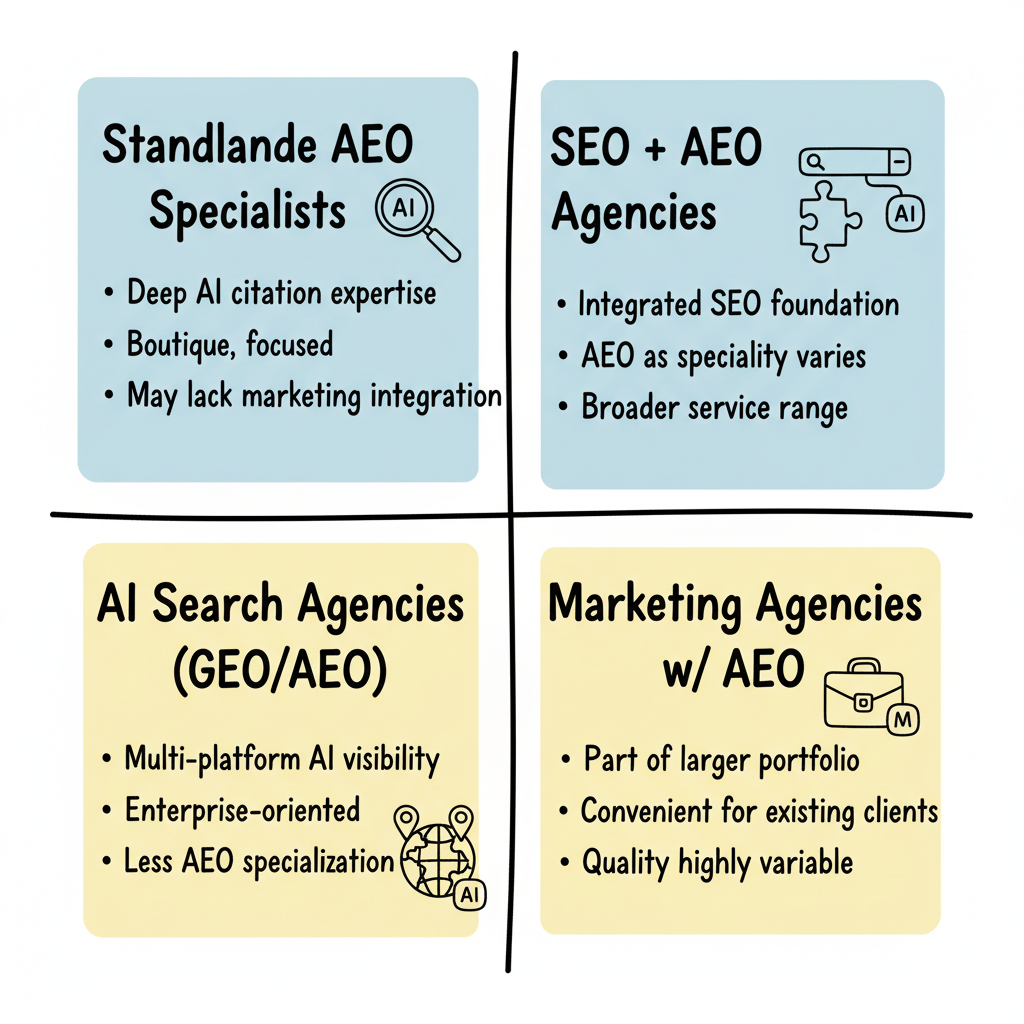
AEO agencies typically fall into distinct categories, each with different strengths and limitations. Understanding the full range of AEO agency services helps you evaluate which model fits your needs:
Standalone AEO specialists:
- Focus exclusively on answer engine optimization
- Deep expertise in AI citation mechanics
- May lack broader marketing integration
- Often smaller, boutique operations
SEO agencies with AEO services:
- Integrated SEO and AEO capabilities
- Existing client relationships may ease onboarding
- AEO expertise varies significantly by agency
- May treat AEO as add-on rather than specialty
AI search agencies (GEO/AEO combined):
- Broader AI visibility focus across platforms
- May dilute AEO-specific expertise
- Often positioned for enterprise clients
- Comprehensive but potentially less specialized
Marketing agencies offering AEO:
- Part of larger service portfolio
- May lack deep technical expertise
- Convenient for existing agency relationships
- Quality highly variable
Market Consolidation Trends
The AEO market is consolidating. Many agencies that rushed to offer AEO services after ChatGPT's rise are now merging, pivoting, or quietly discontinuing services they couldn't effectively deliver.
What this means for your selection:
- Agencies with 2+ years AEO track record have survival-tested expertise
- New entrants require more rigorous vetting
- Look for client retention rates as quality signal
- Ask about agency's AEO team tenure and composition
Industry-Specific AEO Agency Expertise
Not every agency understands your vertical. AI citation patterns, compliance requirements, and content formats differ significantly across industries. When evaluating agencies, match their vertical expertise to your business:
- B2B and SaaS: Complex buyer journeys require agencies experienced with long-form thought leadership and technical content optimized for AI extraction
- Ecommerce: Product-focused AEO demands structured data expertise across large catalogs and transactional query patterns
- Healthcare: Regulatory compliance and E-E-A-T requirements add layers of complexity that generalist agencies often miss
- Professional services: Local entity optimization and customer journey mapping matter more than in other verticals
Key questions: Does the agency have case studies in your vertical? Do they understand your buyer's journey from awareness through conversion?
Core Competencies to Evaluate
Technical Implementation Expertise
AEO requires hands-on technical capability. Evaluate specifically, including their proficiency with AEO implementation services:
Schema markup implementation:
- Can they implement FAQPage, HowTo, Article schema from scratch?
- Do they test and validate schema before deployment?
- What's their process for schema updates and maintenance?
- Can they handle custom schema implementations?
Specifically, evaluate their proficiency with JSON-LD structured data—the standard format for schema markup that AI engines parse most reliably.
Knowledge graph and entity optimization:
- Ask whether the agency performs knowledge graph mapping to identify and strengthen your entity relationships across the web—a capability that directly improves how LLMs associate your brand with relevant topics
- Do they understand emerging standards like llms.txt for signaling content availability to AI crawlers?
Technical audit capability:
- Do they audit for AI crawlability issues?
- Can they assess entity signals on your site?
- Do they evaluate schema validation for AI search?
Red flag: Agencies that outsource all technical work or rely entirely on plugins without custom implementation capability.
E-E-A-T as an Agency Evaluation Lens
An agency's own E-E-A-T signals serve as a proxy for their capability. Evaluate whether they demonstrate:
- Experience: Published AEO case studies with real client outcomes
- Expertise: Team credentials, thought leadership content, and speaking engagements
- Authoritativeness: Industry recognition, citations by peers, and contributions to the AEO knowledge base
- Trustworthiness: Transparent pricing, named team members, and clear methodologies
Agencies strong in E-E-A-T are better positioned to build those same signals for your brand—because they practice what they preach.
Content Optimization Capabilities
AEO success depends on content structured for AI extraction. Assess:
Answer format expertise:
- Can they identify which content needs restructuring?
- Do they understand different AI platforms' extraction patterns?
- What's their process for converting existing content to answer-ready format?
LLM-ready content creation:
- Evaluate whether the agency produces LLM-ready content—material structured with clear entity definitions, direct answers, and semantic markup that LLMs can extract and cite reliably
- Review samples of AEO-optimized content they've produced
- Assess whether content reads naturally while being structured for extraction
- Check if they understand the balance between human readers and AI systems
Red flag: Agencies that can audit content but lack capability to actually create or restructure it.
Platform-Specific Knowledge
Different AI platforms have different citation behaviors. Quality agencies understand these differences and implement platform-specific content strategies:
Platform | Citation Behavior | Optimization Focus |
Google AI Overviews | Web-first, recency-weighted | Traditional SEO + answer structure |
ChatGPT | Parametric + search | Entity authority + citation presence |
Perplexity | Citation-heavy, verification-focused | Academic tone + data backing |
Claude | Parametric knowledge | Training data presence |
Bing Copilot | Web-indexed, Microsoft ecosystem | Bing SEO + structured data |
Gemini | Google index + knowledge graph | Entity optimization + Google ecosystem |
DeepSeek | Emerging, research-oriented | Technical content + citation density |
Assessment approach: Ask how they'd approach optimization differently for each platform. Generic answers indicate surface-level understanding.
Analytics and Measurement
AEO measurement is harder than traditional SEO. Evaluate their measurement infrastructure:
What they should track:
- Featured snippet capture and retention rates
- AI Overview appearances (using Google Search Console for AEO data)
- Brand mentions in ChatGPT/Perplexity responses
- Traffic from AI referral sources
- Conversion rates from AI-referred traffic
- Ongoing citation monitoring as a named service—not just a one-time audit
What they should provide:
- Custom dashboards for AEO metrics
- Regular visibility testing protocols
- Competitive citation analysis
- Clear attribution for AI-driven conversions
- Familiarity with tool categories including backlink and authority tracking platforms alongside proprietary AI citation monitoring tools
Red flag: Agencies that only report traditional SEO metrics and don't have AEO-specific measurement capability.
Red Flags When Vetting Agencies
"AEO Replaces SEO" Messaging
Any agency claiming AEO replaces traditional SEO doesn't understand either discipline. Understanding the AEO, GEO, and SEO comparison is critical. AEO builds on SEO foundations—domain authority, topical relevance, technical health. Agencies positioning AEO as replacement are either inexperienced or misleading.
What quality agencies say instead: "AEO extends your SEO investment by optimizing for AI citation alongside traditional ranking."
Lack of Case Studies with Conversion Data
Citation counts and visibility metrics matter, but conversions prove value. Be skeptical of agencies showing only:
- "Increased AI visibility" without defining metrics
- Screenshot collections of AI responses
- Traffic increases without conversion context
What to look for: Case studies showing citation improvements connected to business outcomes—leads, sales, pipeline influence.
Single-Platform Focus
Agencies optimizing only for ChatGPT or only for Google AI Overviews miss the multi-platform reality of AI search. Users interact with multiple AI platforms. Your visibility strategy should reflect this, especially when considering optimize website AI-powered search engines.
Assessment question: "How would your approach differ if my priority were Perplexity visibility versus Google AI Overviews?"
No Measurement Framework
If an agency can't explain exactly how they'll measure AEO success before you sign, they can't optimize performance after you sign.
Warning signs:
- "We'll figure out measurement as we go"
- Reliance on tools that don't exist yet
- Promises to "track AI mentions" without explaining methodology
- Generic analytics without AEO-specific dashboards
No Mention of Structured Data Beyond Basic Schema
Agencies that only discuss schema markup at a surface level—without referencing JSON-LD, knowledge graph optimization, or semantic search principles—may lack the technical depth needed for competitive AEO. Quality agencies speak fluently about structured data as a foundation for AI discoverability, not just a compliance checkbox.
Green Flags for Quality AEO Partners
Conversion-Focused Positioning
Quality agencies understand that citations without conversions are vanity metrics. They should demonstrate expertise in AI search conversion optimization and look for:
- Discussion of conversion path optimization alongside visibility
- Interest in your current conversion rates for baseline
- Questions about your sales process and how leads engage
- Mention of attribution tracking setup
Multi-Platform AI Search Expertise
Strong agencies demonstrate knowledge across the AI search ecosystem:
- Specific experience with Google AI Overviews optimization
- Understanding of ChatGPT's search integration
- Knowledge of Perplexity's citation patterns
- Awareness of emerging platforms like Claude and industry-specific AI
Published Case Studies with Metrics
Transparent agencies publish detailed case studies. Look for:
- Specific citation metrics (before/after)
- Traffic data from AI referral sources
- Conversion improvements from AI visibility
- Timeline and resource investment transparency
Custom Analytics Setup
Generic reporting indicates generic service. Quality partners:
- Build custom AEO dashboards for your account
- Integrate with your existing analytics
- Set up AI referral tracking specific to your site
- Create visibility testing protocols for your priority queries
Questions to Ask During Agency Vetting
Service and Deliverables Questions
"What specific deliverables will I receive each month?" Good answer: Detailed list including content pieces, technical implementations, visibility reports, competitive analysis. Weak answer: Vague references to "optimization work" or hour counts.
"What's your timeline for seeing initial results?" Good answer: Realistic 3-6 month timeline with milestone expectations. Weak answer: Promises of fast results or inability to give timeline.
"How many clients does each AEO specialist handle?" Good answer: Reasonable ratio (5-10 clients per specialist) indicating focused attention. Weak answer: Evasion or ratios suggesting spread-thin resources.
Pricing and ROI Questions
"What's included in the pricing versus charged additionally?" Good answer: Clear scope with defined additional costs. Understanding AEO agency pricing and costs is essential. Weak answer: Ambiguous scope with surprise charges likely.
"How do you measure ROI for your AEO services?" Good answer: Specific metrics tied to business outcomes with methodology. Weak answer: Generic traffic or visibility metrics without conversion context.
Technical Questions
"How do you approach schema implementation for a site using [your CMS]?" Good answer: Specific technical approach for your platform. Weak answer: Generic response indicating unfamiliarity with your stack.
"What tools do you use to monitor AI citations?" Good answer: Specific toolset with explanation of capabilities and limitations. Familiarity with best AEO tools and reviews is a plus. Weak answer: Vague tool references or claims of proprietary tech without explanation.
"Do you perform knowledge graph mapping and entity optimization?" Good answer: Detailed explanation of how they map entity relationships and strengthen brand associations across the semantic web. Weak answer: Confusion about what knowledge graph mapping entails.
"What is your approach to llms.txt and ensuring AI crawlability?" Good answer: Awareness of emerging standards for signaling content availability to AI systems. Weak answer: No familiarity with the concept.
"How do you create LLM-ready content that balances human readability with AI extractability?" Good answer: Process for structuring content with clear entity definitions, direct answers, and semantic markup. Weak answer: Generic content strategy without AI-specific structuring.
Agency Pricing and Contract Structure
Common Pricing Models
Retainer model (most common):
- Monthly fee for ongoing optimization work
- Typical range: $3,000-$15,000/month for mid-market
- Enterprise: $15,000-$50,000+/month
- Advantages: Predictable costs, ongoing optimization
- Disadvantages: May continue beyond value delivery
Project-based model:
- Fixed fee for defined scope (audit, optimization, setup)
- Typical range: $5,000-$50,000 per project
- Advantages: Clear deliverables, defined endpoint
- Disadvantages: May not include ongoing optimization
Performance-based model:
- Fees tied to measurable outcomes
- Less common in AEO due to measurement challenges
- Advantages: Aligned incentives
- Disadvantages: Complex tracking, potential gaming
For companies evaluating budget-friendly options, understanding affordable AEO services can help calibrate expectations against market rates.
Contract Terms to Negotiate
Contract length:
- 6-month minimum is reasonable for AEO (results take time)
- 12+ month commitments should include performance clauses
- Avoid long-term contracts without exit provisions
Performance clauses:
- Define what "underperformance" means specifically
- Include exit provisions if defined milestones aren't met
- Tie renewal to demonstrated results
Scope flexibility:
- Ensure ability to adjust focus as AI platforms evolve
- Build in quarterly strategy reviews
- Define process for scope changes
Making Your Final Decision
Evaluation Framework
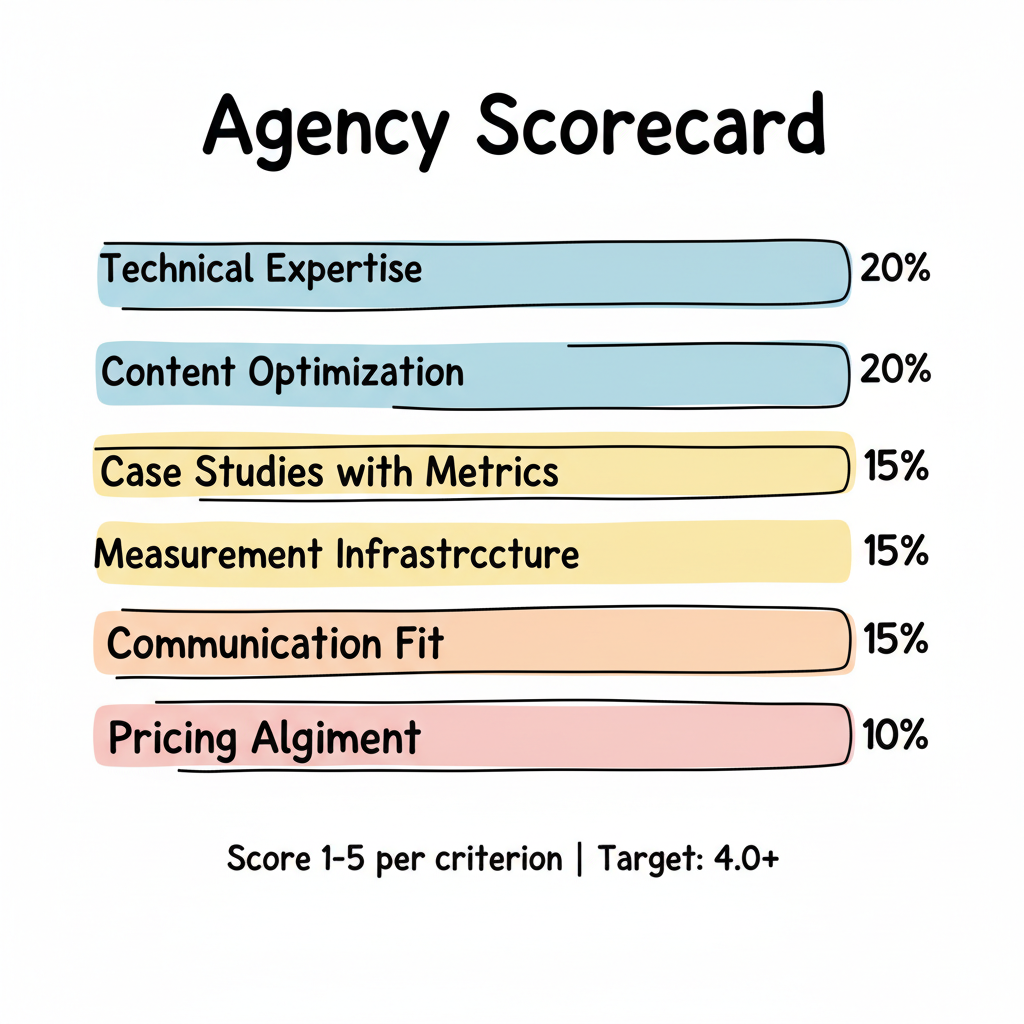
Score each finalist agency (1-5) on these criteria:
Criterion | Weight | Score | Weighted |
Technical expertise demonstrated | 20% | _ | _ |
Content optimization capability | 20% | _ | _ |
Case studies with metrics | 20% | _ | _ |
Measurement infrastructure | 15% | _ | _ |
Cultural/communication fit | 15% | _ | _ |
Pricing alignment | 10% | _ | _ |
Total possible: 5.0 | Your threshold: Recommend 4.0+ for primary consideration.
Trial Project Consideration
Before full engagement, consider a trial project:
Good trial project options:
- AEO audit of priority pages
- Schema implementation for one section
- Content optimization for defined query set
- 60-day visibility tracking pilot
Trial evaluation criteria:
- Quality of deliverables
- Communication responsiveness
- Strategic thinking demonstrated
- Accuracy of initial assessment
Long-Term Partnership Factors
AEO is ongoing, not one-time. Consider understanding AEO challenges:
- Does the team seem interested in your business long-term?
- Do they ask questions indicating strategic thinking?
- Is there chemistry with the people you'll work with?
- Does their growth trajectory suggest stability?
Frequently Asked Questions
What Is the Difference Between an AEO Agency and a Traditional SEO Agency?
An AEO agency specializes in optimizing content for AI-powered answer engines like ChatGPT, Perplexity, Google AI Overviews, and Bing Copilot. While traditional SEO focuses on organic search rankings, AEO agencies earn citations in AI-generated responses through entity optimization, JSON-LD structured data, LLM-ready content, and knowledge graph mapping. Many SEO agencies now offer AEO services as an add-on, but expertise depth varies significantly.
How Much Does It Cost to Hire an AEO Agency in 2026?
AEO agency pricing typically ranges from $3,000-$15,000/month on retainer for mid-market companies and $15,000-$50,000+/month for enterprise. Project-based engagements range from $5,000-$50,000. Performance-based models are less common due to measurement complexity. Costs depend on scope, platforms targeted, and whether the agency provides content creation alongside technical optimization.
How Long Does It Take to See Results from AEO Services?
Realistic timelines for AEO results are 3-6 months for initial measurable improvements in AI citations and visibility. Technical optimizations like schema and structured data can show impact within weeks, but building entity authority and earning consistent AI citations requires sustained effort. Agencies promising results in under 3 months should be vetted carefully for depth of approach.
What Should I Look for in an AEO Agency'S Case Studies?
Look for case studies connecting AI visibility improvements to business outcomes—not just citation counts or screenshot collections. Strong case studies include before/after citation metrics, AI referral traffic data, conversion improvements, timeline transparency, and clear methodology descriptions. Ask whether results came from organic entity building or short-term tactics, as sustainability varies by approach.
Key Takeaways
Selecting an AEO agency requires rigorous evaluation beyond traditional agency vetting:
- Understand your options - Standalone specialists, SEO agencies, AI search agencies, and marketing agencies offer different tradeoffs
- Verify core competencies - Technical implementation, content optimization, platform knowledge, and measurement capability are all required
- Watch for red flags - "AEO replaces SEO" messaging, no case studies with conversion data, single-platform focus, missing measurement frameworks
- Seek green flags - Conversion-focused positioning, multi-platform expertise, published case studies, custom analytics
- Ask specific questions - Vague answers to technical and measurement questions indicate shallow expertise
- Negotiate smart contracts - Balance commitment length with performance provisions and scope flexibility
- Consider trial projects - Small engagements before full commitment reduce risk
The right AEO agency accelerates your AI visibility while connecting citations to business outcomes. The wrong agency wastes budget on activity that doesn't convert. This framework helps you identify the difference.