
Last Updated: March 2026
Before investing in Answer Engine Optimization, you need clarity on where you stand. An AEO audit reveals exactly how visible your brand is across AI-powered search platforms — and identifies the gaps preventing you from earning citations. Understanding the Google AI Overview impact on SEO makes it clear why auditing your AI presence is no longer optional.
This guide explains what an AEO audit includes, what deliverables to expect, and how to get started with a free preliminary assessment.
What Is an AEO Audit?
An AEO audit is a systematic evaluation of your website's readiness and performance across AI answer engines. It analyzes how platforms like ChatGPT, Perplexity, Google AI Overviews, and Microsoft Copilot perceive, cite, and recommend your brand.
Unlike traditional SEO audits that focus on rankings and technical health, AEO audits examine:
- AI citation frequency: How often AI systems mention your brand
- Response accuracy: Whether AI platforms provide correct information about you
- Content structure: How well your content enables AI parsing and citation
- Technical accessibility: Whether AI crawlers can access your content
- Competitive positioning: How your AI visibility compares to competitors
The goal is identifying specific, actionable opportunities to improve your presence in AI-generated answers.
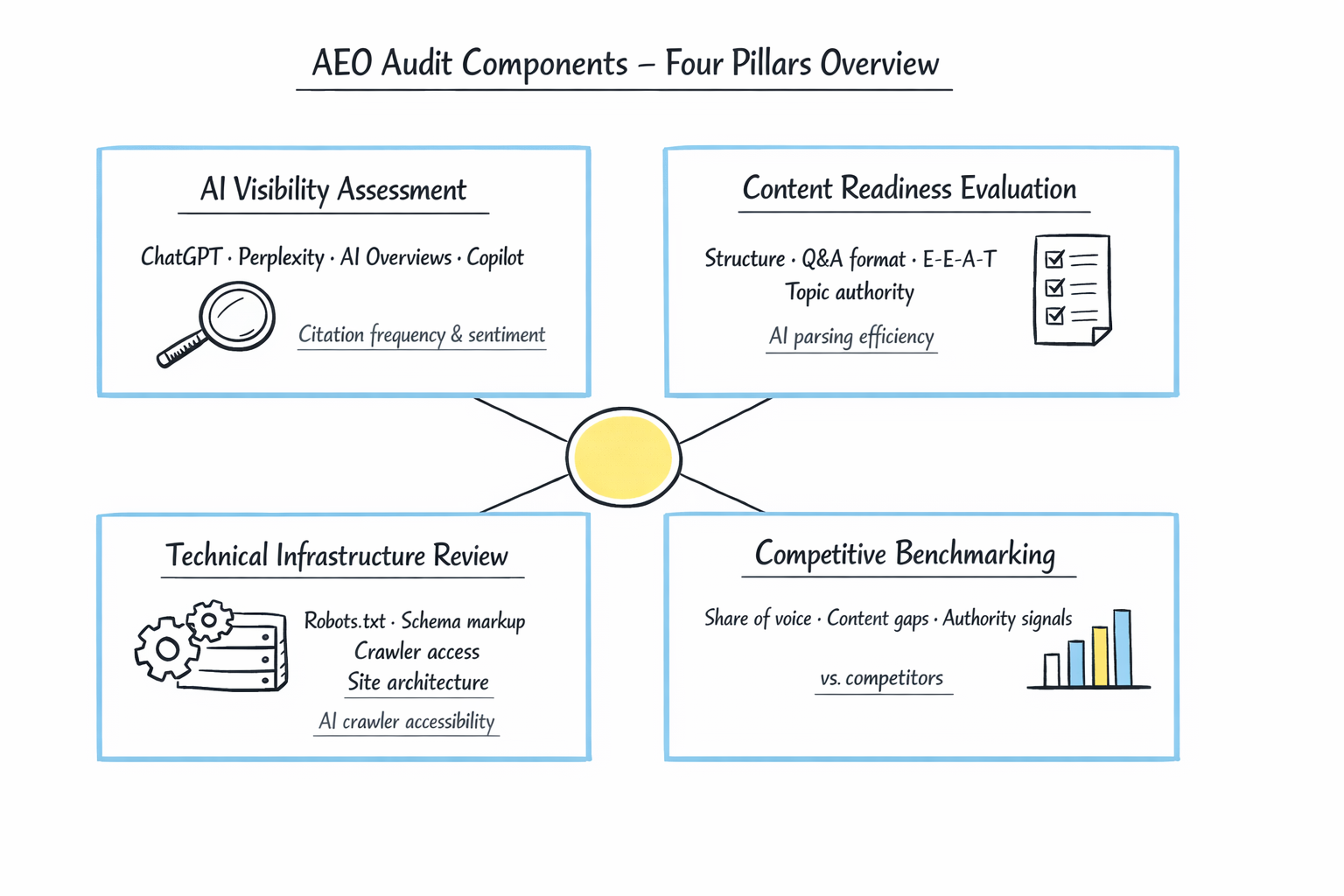
AEO Audit Components
A comprehensive AEO audit examines multiple dimensions of AI visibility:
AI Visibility Assessment
- Brand mention tracking across ChatGPT, Perplexity, AI Overviews, and Copilot
- Keyword-triggered citation analysis for target queries
- Share of voice measurement versus competitors
- Sentiment analysis of AI-generated brand mentions
- Accuracy verification of AI responses about your business
Content Readiness Evaluation
- Content structure analysis for AI parsing efficiency
- Question-answer format assessment
- Topic authority coverage mapping
- E-E-A-T signal strength evaluation
- Content gap identification for high-opportunity queries
Effective AEO audits also evaluate AI-citable content principles: whether your pages front-load factual claims, use explicit entity relationships in prose, and provide inline citations that large language models can reference. Query cluster mapping — identifying buyer questions and informational queries mapped to content gaps — is a key deliverable. This prepares your content for the zero-click marketing paradigm where AI provides direct answers without sending users to a website. Reviewing AEO optimization examples illustrates what AI-citable content looks like in practice.
Technical Infrastructure Review
- AI crawler access verification (GPTBot, PerplexityBot, ClaudeBot)
- Robots.txt configuration audit
- Schema markup implementation check
- Site architecture assessment for AI navigation
- Page speed and performance evaluation
Competitive Benchmarking
- Top competitor citation frequency comparison
- Content strategy gap analysis
- Technical implementation comparison
- Authority signal benchmarking
- Opportunity identification based on competitor weaknesses
Beyond on-site factors, the audit evaluates off-site authority signals. Reddit and community forum presence matters because AI models increasingly reference Reddit discussions and community-sourced answers when generating responses. The audit also assesses your digital PR footprint — whether your brand has been cited by trusted publications that LLMs reference as training sources. These off-site authority signals complement on-site schema and content optimizations to build a complete picture of citation readiness.
Entity Optimization & Knowledge Graph Audit
AI models understand brands through entity relationships in knowledge graphs, not just keyword matching. An entity optimization audit evaluates how well your brand is represented as a distinct entity across the web — and whether AI systems can correctly associate your brand with the products, services, and industry categories you want to own.
A knowledge graph audit examines your brand's presence in Google Knowledge Graph, Wikipedia, and Wikidata. These are trusted knowledge sources that large language models rely on heavily when generating answers. The audit checks whether your Wikipedia entry (if one exists) is accurate and complete, whether your Wikidata properties reflect your current business scope, and whether missing entries are creating blind spots for AI systems.
Semantic relationship mapping is a critical component. The audit traces how your brand entity connects to industry entities, product categories, and topical clusters that AI models use when deciding which sources to cite. Weak or missing entity relationships mean AI systems may not associate your brand with relevant queries — even if your content is strong.
The deliverable is an entity gap report showing where your brand's knowledge graph presence is weak relative to competitors. This report identifies specific actions: claiming or updating Wikipedia and Wikidata entries, strengthening entity references across authoritative third-party sites, and building semantic relationships between your brand and target topic clusters. Tools designed for AEO tools and software evaluation can help identify entity gaps at scale.
Voice Search & Conversational Query Readiness
Voice assistants — Alexa, Siri, and Google Assistant — represent a core AEO channel that pulls from the same authority signals as text-based AI answers. Voice search queries differ from typed queries: they are longer, use natural question formats, and reflect conversational language patterns. An AEO audit must evaluate your content's readiness for these conversational queries.
The audit checks voice search readiness across several dimensions: FAQ schema implementation that enables direct answer extraction, conversational keyword coverage matching how people actually speak, featured snippet eligibility for queries that trigger voice responses, and local search signals that voice assistants prioritize for location-based queries.
Voice readiness scoring evaluates your content against conversational query patterns and checks whether your schema markup uses voice-friendly formats. Content that scores well for voice search typically features concise, direct answers to specific questions — the same qualities that improve citation rates across all AI platforms.
Voice answers represent the ultimate zero-click experience. Users receive a spoken answer without ever seeing a screen, making it essential that your brand is the source AI assistants select. The audit identifies gaps between your current voice readiness and the threshold needed to earn these zero-click answer placements.
Content Analysis
The content analysis portion examines how well your existing content supports AI citation. Understanding what is generative engine optimization geo helps contextualize why content structure matters so critically for AI platforms.
Structure Assessment
AI systems favor well-organized content. The audit evaluates:
- Heading hierarchy: Clear H1-H6 structure that enables extraction
- Question-answer formatting: Direct answers to specific queries
- List and table usage: Structured data AI can easily parse
- Summary sections: Key takeaways AI can cite directly
- Semantic clarity: Clear topic focus without ambiguity
Authority Signals
Content authority influences AI citation decisions:
- Author expertise: Visible credentials and experience
- Source citations: References to authoritative external sources
- Data and statistics: Original research and current data
- Comprehensive coverage: Topic depth that establishes authority
- Recency: Content freshness and update frequency
Query Alignment
The audit maps your content against queries triggering AI responses:
- Target keyword coverage: Content addressing priority search terms
- Long-tail query gaps: Missing content for specific user questions
- Intent matching: Content alignment with user search intent
- Competitor content gaps: Topics competitors cover that you don't
Technical AEO Assessment
Technical factors determine whether AI systems can access and parse your content. Similar to entity optimization ai search principles, technical implementation directly impacts how AI platforms understand and cite your brand.
Crawler Access Audit
- Robots.txt review: Verify AI crawlers aren't blocked
- Crawler log analysis: Confirm AI bots are visiting your site
- Access frequency: Measure how often AI crawlers index your content
- Blocked resources: Identify any inadvertently blocked content
Schema Markup Evaluation
- Implementation check: Verify schema is present and valid
- Schema type coverage: Assess FAQ, HowTo, Q&A, Organization schemas
- Error identification: Flag schema validation issues
- Enhancement opportunities: Recommend additional schema types, including structured data for AI search formats that improve citation eligibility
Site Architecture Review
- Navigation depth: Ensure content is reachable within 3 clicks
- Internal linking: Evaluate link structure for topic relationships
- URL structure: Assess semantic URL optimization
- Canonicalization: Verify proper canonical tag usage
Performance & Core Web Vitals
The technical audit explicitly evaluates Core Web Vitals — Largest Contentful Paint (LCP), First Input Delay (FID), and Cumulative Layout Shift (CLS) — because AI crawlers may deprioritize slow-loading pages when selecting citation sources. The audit also assesses your visibility on Claude (Anthropic) as an answer platform alongside ChatGPT, Perplexity, and Copilot. Claude is not just a crawler (ClaudeBot) but an AI platform users actively query for recommendations and research.
Platform-Specific Audits
Each AI platform has unique characteristics. Platform-specific audits examine:
ChatGPT Analysis
- Current brand mention frequency in ChatGPT responses
- Accuracy of ChatGPT information about your business
- Competitor citation comparison within ChatGPT
- Content optimization opportunities for chatgpt search optimization aeo
Perplexity AI Analysis
- Citation frequency and source attribution
- Content depth requirements for Perplexity visibility
- Source credibility signals Perplexity recognizes
- Competitive positioning within Perplexity results
Google AI Overviews Analysis
- AI Overview trigger frequency for target keywords
- Current inclusion rate in AI Overviews
- Featured snippet overlap opportunities
- Technical requirements specific to google ai overview seo optimization
Microsoft Copilot Analysis
- Bing integration and visibility
- Copilot citation patterns for your industry
- Microsoft ecosystem optimization opportunities
Audit Deliverables and Report
A professional AEO audit delivers actionable documentation:
Executive Summary
- Overall AI visibility score and benchmarks
- Key findings and priority issues
- Strategic recommendations overview
- Competitive positioning summary
Detailed Analysis Report
- Platform-by-platform visibility metrics
- Content audit findings with specific pages identified
- Technical issue inventory with severity ratings
- Competitive analysis with gap identification
Prioritized Action Plan
- Immediate fixes (quick wins)
- Short-term optimizations (30-60 days)
- Long-term strategic initiatives (90+ days)
- Resource requirements and estimated impact
Measuring AEO ROI: AI Attribution & Pipeline Metrics
An AEO audit should connect findings to revenue, not just visibility scores. The audit establishes baselines for key metrics: AI-referred traffic tracked via GA4 referral sources (identifying visits from perplexity.ai, chat.openai.com, and other AI platforms), citation frequency across platforms, and share of voice in AI responses versus competitors.
Pipeline attribution is essential for proving AEO value. The audit recommends setting up UTM parameters and GA4 segments specifically for AI referral sources, enabling you to track leads and conversions that originate from AI citations. AI citation tracking tools provide automated monitoring of these metrics across platforms.
Organizations implementing AEO audit recommendations typically see measurable improvements in AI citation rates within 60-90 days. The recommended monitoring cadence is monthly citation tracking, quarterly competitive benchmarking, and ongoing crawler access verification to ensure sustained visibility.
Technical Documentation
- Schema markup recommendations with code examples
- Robots.txt configuration guidance
- Content structure templates
- Implementation checklists
Monitoring Setup
- Tracking metric definitions
- Baseline measurements
- Recommended monitoring tools
- Reporting schedule suggestions
Audit Pricing
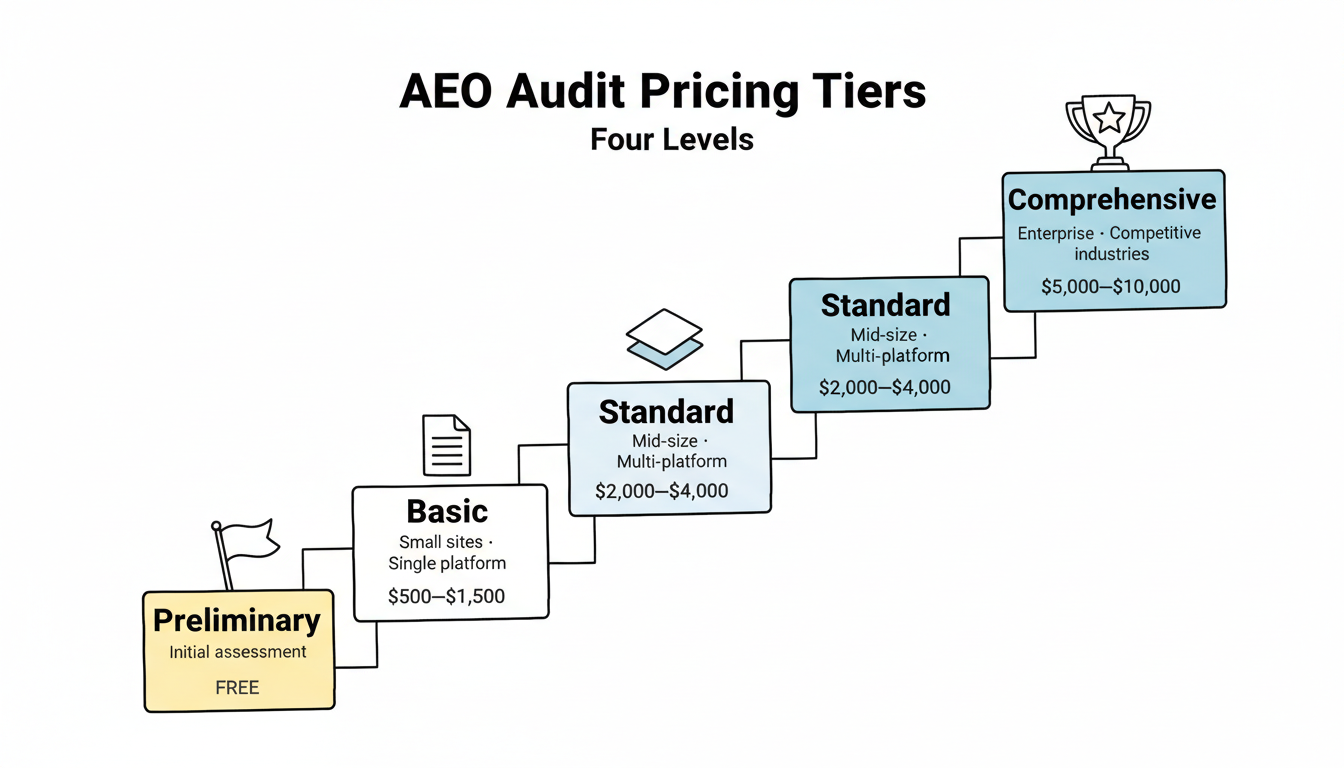
AEO audit pricing varies based on scope and depth:
Audit Level | Price Range | Best For |
Preliminary | Free | Initial assessment, lead qualification |
Basic | $500–$1,500 | Small sites, single-platform focus |
Standard | $2,000–$4,000 | Mid-size sites, multi-platform analysis |
Comprehensive | $5,000–$10,000 | Enterprise sites, competitive industries |
What Affects Pricing
- Site size: More pages require more analysis time
- Platform coverage: Multi-platform audits cost more
- Competitive depth: Extensive competitor analysis increases scope
- Technical complexity: Sites with complex architectures need more review
- Deliverable depth: Detailed implementation guides add cost
ROI Consideration
An AEO audit typically costs a fraction of one month's ongoing optimization. The insights gained prevent wasted effort on low-impact activities and identify high-leverage opportunities that accelerate results.
Frequently Asked Questions
What Is an AEO Audit?
An AEO audit is a systematic evaluation of your website's readiness to appear in AI-generated answers from platforms like ChatGPT, Perplexity, Google AI Overviews, and voice assistants. It assesses schema markup, content structure, entity optimization, E-E-A-T signals, and AI crawler access. The audit produces a prioritized action plan to improve your brand's citation frequency and visibility across answer engines.
What Are AEO Services?
AEO services help businesses optimize their online presence for AI-powered answer engines. Services typically include technical audits of crawler access and schema markup, content optimization for AI citability, entity and knowledge graph strengthening, competitive benchmarking across AI platforms, and ongoing monitoring of citation performance. The goal is to make your brand the preferred source when AI systems answer relevant queries.
Is AEO Replacing SEO?
AEO is not replacing SEO but extending it. Traditional SEO focuses on ranking in search engine results pages, while AEO focuses on being cited by AI answer engines. Many AEO best practices — structured data, authoritative content, E-E-A-T signals — overlap with SEO fundamentals. The most effective strategy combines both disciplines, using SEO for organic traffic and AEO for AI visibility and zero-click answer placement. Exploring the best generative engine optimization tools shows how the two disciplines increasingly converge.
How Often Should You Run an AEO Audit?
A comprehensive AEO audit should be conducted quarterly, with lightweight monitoring checks running monthly. AI platforms update their models and citation behaviors frequently, so regular audits catch shifts in visibility before they impact pipeline. After major website changes, algorithm updates, or new AI platform launches, an ad-hoc audit is recommended to reassess your competitive position across answer engines.
Free Preliminary Audit Offer
Start understanding your AI visibility today with a complimentary preliminary AEO audit. This no-obligation assessment includes:
What You'll Receive:
- AI visibility snapshot across ChatGPT and Google AI Overviews
- Top 5 competitor citation comparison
- 3 priority improvement opportunities
- Estimated impact potential
- Custom recommendations for your industry
How It Works:
- Submit your website URL and target keywords
- Our team conducts the preliminary analysis (2-3 business days)
- Receive your findings via email with a brief video walkthrough
- Optional consultation call to discuss results
No Strings Attached:
The preliminary audit is genuinely free. No credit card required. No sales pressure. We believe the insights speak for themselves — and clients who see the opportunities become long-term partners.