
The search landscape has fundamentally changed. AI-powered answer engines now provide direct responses to user queries, often eliminating the need for users to click through to websites. For businesses, this shift creates both risk and opportunity. Answer Engine Optimization (AEO) addresses this new reality by ensuring your content gets cited in AI-generated answers.
This guide covers the concrete benefits of AEO and why it deserves attention in your marketing strategy.
The Zero-Click Problem: Why AEO Is No Longer Optional
The era of "ten blue links" is fading. Today, 13.14% of Google queries trigger AI-generated answers that resolve user intent without a click-through. These zero-click searches represent a fundamental shift in how users consume information -- and a growing blind spot for brands relying solely on traditional SEO.
The major AI answer platforms driving this change include ChatGPT, Google AI Overviews, Perplexity, Microsoft Copilot, Claude, and Gemini. Each synthesizes content from across the web and delivers direct responses, bypassing traditional search results entirely. Understanding the Google AI Overview impact on SEO is critical for adapting to this new landscape.
For brands, the implication is clear: if your content is not optimized for answer engines, you lose visibility in this rapidly growing segment of search. Users never see your brand, your expertise, or your offerings -- because the AI answered their question before they reached your website.
AEO addresses this shift head-on -- here is what your brand gains.
The Visibility Opportunity
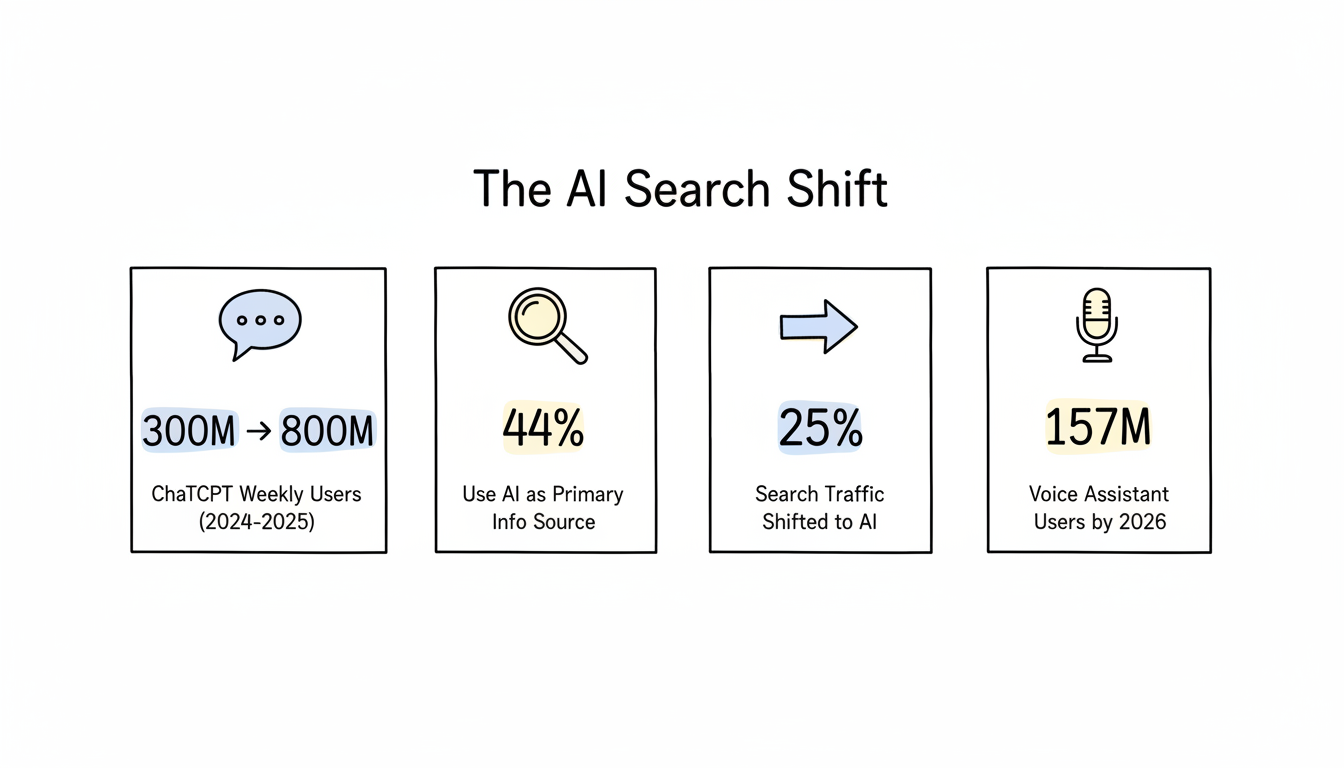
AI search adoption has accelerated dramatically. ChatGPT's weekly active users grew from 300 million in December 2024 to 800 million by October 2025. Research shows 44% of AI-powered search users now turn to AI as their primary information source. By 2026, an estimated 25% of search traffic has shifted to AI assistants.
This represents the largest change in information discovery since mobile search overtook desktop. Organizations that adapt capture new visibility channels. Those that don't risk disappearing from the places their audiences now seek information.
Early AEO investment compounds over time because AI systems increasingly reference sources they have previously cited, creating a self-reinforcing citation authority loop. The more consistently your content earns citations, the stronger your compounding citation signals become -- making it progressively harder for competitors to displace your brand in AI-generated answers.
Key Benefits of AEO
One B2B SaaS company saw a 240% increase in AI search impressions and a 345% increase in AI answer traffic within six months of implementing an AEO strategy (source: Enaks.io, 2025). Results vary by industry, but the directional data is consistent -- brands that optimize for answer engines see measurable gains. For more real-world results, explore these AEO case studies.
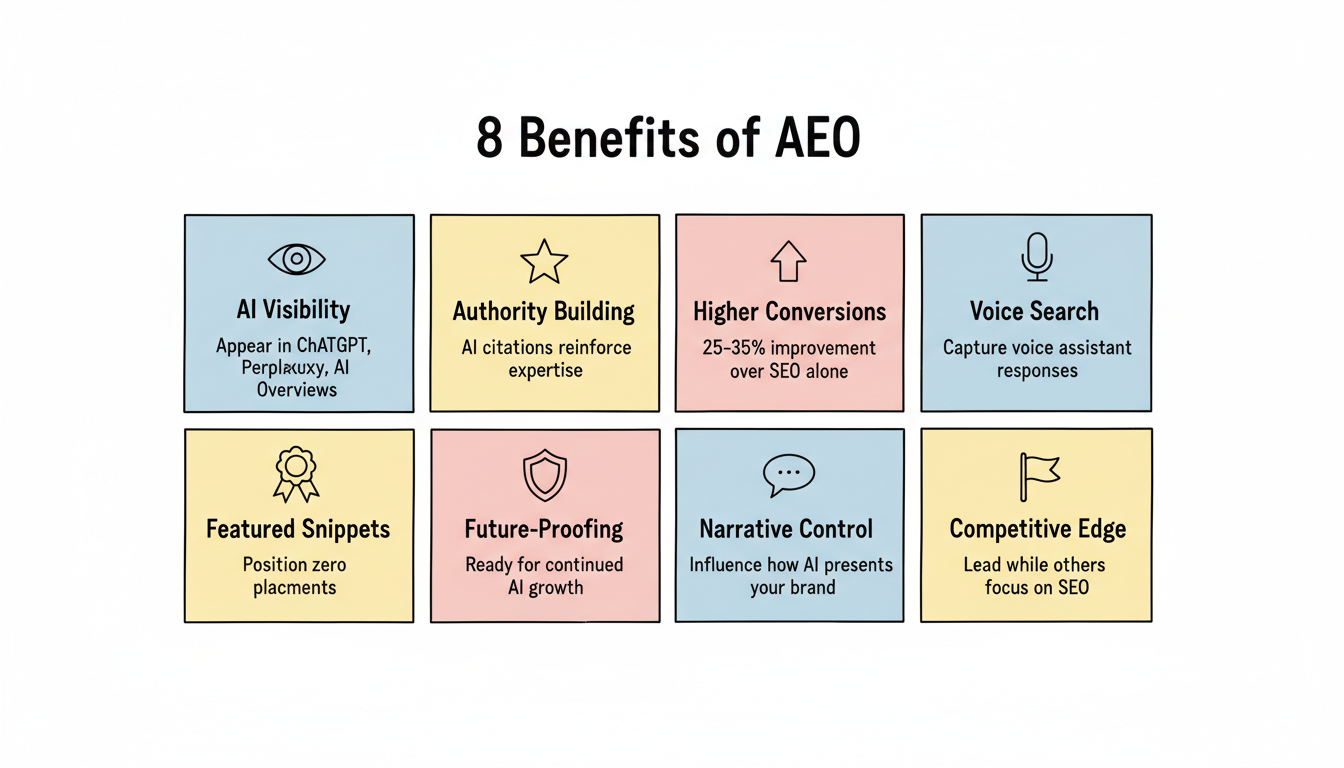
1. Visibility Where Users Actually Search
Traditional SEO assumes users search Google, scan results, and click through to websites. AI search changes this pattern. Users ask ChatGPT, Perplexity, or Google AI Overviews questions and receive synthesized answers—often without clicking any links.
AEO benefit: Your content gets mentioned directly in these AI-generated responses. Even when users don't visit your website, they see your brand, absorb your expertise, and develop familiarity with your offerings. Understanding the differences between AI SEO vs traditional SEO helps clarify why this new approach matters.
Being cited in AI answers provides visibility that traditional rankings increasingly cannot.
2. Authority Building Through AI Citations
When AI systems cite your content, they implicitly endorse your authority on the topic. Users trust AI recommendations similarly to how they trust expert referrals. Consistent AI citations position your brand as a recognized authority in your space.
AEO benefit: Each AI citation reinforces your expertise. Over time, this builds brand recognition and trust even among users who never directly interact with your content.
Early adopters report their authority on subjects grows because the structure of their content matches how answer engines interpret knowledge. This compounding authority effect strengthens competitive positioning, particularly when you optimize AI search content structure for maximum citation potential.
Offsite mentions -- including press coverage, expert quotes, and third-party reviews -- serve as grounding signals that AI systems use to validate authority. The more consistently your brand appears across trusted external sources, the more likely AI engines are to cite you.
3. Higher Conversion Rates
Research indicates brands implementing AEO strategies see 25-35% higher conversion rates compared to traditional SEO alone. Why? AEO surfaces your content at the exact moment users have specific questions—often high-intent queries that indicate purchase consideration. Organizations tracking these improvements through Google Analytics 4 for AI search tracking can measure the direct impact on their bottom line.
AEO benefit: AEO connects you with users actively seeking solutions. When AI cites your content in response to "best project management software for remote teams" or "how to reduce inventory costs," you reach prospects at their moment of need.
Traditional SEO captures search demand. AEO captures answer demand—and users seeking answers often have clearer intent.
4. Voice Search Dominance
Voice search represents a significant and growing channel. Half of U.S. consumers use voice search daily, with projections of 157 million voice assistant users by 2026. Voice commerce is expected to reach $80 billion by 2026.
Voice assistants provide single answers rather than result lists. Featured snippets provide 40.7% of voice search answers, with the remainder coming from similarly structured, answer-optimized content.
AEO benefit: AEO tactics—structured content, direct answers, schema markup—directly align with voice search requirements. Organizations optimizing for answer engines automatically optimize for voice.
5. Featured Snippet Capture
Featured snippets appear above traditional search results, capturing user attention before they scan organic listings. These "position zero" placements drive significant traffic and visibility even in traditional search contexts. The relationship between Google AI Overviews vs featured snippets reveals how these formats work together in modern search.
AEO benefit: The same content structuring and answer optimization that drives AI citations also improves featured snippet capture. AEO investment delivers returns across both traditional and AI search.
6. Future-Proofing Your Strategy
Industry projections suggest a 35-45% drop in B2B website visits by 2030, with a tipping point around 2026 when buyers rely more on AI summaries than vendor websites for initial evaluation. The shift toward "zero-click" AI buyer journeys is accelerating.
AEO benefit: Organizations building AEO capabilities now position themselves for visibility as user behavior continues shifting. Waiting until AI search dominates means playing catch-up against competitors who invested earlier.
Early adopters are quietly building a second layer of visibility that becomes essential as traditional search traffic declines.
7. Control Over Brand Narrative
AI systems synthesize information from multiple sources when generating responses. Without AEO optimization, you have limited control over how—or whether—your brand appears in these synthesized answers.
AEO benefit: AEO gives you influence over your brand's representation in AI responses. By creating citation-worthy content with accurate, authoritative information, you shape the narrative AI systems present to users.
Being absent from AI answers means losing control of your story even when rankings remain strong.
8. Competitive Differentiation
Most businesses remain focused on traditional SEO while AI search grows. This creates an opportunity window for organizations willing to invest in AEO early.
AEO benefit: While competitors chase traditional rankings, you build presence in answer engines. This differentiation becomes more valuable as AI search adoption continues accelerating.
The advantage compounds over time. Organizations with established AI visibility and authority signals become harder to displace.
Benefits Summary
Benefit | Impact |
AI search visibility | Reach users in ChatGPT, Perplexity, Google AI Overviews |
Authority building | AI citations reinforce expertise and trust |
Higher conversions | 25-35% improvement over traditional SEO alone |
Voice search dominance | Capture voice assistant responses |
Featured snippets | "Position zero" placements in traditional search |
Future-proofing | Prepare for continued AI search growth |
Narrative control | Influence how AI presents your brand |
Competitive advantage | Differentiate while others focus on traditional SEO |
AEO vs SEO: How They Compare
AEO and SEO are complementary strategies, not replacements for each other. However, they differ meaningfully in goals, metrics, and content format. Understanding these differences helps you allocate resources effectively. For practical implementation guidance, review these AEO optimization examples.
Dimension | AEO | SEO |
Primary Goal | Get cited in AI-generated answers | Rank in organic search results |
Target Platform | ChatGPT, Perplexity, AI Overviews, Copilot | Google, Bing, Yahoo search results |
Query Type | Conversational, question-based | Keyword-based |
Content Format | Concise Q&A, structured data, direct answers | Long-form, keyword-optimized pages |
Success Metric | AI citation frequency, brand mentions | Rankings, organic traffic, CTR |
Link Value | Citation authority (brand as source) | Backlink authority (domain strength) |
Freshness Factor | High -- AI surfaces 25.7% fresher content | Moderate -- evergreen content ranks longer |
Measurement | Emerging tools, AI referral tracking | Mature tools (GSC, GA4, Ahrefs) |
AEO builds on SEO foundations -- structured data, E-E-A-T signals, and site authority all matter. But AEO adds citation optimization, conversational content structure, and multi-platform presence as distinct priorities. The key distinction: being cited (brand mentioned as authority) differs from being linked (suggested as a resource) in AI answers.
The strongest digital strategies in 2026 combine both AEO and SEO -- AEO captures intent in AI answers while SEO drives organic click-through traffic.
AEO Challenges to Consider
Algorithm volatility: AI engines update their ranking and citation logic frequently, making optimization a moving target. What earns citations today may shift as models retrain on new data.
Measurement difficulty: No standardized metrics for AI citation tracking exist yet. Tools are emerging but remain fragmented -- dedicated AI citation tracking tools can help bridge this gap.
Zero-click paradox: AEO can increase brand mentions without proportionally increasing website traffic. Measuring brand lift alongside traffic metrics is essential.
Resource investment: AEO requires a content freshness cadence -- quarterly updates are recommended, as Ahrefs data shows AI-surfaced URLs are 25.7% fresher than average organic results.
These challenges are real, but the cost of ignoring AEO is higher. Brands that wait risk losing visibility in the fastest-growing search channel.
Who Benefits Most from AEO
AEO delivers particular value for:
B2B companies – Where buyers increasingly research through AI before engaging vendors directly.
Information-rich businesses – Organizations with expertise to share benefit from AI citation opportunities.
Local businesses – Voice search heavily favors local queries, with 58% seeking local business information.
Competitive industries – Where traditional SERP rankings are difficult, AI visibility provides alternative channels.
Getting Started
Begin capturing AEO benefits with these initial steps:
- Audit current AI visibility – Check how your brand appears in major AI platforms
- Structure content for extraction – Add clear Q&A sections and direct answer paragraphs
- Implement schema markup – Help AI systems understand your content
- Monitor and iterate – Track AI citations and refine your approach
- Audit your current AI visibility using free tools like HubSpot AEO Grader and explore dedicated AEO tools and software for deeper analysis
- Implement FAQ schema and structured data for AI search on high-intent pages
- Establish a quarterly content refresh cadence to maintain freshness signals that AI engines prioritize
- Track AI citation frequency alongside traditional SEO metrics in Google Analytics 4
The benefits of AEO compound over time. Organizations starting now build advantages that become harder to replicate as the discipline matures.
FAQs
Is AEO Worth the Investment for Small Businesses?
Yes. AEO doesn't require large budgets—it primarily requires structural changes to existing content. Small businesses competing against larger players in traditional search can find more accessible visibility opportunities in AI search, where authority and content quality matter more than backlink volume.
How Quickly Can I See AEO Benefits?
Some benefits appear quickly—featured snippet captures can improve within weeks of content restructuring. AI citation visibility typically builds over 3-6 months as optimized content gets indexed and AI systems incorporate it into responses.
What Is the Difference Between AEO and SEO?
AEO (Answer Engine Optimization) focuses on getting your brand cited in AI-generated answers from platforms like ChatGPT, Perplexity, and Google AI Overviews. SEO targets traditional organic search rankings. AEO prioritizes conversational content structure, citation authority, and structured data, while SEO emphasizes backlinks and keyword rankings. The most effective 2026 strategies combine both approaches.
How Does AEO Help with Voice Search?
Voice assistants like Siri, Alexa, and Google Assistant pull answers directly from AI-optimized content. AEO structures your content in concise, question-and-answer formats that voice engines prefer. Brands optimized for AEO are more likely to be the single spoken answer to voice queries, which now account for a growing share of daily search activity.
What Industries Benefit Most from AEO?
B2B software, healthcare, financial services, local businesses, and e-commerce brands see the strongest AEO returns. Any industry where users ask specific questions -- pricing, comparisons, how-to procedures -- benefits from answer engine visibility. Professional services and SaaS companies particularly benefit because their buyers research extensively through AI tools before making purchasing decisions.
Can You Measure AEO Results?
Yes, though measurement tools are still maturing. Key AEO metrics include AI citation frequency, featured snippet win rate, brand search volume lift, and direct traffic changes from AI referral sources. Tools like Google Analytics 4 can track AI-sourced referral traffic from domains like perplexity.ai and chat.openai.com. Dedicated AEO platforms offer automated citation monitoring.