
Answer Engine Optimization promises visibility in the new AI search landscape, but the path from strategy to results isn't straightforward. AEO introduces challenges that traditional SEO practitioners haven't faced before—from measurement difficulties to unpredictable AI outputs.
Here are the most significant AEO challenges and how to navigate them in 2026.
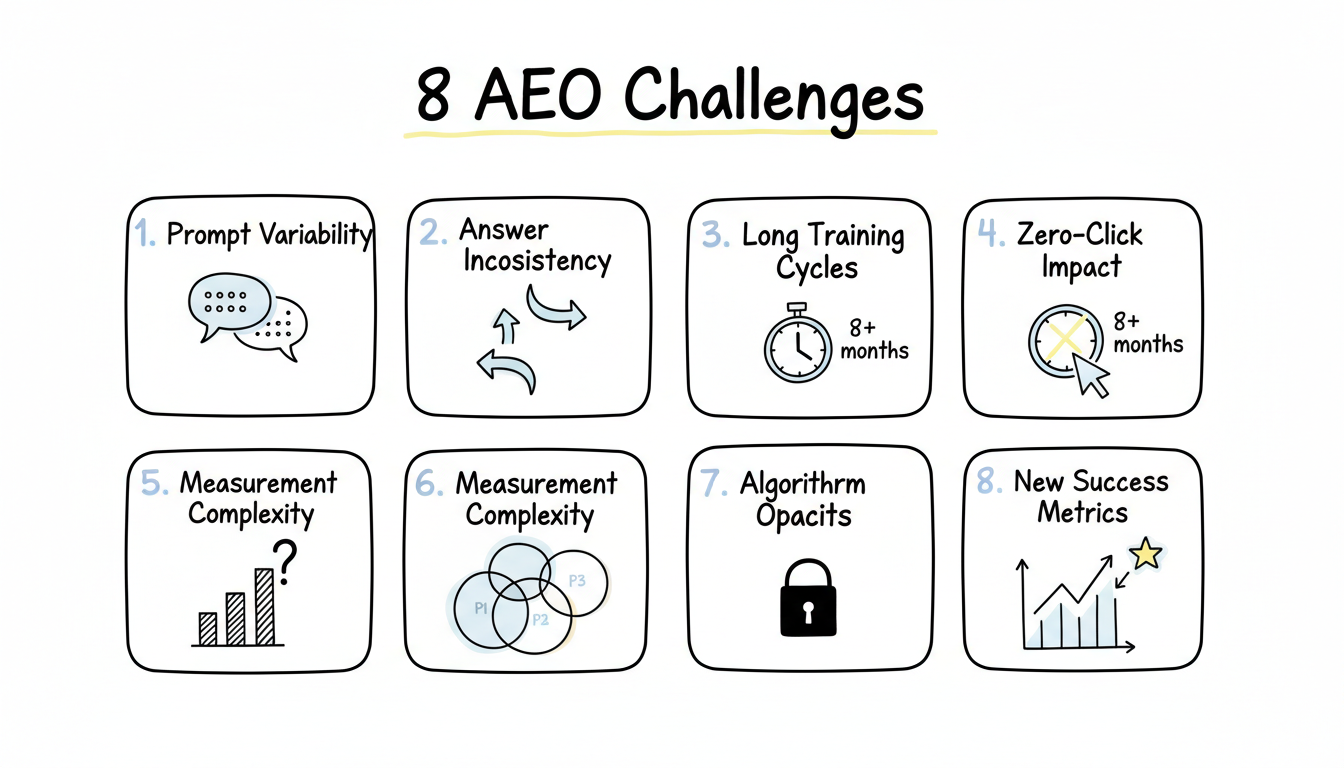
Challenge 1: Prompt Variability
According to Shopify's analysis of AEO challenges, traditional SEO benefited from standardized query formats—three to eight words per search. AEO operates differently. Typical AI prompts run 20 to 30 words, and two users with identical intent may use completely different phrasing.
The problem:
- No standardized query format to optimize for
- Infinite prompt variations for the same topic
- Impossible to track every relevant prompt
- Keyword research methods don't translate directly
The workaround: Focus on comprehensive topic coverage rather than specific query optimization. AI systems synthesize content based on topical relevance, not exact keyword matches. Build content clusters that address topics from multiple angles.
Prompt variability also maps directly to search intent misalignment. Informational, transactional, and navigational intents each trigger different AI response formats, and a single page cannot satisfy all three simultaneously. Before creating content, conduct intent-mapping exercises to identify which prompt patterns your target audience uses most frequently, then structure your pages to match the dominant intent while linking to supporting content for secondary intents.
Challenge 2: Answer Inconsistency
According to Shopify, you can ask the same question ten times and receive slightly different AI responses each time. This variability is inherent to how large language models generate text—it's a feature, not a bug.
The problem:
- Testing yields inconsistent results
- Citation patterns change between identical queries
- A/B testing becomes unreliable
- Success measurement requires larger sample sizes
The workaround: Look at aggregate trends rather than individual responses. Track visibility over time across multiple queries rather than obsessing over specific prompt results. According to Tailored Tactiqs' LLM optimization guide, monitoring overall citation frequency and sentiment provides more reliable signals than individual query testing.
To improve consistency in how AI engines extract your content, use the inverted pyramid structure: lead every section with a direct 30-to-50-word answer, then expand with supporting detail and evidence. This formatting pattern increases the likelihood of consistent AI extraction across different LLM platforms, because models are more likely to pull the concise lead statement regardless of how they sample the surrounding text.
Challenge 3: Long Training Cycles
According to Shopify's AEO research, if your goal is to become part of an AI's training data rather than just getting cited in real-time searches, expect at least eight months before seeing results. This delay makes it difficult to attribute improvements to specific optimization efforts.
The problem:
- 8+ months for training data inclusion
- Difficult to connect cause and effect
- Budget allocation becomes challenging
- Stakeholder patience wears thin
The workaround: Pursue a dual strategy. Optimize for real-time retrieval systems (RAG-based AI search) for faster results while simultaneously building authority for eventual training data inclusion. Track both short-term citations and long-term brand recognition metrics.
Challenge 4: Zero-Click Search Impact
According to Elsner Technologies' AEO analysis, most searches now show AI Overviews at the top, with users reading synthesized answers without clicking through to websites. This fundamentally challenges traditional traffic-based success metrics. Understanding how to turn Google AI Overview on or off can help you see how these features impact search behavior.
The problem:
- Users get answers without visiting your site
- Traffic metrics decline despite increasing visibility
- ROI measurement becomes complicated
- Stakeholders question AEO investment
The workaround: Reframe success metrics. According to Meltwater's LLM metrics guide, AI visibility should be measured through brand mentions, citation frequency, and share of voice—not just clicks. Track brand lift and downstream conversions rather than direct traffic alone.
Challenge 5: Measurement Complexity
According to Conductor's AI visibility platform guide, most companies are flying blind when it comes to tracking LLM visibility. Traditional analytics tools weren't designed for AI search measurement, which is why selecting the right AEO tools and software is essential for tracking performance.
The problem:
- No native AI visibility metrics in standard tools
- Multiple platforms to monitor (ChatGPT, Perplexity, Claude, Gemini)
- Citation data requires specialized tracking
- ROI attribution across AI touchpoints is difficult
The workaround: Invest in dedicated AI visibility tools. Platforms like Profound, SE Visible, and Otterly.AI specifically track AI citations and brand mentions. Use these alongside traditional SEO tools for complete visibility understanding.
Challenge 6: Algorithm Opacity
Unlike Google, which provides webmaster guidelines and Search Console data, AI systems offer minimal transparency about citation selection criteria. You're optimizing for a black box.
The problem:
- No official guidelines from AI providers
- Citation selection criteria are undocumented
- Best practices are based on observation, not confirmation
- Algorithm changes happen without notice
The workaround: Focus on fundamentals that appear to work across all AI systems: comprehensive coverage, clear structure, authority signals, and factual accuracy. According to Authority Tech's LLM SEO research, third-party publications earn 5x more citations than brand websites—earned media matters more than on-site optimization.
Challenge 7: Multi-Platform Complexity
According to PageTraffic's AI optimization guide, AI search operates across three distinct layers: pre-trained LLMs, retrieval systems (RAG), and agentic capabilities. Each requires different optimization approaches. Understanding the differences between GEO vs AEO can help you decide where to allocate resources across platforms.
The problem:
- Multiple AI platforms with different architectures
- Different citation criteria per platform
- Resource constraints limit multi-platform optimization
- Platform dominance shifts over time
The workaround: Prioritize based on your audience. Enterprise B2B brands may prioritize Microsoft Copilot; consumer brands may focus on ChatGPT and Perplexity. Start with the platforms most relevant to your customers and expand from there.
Be wary of the "rented land" risk that comes with over-investing in any single AI platform's optimization playbook. If one platform changes its retrieval algorithm overnight, your entire AEO strategy could be undermined. Diversify your efforts across retrieval-augmented, pre-trained, and agentic AI layers to reduce platform dependency and build resilience.
Challenge 8: Structured Data & Schema Markup Gaps
AI engines increasingly rely on structured data—FAQPage, HowTo, and Article JSON-LD—to parse and surface content in answer boxes and AI-generated responses. Yet most websites either lack schema markup entirely or implement it incorrectly, severely limiting their AI crawlability and citation potential.
The problem:
- Missing FAQPage markup on question-and-answer content
- No HowTo schema on tutorial and guide pages
- Stale or incorrect dateModified fields that signal outdated content
- Invalid or incomplete JSON-LD that fails validation
The workaround: Start with a schema audit of your top ten pages using the Schema.org validator and Google Rich Results Test. Add FAQPage schema to any page with Q&A content, Article schema with accurate dateModified fields to blog posts, and HowTo schema to instructional pages. Monitor rich result impressions in Search Console to measure impact. For a deeper walkthrough, see our guide on structured data for AI search. You can also run an AEO technical audit to identify and fix schema gaps systematically across your site.
Challenge 9: Voice Search & Conversational Interface Optimization
Voice queries via Siri, Alexa, and Google Assistant are conversational and significantly longer than typed searches. AI assistants pull single definitive answers from content, making position-zero competition fiercer than ever. Optimizing for these conversational interfaces introduces a unique tension: content must match natural language patterns while maintaining the depth and authority that text-based AI engines reward.
The problem:
- Voice queries use conversational phrasing that differs from typed searches
- AI assistants select a single answer, leaving no room for second-place results
- Optimizing for voice tone can conflict with text-based SEO performance
- Long-tail spoken queries are difficult to research and track at scale
The workaround: Create a conversational FAQ layer targeting long-tail spoken queries. Structure content with question-and-answer pairs using concise 30-to-50-word responses that voice assistants can read aloud naturally. Implement FAQPage schema on these sections to signal their Q&A format to crawlers. For more on this topic, explore our guide to voice search optimization. The key is balancing conversational accessibility with substantive depth—short answers for voice, expanded sections for readers and text-based AI.
Challenge 10: Traditional Metrics Don'T Predict AI Success
According to PageTraffic, 95% of AI citation variance cannot be explained by website traffic. Sites with minimal visitors can earn over 900 AI mentions, while high-traffic sites often get fewer citations than expected.
The problem:
- Traffic doesn't predict citations
- Backlinks don't guarantee AI references (97.2% unexplained variance)
- Traditional SEO success doesn't translate to AEO success
- Different competitive landscape than organic search
The workaround: Treat AI visibility as a separate channel. According to LinkedIn's Semrush study analysis, AI systems have their own trust hierarchies that don't mirror Google's rankings. Build an AEO strategy that complements but doesn't replicate your SEO approach.
Overcoming AEO Challenges: A Framework
The challenges above are significant, but the data confirms they are worth overcoming. Industry benchmarks show that organizations implementing structured AEO strategies have seen organic click increases of 50 to 100 percent and impression growth exceeding 200 percent within six months of systematic adoption. These gains come not from any single tactic but from addressing multiple AEO obstacles simultaneously with a coordinated framework. For detailed examples, see our collection of AEO success stories and case studies.
According to ChiefMartec's B2B predictions, AEO tactics may prove temporary as AI improves at reading human-optimized content. The solution: build durable authority rather than gaming transient optimization tactics. Success requires mastering generative engine optimization (GEO) alongside traditional AEO practices.
Sustainable approach:
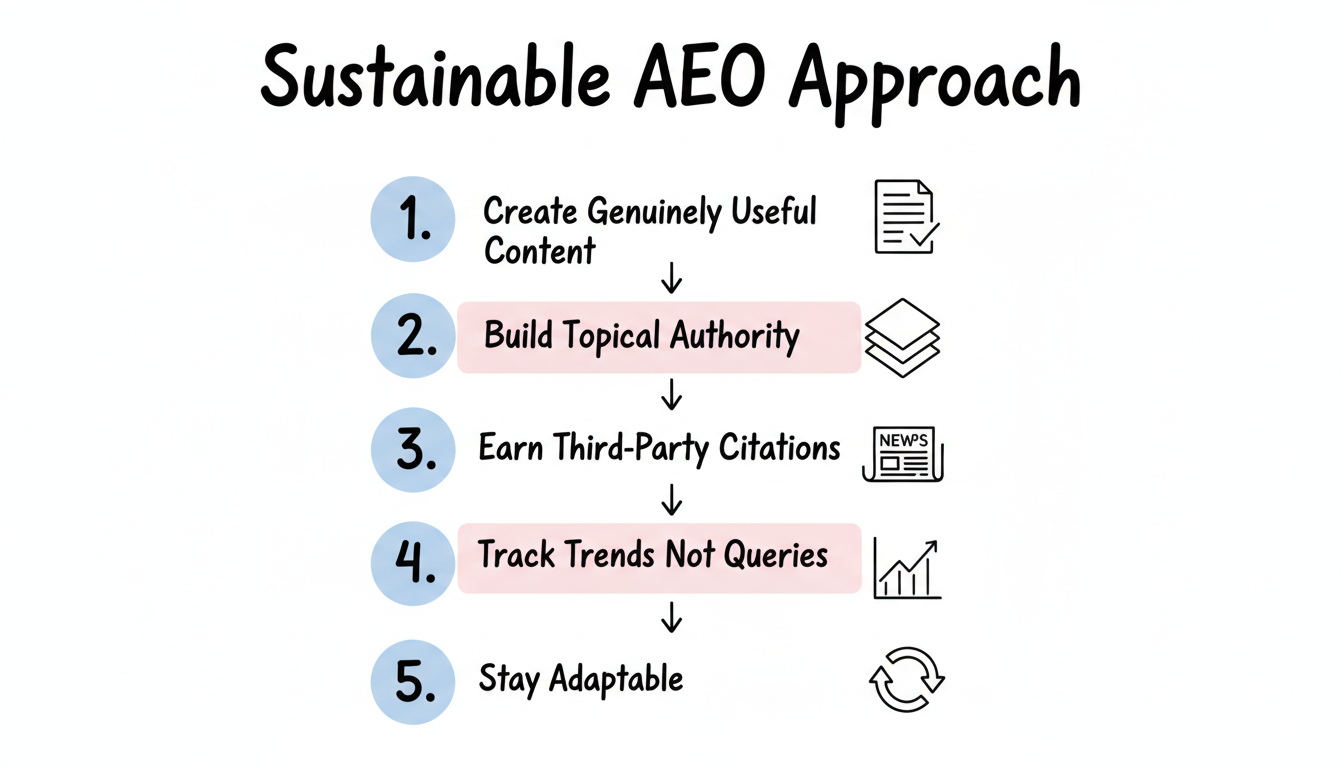
- Create genuinely useful content - AI rewards quality, not optimization tricks
- Build topical authority - Comprehensive coverage beats keyword targeting
- Earn third-party citations - Media mentions carry more weight than on-site optimization
- Track trends, not individual queries - Aggregate data reveals patterns
- Stay adaptable - AEO best practices will evolve as AI systems mature
Prioritizing AEO Investment
Not all AEO challenges deserve equal resources. Use an own/co-opt/observe framework to allocate effort strategically:
- Own: Topics where you have deep E-E-A-T and topical authority to produce definitive, citable answers. Invest heavily here—these are your highest-ROI opportunities for AI visibility.
- Co-opt: Queries where third-party citations dominate the AI response. Rather than competing head-on, optimize your content to become the source that third-party publications reference and cite.
- Observe: Volatile or low-ROI queries where monitoring beats active optimization. Track these for shifts in AI behavior, but don't commit significant resources until the opportunity matures.
Resource and team capacity constraints make prioritization essential. Most organizations cannot optimize for every AI platform and query type simultaneously. Focus your investment where your existing authority gives you an unfair advantage, and build outward from there. For a step-by-step approach to sequencing these priorities, see our AEO implementation roadmap.
Key Takeaways
AEO challenges are real but manageable:
- Prompt variability - Focus on topics, not specific queries
- Answer inconsistency - Track trends, not individual responses
- Long training cycles - Pursue dual real-time and training data strategies
- Zero-click impact - Measure citations and brand lift, not just traffic
- Measurement complexity - Invest in dedicated AI visibility tools
- Algorithm opacity - Focus on fundamentals across all platforms
- Multi-platform demands - Prioritize by audience relevance
- Structured data gaps - Audit and implement schema markup systematically
- Voice search optimization - Build conversational FAQ layers for spoken queries
- New success metrics - Treat AI visibility as its own channel
Understanding these challenges positions you to navigate them strategically rather than being surprised by unexpected obstacles.
Frequently Asked Questions About AEO Challenges
What Is the Biggest Challenge of Answer Engine Optimization?
The biggest AEO challenge is measurement complexity. Unlike traditional SEO where rankings and clicks are trackable, AI-generated answers lack standardized analytics. Most organizations find that conventional metrics like search position and click-through rate explain less than five percent of AI search visibility, requiring new tools and KPIs built specifically for answer engine performance.
How Does Structured Data Help with Answer Engine Optimization?
Structured data like FAQPage, HowTo, and Article JSON-LD schema helps AI engines parse your content more accurately. Schema markup signals content type, relationships, and key answers directly to crawlers, increasing the likelihood of being selected for AI-generated responses. Without proper structured data, even high-quality content may be overlooked by answer engines during retrieval. Learn more about how organization schema and knowledge graphs strengthen your AI search presence.
How Is AEO Different from Traditional SEO?
AEO focuses on optimizing content for AI-generated answers rather than traditional search result rankings. While SEO targets keyword placement and backlinks for page-one positions, AEO requires structured formatting, topical authority aligned with E-E-A-T, and optimization across multiple AI platforms like ChatGPT, Perplexity, and Google AI Overviews simultaneously. The measurement frameworks also differ significantly.
Can You Optimize for Voice Search and Answer Engines at the Same Time?
Yes, voice search and AEO share significant overlap. Both reward concise, direct answers in natural conversational language. Structuring content with question-and-answer pairs, using 30-to-50-word summary responses, and implementing FAQPage schema serves both channels effectively. The key challenge is balancing conversational tone for voice with the depth that text-based AI engines prefer for comprehensive answers.