
Last Updated: March 2026
Checking your AEO performance is essential for understanding how well your content appears in AI-generated answers. Unlike traditional SEO where ranking positions are clearly visible, AEO success requires systematic checking across multiple AI platforms. This guide explains how to audit your answer engine optimization effectively.
Why AEO Checking Matters
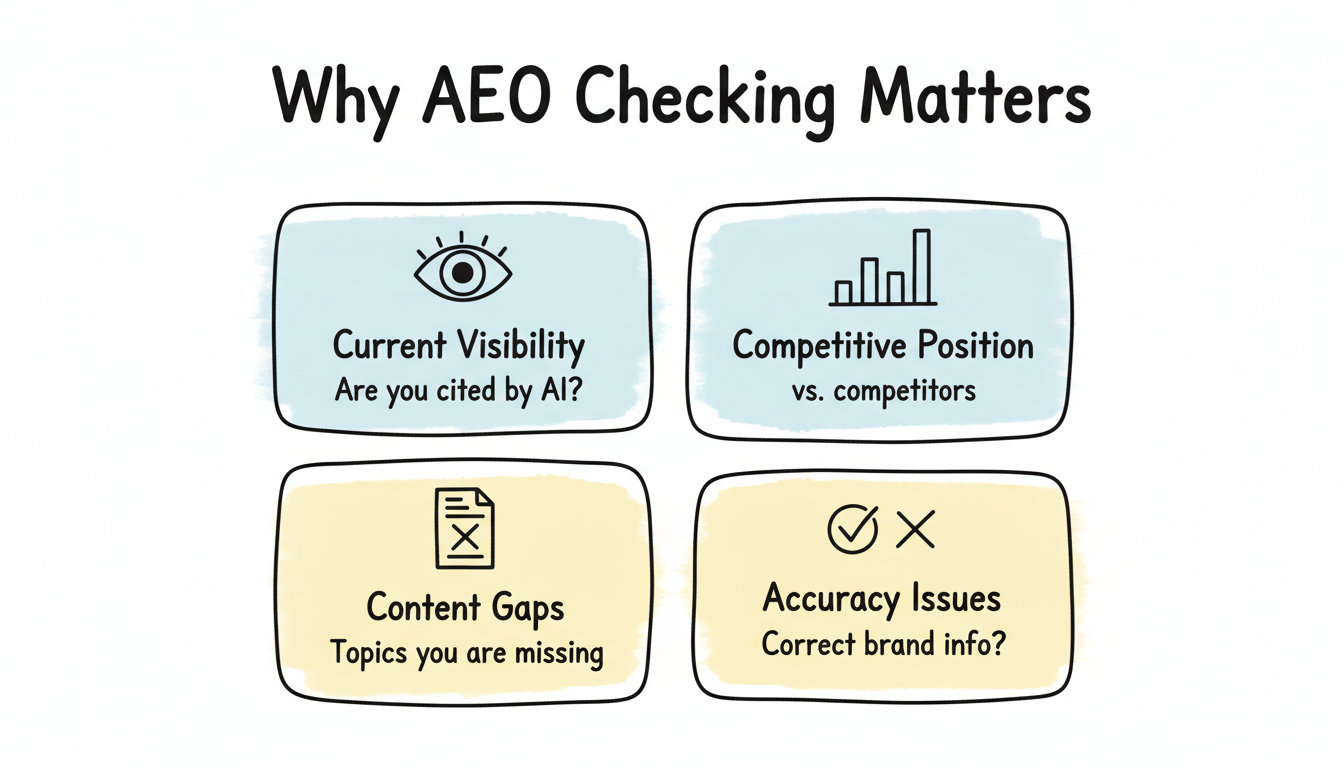
You cannot improve what you don't measure. AEO checking reveals:
- Current visibility: Whether AI platforms cite your content for relevant queries
- Competitive position: How your citation frequency compares to competitors
- Content gaps: Topics where you should be cited but aren't
- Accuracy issues: Whether AI systems represent your brand correctly when they do cite you
Without systematic checking, AEO efforts proceed blindly.
The urgency behind AEO checking continues to grow. According to recent data, 63-64% of Google searches now end in zero clicks, meaning most users get their answers without ever visiting a website. Meanwhile, ChatGPT alone has surpassed 800 million weekly active users, making AI platforms a primary discovery channel. AI search traffic that does click through converts at significantly higher rates than traditional organic traffic, making AEO checking not just a visibility exercise but a revenue-impacting activity.
Understanding AEO Scores: What They Measure and Why They Matter
An AEO score is a numeric rating, typically on a 0-100 scale, that estimates how well a page is optimized for citation by AI answer engines. While different tools calculate scores using proprietary methods, understanding the concept helps you benchmark and track your progress toward greater AI search visibility.
Common scoring factors used by tools like HubSpot AEO Grader, betterAEO, and AEO-Agent include content extractability, schema markup completeness, E-E-A-T signals, direct answer formatting, source credibility, and content freshness. Each factor reflects how easily an AI system can parse, trust, and cite your content.
Score ranges generally break down as follows: 0-30 indicates poor optimization where content is unlikely to be cited by AI platforms. Scores of 31-60 suggest moderate optimization with some elements present but meaningful gaps remaining. A score of 61-80 represents good optimization with content well-structured for AI extraction. Scores above 80 indicate excellent optimization with comprehensive AEO readiness.
AEO scores differ from traditional SEO scores in important ways. AEO scoring weights AI readability, answer-first content structure, and entity clarity more heavily than backlink profiles or domain authority metrics. The emphasis is on whether AI systems can extract clean, authoritative answers from your content.
Keep in mind that different tools weight factors differently, so scores will vary across platforms. The real value is in tracking improvement over time and identifying specific weaknesses, not in chasing a specific absolute number.
The Zero-Click Landscape: Why AEO Checking Is Now Critical
The shift toward zero-click search behavior has fundamentally changed how brands must think about visibility. With 63-64% of Google searches ending without a click to any website, the traditional funnel of search-click-convert is being replaced by what experts call the zero-click funnel.
In this new model, awareness and consideration happen inside AI interfaces. ChatGPT with its 800 million-plus weekly users, Perplexity, Google AI Mode, and Gemini are where users form opinions and make decisions. Your website may never receive a visit, yet your brand can still be recommended, cited, or dismissed entirely within these platforms. Understanding this landscape is central to any answer engine optimization strategy.
The ROI case for AEO checking is compelling. AI search traffic that does result in a click converts at significantly higher rates than traditional organic traffic because users arrive with high-intent context already established by the AI conversation. Early AEO adopters report conversion lifts in the range of 12-16% compared to 1-2% for generic organic traffic. Organizations that invest in a structured AEO marketing strategy are seeing measurable returns from this shift.
There is a critical 2-3 year window as the AI search landscape consolidates. Brands that establish citation authority early will have compounding advantages as AI platforms increasingly rely on a stable set of trusted sources. If you are not actively monitoring your presence in these zero-click environments, you are invisible to a growing majority of searchers.
Manual AEO Checking Methods
Manual checks provide direct insight into how AI platforms treat your content.
ChatGPT Citation Checks
Test your visibility in ChatGPT:
- Identify target queries: List questions your audience asks that relate to your expertise
- Test in ChatGPT: Ask these questions directly in ChatGPT with web search enabled
- Document citations: Record whether your brand, domain, or specific content gets cited
- Note context: How prominently are you cited? As a primary source or brief mention?
- Compare competitors: Which competitors appear for the same queries?
Systematic manual testing across 20-50 queries provides baseline visibility understanding. This foundational work complements broader ChatGPT optimization strategies.
Perplexity Visibility Checks
Perplexity shows sources explicitly, making checking straightforward:
- Search target queries: Enter questions in Perplexity
- Review source panel: Check whether your domain appears in cited sources
- Assess source prominence: Are you a primary source or supporting citation?
- Verify accuracy: Does the citation accurately represent your content?
Perplexity's transparent citation system makes manual checking efficient.
Google AI Overview Checks
Check visibility in Google's AI-generated summaries:
- Search informational queries: Use Google for questions that trigger AI Overviews
- Identify AI Overview presence: Note whether AI Overview appears for your target queries
- Check for citations: Look for your domain in the AI Overview's source links
- Compare to organic results: Does AI Overview citation correlate with organic rankings?
AI Overviews appear selectively, so not all queries trigger them.
Featured Snippet Checks
Featured snippets often feed voice assistants and influence AI citations:
- Search question-format queries: Test queries beginning with who, what, when, where, why, how
- Identify snippet presence: Note whether featured snippets appear
- Check ownership: Determine whether you own the featured snippet
- Analyze format: What format (paragraph, list, table) wins the snippet?
Featured snippet visibility often correlates with broader AEO success.
Automated AEO Checker Tools
Manual checking doesn't scale. Automated tools monitor visibility continuously.
Dedicated AEO Monitoring Platforms
Several platforms specialize in AEO checking:
SE Visible provides straightforward LLM visibility tracking. The platform monitors your presence across major AI chatbots, tracking citation frequency over time. Historical trending helps identify whether optimization efforts improve visibility.
Otterly.AI focuses on practical citation monitoring with alert systems. Get notified when visibility changes significantly—either improvements from optimization or declines requiring attention.
Scrunch AI offers prompt-level monitoring showing exactly which queries cite your content. Topic clustering reveals patterns in how AI systems engage with different content areas. Organizations working with a generative engine optimization agency often integrate these monitoring capabilities into broader programs.
HubSpot AEO Grader is a free tool that provides brand sentiment analysis, competitive positioning, and multi-platform scoring across GPT-4o, Perplexity, and Gemini. It evaluates how AI platforms perceive and represent your brand, offering actionable recommendations for improving your AEO score. With over 260 monthly searches for the tool itself, it has become a popular entry point for teams beginning their AEO monitoring journey.
Enterprise AEO Platforms
Larger organizations benefit from comprehensive solutions:
Ahrefs Brand Radar combines AI visibility monitoring with traditional SEO data. For teams already using Ahrefs, integrated reporting simplifies unified measurement.
Conductor provides enterprise-grade AEO monitoring connected to content workflows. Citation data informs content prioritization and optimization decisions.
Profound specializes in detailed citation analysis including brand sentiment scoring—understanding not just whether AI cites you, but how it portrays your brand across GPT-4o, Gemini, Claude, and other major models.
Tool Selection Considerations
Choose AEO checker tools based on:
- Platform coverage: Does it monitor the AI platforms your audience uses?
- Check frequency: How often does it update visibility data?
- Historical tracking: Can you trend performance over time?
- Competitive features: Does it compare your visibility to competitors?
- Integration: Does it connect with your existing marketing stack?
What to Check in an AEO Audit
Comprehensive AEO audits examine multiple dimensions.
Citation Frequency
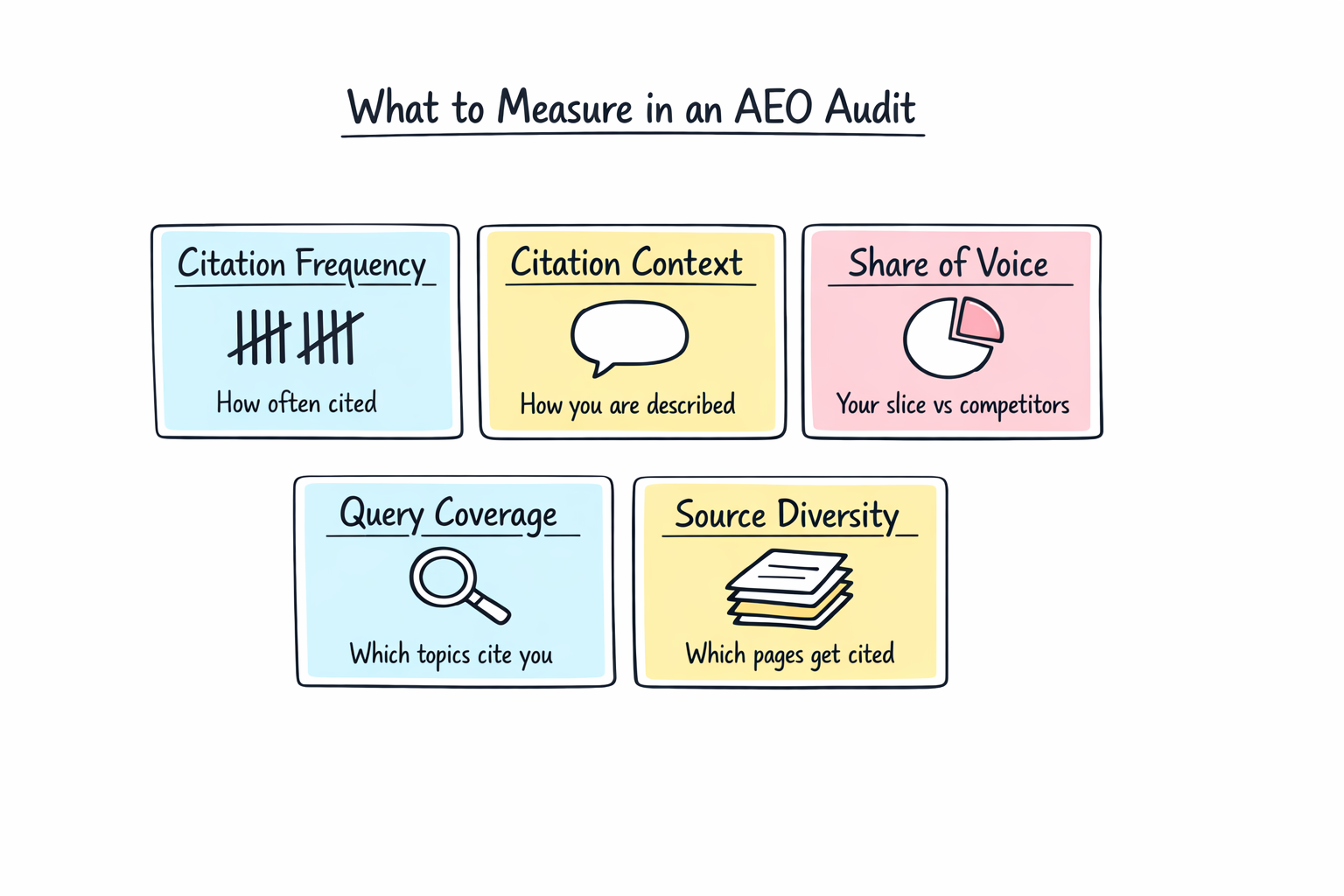
What to measure: How often AI platforms cite your content for target queries
What it indicates: Overall visibility and authority recognition
Benchmark: Track changes over time rather than absolute numbers
Citation Context
What to measure: How AI platforms describe you when citing
What it indicates: Brand accuracy and positioning
Red flags: Incorrect information, outdated details, competitor confusion
Share of Voice
What to measure: Your citation frequency relative to competitors
What it indicates: Competitive positioning in AI answers
Goal: Increase share for high-priority topics
Query Coverage
What to measure: Which target queries cite you versus which don't
What it indicates: Content and authority gaps
Action: Create or optimize content for uncovered queries
Source Diversity
What to measure: Which specific pages get cited most frequently
What it indicates: Content concentration and opportunity
Insight: Diversify citations beyond a few dominant pages
Voice Search and Position Zero Checks
Voice assistants like Siri, Alexa, and Google Assistant pull answers from position zero—the promoted answer block that appears above the first organic result—and from AEO-optimized content. Position zero is the primary source for voice search responses, making it a critical checkpoint in any AEO audit.
To check voice search readiness, test your target queries via voice on mobile devices and smart speakers. Compare whether the content your voice assistant reads aloud matches your featured snippet optimization efforts. If your content appears in the featured snippet visually but is not selected for voice readout, the formatting may need adjustment.
The ideal direct answer format for both voice responses and AI extraction is 40-60 words. This is more concise than general web content guidelines and reflects the tight extraction window that AI systems prefer. Structure key answers as self-contained paragraphs within this range to maximize both voice and AI citation potential.
Note that Google AI Mode is a distinct product from AI Overviews with different citation behavior. AI Mode is an interactive conversational interface, while AI Overviews appear as summary boxes in standard search results. Both should be checked independently during an AEO audit for a complete visibility picture.
Creating an AEO Audit Checklist
Systematic audits follow consistent processes, much like the structured approach in an AEO marketing strategy framework.
Technical AEO Checks
- AI crawlers (GPTBot, ChatGPT-User) not blocked in robots.txt
- Key pages render content without JavaScript dependency
- FAQ schema implemented on relevant pages
- Article schema includes author and date information
- Organization schema establishes entity identity
- Page load times under 3 seconds
- Structured data for AEO validated and deployed across priority pages
Content AEO Checks
- Priority pages have clear, extractable answer paragraphs
- Direct answer paragraphs formatted in the 40-60 word sweet spot that AI engines prefer for extraction
- AI readability verified—content structured so AI systems can easily parse and extract standalone answers
- Question-based headings matching user queries
- Direct answers immediately following question headings
- Specific statistics and facts included
- Content updated within past 6 months
Authority AEO Checks
- Consistent brand information across platforms
- Expert author attribution with credentials
- External citations from authoritative sources
- Brand mentioned on industry-relevant sites
- Comprehensive topical coverage in content area
- E-E-A-T (Experience, Expertise, Authoritativeness, Trustworthiness) signals present across all authority dimensions—these checks map directly to the E-E-A-T framework that AI platforms use to evaluate source credibility
Interpreting AEO Check Results
Understanding what results mean guides action.
Improving Citation Frequency
If citation frequency is low:
- Strengthen traditional SEO rankings (supports AI discovery)
- Restructure content for extractability
- Build entity authority through external presence
- Create content specifically answering common queries
Fixing Citation Accuracy
If AI misrepresents your brand:
- Ensure consistent information across all platforms
- Update outdated content AI may be referencing
- Create clear, authoritative content on misrepresented topics
- Implement comprehensive schema markup
Gaining Query Coverage
If competitors get cited for queries you should own:
- Create content directly addressing those queries
- Optimize existing relevant content for extractability
- Build authority in the topic area through comprehensive coverage
Building a Citation Strategy
AEO checking is only half the equation. To sustainably improve your AI visibility, you also need a proactive content distribution and citation strategy that extends your reach beyond your own website.
Effective citation-building tactics include guest content on authoritative sites, digital PR that generates brand mentions in high-trust publications, influencer partnerships within your niche, and contributing to industry forums and publications where AI platforms frequently source information. Each of these activities increases the probability that AI systems encounter and index your brand as a credible source. Investing in AI content optimization across these channels amplifies the effect.
Consider the concept of citation neighborhoods—the cluster of sources that AI platforms tend to cite together for a given topic. Getting mentioned alongside authoritative sources increases your own citation likelihood through association. Monitor which brands and publications appear alongside you in AI answers and seek opportunities to strengthen those co-citation patterns.
AI citation tracking should be an ongoing discipline. Monitor where your brand gets mentioned across AI platforms, which sources are cited alongside you, and how citation patterns shift after distribution efforts. Over time, this data reveals which activities drive the most meaningful citation gains. Understanding how underlying AI systems like BERT and RankBrain process entity recognition and search understanding helps inform a more targeted citation strategy.
Key Takeaways
Regular checking is essential. AEO visibility isn't visible without active monitoring. Build systematic checking into your optimization workflow.
Combine manual and automated methods. Manual checks provide detailed insight; automated tools enable scale and trending.
Check multiple dimensions. Citation frequency matters, but so do context, accuracy, and competitive position.
Act on findings. Checking without response wastes effort. Build action plans from audit insights.
FAQs
How Often Should I Check AEO Performance?
Run comprehensive audits quarterly. Monitor key metrics through automated tools continuously. Manual spot-checks of priority queries should happen monthly. Adjust frequency based on how actively you're optimizing—more active programs warrant more frequent checking.
Which AEO Checker Tool Is Best?
The best tool depends on your needs. For basic monitoring, SE Visible or Otterly.AI provide accessible starting points. For enterprise needs with existing Ahrefs investment, Brand Radar integrates well. Most teams benefit from starting simple and adding capabilities as programs mature.
Can I Check AEO Without Specialized Tools?
Yes. Manual checking across ChatGPT, Perplexity, and Google AI Overviews provides meaningful insight without tool investment. This approach doesn't scale but works for initial assessment and small-scale programs. Add automated tools when you need historical trending or competitive comparison.
What Is a Good AEO Score?
A good AEO score typically falls between 61 and 80 on a 0-100 scale. Scores above 80 indicate excellent optimization for AI citation. Most tools evaluate factors like E-E-A-T signals, schema markup, content extractability, and direct answer formatting. Focus on improving your score over time rather than chasing a specific number, since different AEO checker tools weight factors differently.
How Do Zero-Click Searches Affect AEO Strategy?
Zero-click searches now account for 63-64% of all Google searches, meaning most users get answers without visiting a website. This makes AEO checking critical because your content may be cited inside ChatGPT, Gemini, or Perplexity without generating a click. Monitoring AI citations ensures you maintain brand visibility and accuracy even when users never reach your site directly.
Should I Check AEO Separately for Google AI Mode and AI Overviews?
Yes. Google AI Mode and AI Overviews are distinct products with different citation behaviors. AI Overviews appear as summary boxes in standard search results, while AI Mode is an interactive conversational interface. Each pulls from sources differently, so a page cited in AI Overviews may not appear in AI Mode. Check both independently for complete visibility assessment.
Does Voice Search Optimization Overlap with AEO Checking?
Significantly. Voice assistants like Siri, Alexa, and Google Assistant pull answers from position zero featured snippets and AI-optimized content. The ideal direct answer format of 40-60 words works well for both voice responses and AI extraction. When running AEO audits, test your target queries via voice to ensure your content reads naturally when spoken aloud by an assistant.