
As AI search engines reshape how users discover information, tracking your visibility across ChatGPT, Perplexity, Google AI Overviews, and Microsoft Copilot has become essential. AEO checker tools provide the monitoring capabilities needed to understand where your brand appears—and where it doesn't—in AI-generated responses.
Here are the top 10 AEO checker tools for 2026, with features, pricing, and use cases for each.
Why You Need AEO Checker Tools
The rise of zero-click search has fundamentally changed how users interact with information. Over 60% of Google searches now result in zero clicks, with AI engines synthesizing answers directly instead of linking to source pages. This shift makes AI citation tracking essential—if your brand isn't being cited in AI-generated responses, you're invisible to a growing share of your audience.
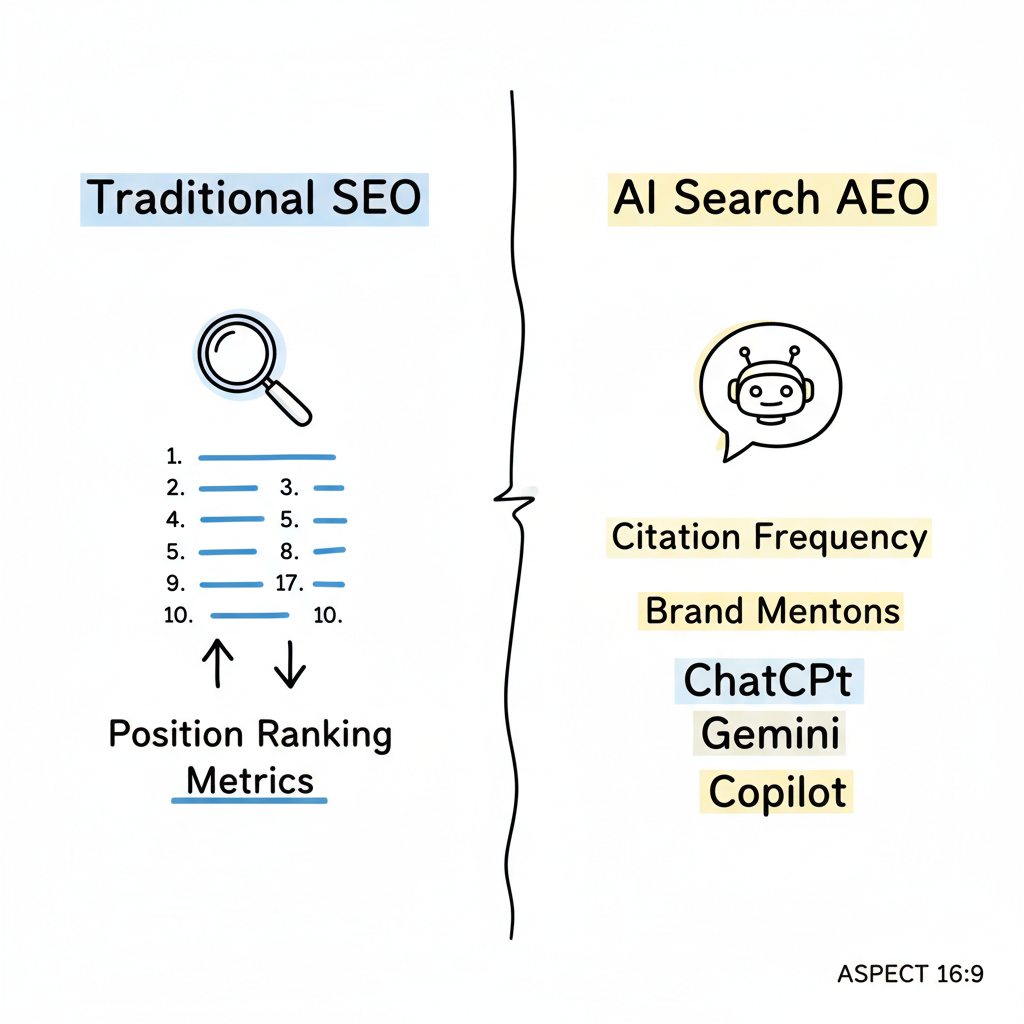
Traditional SEO tools track rankings in Google's 10 blue links. But AI search works differently—there are no positions 1-10, only citations and mentions within generated responses. According to SE Ranking's analysis of AI visibility tools, specialized monitoring tools are required to track brand presence across large language models.
What AEO checkers monitor:
- Citation frequency in AI-generated answers
- Brand mention sentiment and context
- Competitive share of voice across LLMs
- Source attribution patterns
- Citation trends over time
Without these tools, you're optimizing blind. Understanding what is AEO in marketing provides the foundation for why these specialized tracking capabilities matter.
AEO vs SEO: Why Traditional Rank Tracking Falls Short
Traditional SEO focuses on keyword rankings and click-through rates from search engine results pages. AEO addresses a fundamentally different challenge: whether AI engines cite your brand when synthesizing answers to user queries. In a zero-click search environment, users increasingly receive complete answers without ever visiting a website, making SERP position less meaningful as a standalone metric.
Traditional rank trackers were built to monitor positions 1-10 in organic results. They cannot detect whether ChatGPT, Perplexity, or Google AI Overviews reference your content in their generated responses. AEO checker tools fill this gap by providing prompt-level visibility tracking—monitoring specific queries across AI engines to determine if and how your brand is cited.
This distinction matters because optimizing for AI citation requires different tactics than optimizing for rankings. Content structure, entity coverage, and source authority all play larger roles in AI visibility. For a complete comparison of available platforms, see our AEO tools and software comparison. It's also worth noting that GEO (Generative Engine Optimization) represents the content-creation counterpart to AEO monitoring—where AEO tracks your visibility, GEO strategies for content teams focus on producing content that AI engines prefer to cite.
What to Look for in an AEO Grader Tool
Not all AEO checker tools offer the same depth of analysis. When evaluating options, prioritize these capabilities:
- Prompt-level tracking: Can the tool monitor specific queries across multiple AI engines and show exactly when your brand is cited? This is the core differentiator between basic brand monitoring and true AEO analysis.
- E-E-A-T signal assessment: Does the tool evaluate source credibility and authority signals that AI engines use when selecting citation sources? Understanding your E-E-A-T profile helps prioritize authority-building efforts.
- Entity mapping: Does it identify which entities your content is associated with in AI models? Entity coverage directly impacts whether AI engines consider your content relevant for specific queries.
- Analytics integration: Look for GA4 and revenue attribution capabilities that connect AI referral traffic to business outcomes. Tools that support measuring AEO marketing ROI through analytics integration provide the clearest picture of impact.
- Multi-region and multilingual support: For global brands, the ability to track AI visibility across different languages and regions is essential, as AI engine behavior varies significantly by locale.
1. Profound
According to Nick Lafferty's analysis of AEO tools, Profound has emerged as a leading AEO platform, earning G2's Winter 2026 AEO Leader designation. It tracks visibility across major AI platforms including GPT-5.2.
Key features:
- Multi-LLM tracking (ChatGPT, Perplexity, Claude, Gemini)
- Citation analysis with source attribution
- Competitive benchmarking
- Trend analysis and reporting
Pricing: $100-$400/month depending on query volume
Best for: Mid-market companies needing comprehensive AI visibility tracking
2. Conductor
According to Conductor's AI visibility research, their platform consistently ranks among the top GEO and AEO tools. Conductor offers enterprise-grade monitoring with deep integration into broader SEO workflows.
Key features:
- Enterprise-scale AI visibility tracking
- Integration with traditional SEO metrics
- Content optimization recommendations
- Team collaboration tools
Pricing: Custom enterprise pricing
Best for: Large enterprises with existing Conductor SEO infrastructure
3. Semrush AI Toolkit
According to HubSpot's analysis of AI marketing tools, Semrush has expanded into AI visibility tracking through their AI Toolkit. This integrates AI monitoring with Semrush's established SEO platform. Teams using Semrush AEO enterprise AIO capabilities benefit from unified workflows that combine traditional and AI search optimization.
Key features:
- AI visibility tracking across major LLMs
- Competitive benchmarking
- Integration with Semrush keyword and rank tracking
- Content gap analysis for AI optimization
Pricing: $99+/month (included in higher Semrush tiers)
Best for: Teams already using Semrush for traditional SEO
4. Surfer SEO AI Tracker
According to MarketerMilk's review of AI SEO tools, Surfer SEO has added AI tracking capabilities that monitor presence in Google AI Overviews, SearchGPT, and Perplexity.
Key features:
- Content optimization scoring
- AI Overview tracking
- Real-time visibility monitoring
- Content brief generation optimized for AI
Pricing: $89-$219/month
Best for: Content teams focused on optimizing for AI citation
5. Otterly.AI
Otterly.AI focuses specifically on tracking AI search visibility across ChatGPT, Gemini, Copilot, and Perplexity. It provides granular citation analysis and competitive monitoring.
Key features:
- Multi-platform AI tracking
- Citation source analysis
- Sentiment monitoring
- Automated reporting
Pricing: Custom pricing based on tracking needs
Best for: Teams wanting dedicated AI visibility monitoring without traditional SEO features
6. Peec AI
According to SE Ranking's tool comparison, Peec AI offers user-friendly AI visibility tracking with intelligent opportunity ranking. At €89/month, it provides accessible entry-level monitoring.
Key features:
- AI visibility scoring
- Opportunity identification
- User-friendly interface
- Actionable recommendations
Pricing: €89/month (~$97 USD)
Best for: Small to mid-size businesses new to AI visibility tracking
7. SE Visible (by SE Ranking)
SE Ranking launched SE Visible as a dedicated AI visibility tracking tool. According to SE Ranking's product page, it tracks brand footprint across major answer engines.
Key features:
- Brand mention monitoring across LLMs
- Citation frequency tracking
- Competitive share of voice analysis
- Integration with SE Ranking SEO tools
Pricing: Included with SE Ranking subscriptions
Best for: SE Ranking users wanting AI visibility data alongside traditional SEO metrics
8. Ahrefs Brand Radar
Ahrefs has expanded beyond backlink analysis into AI visibility tracking with Brand Radar. This tool monitors real-time brand mentions and sentiment across AI platforms.
Key features:
- Real-time brand monitoring
- Sentiment analysis
- Competitive tracking
- Alert systems for mention changes
Pricing: Included in Ahrefs Enterprise plans
Best for: Teams using Ahrefs for SEO wanting unified brand monitoring
9. Omniseo
OmniSEO offers free comprehensive AI visibility tracking, making it accessible for teams testing AEO monitoring without budget commitment.
Key features:
- Free AI visibility tracking
- Multi-platform monitoring
- Basic reporting
- No credit card required
Pricing: Free tier available
Best for: Teams exploring AI visibility tracking before committing to paid tools
10. Scrunch AI
According to Meltwater's analysis of brand monitoring tools, Scrunch AI provides enterprise-focused brand monitoring across AI platforms with deep sentiment analysis capabilities.
Key features:
- Enterprise brand monitoring
- Advanced sentiment analysis
- Influencer and citation tracking
- Custom reporting dashboards
Pricing: Custom enterprise pricing
Best for: Enterprise teams needing comprehensive brand intelligence
How to Choose an AEO Checker Tool
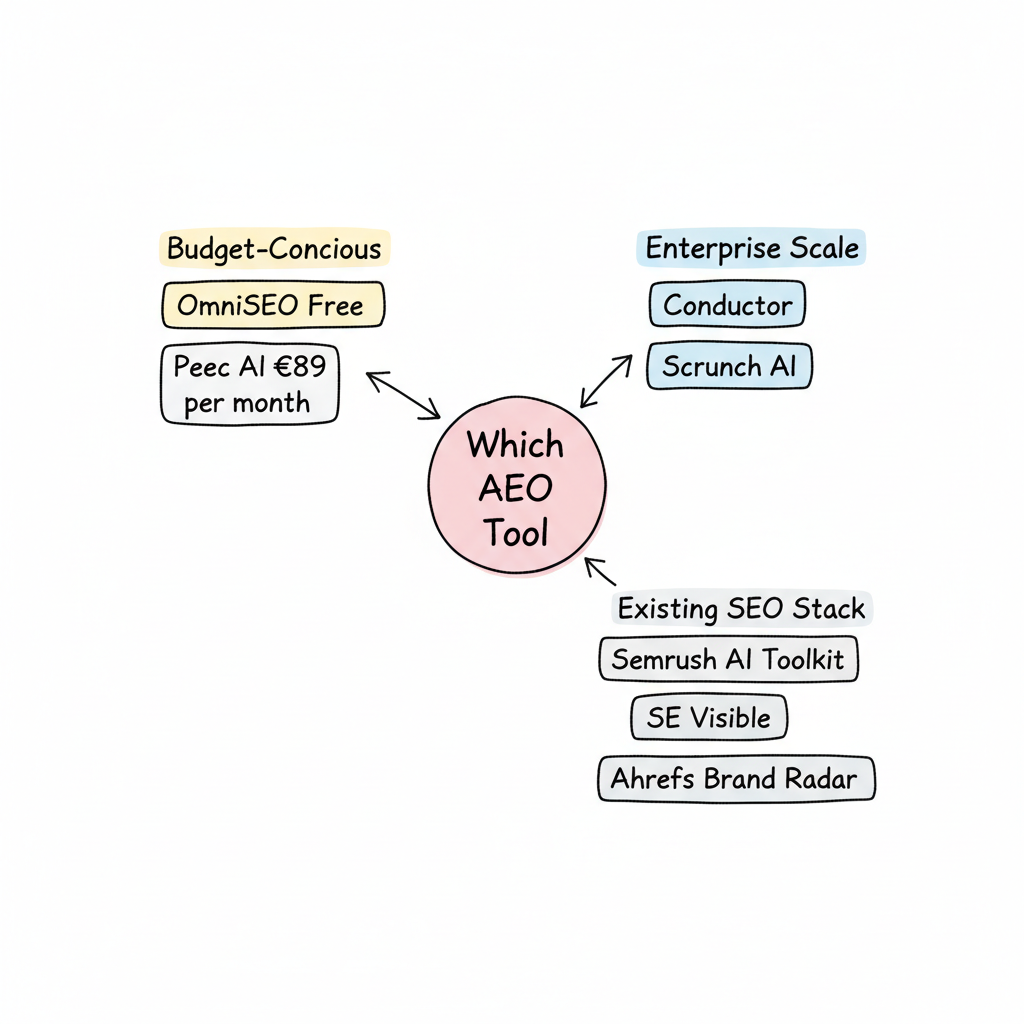
Select tools based on your specific needs. For a deeper look at enterprise AEO platform features, see our Semrush AEO breakdown.
Need | Recommended Tools |
Budget-conscious start | OmniSEO, Peec AI |
Enterprise scale | Conductor, Scrunch AI |
Existing SEO stack integration | Semrush AI Toolkit, SE Visible, Ahrefs |
Content optimization focus | Surfer SEO AI Tracker |
Dedicated AI monitoring | Otterly.AI, Profound |
Prompt-level tracking | Profound, Otterly.AI, Conductor |
GA4 / analytics integration | Semrush AI Toolkit, Conductor, Surfer SEO |
Entity mapping capability | Profound, Semrush AI Toolkit, Peec AI |
Key evaluation criteria:
- Which LLMs does it track? (ChatGPT, Perplexity, Gemini, Copilot, Claude)
- How frequently does it update data?
- Does it integrate with your existing tools?
- What's the reporting depth?
- Is pricing aligned with your budget?
Setting Up AI Visibility Tracking
Once you've selected a tool, implement systematic monitoring:
- Identify target queries - List 20-50 queries your audience asks AI assistants
- Establish baseline - Document current citation frequency and competitors
- Set monitoring frequency - Weekly for competitive markets, bi-weekly for stable ones
- Create alerts - Get notified when citation patterns change significantly
- Review monthly - Analyze trends and adjust content strategy accordingly
Important: AI engines favor sources with strong E-E-A-T signals (Experience, Expertise, Authoritativeness, Trustworthiness). Pair your AEO checker tool insights with authority-building efforts—publish original research, maintain consistent bylines from subject-matter experts, and ensure your content is cited and corroborated across trusted industry sources.
Consistent monitoring reveals which content earns citations and which optimization efforts work. Measuring AEO marketing ROI requires these systematic tracking capabilities to demonstrate how AI visibility drives business outcomes.
How to Structure Content for AI Citations
Tracking visibility is only half the equation—you also need to structure content so AI engines can easily extract and cite it. These practices increase the likelihood of earning AI citations:
- Write concise, direct-answer paragraphs: AI engines prefer extracting self-contained answers of 50-80 words. Lead sections with a clear answer before expanding with supporting detail.
- Use question-based headings and FAQ schema: Structure H2 and H3 headings as questions that match user prompts. Implement FAQ structured data to give AI engines explicit question-answer pairs to reference.
- Build topical authority through corroboration: AI engines cross-reference multiple sources before citing. Strengthen your authority by publishing entity-rich content, earning mentions on Reddit and industry directories, and citing authoritative sources. Review our guide on AI search optimization strategies for foundational approaches.
- Ensure technical AI-readiness: Use server-side rendering so AI crawlers can access your content. Maintain clean HTML with proper heading hierarchy, fast load times, and no JavaScript-dependent content rendering. For guidance specific to Google's AI results, see our AI overview optimization guide.
Key Takeaways
AEO checker tools are essential for AI search visibility management:
- Specialized tools required - Traditional SEO tools don't track AI citations adequately
- Multi-LLM tracking matters - Monitor ChatGPT, Perplexity, Gemini, Copilot, and Claude
- Pricing varies widely - Free options exist (OmniSEO) through enterprise solutions ($400+/month)
- Integration considerations - Tools like Semrush and Ahrefs add AI tracking to existing platforms
- Competitive monitoring essential - Track share of voice against competitors
- Consistent measurement - Weekly or bi-weekly monitoring reveals optimization impact
- Start simple - Begin with one tool, expand as needs grow
- AEO grader tools complement traditional SEO rank trackers by monitoring prompt-level visibility across AI engines
- Pair checker tool insights with content restructuring for AI citation—direct-answer formatting, entity optimization, and corroboration across trusted sources
The brands that monitor AI visibility systematically can optimize with precision—those that don't are guessing.
Frequently Asked Questions About AEO Checker Tools
What Is an AEO Checker Tool?
An AEO checker tool monitors whether your brand and content appear in AI-generated answers from engines like ChatGPT, Perplexity, Google AI Overviews, and Copilot. These tools track prompt-level visibility, showing which queries trigger citations to your pages. Unlike traditional rank trackers that measure SERP positions, AEO checkers measure your presence inside AI-synthesized responses.
What Is the Difference Between an AEO Grader and an AEO Tracker?
An AEO grader evaluates your content readiness for AI citation by scoring factors like E-E-A-T signals, entity coverage, and answer formatting. An AEO tracker continuously monitors your actual visibility across AI engines over time. Graders provide a snapshot audit while trackers deliver ongoing measurement. Most comprehensive tools combine both grading and tracking capabilities.
How Is AEO Different from SEO?
SEO optimizes for traditional search engine rankings and click-through rates. AEO optimizes for visibility inside AI-generated answers where users may never click through to your site. AEO checker tools track whether AI engines cite your brand in their responses, while SEO tools track keyword positions in search results. Both disciplines are complementary and increasingly overlap.
Can AEO Checker Tools Track Visibility Across Multiple AI Platforms?
Yes, most AEO checker tools monitor multiple AI platforms simultaneously, including ChatGPT, Google AI Overviews, Perplexity, Microsoft Copilot, Claude, and Gemini. Multi-platform tracking is essential because each AI engine uses different models and data sources, so your visibility can vary significantly across platforms. Look for tools that cover at least four major AI engines.