
Understanding competitor positioning in AI search reveals opportunities and threats. AEO competitor analysis goes beyond traditional SEO competitive research—you're measuring who AI systems cite, how often, and in what contexts. This guide provides frameworks for benchmarking AI visibility against competitors and identifying actionable opportunities. Whether you are comparing AEO vs GEO vs SEO approaches or running a dedicated AI search audit, the competitive intelligence methodology below applies across all major platforms.
Why AEO Competitor Analysis Matters
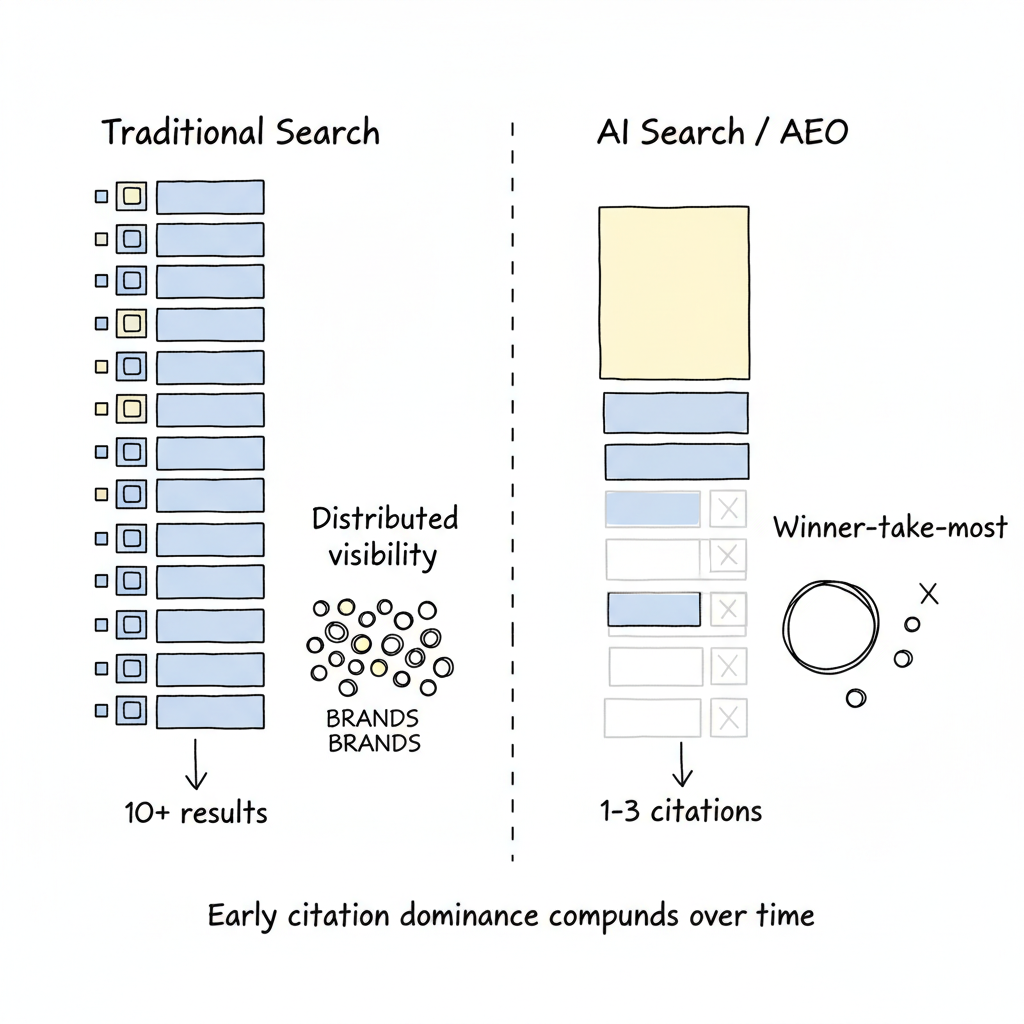
Traditional search shows 10+ results, distributing visibility broadly. AI search concentrates citations among fewer sources, creating winner-take-most dynamics.
Competitive implications:
- Brands cited by AI become default recommendations
- Non-cited competitors effectively don't exist in AI-driven discovery
- Early citation dominance compounds over time
- Understanding competitor positions reveals achievable opportunities
The 2026 AEO landscape rewards organizations understanding and responding to competitive dynamics.
AEO Competitive Intelligence Framework
Systematic competitor analysis requires structured approaches across multiple dimensions.
Citation Share Analysis
Measure how often competitors appear in AI responses relative to your brand.
Citation share metrics:
- Brand mention frequency across target queries
- Share of voice in AI responses for key topics
- Citation position within AI answers
- Source citation versus incidental mention distinction
Analysis approach:
- Define 20-50 target queries representing your market
- Query each across ChatGPT, Perplexity, and Google AI Overviews
- Document which brands appear in responses
- Calculate share of citations by competitor
- Repeat monthly to track trends
This baseline reveals your competitive position and identifies leaders to study.
Topic Authority Mapping
Identify which competitors own specific topic areas in AI perception.
Authority mapping process:
- List major topic clusters in your industry
- Query AI platforms about each topic
- Document which sources get cited consistently
- Map competitor authority by topic area
- Identify gaps where no strong authority exists
Strategic value: Topic authority maps reveal where competitors are vulnerable and where challenging them would be difficult.
Citation Quality Assessment
Not all citations carry equal value. Assess citation quality across competitors.
Quality dimensions:
- Primary source versus supporting citation
- Named as authority versus one of several sources
- Citation with link versus brand mention only
- Positive framing versus neutral reference
Example quality hierarchy:
- "According to [Brand], the definitive source on..."
- "[Brand] recommends..."
- "Sources including [Brand] suggest..."
- "Various providers like [Brand]..."
High-quality citations indicate stronger AI perception of authority.
Conducting AEO Competitor Audits
Follow this process for comprehensive competitor assessment.
Step 1: Identify True AI Competitors
AI competitors may differ from traditional SEO competitors.
Identification methods:
- Query AI platforms—specifically ChatGPT, Perplexity, Google AI Overviews, and Microsoft Copilot—for your core topics
- Document brands appearing in responses
- Compare to known industry competitors
- Include authoritative publishers (not just direct competitors)
Common discovery: Media publishers and educational institutions often dominate AI citations over commercial competitors.
Step 2: Build Competitor Query Matrix
Create a systematic query set for ongoing monitoring.
Matrix dimensions:
- Query category (informational, comparative, transactional)
- Topic area (product categories, problem types, use cases)
- Intent stage (awareness, consideration, decision)
- Primary schema types deployed by each competitor (FAQPage, HowTo, Article, Product)
- E-E-A-T score (1-5) based on author credentials, original research, backlink authority, and cross-platform consistency
Example matrix for SaaS:
Query Type | Awareness | Consideration | Decision |
Product | "What is [category]" | "Best [category] software" | "[Product] vs [Competitor]" |
Problem | "How to solve [problem]" | "Solutions for [problem]" | "Which tool for [problem]" |
Brand | "What is [brand]" | "[Brand] reviews" | "Is [brand] worth it" |
Comprehensive matrices ensure no blind spots in competitive monitoring, similar to how professionals using geo-optimization-tools track visibility across different generative engines.
Step 3: Document Baseline Citations
Record current state before strategy changes.
Documentation elements:
- Query text and date
- AI platform used
- Competitors mentioned in response
- Citation context and quality
- Your brand presence (or absence)
Baselining should also include a content retrievability check—verify that AI bots (GPTBot, ClaudeBot, PerplexityBot) can actually crawl your pages by reviewing your robots.txt directives and JavaScript rendering requirements. Run a schema inventory to document which structured data types you currently deploy versus competitors.
Baseline documentation enables measuring improvement over time.
Step 4: Analyze Competitor Content
Study what competitors do to earn citations.
Content analysis factors:
- Content structure and formatting
- Topic depth and comprehensiveness
- Expertise signals and credentialing
- Technical optimization (schema, site speed)
- Update frequency and freshness
- External authority signals (backlinks, mentions)
Track citation velocity—the rate of change in citation frequency over time, not just the static count. Citation velocity is a leading indicator that reveals emerging competitors gaining momentum before they appear in snapshot analyses. A competitor whose citation velocity is accelerating across ChatGPT, Perplexity, and Google AI Overviews deserves immediate attention.
Reverse-engineering successful competitor content reveals replicable patterns. Organizations exploring generative-ai-search-engine-optimization strategies often find that competitors earning consistent citations share common content characteristics.
Analyzing Competitor Intent Gaps and Semantic Coverage
Semantic gap analysis in the AEO context means identifying topics and user intents that competitors answer but your content does not. While citation share tells you who is winning, intent gap analysis tells you why—and where the specific openings exist.
Start by extracting competitor-cited queries from ChatGPT, Perplexity, and Google AI Overviews. Cluster these queries by buyer journey stage: awareness ("what is" queries), consideration ("best" and "how to" queries), and decision ("vs" and "pricing" queries). This alignment reveals whether competitors own specific stages that your content ignores entirely.
People Also Ask questions are particularly valuable here. PAA clusters reveal the intent neighborhoods that AI models use for context when selecting sources. If competitors consistently appear in PAA-adjacent AI answers and you do not, there is a semantic gap in your coverage.
Buyer Stage | Sample Query | Competitor Coverage | Your Coverage | Gap? |
Awareness | "what is AEO" | 3 of 5 competitors | Yes | No |
Consideration | "best AEO tools for B2B" | 4 of 5 competitors | No | Yes |
Decision | "AEO audit pricing" | 2 of 5 competitors | No | Yes |
Use AI citation tracking tools to automate query extraction and clustering at scale. Prioritize closing gaps in stages where competitors are weakest—these represent the fastest path to citation gains.
E-E-A-T Signals That Influence AI Citations
AI models evaluate source credibility when selecting which content to cite. Understanding the E-E-A-T signals (Experience, Expertise, Authoritativeness, Trustworthiness) that drive these decisions is essential for competitive benchmarking.
Experience: AI models favor sources demonstrating first-hand knowledge. Competitors publishing proprietary case studies, original survey data, or practitioner-authored content earn higher citation rates than those relying on aggregated secondary research.
Expertise: Depth of coverage signals domain expertise. Competitors whose content addresses nuanced subtopics—rather than surface-level overviews—are more likely to be cited for complex queries. Author credentials, detailed methodology explanations, and technical depth all contribute.
Authoritativeness: Backlink profiles from authoritative domains, brand mentions across independent platforms, and consistent presence in industry publications build the authority layer. AI models assess whether multiple independent sources reference a brand before elevating it as a citation.
Trustworthiness: Consistent messaging across owned channels, earned media, and community forums builds consensus signals. AI models weigh agreement across independent sources—forums, review sites, official documentation—before citing a brand. If your messaging contradicts what third-party sources say about you, citation probability drops.
To benchmark competitively, score each competitor (and yourself) on these four dimensions using a 1-5 rubric. Identify where your E-E-A-T profile falls short relative to top-cited competitors and prioritize closing those gaps. Teams following AEO best practices typically find that investing in original research and author credentialing yields the fastest E-E-A-T improvements.
Schema Markup and Content Retrievability for Competitive AEO
Schema markup gives competitors a structural advantage in AI citation selection. Pages deploying FAQPage, HowTo, and Article schema provide AI crawlers with pre-parsed, semantically labeled content that is easier to extract and cite than unstructured HTML.
Before analyzing competitors, audit your own content retrievability for AI crawlers. Verify that GPTBot, ClaudeBot, and PerplexityBot are not blocked in your robots.txt. Check that critical content is not locked behind JavaScript rendering that these bots cannot execute. Page speed matters too—slow-loading pages may time out before AI crawlers finish indexing.
To benchmark competitor schema implementation, run their key URLs through Google Rich Results Test and compare which schema types they deploy. Use Schema.org Validator for detailed markup inspection and Screaming Frog for bulk schema extraction across competitor domains. For a comprehensive overview of available platforms, see our guide to AEO tools and software.
Pay attention to how competitors use structured data for AI search—those deploying multiple schema types (Article + FAQPage + HowTo on a single page) often outperform competitors using only basic Article markup. Structured, concise answer blocks at the top of content sections further increase the probability of AI Overview inclusion.
Step 5: Identify Competitive Gaps
Find opportunities where competitors underperform or leave openings.
Gap categories:
Coverage gaps: Topics competitors haven't addressed comprehensively.
Quality gaps: Areas where competitor content is outdated or superficial.
Format gaps: Question types competitors don't answer (how-to, comparison, etc.).
Platform gaps: AI platforms where competitors have weak presence.
Gap analysis prioritizes where effort will yield fastest results.
Diversifying Content Formats for AI Visibility
Different AI platforms favor different content formats. ChatGPT tends to prefer long-form structured text with clear headings. Perplexity pulls from diverse source types including academic papers and niche publications. Google AI Overviews favor concise, direct answer blocks that can be extracted without heavy summarization. Microsoft Copilot leans on Bing-indexed sources with strong authority signals.
Audit competitor content format diversification: Are they publishing only text articles, or do they also maintain video transcripts, podcast show notes, interactive tools, and downloadable templates? Teams that diversify across three or more content formats typically see measurable citation lift within 90 days, with significant competitive gains within two quarters.
Track citation velocity as a format-level metric—the rate of change in citation frequency for each format type. A competitor whose video transcripts are gaining citations faster than their articles signals a format shift worth responding to. Measuring ROI by format helps prioritize where to invest production resources for maximum AI visibility impact.
Benchmarking Metrics and Kpis
Track specific metrics for competitive comparison.
Share of Voice Metrics
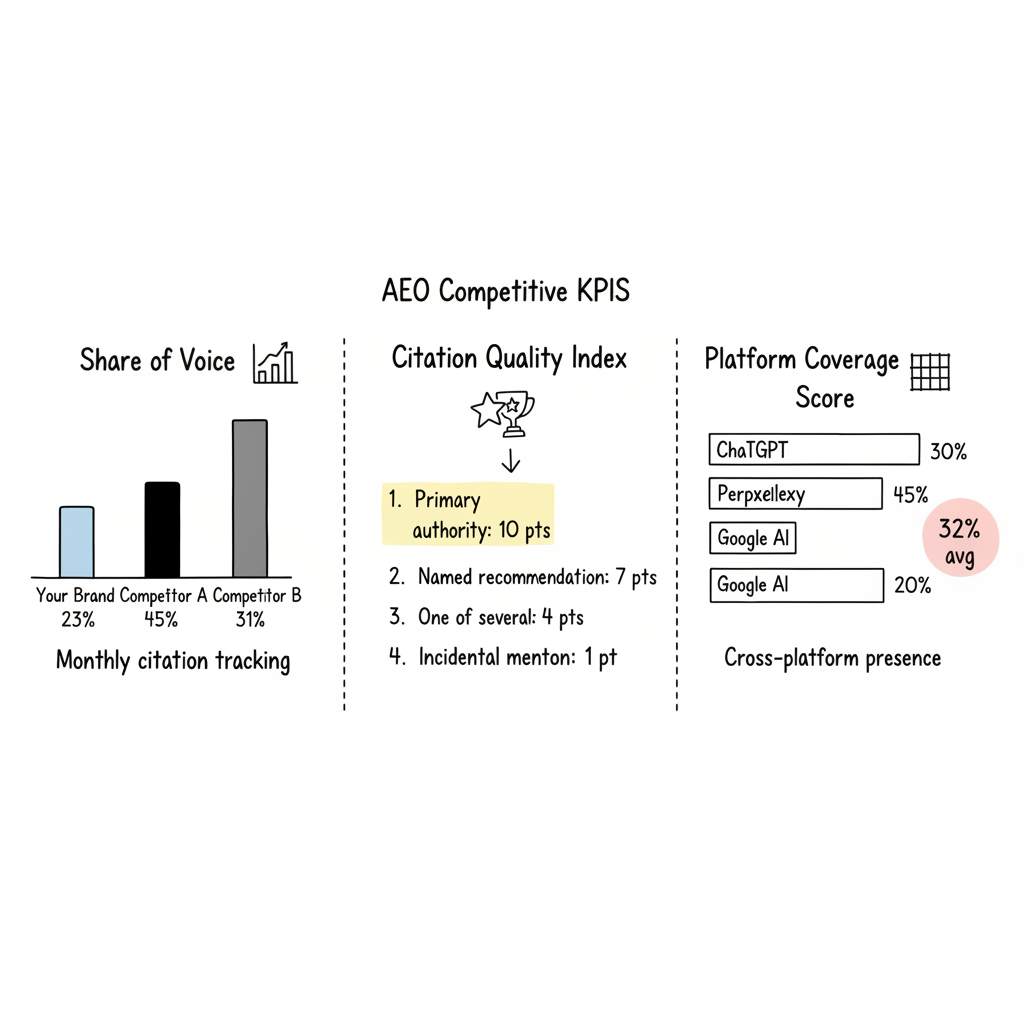
AI brand mention market share: Calculate your brand mentions divided by total competitor mentions across target queries.
Example calculation:
- 100 queries tested monthly
- Your brand cited 23 times
- Competitor A cited 45 times
- Competitor B cited 31 times
- Your share of voice: 23%
Track monthly to measure trajectory. Understanding aeo-metrics-kpis provides additional context for interpreting competitive performance data.
Citation Quality Index
Quality-weighted citation score: Assign point values to citation types, calculate weighted scores.
Example scoring:
- Primary authority citation: 10 points
- Named recommendation: 7 points
- One of several sources: 4 points
- Incidental mention: 1 point
Weighted scores reveal quality differences masked by simple mention counts.
Platform Coverage Score
Cross-platform presence: Measure visibility consistency across AI platforms.
Example metrics:
- ChatGPT citation rate: 30%
- Perplexity citation rate: 45%
- Google AI Overviews: 20%
- Platform coverage score: 32% average
Platform-specific weaknesses reveal optimization opportunities. Research comparing microsoft-copilot-vs-bing-ai citation patterns demonstrates how competitive positioning varies significantly across different AI search platforms.
Competitor Response Strategies
Develop strategic responses based on competitive analysis.
Against Citation Dominators
When competitors hold dominant positions:
Counter-strategies:
- Target adjacent topics where they're weaker
- Build authority in emerging subtopics
- Create content formats they don't provide
- Focus on platforms where they underperform
- Develop differentiated expertise angles
Frontal assaults on established leaders rarely succeed. Find flanking opportunities.
Against Peer Competitors
When competitors have similar citation presence:
Competitive strategies:
- Accelerate content production pace
- Improve content quality and comprehensiveness
- Build more authoritative backlink profiles
- Optimize technical accessibility more aggressively
- Create proprietary data and research
Marginal advantages compound in peer competition situations.
Against Emerging Competitors
When new competitors gain AI visibility:
Defensive strategies:
- Monitor their approach for learnable tactics
- Double down on established topic authority
- Accelerate coverage in areas they're targeting
- Reinforce technical and authority fundamentals
Early response prevents emerging competitors from gaining momentum.
Tools for AEO Competitive Intelligence
Leverage available tools for efficient competitive monitoring.
AEO-Specific Tools
- AI visibility platforms (such as Flink for citation tracking and SE Ranking AEO Tool for visibility monitoring): Track brand mentions across AI platforms automatically
- Citation monitoring tools: Alert when competitors gain or lose citations
- Sentiment analyzers: Measure how AI frames competitor mentions
- Free baseline options: HubSpot AEO Grader provides a quick starting point for initial audits
Adapted SEO Tools
- Rank trackers with AI modules: Extend traditional tracking to AI results
- Content gap analyzers: Identify topics competitors cover that you don't
- Backlink tools: Assess competitor authority signals
Manual Monitoring
Automated tools miss nuance. Supplement with:
- Regular manual queries across ChatGPT, Perplexity, Google AI Overviews, and Microsoft Copilot
- Qualitative citation context analysis
- Competitive content audits
- Industry forum monitoring
Balance automation efficiency with manual depth.
Common Competitive Analysis Mistakes
Avoid these errors undermining competitive intelligence value.
Narrow competitor sets: Including only direct business competitors misses authoritative publishers and educational sources that dominate many AI queries.
Single-platform focus: Competitor positions vary across ChatGPT, Perplexity, Google AI Overviews, and Microsoft Copilot. Analyze all platforms.
Static analysis: One-time competitive audits become outdated quickly. Establish ongoing monitoring cadences.
Ignoring citation context: Counting mentions without assessing quality and context provides misleading signals.
FAQs
What Is AEO Competitor Analysis?
AEO competitor analysis is the process of benchmarking how your content performs against competitors in AI-generated answers. It involves tracking citation share across platforms like ChatGPT, Perplexity, and Google AI Overviews, identifying semantic gaps in topic coverage, and evaluating E-E-A-T signals that influence which sources AI models choose to cite.
How Do I Track Competitor Citations in AI Search?
Start by querying your target keywords in ChatGPT, Perplexity, and Google AI Overviews. Record which competitors are cited, how often, and in what context. Tools like Flink and SE Ranking automate this tracking across multiple AI platforms. Monitor citation velocity—the rate of change over time—to spot emerging competitors and shifting authority signals. For a broader toolkit comparison, see our guide to AI citation tracking tools.
What E-E-A-T Signals Matter Most for AI Citations?
AI models prioritize sources with demonstrated expertise, original research, and consistent cross-platform authority. Key signals include author credentials, first-hand experience data, backlink profiles from authoritative domains, and consensus—agreement across multiple independent sources. Building E-E-A-T for AEO requires publishing proprietary data, earning third-party mentions, and maintaining consistent messaging across all channels.
How Often Should I Run an AEO Competitor Audit?
Run a full AEO competitor audit quarterly to catch shifts in citation patterns and new market entrants. Between audits, monitor citation velocity and share of voice monthly using automated tracking tools. Major algorithm updates or new AI platform launches should trigger an immediate re-audit. Most teams see actionable insights emerge within the first 90-day cycle.
How Often Should I Conduct AEO Competitor Analysis?
Full competitive audits quarterly. Key query monitoring monthly. Emerging competitor alerts continuous. Increase frequency during strategic planning periods or when launching major initiatives.
Should I Analyze All Competitors or Focus on Leaders?
Start with 3-5 top citation leaders in your space. Expand analysis as resources allow. Include one or two emerging competitors showing momentum.
What If Competitors Dominate Across All Target Queries?
Identify micro-topics or specific question types where leaders are weakest. Build authority in these niches first, then expand. Competing broadly against established leaders from a weak position rarely succeeds.