
With 69% of Google searches ending without a click (zero-click searches), optimizing for AI-generated answers is no longer optional. Writing for AI extraction requires fundamentally different approaches than traditional SEO content. When ChatGPT, Perplexity, Gemini, and Bing Copilot select content to cite, they favor specific structural patterns, answer formats, and credibility signals. Content that follows AEO vs GEO vs SEO guidelines gets extracted and cited; content that doesn't gets overlooked regardless of its actual quality.
According to DW Media's 2026 AEO trends analysis, successful AEO content in 2026 requires "quick-answer" architecture—adding 100-word quick answer blocks at the top of posts, structured proof blocks using tables and bulleted lists, and factual integrity that AI-powered search tools can verify.
How AI Models Parse and Select Content
With 69% of Google searches now ending in zero-click results, understanding how AI models select content for citation is critical for any content strategy. Answer engines like ChatGPT, Perplexity, Gemini, Bing Copilot, and DuckDuckGo Instant Answers use natural language processing (NLP) pipelines to decompose web content into extractable passages and evaluate which ones best answer a user's query.
Transformer-based models such as BERT, MUM, and GPT architectures assess semantic relevance by analyzing entity relationships, topical completeness, and passage structure. These models do not read content linearly like a human—they evaluate individual passages independently, scoring each for answer quality. The Google Knowledge Graph further enriches this process by connecting structured entity data to AI-generated answers, which is why structured data for AI search matters so much for AEO.
This is why the inverted pyramid writing approach—placing the most important information first, followed by supporting detail—is a deliberate AEO writing technique, not just a journalism convention. When AI retrieval systems scan a passage, the first sentence carries the most weight for answer selection. Tools like AnswerThePublic can help identify the question-based queries your content should address directly.
The Answer-First Approach
AI systems scan content for direct answers, not narratives that build to conclusions.
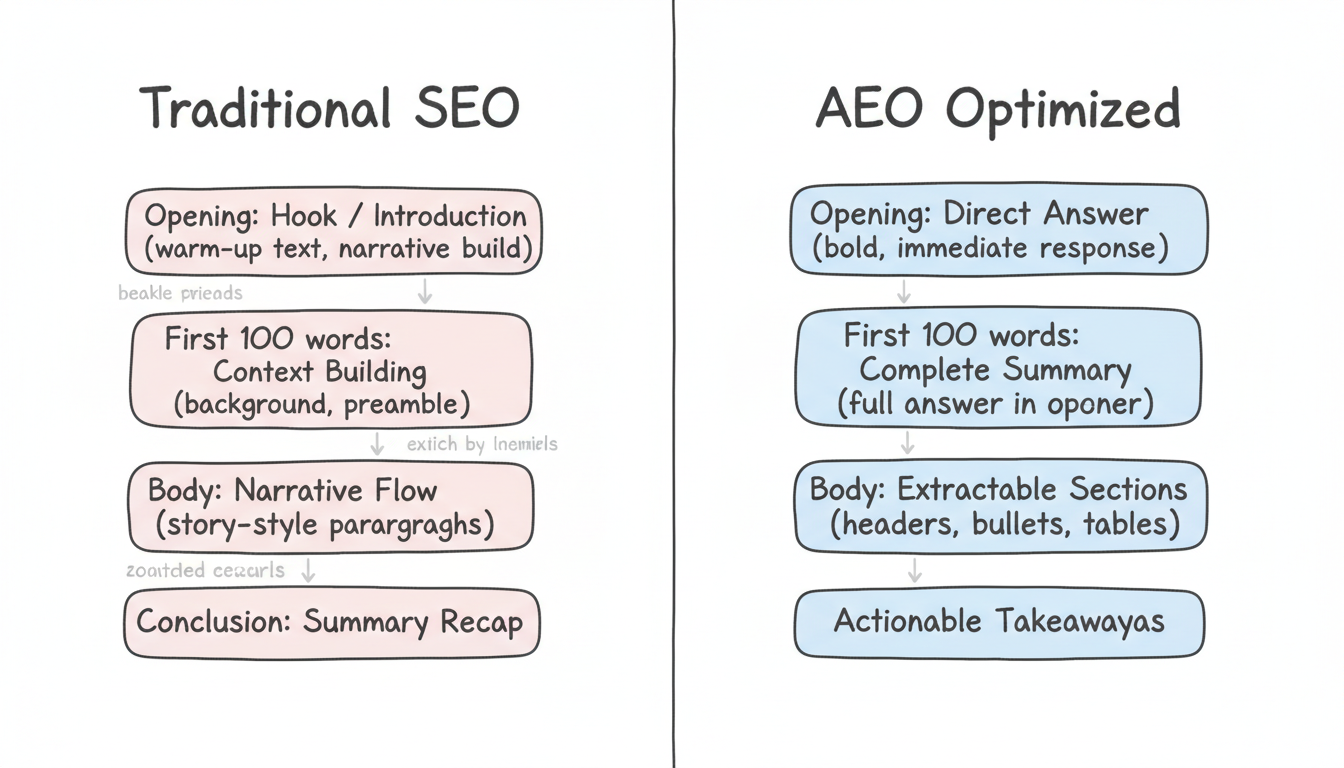
According to SEO Sherpa's AI optimization guide, content for AI citation should open with a direct summary of 2-4 lines that solve the question immediately—no intros, no storytelling, no SEO fluff. This "answer-first" pattern mirrors how AI systems extract information.
Answer-first structure:
Element | Traditional SEO | AEO Optimized |
Opening | Hook/introduction | Direct answer |
First 100 words | Context building | Complete summary |
Body structure | Narrative flow | Extractable sections |
Conclusions | Summary recap | Actionable takeaways |
Structural Patterns AI Systems Prefer
AI extraction favors specific content formats over others.
According to Wellows' schema best practices guide, AI-readable formats include bullet points, numbered steps, comparison tables, pros and cons lists, and FAQ sections with schema markup. These structures enable AI systems to extract discrete facts without parsing complex sentences, particularly when optimizing for SearchGPT content format list vs narrative approaches.
High-extraction content formats:
AI-Preferred Content Structures
├── Definition Boxes
│   ├── "What is X?" answered in 1-2 sentences
│   ├── Followed by expanded explanation
│   └── Example: Standalone definition paragraph
│
├── Step-by-Step Lists
│   ├── Numbered for processes
│   ├── Bulleted for non-sequential items
│   └── Clear action verbs starting each item
│
├── Comparison Tables
│   ├── Clear column headers
│   ├── Consistent data formatting
│   └── Scannable at-a-glance information
│
└── FAQ Sections
    ├── Question as exact H3 heading
    ├── Answer immediately following
    └── Schema markup applied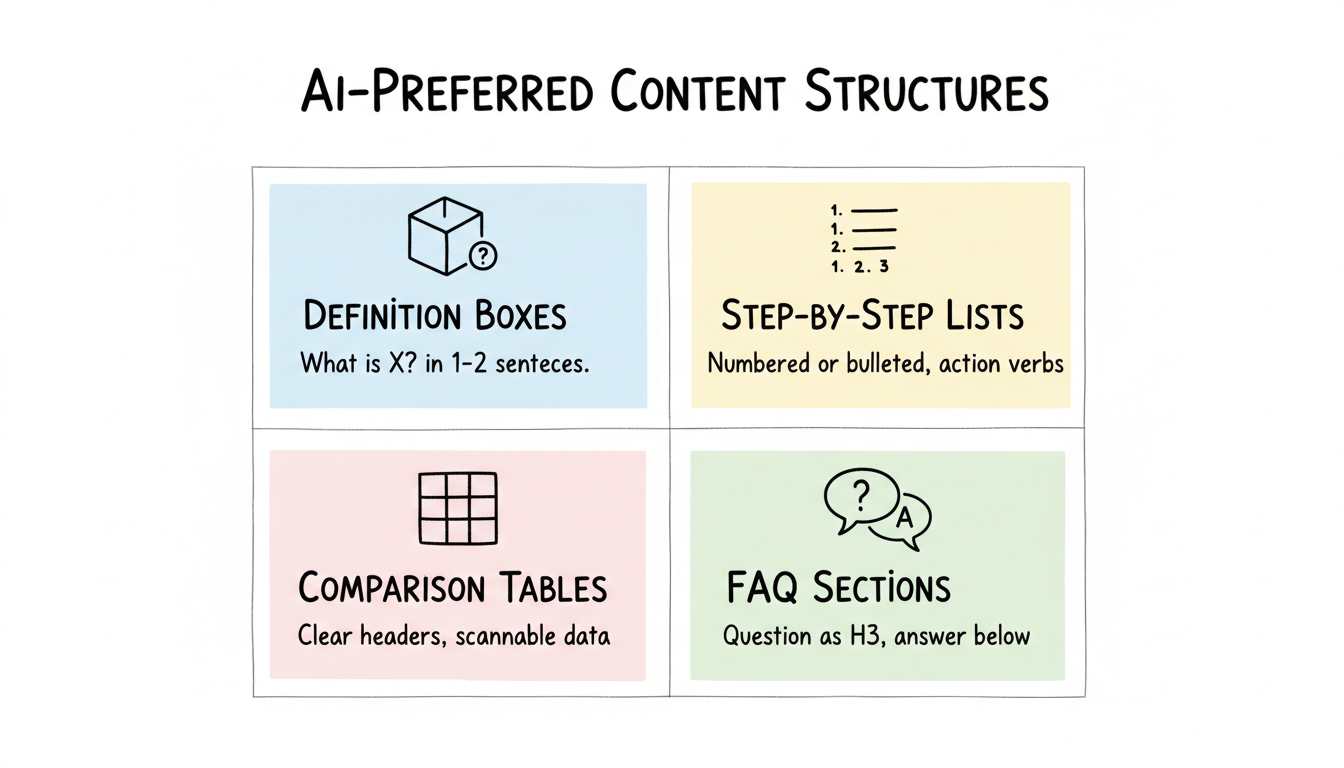
Content Chunking and Featured Snippet Formatting
Content chunking means breaking your content into self-contained, semantically complete passages of 150 to 300 words that AI retrieval systems can extract independently. Rather than writing long-form sections that flow into each other, each chunk should address a single subtopic with a clear heading, a direct answer in the first sentence, and supporting detail that stands alone.
Featured snippets come in three primary formats, and structuring content to match each increases extraction likelihood:
- Paragraph snippets: A concise 40-60 word answer directly below a question-format heading. Lead with the definition or answer, then add one supporting sentence.
- List snippets: Numbered or bulleted lists with 4-8 items. Use consistent formatting and start each item with an action verb or key term.
- Table snippets: Structured comparison data with clear column headers. Keep tables to 3-5 columns and 4-8 rows for optimal extraction.
Adding a TL;DR or quick answer box at the top of each article—formatted as a concise 2-3 sentence direct answer—significantly increases the chance of AI citation. Mining People Also Ask (PAA) queries is also an effective content planning technique; structure your H2 and H3 headings as question-answer pairs that mirror PAA queries your audience is searching. For practical illustrations of these techniques in action, see these AEO optimization examples.
Voice Search and Conversational Query Optimization
Voice search queries through smart speakers and voice assistants are longer, more conversational, and almost always question-based compared to typed searches. AEO content must account for this query format because answer engines like ChatGPT, Perplexity, Gemini, Bing Copilot, and DuckDuckGo increasingly serve voice-driven responses.
Optimizing for voice search is an extension of existing AEO practices with a few key adjustments:
- Write in natural, conversational language with complete sentences rather than keyword fragments
- Structure content around long-tail question queries starting with who, what, where, when, why, and how
- Keep direct answer passages concise—ideally under 50 words for the primary response
- Use shorter sentences that read naturally when spoken aloud
Implement Speakable schema markup to explicitly identify which content passages are most suitable for voice and audio responses. Mark up your most concise, direct-answer paragraphs with Speakable cssSelector properties so AI systems know which sections to prioritize for voice delivery.
Writing Extractable Paragraphs
Individual paragraphs need structure that enables snippet extraction.
According to Prodigmar's AEO trends report, conversational search optimization means anticipating the second, third, and fourth follow-up questions users ask. Each paragraph should function as a potential standalone answer.
Extractable paragraph guidelines:
- Lead with the key fact or answer in the first sentence
- Support with one specific data point or example
- Keep paragraphs to 3-4 sentences maximum
- End with a clear conclusion or transition
- Avoid pronouns that require context from previous paragraphs
Credibility Signals for AI Citation
AI systems evaluate source credibility before selecting content to cite.
According to ALM Corp's content strategy guide, E-E-A-T signals matter for AI citation. Author credentials, original research citations, and first-hand experience markers are weighted by AI models when selecting authoritative sources. Content should include author bylines with credentials, outbound citations to authoritative sources, publication and update dates, and organizational expertise indicators.
Credibility elements to include:
Signal | Implementation | AI Benefit |
Author attribution | Name + credentials in byline | Establishes expertise |
Source citations | Hyperlinked references | Verifiable claims |
Publication date | Visible timestamp | Freshness indicator |
Update frequency | "Last updated" notation | Current relevance |
Organization context | About/expertise section | Authority signal |
Factual Integrity Requirements
AI scrapers increasingly verify factual claims before citation.
According to DW Media, factual integrity scoring means AI systems favor original research and verified case studies over generic content. Claims need supporting data, statistics require sources, and opinions should be clearly distinguished from facts. Understanding AEO vs GEO vs SEO differences helps clarify these verification standards.
Factual integrity checklist:
- Cite sources for all statistics and data points
- Include specific numbers rather than vague qualifiers
- Attribute quotes and expert opinions
- Distinguish opinion from fact with clear language
- Update outdated statistics with current data
Schema Markup for Content Recognition
Structured data helps AI systems categorize and extract content appropriately. Schema markup also feeds directly into the Google Knowledge Graph, reinforcing entity recognition and increasing the likelihood that AI models associate your content with authoritative topic coverage.
According to Wellows' AI SEO analysis, Speakable Schema helps AI determine which content sections are most suitable for voice and audio responses. Author Schema establishes who should be quoted, while FAQ Schema explicitly marks question-answer pairs for extraction. For businesses implementing these strategies, working with a GEO services agency can accelerate schema deployment.
Priority schema types for content:
Schema Implementation for AEO Content
├── Article Schema
│   ├── headline, author, datePublished
│   ├── dateModified for updates
│   └── articleBody summary
│
├── FAQ Schema
│   ├── mainEntity array
│   ├── Question + acceptedAnswer pairs
│   └── Applied to FAQ sections
│
├── HowTo Schema
│   ├── step array with descriptions
│   ├── totalTime when applicable
│   └── Applied to process content
│
└── Speakable Schema
    ├── cssSelector for voice-ready sections
    └── Applied to key answer paragraphs
AI systems prefer recently updated sources when selecting citations.
According to NoGood's future of search analysis, Perplexity and other AI platforms check publication dates and update frequency when evaluating source relevance. Content that hasn't been updated may be deprioritized even if the information remains accurate.
Freshness maintenance practices:
- Add "Last updated" timestamps visible on page
- Review and refresh statistics quarterly
- Update examples with current year references
- Remove or update dated references
- Expand content sections based on emerging topics
Measuring AEO Content Performance
Knowing whether your AEO content guidelines are working requires tracking performance across three channels. First, monitor AI referral traffic in Google Analytics 4 by filtering sessions from perplexity.ai, chat.openai.com, copilot.microsoft.com, and other AI platform domains. These referral sources indicate when answer engines are driving users to your content after citation.
Second, use AI citation tracking tools to measure how often your content appears in LLM-generated responses. Citation frequency is a direct measure of AEO success that traditional SEO metrics do not capture.
Third, track featured snippet and People Also Ask appearances in traditional search results, as these formats overlap heavily with AI answer selection criteria. A/B test different content structures—paragraph vs. list vs. table formats—to determine which format gets extracted most frequently for your target queries.
Internal linking strategy also plays a measurable role in AEO performance. Building topical clusters through strategic internal links reinforces the authority signals that AI models use when selecting sources. Review your AEO tools and software stack regularly to ensure you have visibility into these metrics.
Common AEO Content Mistakes
Avoid patterns that reduce AI extraction potential.
Mistakes that limit AI citation:
Mistake | Problem | Solution |
Buried answers | Key info in paragraph 5+ | Lead with answers |
Vague language | "Many experts say" | Cite specific sources |
Complex sentences | Hard to parse | Short, direct statements |
Missing structure | Wall of text | Headers, lists, tables |
No dates | Freshness unknown | Add timestamps |
Frequently Asked Questions
What Is Content Chunking for AEO?
Content chunking for AEO means breaking your content into self-contained passages of 150 to 300 words, each addressing a single subtopic. AI retrieval systems extract content in chunks rather than reading entire pages. Each chunk should have a clear heading, a direct answer in the first sentence, and supporting detail that stands alone without requiring context from surrounding sections. This structure increases the likelihood that answer engines like ChatGPT and Perplexity will select and cite your content.
How Do You Optimize Content for Voice Search in AEO?
Voice search optimization for AEO requires writing in a conversational, question-and-answer format that mirrors how people speak to smart speakers and voice assistants. Use natural language with complete sentences rather than keyword fragments. Structure content around long-tail question queries starting with who, what, where, when, why, and how. Implement Speakable schema to mark up the most voice-ready passages. Keep answer passages concise, ideally under 50 words for the direct response.
How Does NLP Affect AEO Content Strategy?
Natural language processing models like BERT and MUM analyze your content for semantic relevance, entity relationships, and answer completeness. For AEO, this means writing clearly and directly rather than stuffing keywords. AI models evaluate whether your content fully answers a query, whether entities are properly contextualized, and whether the passage structure makes extraction straightforward. Focus on topical depth and logical flow rather than keyword density.
How Do You Measure AEO Content Success?
Track AEO content performance through three channels. First, monitor AI referral traffic in Google Analytics 4 by filtering sessions from perplexity.ai, chat.openai.com, and other AI platform domains. Second, use AI citation tracking tools to measure how often your content appears in LLM-generated responses. Third, track featured snippet and People Also Ask appearances in traditional search results, as these formats overlap heavily with AI answer selection criteria.
Key Takeaways
Writing for AI extraction requires specific structural and credibility approaches:
- Answer first always - Open with direct 2-4 line summaries that solve questions immediately
- Structure for extraction - Use tables, lists, and FAQs that AI can easily parse
- Build credibility signals - Author attribution, source citations, and dates establish authority
- Maintain factual integrity - Cite sources, use specific data, distinguish fact from opinion
- Keep content fresh - Update regularly and display modification dates prominently
According to SEO Sherpa, the shift to AI-first content means every paragraph should function as a potential standalone answer—complete, credible, and structured for extraction.