
One of the most compelling arguments for AEO investment lies in conversion data. Traffic from AI search citations—across platforms like ChatGPT, Perplexity, Google AI Overviews, Gemini, and Claude—consistently converts at higher rates than traditional organic search traffic. With 58-65% of Google searches now ending without a click, these AI-referred visits represent the highest-quality traffic available. Understanding why this happens—and how to maximize these conversions—helps organizations build stronger business cases for answer engine optimization.
The Zero-Click Context: Why AEO Conversion Rate Matters Now
The search landscape has fundamentally shifted. According to Semrush and SparkToro data, 58-65% of Google searches now end without a click—a phenomenon known as zero-click searches. Google AI Overviews, ChatGPT, Perplexity, Gemini, and Claude are reshaping how users find and consume information, pulling answers directly into the search experience itself.
This shift creates a paradox that savvy marketers are exploiting: while total click volume declines, the clicks that do happen carry significantly more value. When a user reads an AI-generated answer citing multiple sources and still chooses to click through to your site, they arrive with pre-qualified intent. The AI engine has already done the filtering—educating the user, narrowing their options, and validating your content as authoritative.
This is why AEO conversion rates consistently outperform traditional organic search. The 6.8% average conversion rate from AI citations isn't an anomaly—it's the natural result of a traffic source that pre-qualifies every visitor. Users who click through from Google AI Overviews and their SEO impact context or a ChatGPT recommendation have already demonstrated deeper intent than a typical SERP browser.
For marketers, the implication is clear: optimizing for AI citations isn't just about visibility—it's about capturing the shrinking pool of high-intent clicks before competitors do. The brands that earn AI citations today are building conversion advantages that compound as zero-click behavior accelerates.
The AEO Conversion Advantage
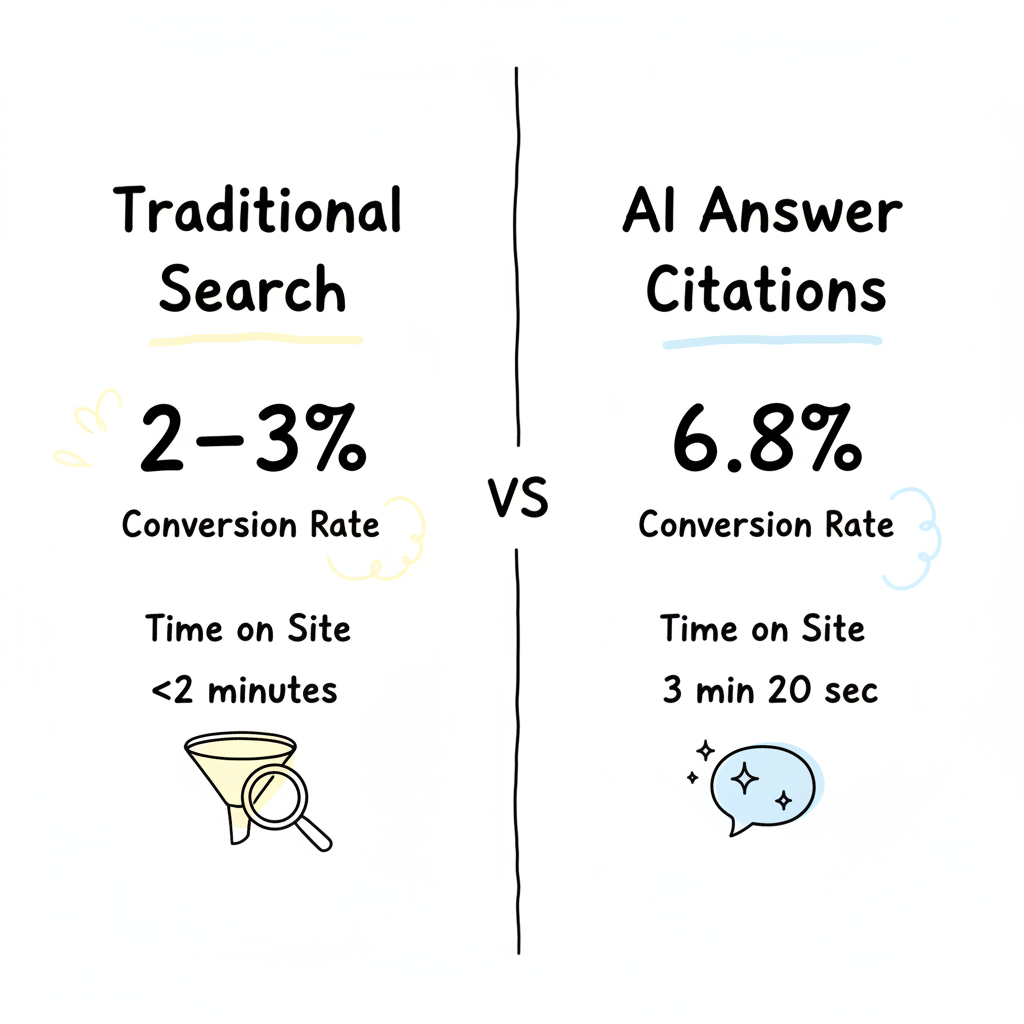
Early data from 2026 reveals significant conversion differences between AI-referred traffic and traditional search visitors.
Reported conversion metrics:
- AI answer citations: 6.8% average conversion rate
- Average time on site from AI referrals: 3 minutes 20 seconds
- Traditional organic search: typically 2-3% conversion rates
- Traditional organic average time on site: often under 2 minutes
These numbers represent early industry data and vary by sector, but the pattern holds across most categories—AI-referred visitors engage more deeply and convert more frequently.
Why AI Traffic Converts Better
Several factors explain the conversion rate differential between AI search and traditional organic traffic.
Pre-Qualified Intent
Users asking AI assistants (ChatGPT, Perplexity, Google AI Overviews, Gemini, Claude) questions have already demonstrated specific intent. Unlike broad keyword searches that capture users at various awareness stages, AI queries typically indicate clear information needs or purchase consideration.
Intent qualification examples:
- "What's the best CRM for small businesses?" indicates active evaluation
- "Is [product] worth buying?" signals near-purchase consideration
- "How do I solve [specific problem]?" reveals qualified need
AI systems filter and respond to these queries, meaning your cited content reaches users with demonstrated, specific intent rather than casual browsers.
Trust Transfer Effect
When AI platforms (ChatGPT, Perplexity, Google AI Overviews) cite your content, they transfer credibility to your brand. Users encountering your business as an AI-recommended source perceive you differently than finding you in a list of search results. This mechanism directly reflects E-E-A-T (Experience, Expertise, Authoritativeness, Trustworthiness) principles—when ChatGPT or Perplexity cites your content, it signals E-E-A-T validation, meaning the AI has evaluated your page against hundreds of sources and deemed it authoritative enough to quote.
Trust transfer dynamics:
- AI recommendation implies vetting and authority
- Citation context frames your brand as an expert source
- Users arrive predisposed to trust your information
- Reduced skepticism compared to paid advertising or generic results
This trust transfer reduces friction throughout the conversion funnel. Visitors who already trust you spend less time evaluating credibility and move faster toward conversion actions. Consensus building—aligning claims across multiple pages on your site so AI engines find consistent, reinforcing evidence—further strengthens this effect. When your site presents unified, well-supported positions across AI search ranking factors, AI platforms are more likely to cite you repeatedly.
Answer-First Engagement
AI citations often occur within comprehensive answer contexts. Users have already received valuable information before visiting your site, meaning they arrive with baseline knowledge rather than starting from zero.
Engagement implications:
- Visitors understand their problem and potential solutions
- Less educational content consumption required
- Faster progression to evaluation and decision stages
- Higher likelihood of conversion-focused page engagement
Pre-educated visitors convert more efficiently because the AI interaction has already handled initial awareness and education stages.
Reduced Competition at Point of Contact
Traditional search results present 10+ competing options simultaneously. AI citations typically mention fewer sources within answer contexts, reducing direct competition when users click through.
Competitive dynamics:
- AI answers cite 2-5 sources on average, not 10+
- Users often click the first cited source
- Less comparison shopping behavior
- Higher commitment to evaluating cited sources thoroughly
With fewer alternatives competing for immediate attention, cited sources receive more focused consideration from visitors.
Maximizing AEO Conversion Rates
Capitalizing on higher-converting AI traffic requires optimizing the post-click experience. Organizations should follow AEO content guidelines to ensure their pages deliver on the promise that earned the citation. A key principle here is information gain—original data, proprietary benchmarks, and first-party research are prioritized by AI engines because they provide net-new information the model hasn't seen elsewhere. The 6.8% conversion rate benchmark itself is an example of information gain that competitors frequently cite, creating a self-reinforcing citation loop.
Landing Page Alignment
Ensure pages receiving AI traffic align with the context that generated citations.
Alignment strategies:
- Match page content to queries earning citations
- Provide clear next steps for visitors arriving with specific intent
- Remove friction between citation context and page content
- Include conversion opportunities appropriate to visitor intent
If AI cites your page for "best project management software for remote teams," visitors expect content addressing that specific topic with clear paths to evaluation or purchase.
Intent-Matched Conversion Paths
Different AI queries indicate different funnel stages. Design conversion paths matching the intent that generated visits.
Intent-to-conversion mapping:
Informational queries: Offer deeper content, newsletter signups, or resource downloads before purchase conversations.
Comparison queries: Provide comparison tools, free trials, or consultation requests—visitors are evaluating options.
Transactional queries: Make purchase or signup processes immediately accessible—these visitors are ready to act.
Mismatched conversion paths waste high-quality traffic. Don't push hard sales on informational visitors or bury purchase options from ready buyers.
Trust Reinforcement
AI referrals arrive with elevated trust—reinforce rather than squander it.
Trust reinforcement tactics:
- Display credibility indicators prominently (reviews, certifications, client logos)
- Reference the expertise that earned the AI citation
- Avoid aggressive tactics that conflict with trusted-source positioning
- Maintain consistency between AI-cited information and page content
Visitors trusting you based on AI recommendations will quickly distrust if your site contradicts that positioning with pushy or inconsistent experiences.
Speed and Experience Optimization
High-intent visitors won't tolerate slow or frustrating experiences. Technical performance matters more when conversion probability is already elevated. Consider implementing AI overview website optimization techniques to maximize engagement.
Experience priorities:
- Fast page load times (under 3 seconds)
- Mobile optimization (many AI queries come from mobile devices, and voice search optimization is increasingly important as voice-initiated AI queries grow)
- Clear navigation and information architecture
- Minimal distractions from primary conversion paths
Every friction point represents lost conversions from otherwise highly-qualified visitors.
Technical Foundations: Schema Markup and Structured Data for AEO Conversions
Beyond content quality, the technical structure of your pages plays a critical role in earning AI citations and driving conversions. Structured data for AI search provides machine-readable signals that help AI engines extract, interpret, and cite your content accurately.
How Structured Data Earns AI Citations
Schema markup—including FAQPage, HowTo, Article, and Organization types—gives AI platforms structured context about your content. When ChatGPT, Perplexity, or Google AI Overviews process your page, structured data provides clear signals about what claims you're making, who is making them, and how authoritative those claims are.
Pages with comprehensive schema markup earn citations more frequently because AI engines can extract structured claims with higher confidence. This translates directly to more pre-qualified traffic and higher conversion rates.
Semantic Structure and Semantic Triples
AI engines parse content by identifying subject-predicate-object patterns, known as semantic triples. Writing content in clear claim-evidence pairs makes it easier for AI platforms to extract and cite specific statements.
Effective semantic structure examples:
- "AEO conversion rates [subject] average [predicate] 6.8% across industries [object]"
- "B2B software companies [subject] see [predicate] 7-9% AEO conversion rates [object]"
When your content follows these clear patterns, AI engines can confidently attribute specific claims to your page, increasing citation frequency and the quality of traffic referred back to your site.
FAQ Schema for Conversion-Oriented Questions
FAQ schema targets People Also Ask queries like "How do you measure AEO?" and "Is a 2.5% conversion rate good?" These queries represent users actively seeking conversion-related information—exactly the audience most likely to convert when they reach your site.
Implementation checklist for FAQ schema:
- Use JSON-LD format (preferred by Google and AI platforms)
- Match FAQ content exactly between visible page content and schema markup
- Target questions with commercial or evaluative intent
- Keep answers concise (40-60 words) in schema while expanding on the page
- Include relevant entities (platform names, metrics, industry terms) in both questions and answers
Measuring AEO Conversion Performance
Track AI traffic conversions separately from general organic traffic when possible. Organizations should establish AI search KPI goal setting frameworks to measure success accurately.
Attribution Approaches
Direct tracking methods in GA4 (Google Analytics 4):
- UTM parameters where AI platforms pass referrer data
- Referrer analysis for identifiable AI traffic sources (look for
chat.openai.com,perplexity.ai,gemini.google.comin your referral reports) - Landing page segmentation for pages primarily receiving AI citations
Indirect measurement:
- Conversion rate changes correlating with visibility improvements
- Quality metric changes (time on site, pages per session, bounce rate)
- Assisted conversions analysis in GA4 showing AI influence on purchase paths—this is critical because AI touchpoints often influence conversions even when they aren't the last click
Attribution remains imperfect, but directional measurement reveals whether AEO investments produce conversion benefits.
Measuring AEO Conversions: GA4 Setup and Citation Tracking
Effective AEO measurement requires dedicated analytics configuration. Generic analytics setups miss AI-referred traffic entirely because they lump it into "direct" or "referral" buckets without differentiation. A proper AEO analytics setup guide is essential for accurate measurement.
GA4 Configuration for AI Traffic
Set up GA4 to identify and segment AI-referred traffic by creating custom channel groupings:
- Create a new channel group called "AI Search" in GA4 Admin > Data Display > Channel Groups
- Add source/medium rules for ChatGPT (
chat.openai.com), Perplexity (perplexity.ai), Google AI Overviews (identified via specific referral parameters), and Gemini (gemini.google.com) - Build a dedicated exploration report comparing AI Search vs. Organic Search conversion rates
- Set up custom UTM parameters (
utm_source=chatgpt,utm_medium=ai-citation) for content specifically optimized for AI platforms
This segmentation allows you to isolate AEO conversion performance from general organic traffic and track improvements over time.
Citation Frequency Tracking
Beyond traffic analytics, track how often AI engines cite your content:
- Manual spot-checks: Regularly query ChatGPT, Perplexity AI optimization strategy targets, and Google AI Overviews with your target keywords to verify citations
- Third-party citation trackers: Emerging tools monitor AI citation frequency across platforms
- API monitoring: For higher volume, use platform APIs where available to programmatically track citation appearances
- Citation-to-conversion correlation: Map citation frequency trends against conversion data to identify which cited pages drive the most value
Assisted Conversions and Multi-Channel Attribution
AI touchpoints frequently influence conversions without being the last click. In GA4, compare attribution models to understand AI's true impact:
- Data-driven attribution often reveals AI touchpoints earlier in the conversion path
- Compare last-click vs. data-driven models to quantify AI-assisted conversions
- Look for patterns where users first encounter your brand via AI citation, then return through branded search to convert
- Track the assist-to-conversion ratio for AI channels—a high ratio indicates AI is driving awareness that other channels close
Benchmarking Considerations
Compare AEO conversion rates against appropriate baselines:
- Overall organic search conversion rate
- Branded search conversion rate (often higher, similar trust dynamics)
- Paid search conversion rate
- Industry benchmarks where available
Context matters—a 6% AEO conversion rate means different things depending on your typical organic conversion rate.
Industry Variations
Conversion advantages vary by industry and query type.
Higher conversion differential sectors:
- Professional services (high consideration, trust-dependent purchases)
- B2B software and technology
- Financial services and products
- Healthcare and wellness
Lower differential sectors:
- Commodity e-commerce (price-driven decisions)
- Entertainment and media (impulse-driven)
- Low-consideration consumer goods
Industries where trust and expertise influence purchase decisions see larger AEO conversion premiums than commodity categories.
AEO vs SEO vs GEO: How Conversion Rates Compare
Understanding how AEO stacks up against traditional SEO and the emerging discipline of GEO (generative engine optimization) provides critical context for resource allocation. For a deeper exploration, see our AEO vs GEO vs SEO comparison.
SEO (Search Engine Optimization) targets traditional search engine rankings. Average organic conversion rates sit at 2-3% across most industries. SEO captures high traffic volume but includes many low-intent browsers.
AEO (Answer Engine Optimization) targets AI platforms like ChatGPT, Perplexity, and Google AI Overviews to earn direct citations. Conversion rates average 6.8%—roughly 2-3x traditional organic—because AI pre-qualifies visitor intent before the click.
GEO (Generative Engine Optimization) focuses specifically on visibility within generative AI outputs. GEO and AEO overlap significantly, but GEO emphasizes appearing in AI-generated responses while AEO emphasizes converting the traffic those citations drive.
Conversion rate benchmarks by channel:
- Traditional organic SEO: 2-3% average
- AEO (AI citation traffic): 6.8% average
- GEO (generative AI referrals): 5-7% estimated (emerging data)
- Paid search: 3-5% average
- Branded organic: 5-8% average
The most effective strategy combines all three approaches. Topic clusters and pillar pages serve as the content architecture bridging SEO, AEO, and GEO—creating comprehensive coverage that ranks in traditional search, earns AI citations, and appears in generative outputs. Each channel reinforces the others: strong SEO builds the domain authority that AI engines trust, AEO citation signals improve traditional rankings, and GEO visibility drives branded search that converts at premium rates.
Building the ROI Case
Use conversion data to justify AEO investment. Tools like the AEO ROI calculator can help quantify the financial impact of answer engine optimization.
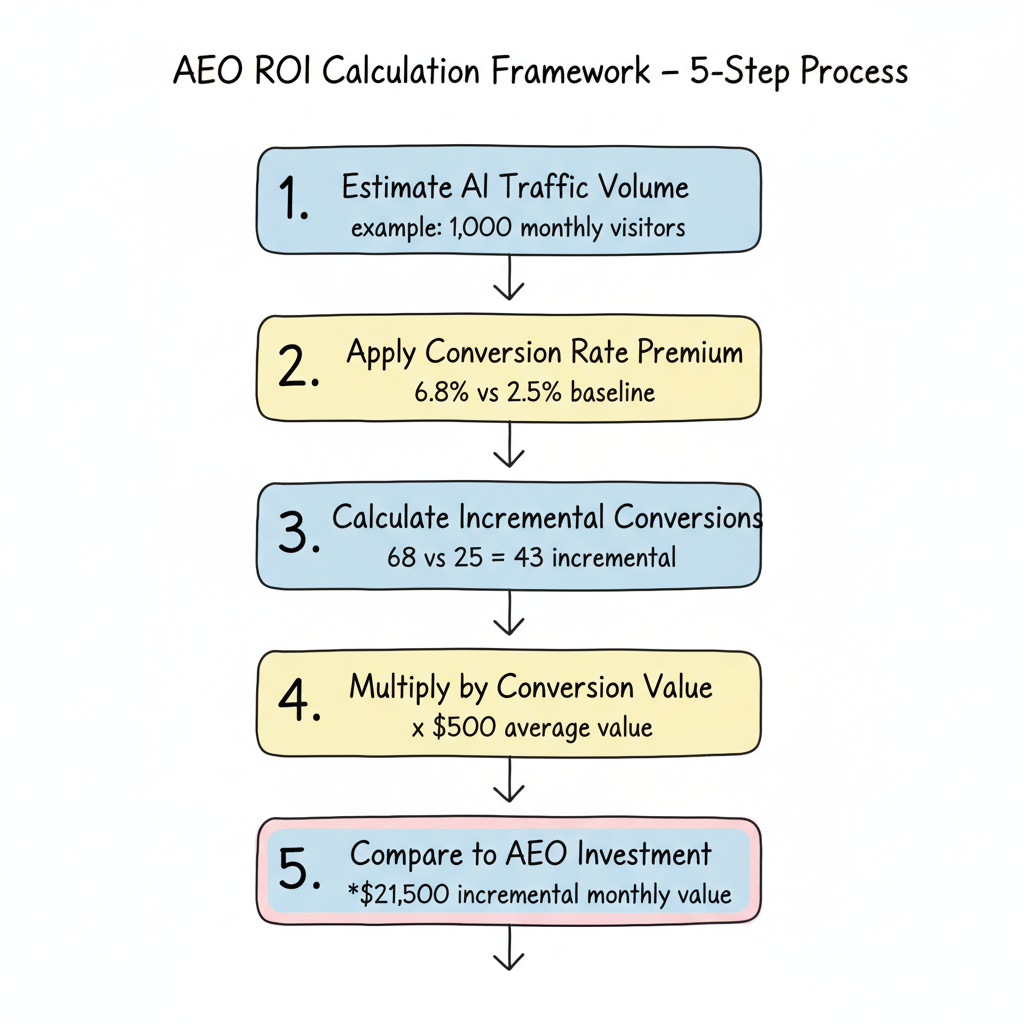
ROI calculation framework:
- Estimate AI traffic volume (current or projected)
- Apply conversion rate premium versus baseline
- Calculate incremental conversions from AI traffic
- Multiply by average conversion value
- Compare to AEO investment cost
Even modest AI traffic volumes produce meaningful ROI when conversion rates significantly exceed alternatives.
Example calculation:
- 1,000 monthly AI-referred visitors
- 6.8% conversion rate (vs. 2.5% baseline)
- 68 conversions vs. 25 baseline = 43 incremental conversions
- $500 average conversion value = $21,500 incremental monthly value
These calculations help executives understand AEO as a business investment rather than abstract marketing activity.
Frequently Asked Questions About AEO Conversion Rates
How Do You Measure AEO Conversion Rate?
Track AI-referred traffic in GA4 by creating a custom channel group for sources like ChatGPT (chat.openai.com), Perplexity (perplexity.ai), and Google AI Overviews. Compare conversion rates for this segment against your organic baseline. Use UTM parameters on content specifically optimized for AI citations to isolate AEO performance from general organic traffic.
What Is a Good AEO Conversion Rate by Industry?
AEO conversion rates vary significantly by sector. B2B software averages 7-9%, professional services 8-12%, financial services 5-7%, healthcare 4-6%, and e-commerce 3-5%. These outperform typical organic conversion rates by 2-3x because AI-referred visitors arrive with pre-qualified intent—the AI engine has already validated your content as the answer.
What Is the Difference Between AEO, SEO, and GEO?
SEO optimizes for traditional search engine rankings. AEO (answer engine optimization) targets AI platforms like ChatGPT, Perplexity, and Google AI Overviews to earn direct citations. GEO (generative engine optimization) focuses specifically on generative AI outputs. AEO and GEO overlap significantly, but AEO emphasizes conversion from cited traffic while GEO focuses on visibility in AI-generated responses.
Does Schema Markup Improve AEO Conversion Rates?
Yes. Structured data markup—especially FAQPage, HowTo, and Article schema—helps AI engines parse and cite your content more accurately. Pages with comprehensive schema markup earn citations more frequently because AI platforms can extract structured claims with higher confidence. This drives more pre-qualified traffic, which converts at rates 2-3x above unstructured pages.
FAQs
Are AEO Conversion Rates Sustainable as AI Traffic Grows?
Early adopters benefit from novelty effects that may moderate over time. However, fundamental factors driving higher conversions—pre-qualified intent, trust transfer, reduced competition—should persist even as AI search matures.
How Do I Track Conversions from AI Traffic Specifically?
Most AI platforms don't pass clean referrer data. Use landing page segmentation, correlational analysis, and available referrer data where platforms do identify AI sources. Perfect attribution isn't possible, but directional measurement guides optimization.
Should I Optimize for Conversions or Citations?
Both matter. Citations drive traffic; conversion optimization extracts value from that traffic. Neglecting either limits AEO program effectiveness.