
AI shopping assistants have fundamentally changed how consumers discover and evaluate products. When users ask ChatGPT for product recommendations or Google AI Overviews for buying advice, they receive curated suggestions—not a list of ten blue links to click through. The scale of this shift is staggering: Adobe reports a 4,700% year-over-year surge in AI-driven traffic to US e-commerce sites in 2025, and 41% of consumers now trust AI product recommendations over paid search ads (Forbes).
For e-commerce brands, this shift demands specific optimization beyond general AI search optimization tactics. Product visibility in AI shopping search requires structured data, optimized product content, and measurable attribution systems that most e-commerce sites haven't implemented. It also requires understanding the distinction between AEO and GEO (Generative Engine Optimization): AEO targets all answer-capable platforms including voice and featured snippets, while GEO specifically targets generative AI systems. A combined AEO and GEO strategy is now standard for e-commerce brands seeking full coverage across both traditional answer boxes and newer AI shopping experiences. For dedicated tools, explore GEO optimization tools that complement your AEO efforts.
This guide provides the specific AEO tactics e-commerce brands need to appear when AI assistants answer shopping queries.
The AI Shopping Search Revolution
How Consumers Now Shop with AI
AI shopping behavior differs fundamentally from traditional search. With ChatGPT now reaching 800 million weekly active users and shopping as a top use case, the shift is accelerating rapidly. Meanwhile, 69% of Google searches end without a click (SparkToro), making AI answer visibility critical for e-commerce brands that can no longer rely on traditional click-through traffic.
Traditional e-commerce search:
- User searches "best running shoes for flat feet"
- Reviews 10+ results, clicks through multiple sites
- Compares products across tabs
- Returns to search for more research
- Eventually converts (maybe)
AI shopping search:
- User asks "What running shoes should I buy for flat feet under $150?"
- AI provides 3-5 specific recommendations with reasoning
- User clicks one recommended product
- Conversion (often immediately)
The compression of the shopping journey from hours to minutes changes everything about e-commerce optimization.
How RAG and Query Fan-Out Drive AI Product Recommendations
Understanding the mechanics behind AI product recommendations helps explain why specific optimization tactics work. Retrieval Augmented Generation (RAG) is the core architecture powering AI shopping assistants. Rather than relying solely on training data, RAG-enabled systems fetch live product data from indexed sources at query time, ensuring recommendations reflect current pricing, availability, and reviews.
When a user asks something like "best running shoes under $150 for flat feet," the AI doesn't process this as a single lookup. Instead, it uses query fan-out to decompose the prompt into multiple sub-queries: price comparison across retailers, review aggregation for arch support mentions, feature extraction for cushioning specs, and availability checks. Each sub-query retrieves relevant passages from different product pages.
The critical implication for e-commerce: AI systems perform passage-level extraction, pulling specific sections from product pages rather than evaluating whole pages. A concise, self-contained product description that addresses price, use case, and key features in a single paragraph is more likely to be retrieved than a lengthy marketing narrative. Each section of your product page should be independently valuable because AI may extract any single passage as a citation source.
ChatGPT Shopping and Product Recommendations
ChatGPT's shopping capabilities have expanded significantly. Users now ask directly:
- "What's the best vacuum cleaner for pet hair?"
- "Compare the iPhone 15 Pro and Samsung S24 Ultra"
- "What laptop should I buy for video editing under $1500?"
ChatGPT responds with specific product recommendations, often with pricing, where to buy, and key differentiators. Products that appear in these recommendations capture high-intent buyers at the decision moment. Understanding how to rank on ChatGPT has become essential for e-commerce visibility.
Google AI Overviews for Product Queries
Google AI Overviews now appear for approximately 47% of product-related queries, according to industry tracking data. These overviews synthesize buying advice from multiple sources, often recommending specific products or directing users to particular retailers. Implementing Google AI Overviews optimization strategies ensures your products appear in these high-visibility positions.
Product query types triggering AI Overviews:
- Best [product category] for [use case]
- [Product A] vs [Product B]
- Is [product] worth buying?
- What to look for when buying [product]
- [Product category] buying guide
E-commerce sites that appear in these AI Overviews capture traffic before traditional organic results.
Conversion Potential from AI Shopping
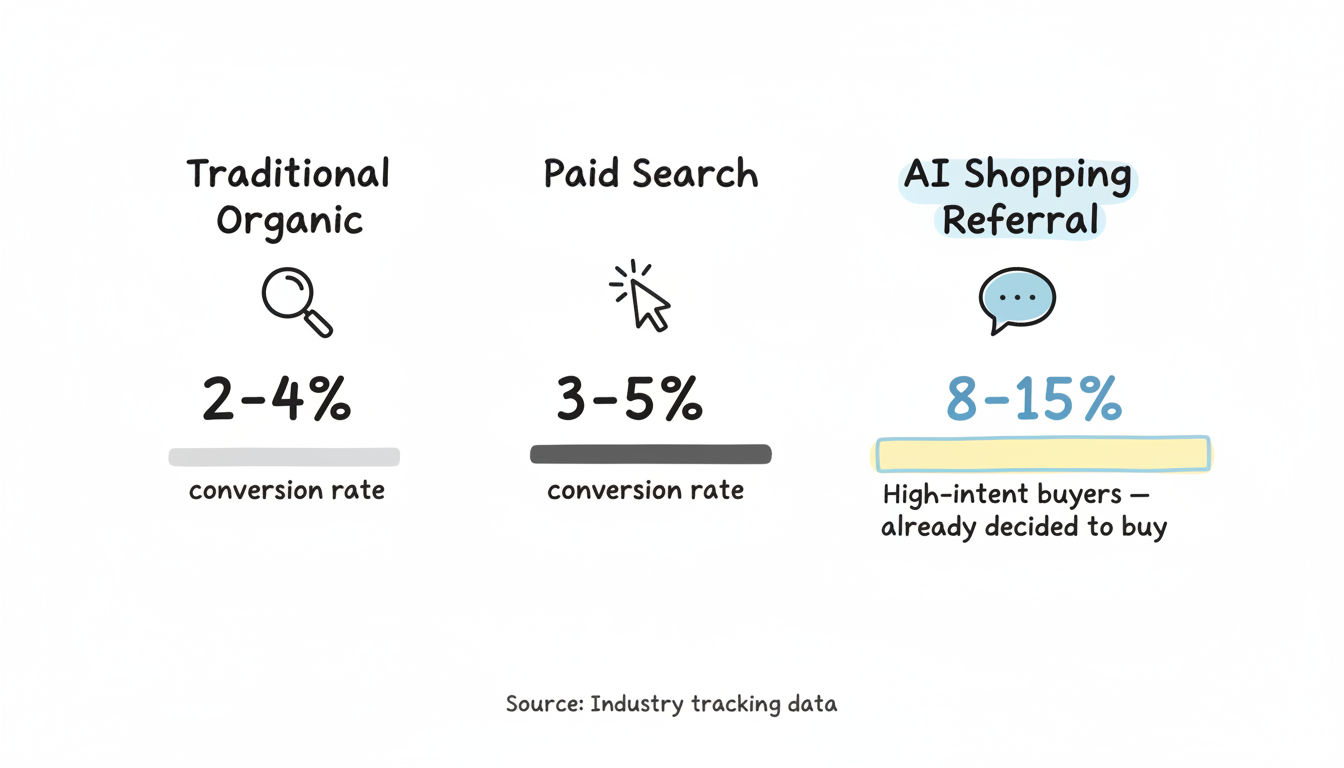
AI-referred e-commerce traffic converts at dramatically higher rates than traditional organic. Research shows 22% of shoppers already use AI search tools for product research, and this cohort converts at significantly elevated rates:
Traffic Source | Typical E-commerce Conversion Rate |
Traditional organic | 2-4% |
Paid search | 3-5% |
AI shopping referral | 8-15% |
The conversion advantage stems from intent qualification—users asking AI for product recommendations have already decided to buy. They want help choosing, not researching whether to purchase. Proper AI search traffic attribution helps quantify this value.
Product Schema Optimization for AEO
Structured data forms the foundation of e-commerce AEO. AI systems rely heavily on schema markup to understand product attributes, pricing, and availability. For a deeper dive into schema implementation, see our guide on structured data for AI search.
Essential Product Schema Requirements
Core Product schema implementation:
{
  "@context": "https://schema.org/",
  "@type": "Product",
  "name": "Brooks Ghost 15 Running Shoes",
  "description": "Neutral road running shoe with DNA LOFT cushioning for everyday training",
  "brand": {
    "@type": "Brand",
    "name": "Brooks"
  },
  "sku": "GHOST15-001",
  "gtin13": "0190340890123",
  "category": "Running Shoes > Neutral > Road",
  "image": [
    "https://example.com/images/ghost-15-main.jpg",
    "https://example.com/images/ghost-15-side.jpg"
  ],
  "offers": {
    "@type": "Offer",
    "url": "https://example.com/brooks-ghost-15",
    "priceCurrency": "USD",
    "price": "139.95",
    "priceValidUntil": "2026-12-31",
    "availability": "https://schema.org/InStock",
    "itemCondition": "https://schema.org/NewCondition",
    "seller": {
      "@type": "Organization",
      "name": "Your Store Name"
    }
  }
}
AI shopping assistants prioritize products with clear, current pricing. Missing or stale price data disqualifies products from recommendations.
Pricing schema best practices:
- Keep prices current - Update schema when prices change
- Include validity dates - priceValidUntil helps AI assess data freshness
- Show availability status - InStock, OutOfStock, PreOrder distinctions matter
- Add shipping information - shippingDetails schema influences purchase decisions
Availability schema addition:
"shippingDetails": {
  "@type": "OfferShippingDetails",
  "shippingDestination": {
    "@type": "DefinedRegion",
    "addressCountry": "US"
  },
  "deliveryTime": {
    "@type": "ShippingDeliveryTime",
    "handlingTime": {
      "@type": "QuantitativeValue",
      "minValue": 0,
      "maxValue": 1,
      "unitCode": "d"
    },
    "transitTime": {
      "@type": "QuantitativeValue",
      "minValue": 2,
      "maxValue": 5,
      "unitCode": "d"
    }
  },
  "shippingRate": {
    "@type": "MonetaryAmount",
    "value": "0",
    "currency": "USD"
  }
}
Product reviews directly influence AI recommendations. Well-structured review data helps AI systems evaluate product quality and match products to specific use cases.
AggregateRating schema:
"aggregateRating": {
  "@type": "AggregateRating",
  "ratingValue": "4.6",
  "reviewCount": "2847",
  "bestRating": "5",
  "worstRating": "1"
}
Individual Review schema (include 2-3 per product):
"review": [
  {
    "@type": "Review",
    "reviewRating": {
      "@type": "Rating",
      "ratingValue": "5",
      "bestRating": "5"
    },
    "author": {
      "@type": "Person",
      "name": "Verified Buyer"
    },
    "reviewBody": "Perfect for my flat feet. Great arch support and cushioning for daily 5K runs.",
    "datePublished": "2026-01-05"
  }
]
Beyond schema, product description content determines whether AI systems understand your product well enough to recommend it.
Feature Bullet Optimization
AI systems extract key features from bullet points. Optimize bullets for extractability using AI search ranking factors principles:
Weak product bullets (hard for AI to extract):
- Comfortable and lightweight
- Great for everyday use
- Quality materials
Strong product bullets (AI-extractable):
- DNA LOFT cushioning absorbs impact on runs up to 10 miles
- 9.8 oz weight (men's size 9) for responsive daily training
- BioMoGo DNA midsole adapts to runner's stride and pace
- Engineered mesh upper provides breathability without sacrificing support
Each bullet contains specific, factual information AI can cite when explaining why a product suits a particular need.
Specification Table Formats
Technical specifications presented in structured tables help AI compare products. Consider list formatting for LLM optimization when structuring product data:
Specification | Value |
Weight | 9.8 oz (men's), 8.2 oz (women's) |
Heel Drop | 12mm |
Cushioning | DNA LOFT |
Support Type | Neutral |
Surface | Road |
Best For | Daily training, long runs |
Tables with consistent formatting enable AI systems to make accurate comparisons across products.
Use Case and Benefit Clarity
AI shopping assistants match products to specific user needs. Content must explicitly state who the product serves. E-E-A-T signals—brand authority, verified reviews, and author expertise—directly influence which product pages LLMs cite as authoritative sources. Maintaining brand entity consistency across Google Business Profile, product feeds, and social profiles reinforces these trust signals for AI systems.
Vague use case (AI struggles to match): "Great all-around shoe for runners of all levels."
Clear use case (AI can match): "Designed for neutral runners logging 20-40 miles per week. The Ghost 15 excels at daily training runs between 3-10 miles. Runners with high arches or neutral pronation get optimal support. Not recommended for trail running or runners needing stability features."
Clear use case statements help AI recommend your product to the right queries while avoiding mismatched recommendations that lead to returns.
Category Page Optimization for AEO
Category pages often capture broader shopping queries like "best running shoes 2026" or "running shoes for beginners." Optimizing these pages requires understanding landing page optimization for AI search.
Buying Guide Integration
Category pages with integrated buying guides perform better in AI shopping search:
Effective category page structure:
## How to Choose Running Shoes
[Buying criteria explanation]

## Best Running Shoes by Category
### Best for Daily Training: [Product]
### Best for Long Distance: [Product]
### Best for Beginners: [Product]

## Product Grid
[Full category listings]
This structure provides AI with recommendation-ready content while maintaining e-commerce functionality.
Comparison Content Formats
AI shopping assistants frequently need to compare products. Category pages with comparison content get cited more often:
Comparison table format:
Feature | Product A | Product B | Product C |
Price | $139.95 | $149.95 | $119.95 |
Weight | 9.8 oz | 10.2 oz | 9.4 oz |
Cushioning | DNA LOFT | React Foam | Fresh Foam |
Best For | Daily training | Marathon | Budget runs |
AI systems extract comparison tables directly when answering "Product A vs Product B" queries.
Filter and Attribute Optimization
Product filters should reflect how users ask AI for recommendations:
Traditional filter attributes:
- Color, Size, Price, Brand
AI-optimized filter attributes:
- Running surface (road, trail, track)
- Support type (neutral, stability, motion control)
- Use case (daily training, racing, recovery)
- Foot type (high arch, flat feet, normal)
- Distance (5K, half marathon, ultra)
When your filter categories match how users phrase AI queries, your category pages become more likely citation sources.
Review and UGC Optimization
User-generated content provides signals AI systems use to evaluate products. Implementing QAPage schema for AI content enhances this further.
Review Schema Implementation
Beyond AggregateRating schema, implement detailed review markup:
Best practices for review optimization:
- Encourage use-case mentions - "Great for [activity]" reviews help AI match products
- Allow verified buyer badges - Trust signals influence AI recommendations
- Display recent reviews - Freshness matters for AI credibility assessment
- Show review dates - Schema should include datePublished
Q&A Content Optimization
Product Q&A sections provide extractable content for AI systems:
Q&A format example:
Q: Are these good for people with plantar fasciitis? A: Many customers with plantar fasciitis report relief with the Ghost 15's DNA LOFT cushioning. However, severe cases may benefit from the Adrenaline GTS with additional stability features.
Q&A content directly answers questions users ask AI assistants, making your product pages citation targets.
Social Proof for AI Extraction
AI systems evaluate social proof when making recommendations:
Extractable social proof elements:
- "Rated 4.6/5 by 2,847 runners"
- "97% of reviewers recommend this shoe"
- "#1 selling neutral trainer for 3 consecutive years"
- "Featured in Runner's World Best Running Shoes 2026"
Prominently displayed social proof gets extracted into AI recommendations.
Agentic Commerce Protocols: How Products Surface in AI Checkout Flows
The most significant development in e-commerce AEO for 2026 is the emergence of agentic commerce protocols that enable AI systems to complete purchases directly within chat interfaces. Two protocols are reshaping how products reach buyers.
The Universal Commerce Protocol (UCP) is a coalition-driven initiative backed by Google and major retailers that allows AI agents to browse, compare, and transact across multiple storefronts without users leaving the AI interface. The Agentic Commerce Protocol (ACP), developed by OpenAI with Stripe payment rails, powers ChatGPT Instant Checkout—enabling users to purchase recommended products in a single conversation.
Both protocols rely on MCP (Model Context Protocol) and A2A (Agent-to-Agent) protocol compatibility as interoperability layers, meaning your product data must be machine-readable across multiple systems simultaneously.
Protocol | Backed By | Checkout Flow | Merchant Action Required |
UCP | Google, major retailers | Multi-platform AI storefronts | Syndicate feeds to participating platforms, ensure GTIN compliance |
ACP | OpenAI, Stripe | ChatGPT Instant Checkout | Stripe integration, structured product data with pricing/shipping |
To be eligible for protocol-driven transactions, merchants must ensure product feeds include valid GTINs, standardized product naming, real-time pricing and availability, and complete shipping details. Products without these data points are invisible to agentic checkout flows. Use AI citation tracking tools to verify your products are surfacing in these AI commerce environments.
AI Shopping Platforms: Where Your Products Need to Appear
Optimizing for ChatGPT and Google alone is no longer sufficient. Multiple AI shopping platforms now influence purchase decisions, each with distinct crawling behaviors and citation preferences.
Amazon Rufus is Amazon's AI shopping assistant embedded across the marketplace. It prioritizes products with complete A+ content, filled-out backend keyword fields, and detailed product attributes. For brands selling on Amazon, Rufus optimization means treating every product listing field as a potential AI extraction source.
Perplexity Shopping delivers product search results with full source citations. It rewards well-structured product pages that present clear specifications, transparent pricing, and comparison-ready data. Pages with specification tables and concise feature descriptions outperform narrative-heavy marketing copy.
Microsoft Copilot handles both enterprise procurement and consumer shopping queries. Product visibility in Copilot depends on Bing index presence and merchant feed optimization through Microsoft Merchant Center. For more on adoption patterns, see Copilot adoption trends shaping enterprise and consumer purchasing.
Meta AI powers shopping discovery within Instagram and Facebook surfaces, leveraging social proof signals and product catalog data from Meta Commerce Manager.
Emerging platforms including Grok (xAI) and DeepSeek are building shopping capabilities worth monitoring in 2026, though optimization strategies for these are still developing.
The key insight: a multi-platform AEO strategy requires product data syndication across all these surfaces, not just on-site optimization for a single AI system. For the assistant-led buying surface specifically, see how ChatGPT shopping assembles product answers.
Measuring E-Commerce AEO Performance
E-commerce AEO requires specific measurement beyond general AI visibility tracking. Use AEO checker tools to monitor performance systematically.
Product Visibility Tracking
Monitor which products appear in AI shopping recommendations:
Product-level tracking protocol:
- Identify product queries - List common AI shopping queries in your category
- Test regularly - Check product visibility in ChatGPT and Perplexity monthly
- Track competitors - Document which products AI recommends instead of yours
- Analyze patterns - Identify what recommended products have that yours lack
Conversion Rate from AI Referrals
Segment AI shopping traffic for conversion analysis using AEO analytics setup methods:
Referral source identification:
- chat.openai.com referrals
- perplexity.ai referrals
- Google AI Overview clicks (harder to track)
Metrics to compare:
Metric | Traditional Organic | AI Shopping Referral |
Conversion rate | Track baseline | Compare to baseline |
Average order value | Track baseline | Often higher |
Return rate | Track baseline | Usually lower |
Time to purchase | Track baseline | Typically faster |
Revenue Attribution Analysis
Connect AI visibility to revenue:
Attribution model for AI shopping:
AI Recommendation → Product Page Visit → Purchase → Revenue
         ↓
   Track and attribute
Even imprecise attribution helps justify AEO investment. If AI referrals convert at 12% versus 3% for organic, the value proposition becomes clear.
Implementation Roadmap for E-Commerce AEO
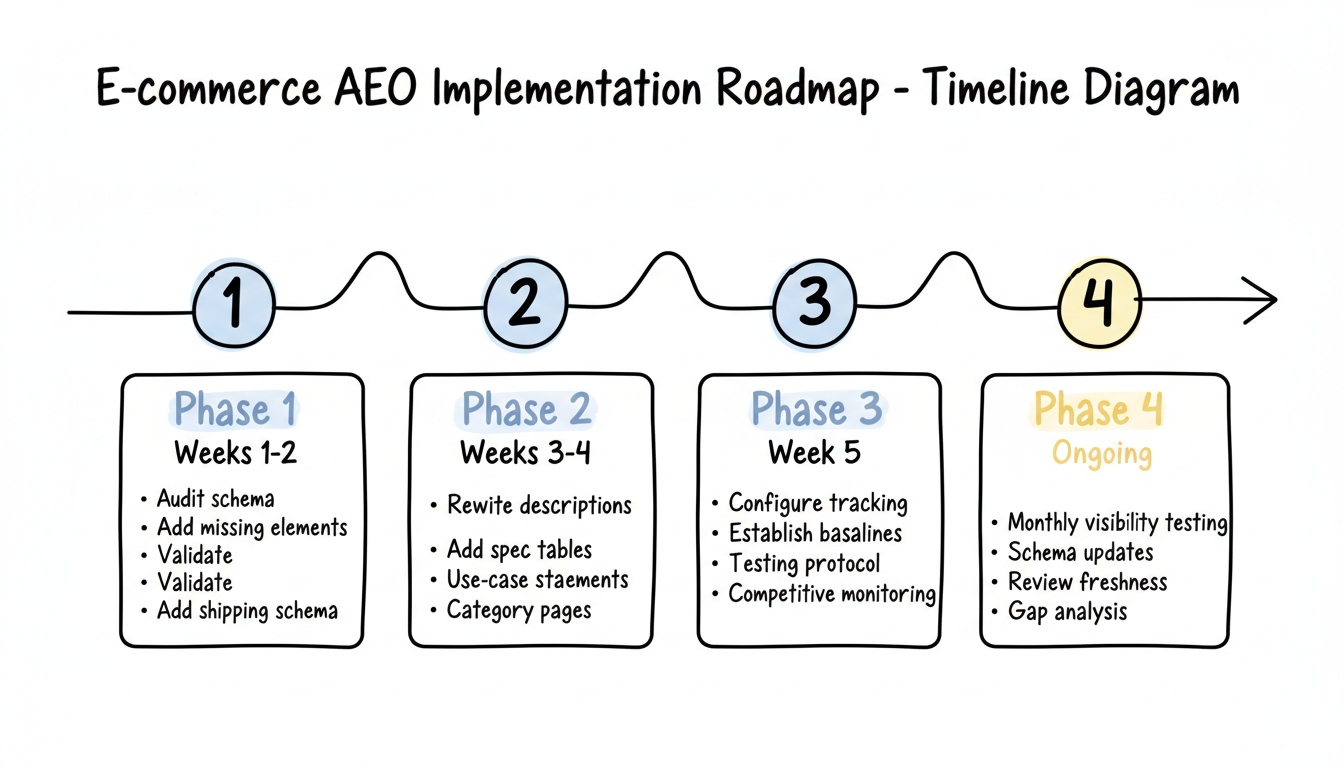
Phase 1: Technical Foundation (Weeks 1-2)
- Audit existing Product schema implementation
- Add missing schema elements (reviews, pricing, availability)
- Verify schema validation across all product pages
- Implement shipping and delivery schema
Phase 2: Content Optimization (Weeks 3-4)
- Rewrite product descriptions with extractable features
- Add specification tables to product pages
- Create use-case statements for each product
- Optimize category pages with buying guides
Phase 3: Measurement Setup (Week 5)
- Configure AI referral tracking
- Establish baseline conversion metrics
- Create product visibility testing protocol
- Set up competitive monitoring using AEO tools and software for ongoing measurement
Phase 4: Ongoing Optimization (Continuous)
- Monthly AI visibility testing
- Schema updates for price/availability changes
- Review content freshness maintenance
- Competitive analysis and gap closure
If you sell products, extend your markup with product schema to earn price and rating rich results in search.
Frequently Asked Questions
What Are Agentic Commerce Protocols and Why Do They Matter for E-Commerce?
Agentic commerce protocols like UCP (Universal Commerce Protocol) and ACP (Agentic Commerce Protocol) enable AI systems to complete product purchases directly within chat interfaces. UCP is backed by Google, Shopify, and major retailers. ACP powers ChatGPT Instant Checkout via Stripe. Merchants who optimize product feeds for these protocols can capture transactions without shoppers ever visiting their website.
Which AI Shopping Platforms Should E-Commerce Stores Optimize for in 2026?
Beyond ChatGPT and Google AI Overviews, e-commerce stores should optimize for Amazon Rufus, Perplexity Shopping, and Microsoft Copilot. Each platform crawls and cites product data differently. Amazon Rufus prioritizes marketplace listings with complete A+ content. Perplexity rewards structured product pages with clear specs. A multi-platform strategy with syndicated product feeds ensures broad AI visibility.
How Does RAG Affect Which Products AI Recommends?
Retrieval Augmented Generation lets AI shopping assistants fetch live product data from indexed pages rather than relying on training data alone. AI systems decompose queries into sub-queries covering price, reviews, features, and availability. Products with well-structured, self-contained descriptions on each attribute are more likely to be retrieved and cited in AI recommendations.
What Is the Difference Between AEO and GEO for E-Commerce?
AEO (Answer Engine Optimization) targets all answer-capable platforms including voice assistants, featured snippets, and AI chat interfaces. GEO (Generative Engine Optimization) specifically focuses on generative AI systems like ChatGPT, Perplexity, and Google AI Overviews. For e-commerce, a combined AEO and GEO strategy covers both traditional answer boxes and the newer AI shopping experiences driving purchase decisions.
Key Takeaways
E-commerce AEO requires specific optimizations beyond general AI visibility tactics:
- Product schema is foundational - AI shopping assistants rely heavily on structured data for pricing, availability, and product attributes
- Description content must be extractable - Specific features, specifications, and use cases help AI match products to user needs
- Category pages capture broader queries - Buying guides and comparison content position category pages as citation sources
- Reviews drive recommendations - User-generated content with use-case mentions influences AI product suggestions
- Measurement enables optimization - Tracking AI referral conversion rates proves ROI and guides improvements
- Agentic commerce protocols are the future - UCP and ACP enable AI-native checkout flows that bypass traditional e-commerce entirely
- Multi-platform visibility is essential - Amazon Rufus, Perplexity Shopping, Microsoft Copilot, and Meta AI each require distinct optimization approaches
The brands that optimize for AI shopping search now will capture the high-intent, high-converting traffic that increasingly bypasses traditional search results. Leveraging AI search optimization tools and following ChatGPT SEO optimization guide principles will accelerate your progress in this emerging channel.