
AEO for SaaS companies requires distinct approaches that reflect how B2B software buyers research, evaluate, and make purchasing decisions. As buyers increasingly rely on ChatGPT, Perplexity, Gemini, and Claude to research software solutions, SaaS brands that remain invisible in these AI-generated answers lose opportunities to competitors who've adapted their visibility strategies.
This guide provides industry-specific Answer Engine Optimization strategies for SaaS companies, addressing the unique challenges and opportunities of positioning B2B software brands for AI search visibility.
AEO, GEO, and LLM Optimization: What SaaS Teams Need to Know
Answer Engine Optimization (AEO) and Generative Engine Optimization (GEO) are companion disciplines that SaaS marketing teams should treat as a unified strategy. AEO focuses broadly on earning visibility across all answer engines, including Google AI Overviews, featured snippets, and AI assistants. GEO focuses specifically on generative AI outputs—the answers produced by large language models like ChatGPT, Perplexity, Gemini, and Claude. For SaaS companies, the overlap between AEO and GEO is substantial, and the most effective teams build a single integrated program rather than managing them as separate initiatives. To understand the foundational concepts, explore best generative engine optimization tools available today.
At its core, AEO is LLM optimization—the practice of structuring content so that large language models can accurately extract, synthesize, and cite your SaaS brand in their responses. Unlike traditional search engines that rank pages by relevance signals, LLMs use a fundamentally different process. They perform query fan-out (decomposing a user question into sub-queries), entity matching (identifying which brands and concepts relate to the query), and source authority assessment (determining which sources are trustworthy enough to cite).
Each AI platform exhibits distinct citation behaviors that SaaS teams should understand. Perplexity is the most transparent, providing URL-linked source citations for nearly every claim. ChatGPT cites sources selectively, primarily when using its browsing capability, and tends to favor well-structured, authoritative pages. Gemini leans heavily on E-E-A-T signals—experience, expertise, authoritativeness, and trustworthiness—when deciding what to cite. Understanding these differences helps SaaS teams prioritize optimization efforts by platform. For deeper context on how AI search results work, see Google AI Overview SEO impact analysis.
Why SaaS Companies Need Specialized AEO Approaches
SaaS purchasing decisions involve extended research cycles, multiple stakeholders, and complex evaluation criteria that differ fundamentally from consumer purchases. AEO strategies must address these realities.
The B2B Software Research Shift
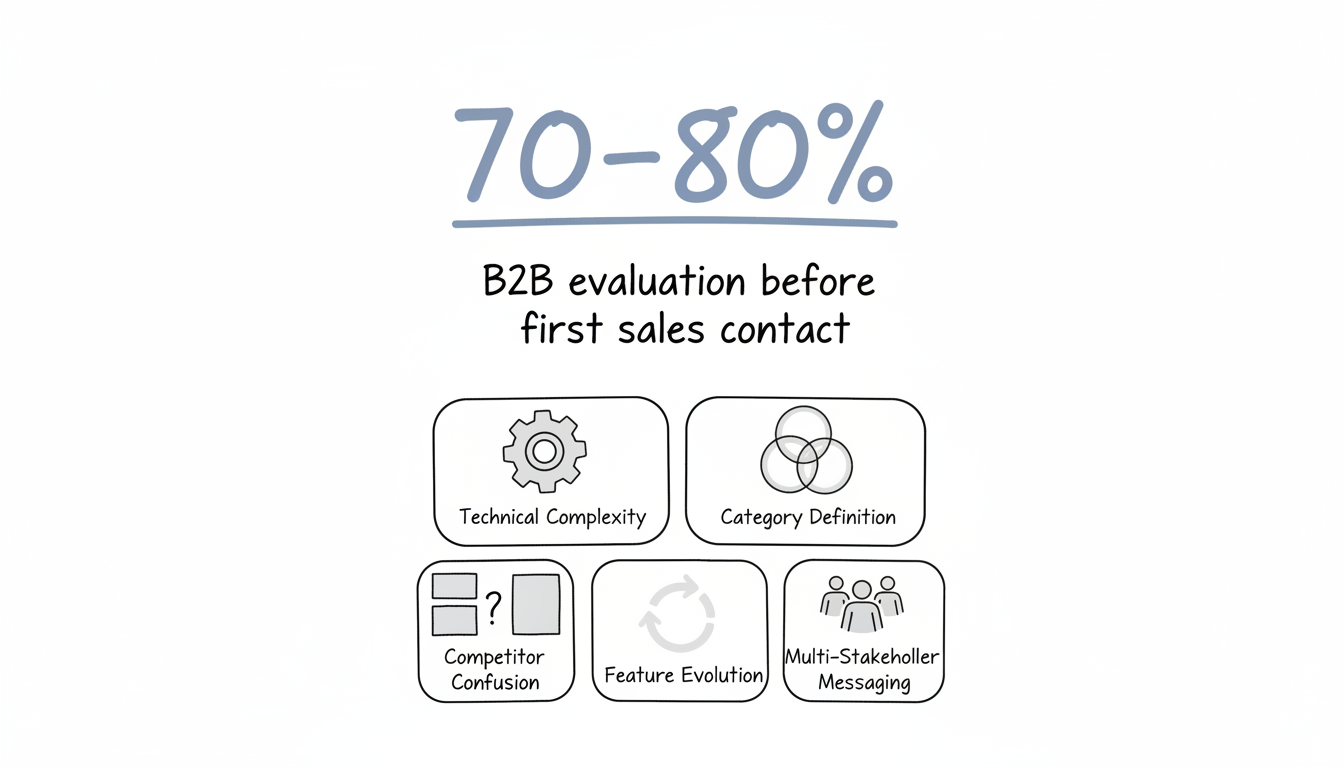
Modern B2B software buyers conduct extensive independent research before engaging vendors. Research indicates that B2B buyers complete 70-80% of their evaluation process before contacting sales teams. Increasingly, this research happens through AI platforms.
How AI changes SaaS research:
- Buyers ask conversational questions about software categories
- AI platforms provide synthesized comparisons rather than requiring multiple site visits
- Recommendations include citations establishing credibility
- Follow-up queries dive deeper into specific capabilities
When AI platforms answer "What's the best CRM for mid-market companies?" or "How does [Tool A] compare to [Tool B]?", the brands appearing in those responses capture buyer attention during critical decision moments.
SaaS-Specific Visibility Challenges
SaaS companies face unique AEO challenges that consumer brands don't encounter:
Technical complexity: Software capabilities require clear explanation for AI systems to understand and accurately represent.
Category definition: SaaS products often span multiple categories or create new ones, complicating how AI systems classify and recommend them.
Competitor confusion: Similar-sounding products can blur AI understanding of distinct offerings.
Feature evolution: Regular updates and new capabilities require continuous optimization to maintain accurate AI representation.
Multi-stakeholder messaging: Different buyers (technical, financial, operational) need different information, complicating content organization.
Foundation: Establishing Clear Entity Identity
AI systems must understand what your SaaS product does before they can recommend it appropriately. Entity clarity forms the foundation of effective SaaS AEO, and implementing proper entity optimization for AI search ensures accurate representation across platforms.
Define Your Category Position
Clearly position your product within recognizable software categories while differentiating from competitors.
Category positioning requirements:
- State your primary category explicitly in key content
- Explain how you fit within or differ from established categories
- Define your target market segments clearly
- Articulate differentiation from adjacent solutions
Implementation: Create a consistent positioning statement appearing across your homepage, product pages, about section, and marketing materials. AI systems synthesize information from multiple sources—consistency ensures accurate understanding.
Build Knowledge Graph Presence
AI systems draw on knowledge graphs to understand entities and their relationships.
Knowledge graph strategies:
- Ensure Crunchbase, G2, Capterra, and other B2B databases contain accurate, consistent information
- Create or improve Wikipedia presence where notable enough
- Maintain consistent information across review platforms
- Implement comprehensive Organization schema markup
Schema implementation for SaaS:
{
  "@context": "https://schema.org",
  "@type": "SoftwareApplication",
  "name": "Your Product Name",
  "applicationCategory": "BusinessApplication",
  "operatingSystem": "Web-based",
  "offers": {
    "@type": "Offer",
    "price": "0",
    "priceCurrency": "USD"
  }
}
Structured data helps AI systems accurately categorize and describe your product. Beyond traditional SEO benefits, schema markup directly improves AI extractability—it helps AI systems parse entity relationships, feature attributes, and product metadata, making citations more likely and more accurate when combined with effective generative AI for structured data implementation.
Clarify Feature Capabilities
AI systems frequently cite sources when answering specific capability questions. Clear feature documentation increases citation likelihood.
Feature content optimization:
- Create dedicated pages for major capabilities
- Use consistent feature naming across all content
- Provide clear, quotable descriptions of what each feature does
- Include use cases demonstrating practical application
Content Strategy for SaaS AEO
SaaS content must serve multiple purposes: educating buyers, demonstrating expertise, and providing extractable information for AI citations.
Comparison Content Dominance
AI platforms frequently receive comparison queries: "What's the difference between X and Y?" or "Which tool is best for [use case]?"
Comparison content requirements:
- Create honest, detailed comparison pages against key competitors
- Include comparison tables with specific feature breakdowns
- Address strengths AND limitations transparently
- Update comparisons as products evolve
Why honesty matters: AI systems evaluate content quality. Transparently acknowledging where competitors excel actually increases citation likelihood because it demonstrates expertise and builds trust signals.
Use Case-Specific Content
B2B buyers research solutions for specific problems. Content addressing particular use cases earns citations when AI platforms answer related queries, and understanding what is geo in search engine optimization helps target location-specific use cases.
Use case content structure:
- Create dedicated pages for major use cases
- Open with direct statements about how your product addresses the use case
- Include specific examples and outcomes
- Provide implementation details relevant to that use case
Example structure: "[Product Name] for [Use Case]: [Direct capability statement]. Companies using [Product] for [use case] typically achieve [outcomes]. Here's how the solution addresses key requirements..."
Integration Documentation
SaaS buyers frequently ask about integrations. AI platforms answering "Does X integrate with Y?" need clear documentation to cite.
Integration content requirements:
- Create individual pages for major integrations
- Clearly state integration capabilities and limitations
- Describe data flow and functionality
- Include setup and configuration details
Integration pages often earn citations for specific technical queries that broader marketing content misses.
Thought Leadership That Gets Cited
B2B SaaS buyers value expertise. Thought leadership content demonstrating genuine insight earns both buyer trust and AI citations.
Citation-worthy thought leadership:
- Original research with quotable statistics
- Industry analysis providing unique perspectives
- Methodology content explaining approaches
- Benchmark data enabling buyer comparison
Key principle: Generic thought leadership gets ignored. Content providing unique insights or data that AI systems can't find elsewhere earns citation priority.
Content Extractability: Structuring SaaS Content for AI Answers
Content extractability refers to how easily an AI system can pull a concise, accurate answer from your page. For SaaS companies competing for AI citations, this is a critical differentiator—pages that are easy for AI to parse earn more citations than pages with equivalent information buried in dense prose.
The most effective technique is the "atomic answer" pattern: self-contained passages of 40-60 words that directly answer a specific question, positioned immediately after a heading. When an AI system processes your page, these atomic answers serve as ready-made citation candidates. Each answer should be complete enough to stand alone, providing value even without the surrounding context. For real-world implementations of this pattern, see AEO optimization examples across different industries.
Beyond individual answers, organize your content around "intent constellations"—clusters of related sub-questions surrounding a core topic. A single well-structured page addressing an intent constellation can serve multiple AI queries, multiplying your citation surface area without requiring separate pages for each question.
SaaS teams should also distinguish between commercial-intent and informational query optimization. Comparison pages targeting queries like "best project management tool for remote teams" need atomic verdict sentences—clear, quotable recommendations. Educational pages need structured definitions and step-by-step frameworks that AI systems can extract cleanly. Consider using structured data for AI search to reinforce the semantic structure of your content.
Freshness signals matter for extractability as well. Implement monthly content refresh cycles with visible "Last updated" dates and inline year references (e.g., "as of 2026"). AI crawlers use recency signals when determining which sources to prioritize, and stale content loses citation priority regardless of quality.
Technical Optimization for SaaS Sites
SaaS websites often have technical characteristics requiring specific AEO attention, and conducting a thorough AEO technical audit identifies optimization opportunities.
Ensure AI Crawler Access
Many SaaS sites inadvertently block AI crawlers through robots.txt or technical configuration.
Crawler access checklist:
- Allow GPTBot, ClaudeBot, PerplexityBot in robots.txt
- Ensure marketing pages render without JavaScript execution
- Verify important content isn't hidden behind authentication
- Check that pricing and feature pages are crawlable
Common SaaS-specific issues:
- Login walls blocking crawler access to key pages
- JavaScript-heavy sites that AI crawlers can't parse
- Dynamic pricing pages that crawlers can't access
- Feature documentation behind customer-only portals
Optimize Documentation and Help Content
SaaS documentation often contains exactly the information AI systems need for technical queries.
Documentation optimization:
- Ensure public documentation is crawlable
- Structure help content with clear question-answer format
- Include practical examples and use cases
- Maintain current information as product evolves
Well-optimized documentation can earn citations for "how to" queries that marketing content doesn't address.
Pricing Page Optimization
Pricing queries are common in SaaS research. AI platforms answering pricing questions need clear information to cite.
Pricing page requirements:
- Display pricing clearly (or state "contact for pricing" explicitly)
- Explain what each tier includes
- Clarify any limitations or restrictions
- Include comparison to demonstrate value
Even "custom pricing" models benefit from clarity about what determines pricing and typical ranges.
Building SaaS Authority for AI Visibility
AI systems prioritize authoritative sources. SaaS companies must build authority signals AI systems recognize, and studying AEO success stories and case studies reveals effective authority-building patterns.
Review Platform Presence
G2, Capterra, TrustRadius, and similar platforms significantly influence AI perceptions of SaaS products.
Review platform optimization:
- Maintain accurate, complete profiles
- Encourage genuine customer reviews
- Respond to reviews demonstrating engagement
- Keep feature lists and information current
AI systems frequently cite review platforms when comparing SaaS options. Strong presence influences how your product appears in comparisons.
Industry Publication Citations
Being mentioned by respected industry publications builds authority AI systems recognize.
Publication strategies:
- Earn coverage through genuine news and developments
- Contribute expert content to industry publications
- Participate in industry reports and analyses
- Build relationships with B2B technology media
Community Presence
Reddit and other communities appear frequently in AI citations. Strategic community presence can influence AI visibility.
Community guidelines:
- Participate genuinely in relevant subreddits and forums
- Provide helpful answers mentioning your product appropriately
- Build reputation through consistent valuable contribution
- Avoid promotional behavior that undermines credibility
Community discussions influence how AI systems understand and represent your product's reputation. Beyond direct engagement, multi-source validation plays a critical role in AI citation decisions. AI systems weigh mentions across forums, SaaS directories, expert roundups, and industry publications as distinct trust signals—separate from and complementary to traditional backlinks. Think of this as "surround sound" visibility: when your brand appears consistently across diverse, independent sources, AI systems gain higher confidence in recommending you. Prioritize earning mentions in curated lists, contributing to community knowledge bases, and participating in expert panels that generate citable content. Voice search and digital assistants also consume AEO-optimized content, extending the reach of SaaS AEO beyond text-based AI tools into conversational interfaces.
Measuring SaaS AEO: Citation Tracking and AI Referral Attribution
Effective SaaS AEO requires dedicated measurement infrastructure that goes beyond traditional SEO metrics. The following framework addresses three critical capabilities every SaaS team needs.
Citation Tracking Tools
Citation tracking monitors when and how AI systems reference your SaaS brand in their responses. There are three primary approaches: dedicated AI citation trackers that systematically query AI platforms and log mentions, server log monitoring that detects visits from AI bot crawlers like GPTBot, ClaudeBot, and PerplexityBot, and GA4 referral traffic filtering that isolates visits originating from AI platforms. For a comprehensive overview of available solutions, explore AI citation tracking tools for SaaS brands.
Each approach captures different signals. Bot crawl monitoring tells you which of your pages AI systems are actively indexing. Citation tracking tells you which pages are actually being cited in responses. Referral traffic tells you which citations are driving actual visits. Used together, these three signals provide a complete picture of your AI visibility pipeline.
Prompt Simulation for SaaS Buyers
Prompt simulation is the practice of systematically querying AI platforms with prompts that mimic real buyer research behavior. Craft persona-driven prompts reflecting actual buyer queries—for example, "What is the best project management tool for remote teams?" or "How do I choose a CRM for mid-market B2B companies?"—and run them across ChatGPT, Perplexity, Gemini, and Claude. Track whether your SaaS product appears in the responses, note the context and positioning, and log results over time. Explore AEO tools and software that can help automate this process.
Establish a systematic testing cadence—weekly or biweekly—to detect visibility changes early. Rotate prompt variations to cover different buyer personas, use cases, and comparison scenarios. This data reveals which content investments are translating into actual AI citations and where gaps remain.
ROI Metrics That Matter
SaaS teams should track four key AEO metrics: citation frequency rate (how often your brand appears in AI responses for target queries), AI-sourced MQLs (marketing qualified leads attributed to AI platform referrals), AI referral pipeline value (revenue pipeline generated from AI-sourced leads), and uncited mention rate (how often AI describes your product category without naming your brand—a measure of missed opportunity).
Teams running structured AEO programs typically see measurable AI-sourced pipeline within 90 days of implementation. Critically, AI referral traffic should be tracked separately from organic search in your attribution models. Blending the two obscures the distinct value of AEO investment and makes it impossible to optimize channel-specific strategies.
Common SaaS AEO Mistakes
Learning from common failures accelerates success.
Over-Relying on Marketing Jargon
AI systems struggle with marketing-speak that doesn't clearly explain what products do. "Revolutionary platform that transforms workflows" tells AI nothing useful.
Fix: Use clear, specific language explaining capabilities in practical terms.
Neglecting Technical Documentation
SaaS companies often focus AEO on marketing content while ignoring documentation that could earn technical query citations.
Fix: Optimize documentation alongside marketing content. Technical queries deserve optimized answers too.
Inconsistent Product Information
Different pricing, features, or positioning across platforms confuses AI systems about what's accurate.
Fix: Audit and align information across website, review platforms, directories, and marketing materials.
Ignoring Review Platforms
Some SaaS companies treat review platforms as maintenance rather than visibility channels.
Fix: Actively manage review platform presence as a core AEO activity.
Avoiding Comparison Content
Fear of highlighting competitors leads some SaaS companies to avoid comparison content entirely.
Fix: Create comprehensive comparison content. AI will compare your product anyway—ensure accurate information exists to cite.
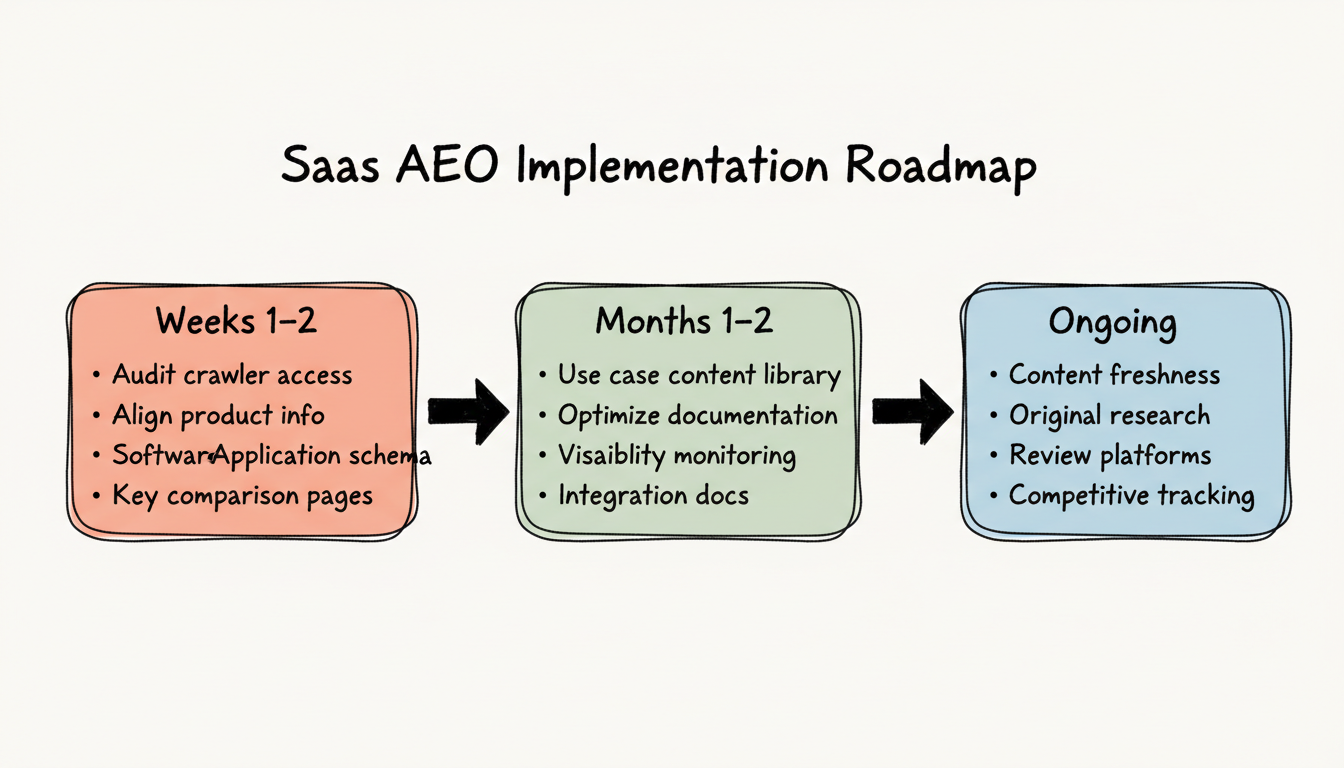
SaaS AEO Implementation Roadmap
Prioritize implementation based on impact and effort, and consider whether to pursue AEO implementation services for faster execution.
Immediate priorities (weeks 1-2):
- Audit AI crawler access and fix any blocks
- Review and align product information across platforms
- Implement SoftwareApplication schema markup
- Create or optimize key comparison pages
Short-term priorities (months 1-2):
- Develop use case-specific content library
- Optimize documentation for AI extraction
- Establish visibility monitoring systems
- Build out integration documentation
Ongoing priorities (continuous):
- Maintain content freshness with regular updates
- Generate original research and thought leadership
- Manage review platform presence actively
- Track and respond to competitive visibility changes
Frequently Asked Questions
What Is AEO and Why Does It Matter for SaaS Companies?
AEO (Answer Engine Optimization) is the practice of structuring your content so AI-powered search tools like ChatGPT, Perplexity, and Google AI Overviews cite your SaaS product in their answers. It matters because B2B buyers increasingly use AI assistants to research software, and if your product is absent from those answers, you lose visibility at a critical decision-making moment.
How Is AEO Different from Traditional SEO for SaaS?
Traditional SEO focuses on ranking in search engine results pages through keywords and backlinks. AEO focuses on earning citations inside AI-generated answers, which requires entity clarity, structured data, content extractability, and multi-source validation. SaaS companies need both, but AEO specifically targets the AI answer layer that sits above organic results.
How Do I Track Whether AI Tools Are Recommending My SaaS Product?
Use a combination of prompt simulation testing, where you systematically query AI platforms with buyer-intent prompts, and server log monitoring to detect AI bot crawlers like GPTBot and PerplexityBot. Track AI referral traffic in your analytics platform separately from organic search to measure pipeline impact from AI citations.
What Is GEO and How Does It Relate to AEO for SaaS?
GEO (Generative Engine Optimization) is a subset of AEO that focuses specifically on generative AI outputs rather than all answer engines. For SaaS companies, GEO and AEO overlap heavily—both require structured content, strong entity identity, and citation-worthy authority signals. Most SaaS teams treat them as a single unified strategy.