
Answer engine optimization for startups is the practice of making your company the source AI assistants like ChatGPT cite when founders, buyers, and investors ask about your category. It is how early-stage startups earn authoritative visibility in AI search without a six-month traditional SEO runway. Here is the startup playbook for getting cited in AI answers.
See also the startup AEO checklist.TL;DR: AEO for Startups
- Answer engine optimization (AEO) is earning placement in AI-generated answers -- ChatGPT, Perplexity, Gemini -- not just blue links on a results page.
- For startups it matters because buyers now ask AI "what tool should I use" before they ever open a search engine, and those answers shape the shortlist.
- AEO is related to but distinct from SEO: SEO gets you ranked; AEO gets you cited as the answer. Both feed each other.
- The lever is entity clarity plus genuinely citable content -- clear structured data, consistent facts, and direct answers to the questions your buyers ask.
- A pre-seed team can start AEO with almost no budget: it rewards accuracy and authority more than it rewards link volume.
What Is Answer Engine Optimization (AEO)?
Answer engine optimization is the discipline of structuring your brand, content, and data so that large language models choose your company as the answer when someone asks a question in an AI assistant. Where SEO optimizes pages for a ranking algorithm that returns a list, AEO optimizes for a generative model that returns a single synthesized answer -- and often names the sources it trusted.
For a startup, AEO is less about publishing volume and more about becoming unambiguous. The model needs to know what you do, who you serve, and why you are credible, in language that matches how your buyers actually phrase their problems. The AI SEO strategy guide covers the broader site-optimization side; AEO is the specific tactic of being the cited source inside the answer itself.
Why Does AEO Matter for Startups?
Because the buyer journey has moved upstream. A head of growth no longer starts at Google. They open ChatGPT and ask, "What is the best Reddit ads agency for a Series A SaaS?" or "How should a startup set up server-side tracking?" The answer they get -- and the vendors named in it -- becomes their consideration set before they visit a single website.
Early-stage startups are disproportionately helped by this shift. Traditional SEO favors domains with years of backlinks and content velocity that a seed-stage team cannot match. AEO rewards clarity, factual consistency, and topical authority, which a focused startup can build quickly in its niche. A startup that becomes the cited answer for three high-intent category questions owns a channel its larger competitors are still optimizing for the old way.
AEO vs SEO: What Is the Difference?
SEO and AEO share foundations -- good content, clean technical structure, authority -- but they target different outputs. SEO earns a position in a ranked list of links. AEO earns a mention inside a generated answer. SEO success is measured in rankings, clicks, and traffic. AEO success is measured in citations, branded prompts, and assisted conversions that never show up as a direct click because the answer already did the selling.
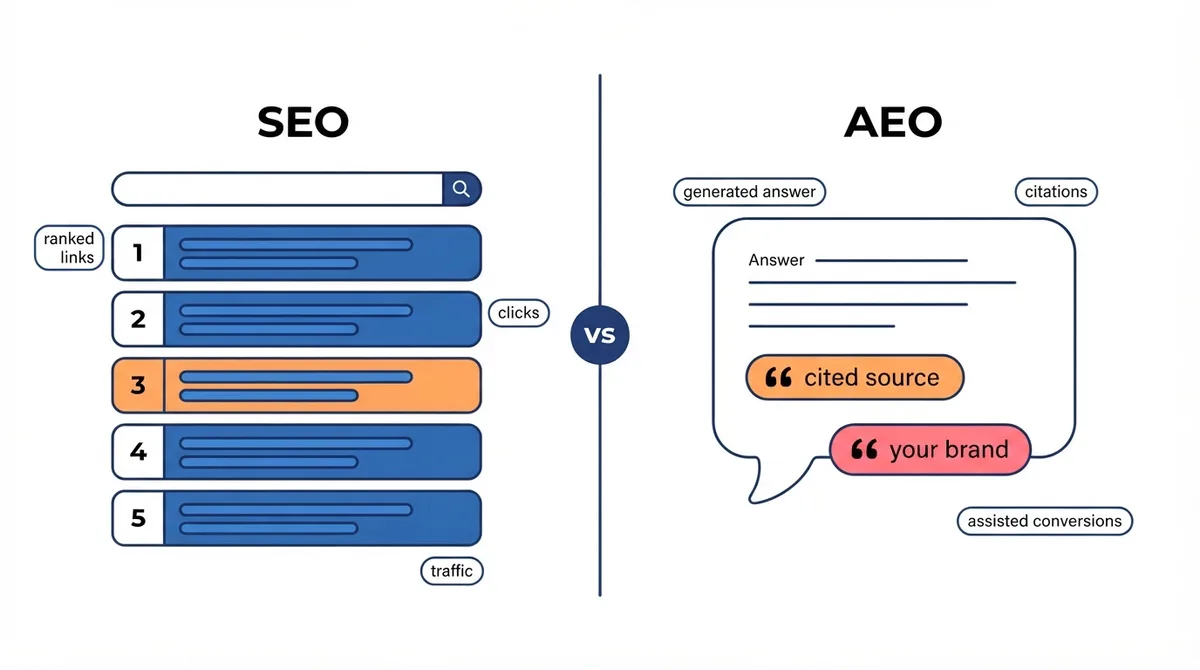
Practically, a startup should run both. The complete SEO guide for startups builds the ranking foundation; AEO layers citation optimization on top. A page that ranks well is also more likely to be cited, and a page that is cited reinforces the domain's authority for ranking. They compound.
How Do AI Answer Engines Decide What to Cite?
No model publishes its exact citation algorithm, but the consistent patterns across ChatGPT, Perplexity, and Gemini are clear. They favor sources that are factually consistent across the web, clearly structured with schema, frequently referenced by other trustworthy sources, and directly answer the query without fluff. They also favor entities -- recognizable organizations with consistent names, descriptions, and relationships -- over anonymous pages.
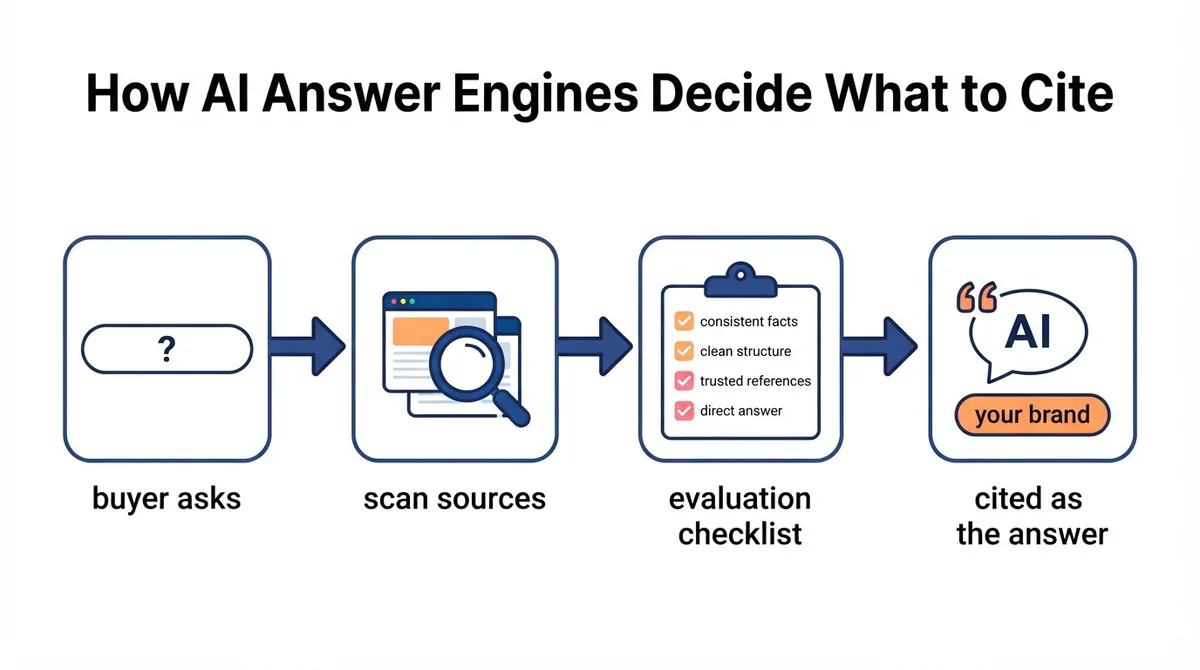
For a startup this means two jobs. First, make your entity legible: consistent name, description, leadership, and category across your site, directories, and social profiles. Second, make your content citable: answer the question outright, support claims with specifics, and mark up the page with the right structured data so models can parse it confidently.
How Do You Optimize Your Startup for Answer Engines?
- Clarify your entity. Define a single, consistent description of what you do and who you serve, and reuse it everywhere -- site, Crunchbase, LinkedIn, product directories. Inconsistency is the fastest way to be ignored.
- Publish direct-answer content. Build a library of pages that answer the exact questions your buyers ask AI, stated in the first sentence. "Reddit ads for startups: a founder guide" beats "Unlock growth with social."
- Add structured data. Mark up posts and key pages with schema (Organization, Article, FAQ) so models parse intent and facts cleanly. This is the single highest-leverage technical AEO step.
- Earn referenced authority. Get cited by category-relevant publications, communities, and directories. Models treat repeated, consistent third-party mention as a trust signal.
- Monitor your mentions. Track when AI answers name you versus competitors, and close gaps by strengthening the pages that should be the source. Measurement is the part most startups skip.
What Content Formats Do Answer Engines Prefer?
AI models cite content that is structured and unambiguous. Comparison pages ("X vs Y for startups"), definitive explainers ("what is server-side tracking"), and FAQ-rich guides perform well because they map cleanly to user questions. Lists and tables get pulled into answers directly. Long, meandering thought pieces get summarized or skipped. The pattern: answer first, elaborate second. Pages that lead with a 40-word direct answer to the H1 question are far more citable than pages that build to the point.
How Do You Build Entity Authority as a Startup?
Entity authority is the cumulative signal that you are a real, consistent, noteworthy organization. Start with the basics: a clean "About" narrative, founder profiles with real bios, and a consistent category label. Then extend presence to the places models scrape -- founder content on relevant platforms, credible directory listings, and genuine press or community contributions in your niche. You do not need a PR firm; you need consistent, factual, repeated mention of the same entity facts. A focused analytics setup, like the one in the startup marketing analytics guide, helps you see which mentions correlate with assisted pipeline.
What Are Common AEO Mistakes Startups Make?
- Inconsistent entity facts. Different descriptions on your site, Crunchbase, and LinkedIn confuse models about what you are.
- Answering around the question. If the first paragraph does not state the answer, the model summarizes someone who did.
- No structured data. Unmarked pages are harder to parse and less likely to be cited as a source.
- Chasing volume over clarity. Ten thin posts beat one clear, citable one only in the old playbook. AEO rewards the citable one.
- Ignoring mention monitoring. If you never check whether AI names you, you cannot tell which page to strengthen.
How Do You Measure AEO Success?
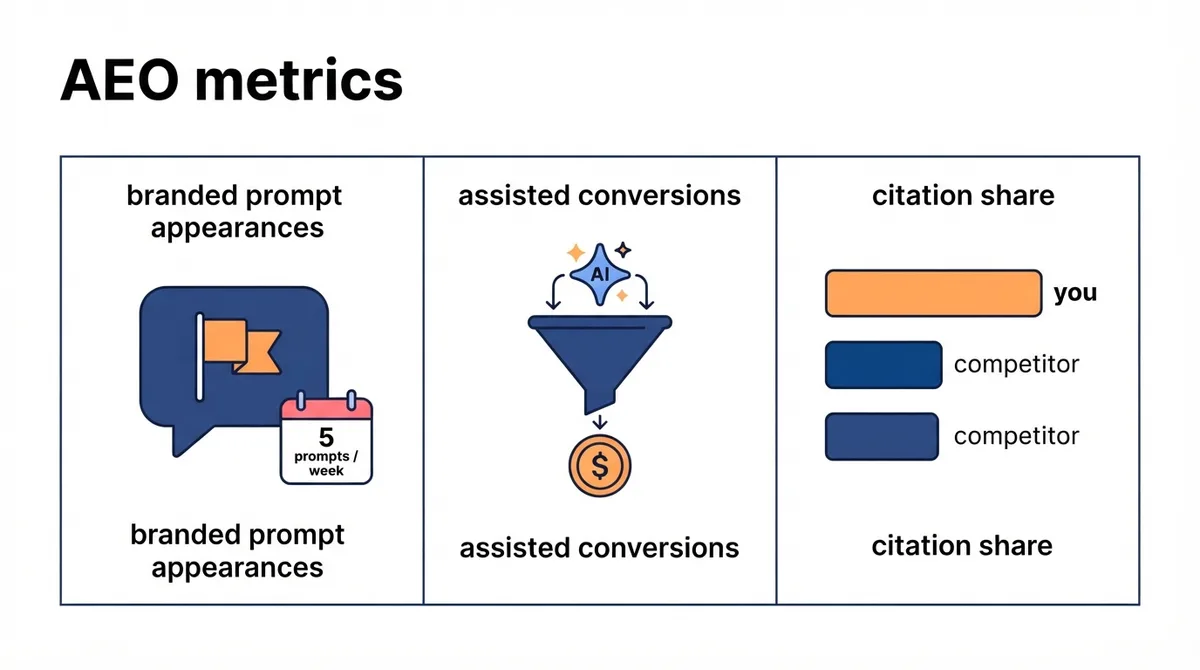
AEO metrics are newer than SEO metrics but tractable. Track branded prompt appearances (does ChatGPT name you for category questions?), assisted conversions (pipeline that starts with an AI-referred session), and citation share versus competitors for target queries. Tools that monitor AI search visibility are emerging, but a simple weekly manual check of five high-intent prompts gets a startup 80 percent of the signal. The goal is not to rank; it is to be the answer.
For startups curious about paid discovery inside the same channel, our ChatGPT Ads for startups guide covers launching sponsored placements inside ChatGPT answers.
FAQ
What Is Answer Engine Optimization in Simple Terms?
AEO is making your company the source that AI assistants like ChatGPT and Perplexity cite when someone asks a question about your category. Instead of optimizing to appear in a list of search results, you optimize to be named inside the AI's answer.
Is AEO the Same as SEO?
No. SEO earns you a ranking in a list of links; AEO earns you a citation inside a generated answer. They share foundations like good content and authority, and they compound -- a page that ranks is also more likely to be cited -- but the tactics and success metrics differ.
How Long Does It Take a Startup to Show Up in AI Answers?
Faster than traditional SEO. Because AEO rewards clarity and factual consistency over years of backlinks, a focused startup can begin appearing in relevant AI answers within weeks of publishing clear, structured, consistently-described content -- though competitive categories take longer.
Can a Pre-Seed Startup Do AEO?
Yes, and it is one of the highest-leverage early channels. A pre-seed team with almost no budget can clarify its entity, publish direct-answer content, add structured data, and earn citations in its niche well before it could compete on traditional search ranking.
For a platform-specific walkthrough, see our guide on the best CMS for AEO.