
Answer engine optimization continues evolving rapidly as AI search platforms mature and user behaviors shift. Understanding emerging trends helps organizations prepare strategies that remain effective through ongoing changes. This guide examines the AEO developments expected through 2026-2027 and their implications for digital marketing strategy.
The Trajectory of AI Search Adoption
AI search adoption accelerates faster than most predictions anticipated.
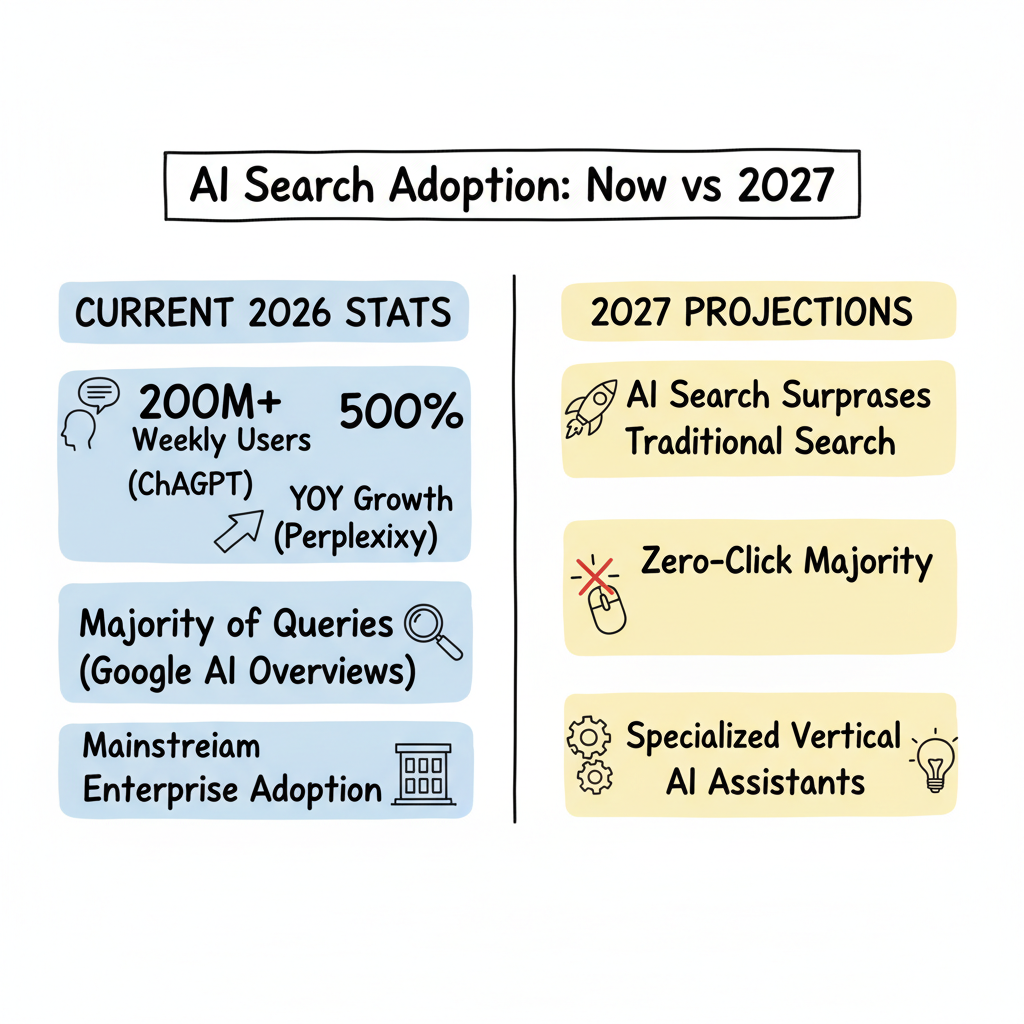
Current adoption indicators (2026):
- ChatGPT surpasses 200 million weekly active users
- Perplexity grows 500% year-over-year in query volume
- Google AI Overviews appear on majority of informational queries
- Enterprise AI assistant adoption reaches mainstream levels
- According to McKinsey's 2026 Global AI Survey, 72% of enterprises have adopted AI in at least one business function, up from 55% in 2024, underscoring the acceleration of AI-driven information consumption
Projected trajectory:
- AI-assisted search traffic may exceed traditional search by late 2027
- Zero-click interactions continue growing as AI answers satisfy queries directly
- Voice and conversational interfaces drive additional AI query growth
- Specialized AI assistants emerge for vertical industries
Organizations not investing in AEO risk declining visibility as AI intermediates more information discovery.
Emerging AEO Trends for 2026-2027
Several trends shape the near-term AEO landscape.
Multimodal AI Integration
AI platforms increasingly process and cite multiple content formats.
Emerging capabilities:
- Video content citation and summarization, with YouTube serving as the dominant video platform AI engines cite for visual and tutorial content
- Image-based information extraction
- Audio and podcast content integration
- Interactive content understanding
- Reddit emerging as a key text-based UGC source that AI models like ChatGPT and Gemini increasingly draw from for community-validated insights
Optimization implications:
- Diversify content formats beyond text
- Optimize video transcripts and descriptions for AI processing
- Ensure visual content includes accessible metadata
- Consider podcast and audio content strategies
- Amazon's commerce-integrated AI search (Rufus, Alexa) and Adobe's creative and enterprise AI tools illustrate how vertical-specific AI platforms are expanding the optimization surface area
Organizations limited to text content may miss citation opportunities as multimodal AI matures.
Real-Time Information Emphasis
AI platforms increasingly prioritize current information over static knowledge. Understanding how Google AI Overview works internationally reveals how different platforms handle real-time information across markets.
Trend drivers:
- User expectations for current answers
- Platform competition on information freshness
- Decreasing reliance on training data cutoffs
- Integration with real-time data sources
Strategic adaptations:
- Increase content update frequency
- Implement systematic content refresh programs
- Monitor time-sensitive topics for rapid response
- Build infrastructure for timely content production
Freshness becomes a primary citation factor for many query types.
Personalized AI Responses
AI systems increasingly customize responses based on user context.
Personalization dimensions:
- Geographic and regional customization
- Industry and professional context
- User history and preference learning
- Device and interface adaptation
AEO implications:
- Create content addressing diverse audience segments
- Consider geographic variations in information
- Build content libraries covering multiple use cases
- Optimize for various query contexts and intents
Single-answer content may yield to segmented, context-aware approaches. Organizations implementing GEO optimization tactics can better prepare for geographic personalization in AI responses.
E-E-A-T and AI Citation: Why Trust Signals Define AEO Success
As answer engines mature, the signals they use to select citable sources increasingly mirror the E-E-A-T framework: Experience, Expertise, Authoritativeness, and Trustworthiness. Unlike traditional search ranking where E-E-A-T influenced position on a results page, in the AI answer context E-E-A-T determines whether your content appears at all in a synthesized response.
AI platforms such as ChatGPT, Gemini, Claude, and Copilot do not simply retrieve links. They synthesize answers from sources they evaluate as credible. Content that demonstrates first-hand experience (original case studies, proprietary data, practitioner insights) receives preferential treatment over generic summaries. Verifiable expertise, signaled through author credentials, cited methodology, and depth of analysis, further elevates citation probability.
Authoritativeness in the AEO context extends beyond domain authority metrics. AI models assess entity recognition: Is your organization or author a recognized entity in the Knowledge Graph? Do other trusted sources reference your work? McKinsey's 2026 research on enterprise AI trust found that 68% of organizations now factor source authority into their AI procurement decisions, a signal that reverberates through AI training and retrieval pipelines.
Trustworthiness completes the framework. AI platforms penalize content with unverifiable claims, thin sourcing, or patterns associated with low-quality generation. Concrete trust signals include:
- Detailed author bios with verifiable credentials and links to professional profiles
- Cited primary sources, original research, and named data sets
- Real case studies with measurable outcomes rather than hypothetical examples
- Backlinks from trusted domains within your niche, reinforcing third-party validation
The practical consequence is clear: content that lacks E-E-A-T signals gets filtered out of AI-synthesized answers before users ever see it. Building entity-based SEO and topical authority is foundational to establishing the trust signals AI platforms require for citation.
AI Agent Integration
AI agents performing tasks on behalf of users represent an emerging channel.
Agent use cases:
- Research and information gathering
- Product evaluation and comparison
- Task execution and workflow automation
- Decision support and recommendation
Optimization considerations:
- Structure content for agent consumption
- Provide clear, actionable information
- Include specific data agents can use in decision-making
- Consider API and structured data formats
Agent-friendly content may become a distinct optimization category.
Platform Evolution Predictions
Major AI platforms will evolve in distinct directions.
ChatGPT Evolution
OpenAI's platform continues expanding capabilities. Understanding how to rank on ChatGPT becomes increasingly important as the platform expands its citation sources.
Expected developments:
- Enhanced real-time web integration
- Improved source citation transparency
- Expanded enterprise features
- Deeper vertical specialization options
Optimization focus: Build comprehensive authority content that serves both training data influence and real-time citation.
Claude, Copilot, and the Expanding AI Search Ecosystem
The AI search landscape extends well beyond ChatGPT and Google. Several platforms are rapidly building distinct audiences and content preferences that demand dedicated optimization attention.
Claude (Anthropic) has emerged as a major AI platform with particular strength in long-context retrieval and safety-focused responses. Claude's research mode surfaces authoritative, well-structured content and favors sources that demonstrate depth over breadth. Organizations producing comprehensive, long-form analysis with clear sourcing are well-positioned for Claude AI optimization.
Microsoft Copilot (formerly Bing Chat) integrates deeply with the Bing search index and Microsoft 365 ecosystem. With enterprise adoption accelerating as organizations deploy Copilot across their Microsoft stack, this platform represents a significant and growing share of AI-assisted queries. Copilot draws from Bing's index, meaning traditional Bing SEO signals (quality backlinks, structured data, fresh content) directly influence Copilot citation likelihood. Tracking Copilot market adoption trends helps organizations anticipate where enterprise AI search traffic is heading.
YouTube increasingly serves as a multimodal source that AI platforms cite for video-based explanations, tutorials, and demonstrations. Optimizing video titles, descriptions, transcripts, and chapter markers improves AI discoverability across platforms.
Reddit functions as a community-validated UGC source that ChatGPT and Gemini increasingly reference for authentic user perspectives, product reviews, and niche expertise. Content strategies that build genuine community presence on Reddit can unlock an additional AI citation channel.
The strategic shift is fundamental: organizations must move from optimizing for Google alone to optimizing for a constellation of AI platforms, each with different content preferences, ranking signals, and audience profiles.
Google AI Integration
Google deepens AI integration across search products.
Expected developments:
- AI Overviews on increasingly diverse query types
- Tighter integration with traditional ranking signals
- Enhanced local and commerce AI features
- Gemini capabilities expanding across products
Optimization focus: Maintain strong traditional SEO while optimizing answer formatting for AI extraction.
Perplexity and Emerging Platforms
Challenger platforms continue innovating.
Expected developments:
- New entrants with specialized focuses
- Enhanced citation and attribution features
- Differentiated user experience innovations
- Potential consolidation and partnerships
Optimization focus: Monitor emerging platforms and adapt quickly to new citation opportunities.
Schema.Org and Knowledge Graph Alignment: Technical Foundations for AEO
While content quality and authority determine whether AI platforms want to cite your content, structured data for AI search determines whether they can parse it accurately. Schema.org provides the universal vocabulary AI platforms use to understand page content, entity relationships, and informational structure.
Several Schema.org types are particularly relevant for answer engine optimization:
FAQ Schema directly feeds answer engine question-answer pairs. When you mark up your FAQ content with FAQPage and Question schema, AI platforms can extract precise answers without ambiguity. This structured format aligns perfectly with how answer engines construct responses: they identify a question, locate a concise answer, and attribute the source.
Product Schema is critical for e-commerce AEO. Pricing, availability, reviews, and specifications encoded in Product schema enable AI platforms to include your product information in commerce-related answers. As AI-assisted shopping grows, complete Product markup becomes table stakes for visibility.
Organization Schema establishes your brand entity identity so AI platforms can correctly attribute content to your organization. This is foundational for building the entity recognition that feeds authority signals. Implementing comprehensive organization schema and Knowledge Graph alignment ensures AI platforms connect your content to a recognized, authoritative entity.
LocalBusiness Schema enables geographic personalization for local AEO. As AI platforms increasingly customize responses based on user location, LocalBusiness markup ensures your organization surfaces in geographically relevant AI answers.
Beyond individual schema types, Knowledge Graph alignment represents the broader goal. Building entity relationships through structured data, Wikipedia citations, consistent NAP (Name, Address, Phone) data, and cross-platform entity consistency helps AI platforms verify and trust your content as a citable source. A Knowledge Graph case study demonstrates how systematic entity optimization translates to measurable AI visibility gains.
Concrete action items for technical AEO readiness:
- Audit existing schema markup for completeness and accuracy
- Add FAQ schema to all question-answer content sections
- Implement Organization schema with full entity details
- Deploy Product schema on all commerce pages with complete attributes
- Add LocalBusiness schema for each physical location
- Test all markup with Google's Rich Results Test before deployment
- Monitor schema validation errors in Google Search Console
Strategic Preparation Recommendations
Prepare for AEO evolution with forward-looking strategies.
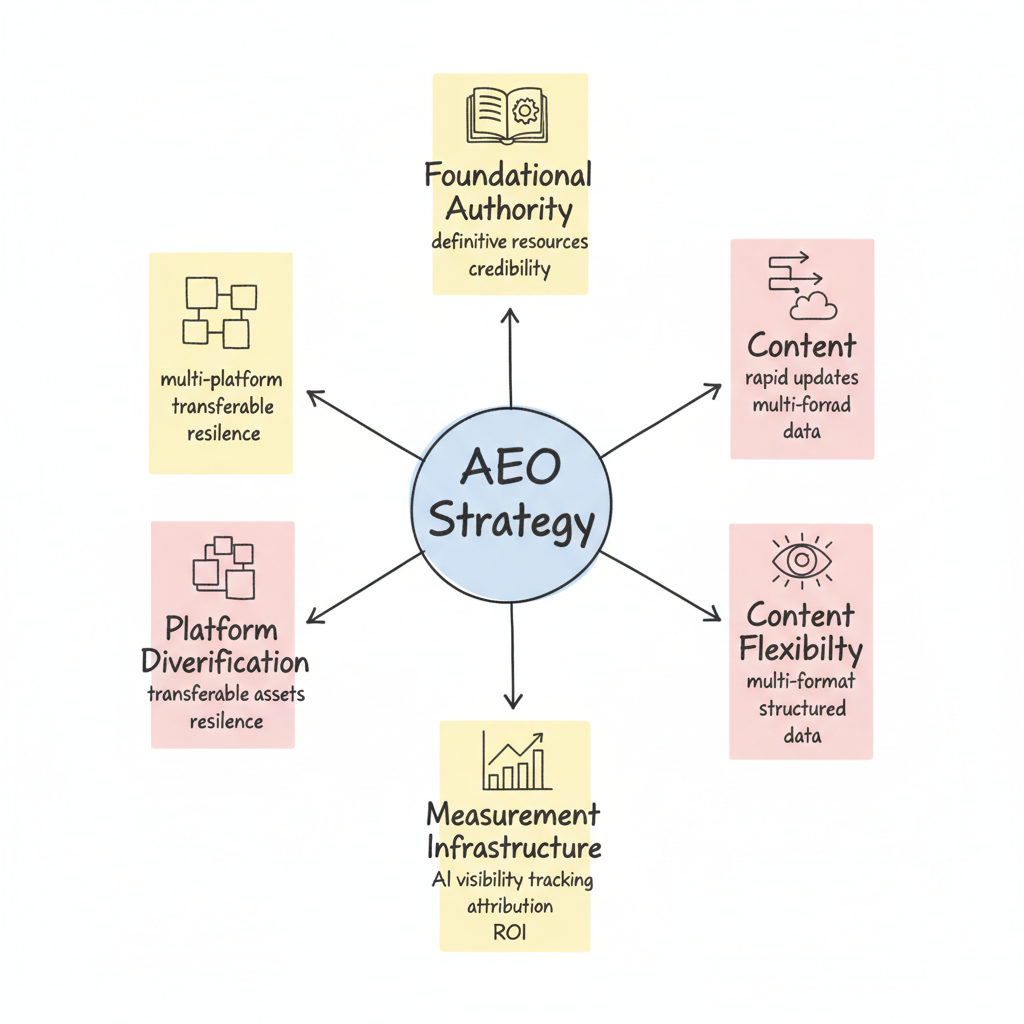
Build Foundational Authority
Long-term authority building becomes increasingly important.
Authority investments:
- Develop recognized expertise in core domains
- Create definitive resources on key topics
- Build consistent brand presence across channels
- Invest in credible authorship and credentials
Authority advantages compound over time as AI systems learn source reliability patterns. Building entity-based SEO and topical authority creates foundational signals that AI platforms increasingly rely on.
Develop Content Flexibility
Prepare for changing content requirements.
Flexibility capabilities:
- Content management systems supporting rapid updates
- Multi-format content production workflows
- Structured data infrastructure for emerging schemas
- Content refresh and versioning processes
Organizations with agile content operations adapt faster to platform changes.
Invest in Measurement Infrastructure
Measurement capabilities will evolve alongside platforms.
Infrastructure investments:
- AI visibility tracking tools
- Attribution modeling for AI traffic
- Competitive intelligence monitoring
- ROI measurement frameworks
Early measurement investment enables data-driven optimization as the field matures.
The AEO Measurement Stack: Tools and Metrics That Matter
Measuring AEO performance requires moving beyond traditional SEO analytics to a purpose-built measurement stack. While the tooling landscape is still maturing, several established platforms provide meaningful visibility into AI search performance.
Google Search Console remains the foundational measurement tool. Monitor impression and click changes as AI Overviews expand across query types. Track which queries trigger AI results and how your click-through rates shift in response. The Search Console performance report, filtered by search appearance, reveals how AI-generated results affect your organic traffic patterns.
Semrush has introduced AI visibility features that track featured snippet and AI Overview appearances. Its Position Tracking tool monitors keyword rankings alongside AI result triggers, enabling correlation analysis between traditional rankings and AI citation. Use the Organic Research tool to identify which of your pages appear in AI-generated answers and which competitors dominate AI visibility in your space.
Ahrefs provides critical organic authority signals that influence AI trust. Monitor keyword positions, backlink profile growth, and referring domain quality. Since AI platforms use authority signals similar to traditional search (domain trust, topical relevance, link equity), Ahrefs data serves as a proxy for AI citation potential.
Conductor has developed purpose-built AEO and GEO benchmarking capabilities. Their 2026 report provides industry-level benchmarks for AI visibility, making it possible to compare your AI citation performance against sector peers.
Beyond established tools, organizations should track emerging AEO-specific metrics:
- AI citation rate: How frequently your content is cited in AI-generated answers across platforms
- Answer engine impression share: Your brand's share of AI answer appearances for target queries
- Brand mention frequency: How often AI platforms reference your organization by name in responses
- Citation attribution accuracy: Whether AI platforms correctly link citations to your source URLs
No single tool captures the full AEO measurement picture yet. The most effective approach combines multiple data sources: Google Search Console for Google AI Overview tracking, platform-specific monitoring for ChatGPT and Claude citation, and competitive tools like Semrush and Ahrefs for relative authority measurement.
Maintain Platform Diversification
Avoid over-reliance on any single AI platform.
Diversification approach:
- Optimize for multiple AI platforms simultaneously
- Monitor emerging platform adoption in your audience
- Build transferable content assets
- Develop platform-agnostic authority signals
Platform market share will shift—diversified strategies provide resilience.
Preparing for Uncertainty
AEO prediction inherently involves uncertainty.
Managing uncertainty:
- Focus on fundamentals likely to remain valuable (quality, authority, structure)
- Build adaptable strategies rather than platform-specific tactics
- Monitor developments and adjust quarterly
- Allocate resources for experimentation and learning
Organizations treating AEO as static face obsolescence risk—continuous adaptation is required.
The Convergence of AEO and Traditional Marketing
AEO increasingly integrates with broader marketing strategy.
Integration trends:
- AEO visibility supporting brand awareness goals
- AI citations influencing purchase consideration
- Traditional PR and AEO strategies aligning
- Content marketing and AEO becoming inseparable
Siloed AEO programs yield to integrated approaches where AI visibility supports holistic marketing objectives.
Skills and Capabilities for Future AEO
Organizations need evolving capabilities for AEO success.
Emerging skill requirements:
- AI platform expertise across multiple systems
- Technical implementation (structured data, accessibility)
- Content strategy for AI consumption
- Analytics and measurement innovation
- Cross-functional collaboration and integration
AEO expertise becomes a core marketing competency rather than specialist function.
FAQs
Will AEO Replace Traditional SEO?
AEO complements rather than replaces SEO. Traditional search remains significant, and many SEO fundamentals (technical optimization, content quality, authority building) apply directly to AEO. Expect integration rather than replacement—effective strategies address both.
How Quickly Is AEO Evolving?
Rapidly. Strategies effective in early 2026 may require adjustment by mid-year. Major platform updates occur quarterly or more frequently. Organizations need ongoing monitoring and adaptation rather than static approaches.
Should I Wait for AEO to Stabilize Before Investing?
No. Early investment builds advantages that compound over time. Organizations establishing AI visibility now gain authority and learning that later entrants must work harder to achieve. The cost of waiting exceeds the cost of early experimentation.
How Does E-E-A-T Affect AEO Rankings in 2026?
E-E-A-T (Experience, Expertise, Authoritativeness, Trustworthiness) directly influences which content AI platforms cite in their answers. Answer engines like ChatGPT, Claude, and Gemini prioritize sources that demonstrate first-hand expertise and verifiable authority. To strengthen E-E-A-T for AEO, add author credentials, cite original research, include real case studies, and earn backlinks from trusted domains in your niche.
What Schema.Org Markup Should I Use for Answer Engine Optimization?
Prioritize FAQ Schema for question-answer content, Organization Schema to establish your brand entity, and Product Schema for e-commerce pages. LocalBusiness Schema is critical for geographic AEO. These structured data types help AI platforms parse your content accurately and increase the likelihood of citation in AI-generated answers. Test markup with Google's Rich Results Test before deploying.
How Do I Measure AEO Performance and AI Search Visibility?
Use Google Search Console to track impressions from AI-triggered queries, Semrush for AI visibility scoring and featured snippet tracking, and Ahrefs for monitoring organic authority signals. Emerging metrics include AI citation rate and answer engine impression share. No single tool covers all AI platforms yet, so combine multiple data sources for a complete picture.
Which AI Platforms Should I Optimize for Besides Google AI Overviews?
Beyond Google AI Overviews, optimize for ChatGPT (OpenAI), Claude (Anthropic), Microsoft Copilot, Perplexity, and Gemini. Each platform has different content preferences—Copilot draws from Bing's index, Claude emphasizes long-form authoritative content, and Perplexity favors cited sources. A multi-platform AEO strategy ensures visibility across the full AI search ecosystem.