
AEO and GEO courses have become essential for marketers adapting to the AI-transformed search landscape. As users increasingly discover information through ChatGPT, Perplexity, Google AI Overviews, and other AI platforms, traditional SEO skills alone no longer suffice. Answer Engine Optimization (AEO) and Generative Engine Optimization (GEO) require distinct competencies that structured learning programs can develop.
This guide examines what AEO and GEO courses cover, the skills they develop, and how to choose the right learning path for your career or team.
Understanding AEO and GEO: What You'Ll Learn
Before selecting courses, understanding what each discipline entails helps identify relevant training.
Answer Engine Optimization (AEO)
AEO focuses on optimizing content for featured snippets, knowledge panels, voice search responses, and direct answers that appear before traditional search results. When Google or voice assistants provide immediate answers rather than listing links, AEO determines whether your content becomes that answer.
Core AEO skills:
- Structured data implementation for answer selection
- Content formatting for featured snippet capture
- Voice search optimization techniques
- Knowledge panel optimization
- Schema markup for answer engine recognition
AEO targets single-answer systems where one source receives the featured position.
Generative Engine Optimization (GEO)
GEO prepares content for AI platforms that synthesize answers from multiple sources. ChatGPT, Perplexity, Claude, and Google AI Overviews generate responses by combining information from various citations. GEO influences which sources receive attribution within these generated responses.
Core GEO skills:
- Content structure for AI extraction
- Entity optimization for brand recognition
- Authority building AI systems recognize
- Cross-platform visibility strategies
- AI crawler access configuration
- Citation context monitoring
GEO addresses how AI systems reference, explain, and recommend brands within generated responses.
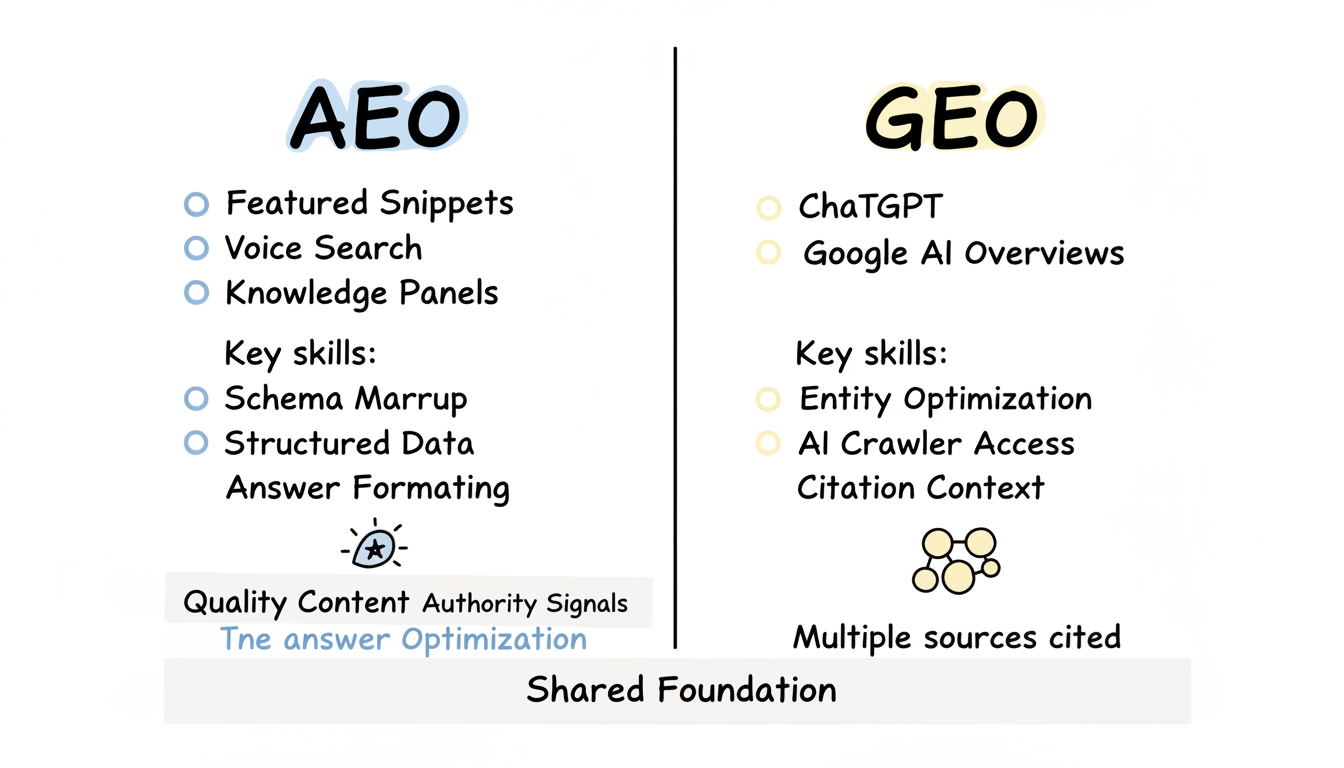
The Overlap
AEO and GEO share foundations—both require quality content, authority signals, and technical optimization. However, they target different discovery mechanisms. Comprehensive courses cover both disciplines, recognizing that effective AI visibility requires competence in each.
How AI Search Engines Retrieve Answers
Understanding how AI search engines work under the hood is essential before diving into optimization tactics. Modern AI platforms like ChatGPT Search, Perplexity, and Google AI Overviews rely on a process called Retrieval Augmented Generation (RAG) to produce accurate, cited responses.
RAG operates as a two-stage pipeline. First, the retrieval stage searches an index of web content to find passages relevant to the user's query. Then, the generation stage feeds those retrieved passages to a large language model, which synthesizes them into a coherent answer with citations. This retrieve-then-generate architecture means your content must be both discoverable by the retrieval system and useful enough for the generator to cite.
When a user submits a prompt, AI engines often perform query fan-out — decomposing the single question into multiple sub-queries. A question like "best AEO course for beginners" might generate sub-queries about AEO definitions, course comparison criteria, and beginner learning paths. Each sub-query retrieves different source documents, which means your content can earn citations across multiple facets of a single user question.
At the retrieval stage, content is matched using vector embeddings and cosine similarity scoring. Your pages are converted into numerical vector representations that capture semantic meaning. When a query arrives, the system computes similarity between the query vector and content vectors. This is why semantic relevance — writing content that genuinely addresses the topic — matters more than exact keyword matching in AI search.
Crucially, AI engines perform chunk-level retrieval rather than indexing whole pages. The system pulls specific passages, paragraphs, or sections that answer the query. This makes heading structure, concise paragraphs, and self-contained sections critical. Each section of your content should be able to stand alone as a meaningful answer when extracted from context. Courses that teach structured data for AI search emphasize this principle as foundational to GEO success.
Building an AEO Strategy: What Top Courses Teach
An effective AEO strategy goes beyond individual optimization tactics. The best courses teach a systematic framework for auditing, optimizing, and measuring AI search visibility across platforms.
The foundation of any AEO strategy is an AI search audit methodology. This involves systematically querying your brand and key topics across ChatGPT, Perplexity, Gemini, and Google AI Overviews, then logging whether your content is cited, how accurately it is represented, and where competitors appear instead. Structured courses provide audit templates and scoring rubrics that teams can use for repeatable assessments. Practitioners looking for audit tooling can explore AEO tools and software that streamline this process.
Co-occurrence optimization is another core concept in advanced AEO curricula. This technique ensures your brand appears alongside relevant entities in both training data and live-indexed pages. When AI models consistently encounter your brand in the context of specific topics, they develop stronger associations — making citations more likely when users ask about those topics.
Courses also address zero-click optimization as a strategic imperative. With approximately 58% of searches now ending without a click to external sites, optimizing for answer-box placements and AI-generated responses is no longer optional — it is essential for maintaining visibility. An effective AEO strategy treats zero-click results as a primary channel rather than a threat.
Comparison content formats receive significant attention in AEO training. Two-way comparisons ("X vs Y"), three-way evaluations, and "alternative to" content structures are preferentially cited by LLMs because they provide structured, balanced information that AI engines can extract cleanly. Courses teach how to create these formats with AEO optimization examples demonstrating measurable citation improvements.
Finally, the concept of information gain — creating original data, unique perspectives, or novel frameworks — distinguishes content that AI engines actively surface from content that merely restates existing knowledge. Information gain is what earns your content a citation when multiple sources cover the same topic.
Essential Skills AEO GEO Courses Develop
Structured courses develop specific competencies beyond what self-directed learning typically provides.
Technical Configuration Skills
AI visibility requires technical foundations many marketers lack:
- Schema markup implementation: Understanding JSON-LD, Organization schema, FAQPage schema, HowTo schema, and other structured data types
- Robots.txt configuration: Ensuring AI crawlers (GPTBot, ClaudeBot, PerplexityBot) can access content
- Server-side rendering: Making content accessible without JavaScript execution
- llms.txt files: Configuring explicit AI guidance where supported
Courses provide hands-on practice implementing these technical elements.
Content Architecture Skills
Creating content AI systems want to cite requires structural understanding:
- Answer-first formatting: Structuring sections with direct answers before supporting detail
- Question-based organization: Headers matching conversational query patterns
- Extraction-friendly paragraphs: Standalone statements that work when quoted in isolation
- FAQ development: Building question banks that mirror actual user queries
Practical exercises in courses develop these architectural instincts.
Authority Building Skills
AI systems prioritize authoritative sources. Courses teach:
- Entity clarity development: Ensuring consistent brand representation across properties
- Expert signal creation: Building content demonstrating genuine expertise
- External validation strategies: Earning mentions from respected sources
- Knowledge base presence: Developing Wikipedia and Knowledge Graph relevance
Authority building requires strategic understanding courses can provide. For those seeking guidance on establishing authority signals, learning how to choose an AEO agency provides insights into the expertise markers that distinguish effective practitioners.
Measurement and Analysis Skills
Tracking AI visibility differs from traditional SEO metrics:
- Citation monitoring: Tracking brand mentions across AI platforms
- Sentiment analysis: Understanding how AI represents your brand
- Competitive benchmarking: Measuring visibility against competitors
- Attribution tracking: Connecting AI visibility to business outcomes
Courses introduce tools and frameworks for meaningful measurement.
What to Look for in AEO GEO Courses
Not all courses deliver equal value. Evaluate programs against these criteria.
Current and Accurate Content
AI search evolves rapidly. Courses must reflect current platform behaviors rather than outdated practices. Look for:
- Publication or update dates showing 2025-2026 currency
- References to current AI platforms (ChatGPT with search, Google AI Overviews, Perplexity)
- Acknowledgment that techniques evolve as platforms update
- Regular content updates reflecting platform changes
Courses based on 2023-era understanding miss significant developments. Understanding SearchGPT ranking factors demonstrates the kind of current, platform-specific knowledge quality courses should provide.
Practical Application Focus
Theory without application produces limited skill development. Effective courses include:
- Hands-on exercises implementing techniques
- Real-world case studies demonstrating results
- Project-based learning with actual optimization
- Tools and templates for implementation
Beware courses that only describe concepts without practicing them.
Instructor Credibility
Evaluate instructor backgrounds for relevant experience:
- Active practitioners working with AI optimization
- Demonstrated results from their own implementations
- Recognition within SEO and AI visibility communities
- Current engagement with evolving best practices
Theory-only instructors may lack practical implementation insight.
Comprehensive Coverage
Complete programs address both AEO and GEO alongside foundational SEO:
- Traditional SEO foundations (since AI citations correlate with rankings)
- AEO-specific techniques for featured snippets and voice search
- GEO-specific strategies for AI platform visibility
- Integration approaches coordinating all disciplines
Narrow coverage leaves skill gaps. Understanding Google AI Overview SEO optimization shows how effective courses integrate traditional SEO with AI-specific strategies.
Platforms and Tools to Practice On
Effective AEO and GEO courses provide hands-on experience across the full spectrum of AI search platforms. Beyond ChatGPT and Perplexity, practitioners should develop familiarity with Gemini — Google's AI assistant that integrates directly with Google Search results, making it a critical platform for visibility testing. Google AI Mode, the next evolution beyond AI Overviews, is currently rolling out and represents the future of how Google surfaces AI-generated answers.
Courses are also beginning to address optimization for Deep Research — the emerging multi-step research format available in both ChatGPT and Gemini. Deep Research queries trigger comprehensive, multi-source investigations that produce long-form reports, creating new opportunities for content citation across extended AI-generated outputs.
On the measurement side, citation monitoring tools are essential for tracking how AI platforms mention your brand. Dedicated platforms exist for monitoring AI citations, and server log analysis can reveal GPTBot and ClaudeBot crawl activity on your content. For a comprehensive overview of available tracking solutions, see our guide to AI citation tracking tools. Understanding the Google AI Overview SEO impact on traffic patterns helps practitioners contextualize their monitoring data.
Course Format Options
Different formats suit different learning styles and constraints.
Self-Paced Online Courses
Platforms like Udemy, Coursera, and LinkedIn Learning offer self-paced AEO GEO training.
Advantages:
- Flexible scheduling around existing commitments
- Lifetime access for reference
- Lower cost than live programs
- Learn at your own pace
Considerations:
- Limited interaction with instructors
- Self-discipline required for completion
- May lack current updates
- No personalized feedback
Self-paced works for motivated learners who can maintain momentum independently.
Live Online Programs
Instructor-led virtual courses provide interactive learning.
Advantages:
- Real-time Q&A with instructors
- Cohort-based networking
- Structured timeline ensuring completion
- Personalized feedback on work
Considerations:
- Fixed schedule requirements
- Higher cost than self-paced
- Dependent on instructor quality
- Limited replay options sometimes
Live formats suit learners who benefit from structure and interaction.
In-Person Workshops
Intensive workshops deliver immersive learning experiences.
Advantages:
- Deep focus without distractions
- Hands-on implementation guidance
- Networking with peers
- Immediate expert feedback
Considerations:
- Travel and time requirements
- Highest cost option
- Limited availability
- Location constraints
Workshops work for teams investing in rapid skill development.
Internal Training Programs
Organizations building AI visibility competencies may develop custom training.
Advantages:
- Tailored to organizational context
- Uses actual brand examples
- Addresses specific competitive challenges
- Builds team alignment
Considerations:
- Requires internal expertise or external consultants
- Development investment
- May miss external perspectives
Custom programs suit enterprises with specific capability needs.
Building Your Learning Path
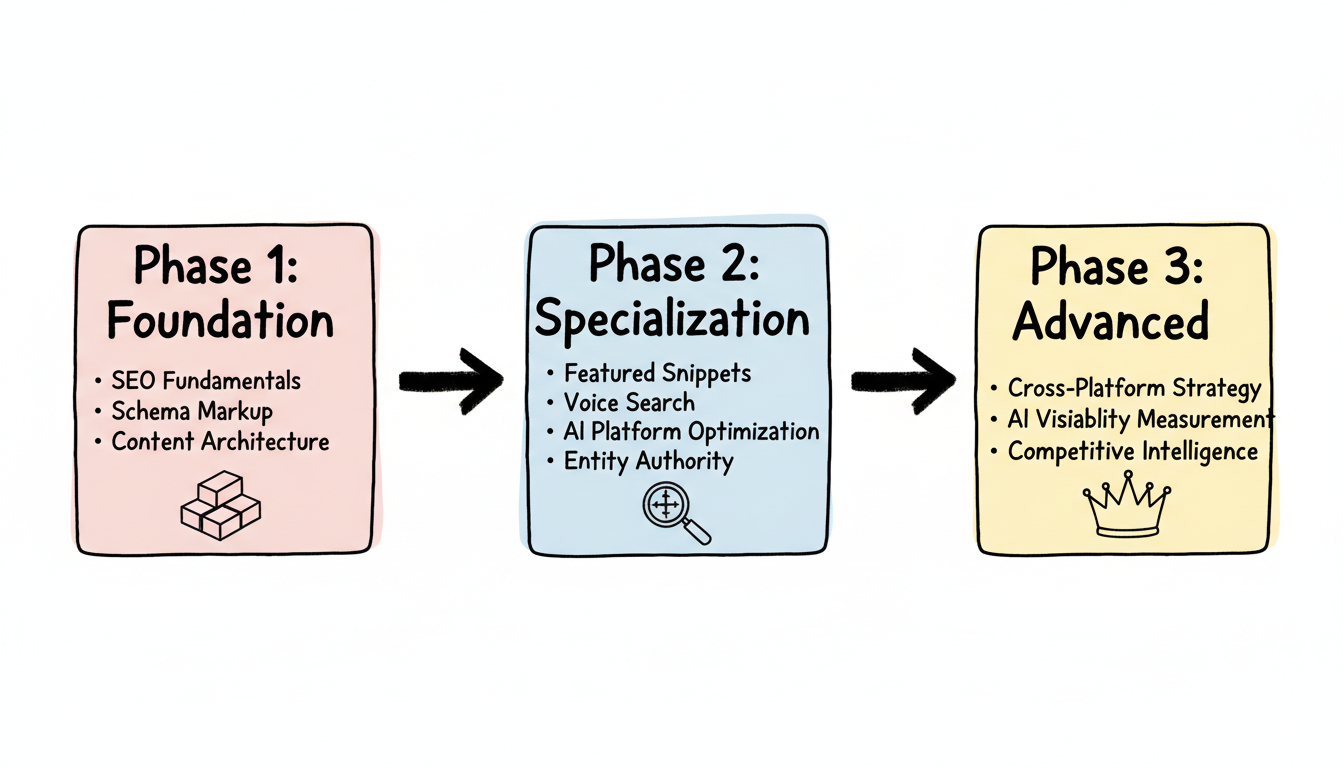
Rather than single courses, consider progressive skill development.
Foundation Phase
Start with core competencies:
- Traditional SEO fundamentals (if not already proficient)
- Structured data and schema markup implementation
- Content architecture principles
Strong foundations enable advanced AEO GEO learning.
Specialization Phase
Develop AEO and GEO-specific skills:
- Featured snippet optimization techniques
- Voice search and answer engine targeting
- AI platform content optimization
- Entity and authority development
Specialization builds on foundational knowledge. Exploring AI Overview citation analysis demonstrates the analytical skills that distinguish advanced practitioners from beginners.
Advanced Phase
Master strategic and analytical capabilities:
- Cross-platform visibility strategy
- AI visibility measurement and analytics
- Competitive intelligence for AI search
- Integration with broader marketing strategy
Advanced skills differentiate practitioners.
Reddit, Forums, and Community Signals
An often-overlooked element of advanced AEO and GEO learning is the role of community platforms as citation amplifiers. LLMs frequently cite Reddit threads as social proof when generating responses, particularly for recommendation and comparison queries. Participating authentically in relevant subreddits — sharing genuine expertise, answering questions, and contributing to discussions — can amplify how often AI engines reference your brand in generated answers.
Courses increasingly cover AI-friendly brand language as a core skill. This means structuring your brand messaging so it is unambiguous and consistently cited by LLMs: using consistent naming conventions, clear value propositions, and entity-rich descriptions across all your web properties. When AI models encounter the same clear brand signals repeatedly across authoritative sources and community discussions, they develop stronger associations that translate into more frequent and accurate citations.
Applying Course Learning
Courses provide knowledge — application produces results.
Immediate Implementation
After completing courses, implement learning on priority content:
- Optimize highest-value pages for AI extraction
- Implement technical configurations (schema, crawler access)
- Structure new content following learned principles
- Establish baseline measurement for tracking improvement
Ongoing Practice
Skill development requires continuous practice:
- Apply techniques to new content consistently
- Monitor results and refine approaches
- Stay current as platforms evolve
- Share learnings with team members
Measurement Validation
Confirm course investment produces returns:
- Track citation frequency changes
- Monitor featured snippet capture rates
- Measure competitive visibility shifts
- Connect improvements to business outcomes
Frequently Asked Questions
What Is the Difference Between AEO and GEO?
AEO (Answer Engine Optimization) focuses on getting your content selected as the direct answer in AI-powered search results from platforms like ChatGPT and Perplexity. GEO (Generative Engine Optimization) is the broader discipline of optimizing for any generative AI output, including Google AI Overviews and Gemini. In practice, a good AEO strategy is a subset of a comprehensive GEO approach.
Do I Need a Generative Engine Optimization Course, or Can I Learn AEO on My Own?
Self-study is viable if you have an SEO background — start with RAG fundamentals, schema markup, and llms.txt implementation. A structured course accelerates learning by providing audit frameworks, hands-on exercises, and instructor feedback on real sites. Courses are most valuable for teams that need a shared methodology and measurable AEO strategy.
How Long Does It Take to See Results from AEO and GEO Optimization?
Initial improvements in AI citation visibility can appear within 4 to 8 weeks after implementing structured data, improving chunk-friendly content formatting, and submitting an llms.txt file. Sustained gains in branded AI mentions and zero-click visibility typically take 3 to 6 months of consistent optimization and content publishing.
Is There a Certification for Answer Engine Optimization?
Formal AEO certifications are still emerging. Some training providers offer completion certificates, and platforms like Udemy and Coursera include AEO modules within broader AI marketing programs. The most recognized credentials come from completing hands-on course projects with measurable AI visibility improvements rather than a single standardized exam.
Do I Need Traditional SEO Knowledge Before Taking AEO GEO Courses?
Strong SEO foundations help significantly. Research shows 87% of AI citations come from content ranking in organic positions 1-10. Courses assuming SEO knowledge move faster; beginners should start with SEO fundamentals first.
How Long Does It Take to Develop AEO GEO Skills?
Foundational concepts can be learned in days to weeks. Developing practical proficiency typically requires 2-3 months of applying learned techniques. Mastery emerges through ongoing practice as you encounter varied optimization challenges.
Are AEO GEO Certifications Valuable?
Certifications demonstrate structured learning completion and may support career advancement. However, practical results matter more than credentials. Focus on skill development and documented results rather than certification collection.
Should My Whole Marketing Team Take AEO GEO Courses?
Core team members handling SEO and content strategy benefit from comprehensive training. Others may need awareness-level education understanding how AI visibility affects their work without mastering implementation details.