
Understanding the differences between SEO, AEO, and GEO helps you build a complete visibility strategy for 2026. This quick reference breaks down each approach with comparison tables you can use for planning and stakeholder communication. Note that GEO is also referred to as "generative engine optimization" or sometimes "LLMO (Large Language Model Optimization)," and awareness of these variant terms helps when researching the space.
The Core Comparison Table
Aspect | SEO | AEO | GEO |
Full Name | Search Engine Optimization | Answer Engine Optimization | Generative Engine Optimization |
Primary Goal | Rank pages in search results | Get selected as the answer | Get cited in AI responses |
Target Platforms | Google, Bing, Yahoo | Featured Snippets, Voice Search, AI Overviews | ChatGPT, Claude, Perplexity, Gemini |
Success Metric | Rankings, organic traffic | Answer box appearances, voice responses | AI citations, mention frequency |
Competition Type | Position 1-10 rankings | Winner-take-most for answers | Multiple sources cited |
Content Focus | Keyword-optimized pages | Extractable, concise answers | Comprehensive, authoritative depth |
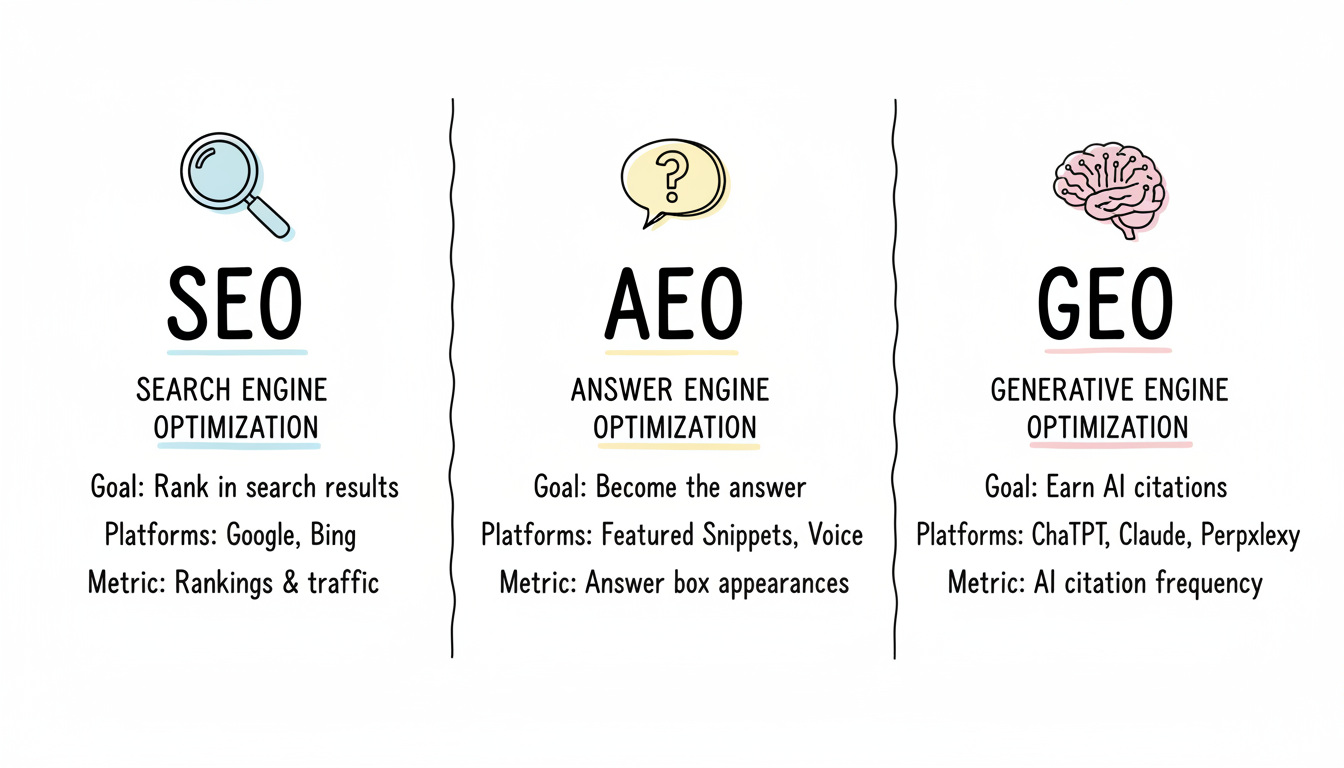
What Each Approach Optimizes For
SEO: Ranking in Search Results
SEO targets visibility in traditional search engine results pages. The goal is earning positions on page one where users can find and click through to your content.
Key activities:
- Keyword research and optimization
- Technical site health (speed, mobile, crawlability)
- Backlink building
- Content quality and relevance
Success looks like: Higher rankings, increased organic traffic, improved click-through rates.
AEO: Becoming the Answer
AEO targets selection as the direct answer to user queries. When search engines display answers without requiring clicks, AEO determines whose content gets featured. Structured data helps content enter the Knowledge Graph, which feeds both featured snippets and AI answers. AEO matters because zero-click searches now account for a growing share of queries, meaning visibility without clicks is the new baseline.
Key activities:
- Structuring content in Q&A format
- Optimizing for featured snippets
- Voice search optimization
- Schema markup implementation and structured data for AI search
Success looks like: Featured snippet captures, voice assistant selections, position zero appearances.
GEO: Earning AI Citations
GEO targets citation in AI-generated responses. When LLMs synthesize answers from multiple sources, GEO determines whether your content gets referenced. AI platforms use dedicated LLM crawlers such as GPTBot and PerplexityBot to index content, so ensuring these crawlers are not blocked in your robots.txt is a prerequisite for GEO success.
Key activities:
- Building topical authority—consistent, interlinked coverage of a subject area that signals expertise to both search engines and AI systems, also known as entity-based SEO and topical authority
- Creating citation-worthy depth
- Strengthening E-E-A-T signals
- Cross-platform presence building
Success looks like: AI citations, brand mentions in ChatGPT/Claude/Perplexity responses, AI referral traffic.
The Emerging 4th Pillar: AIO (AI Optimization)
AIO, or AI Optimization, is an umbrella term that some practitioners use to encompass both AEO and GEO under a single discipline focused on AI-driven discovery. The relationship is straightforward: SEO targets search engines, AEO targets answer boxes, GEO targets generative AI outputs, and AIO is the strategic wrapper that unifies AEO and GEO into one coordinated effort.
Search interest in the term is growing—"seo vs aio" sees roughly 90 searches per month with a +467% year-over-year increase. Whether you treat AEO and GEO as separate workstreams or bundle them under AIO, the underlying tactics remain the same. The value of AIO as a concept is in giving teams a single label for all AI-focused optimization work, which simplifies planning, budgeting, and reporting. For a deeper look at how AI platforms process and surface content, see our guide on optimizing content for ChatGPT.
Platform Coverage Comparison
Platform | SEO Relevant | AEO Relevant | GEO Relevant |
Google Search (organic) | Yes | Partial | No |
Google Featured Snippets | Yes | Yes | Partial |
Google AI Overviews | Yes | Yes | Yes |
Bing Search | Yes | Partial | No |
ChatGPT Search | Partial | Partial | Yes |
Perplexity | Partial | Partial | Yes |
Claude | No | Partial | Yes |
Gemini | Partial | Partial | Yes |
Voice Assistants | Partial | Yes | No |
Content Requirements Comparison
Requirement | SEO Priority | AEO Priority | GEO Priority |
Keyword optimization | High | Medium | Low |
Q&A structure | Medium | High | High |
Extractable answers | Medium | High | High |
Comprehensive depth | Medium | Low | High |
Original data/research | Medium | Low | High |
Author credentials | Medium | Medium | High |
Schema markup | High | High | High |
Freshness/updates | Medium | Medium | High |
Backlinks | High | Medium | Medium |
Cross-platform presence | Low | Low | High |
Technical Requirements
Technical Factor | SEO | AEO | GEO |
Site speed | Critical | Important | Important |
Mobile optimization | Critical | Important | Important |
Crawler access | Critical | Critical | Critical |
Schema markup | Important | Critical | Critical |
HTTPS security | Critical | Important | Important |
Clean HTML structure | Important | Critical | Critical |
JavaScript rendering | Important | Important | Important |
When to Prioritize Each
Prioritize SEO When:
- Building foundational online presence
- Targeting transactional keywords
- Seeking direct traffic and conversions
- Competing in established SERP landscapes
Prioritize AEO When:
- Targeting question-based queries
- Optimizing for voice search
- Seeking featured snippet visibility
- Answering factual, simple questions
Prioritize GEO When:
- Targeting research-focused audiences
- Building long-term brand authority
- Competing for complex, synthesized answers
- Seeking visibility in ChatGPT/Claude/Perplexity
The Relationship Between All Three
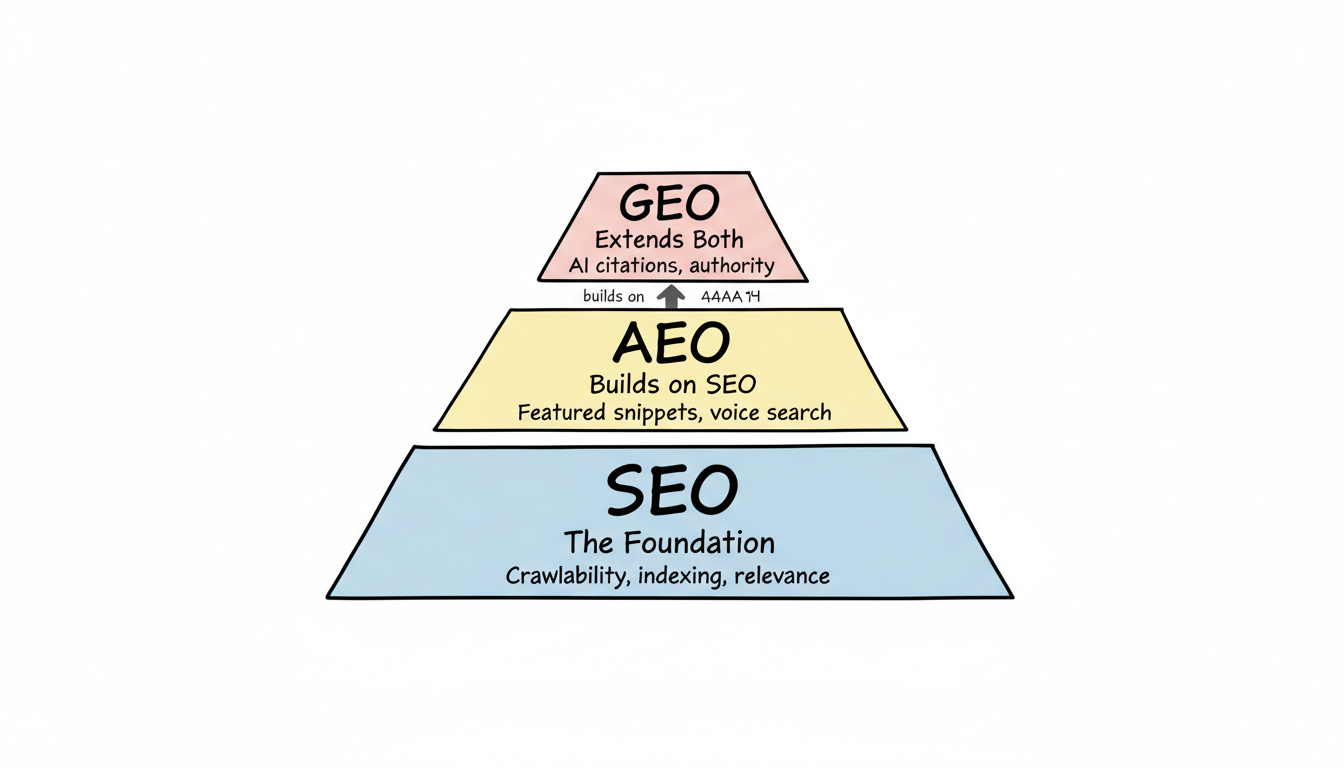
These approaches build on each other rather than competing:
SEO provides the foundation. Without crawlability, indexing, and basic relevance, neither AEO nor GEO can succeed. AI systems can't cite content they can't access.
AEO builds on SEO. Featured snippet optimization requires ranking well first. Answer engines draw from search-indexed content.
GEO extends both. Generative AI systems reference authoritative content that often ranks well and captures featured snippets.
Quick Decision Framework
Ask yourself:
- "Do we rank for important keywords?" → If no, start with SEO
- "Do we appear in featured snippets?" → If no, add AEO
- "Do AI systems cite us?" → If no, add GEO
Most organizations need all three working together. The question isn't which to choose—it's which to prioritize first based on current gaps. Understanding the differences between GEO and AEO helps you allocate resources effectively across both emerging channels.
Summary Table: Choose Your Focus
Your Situation | Primary Focus | Secondary Focus |
New website, no rankings | SEO | AEO |
Ranking well, missing snippets | AEO | GEO |
Strong SEO, invisible to AI | GEO | AEO |
Comprehensive strategy needed | All three | - |
How to Measure SEO, AEO, and GEO Success
Each strategy requires its own set of metrics to track progress and justify investment.
SEO Metrics
Track organic sessions, keyword rankings, click-through rate from SERPs, and the number of indexed pages. These are well-established indicators available through Google Search Console and standard analytics platforms.
AEO Metrics
Monitor your featured snippet ownership rate across target queries, People Also Ask appearances, and voice search answer rate. Position zero tracking tools can automate much of this, giving you a clear picture of answer engine visibility over time.
GEO Metrics
GEO measurement is newer and requires a more hands-on approach. Track AI citation frequency, brand mentions in AI-generated responses, referral traffic from AI platforms, and your AI Overview inclusion rate. The practice of citation tracking—monitoring whether AI systems reference your content when answering relevant queries—is becoming essential for GEO practitioners. Dedicated AI citation tracking tools can help automate this process. Establish a monthly audit cadence: check AI platforms for your target queries and log whether your content is cited, paraphrased, or absent. To understand the broader implications for organic traffic, see our analysis of Google AI Overview impact on SEO.
Resource Allocation: Where to Invest First
How you split effort across SEO, AEO, and GEO depends on where your business stands today. Here are suggested allocations for three common archetypes:
Established sites with strong organic traffic: 50% SEO (maintain and defend rankings), 20% AEO (capture answer boxes), 30% GEO (build AI visibility).
New sites building authority: 60% SEO (lay the foundation), 25% AEO (target quick wins in snippets), 15% GEO (begin building citations).
Content-heavy brands seeking AI visibility: 30% SEO (maintain baseline), 25% AEO (leverage existing content for answers), 45% GEO (prioritize AI platform presence).
SEO remains foundational in every scenario—AEO and GEO build on top of solid SEO fundamentals rather than replacing them. These allocations will shift as AI search adoption grows, so revisit them quarterly. For teams ready to go deeper on generative optimization, explore our guide to advanced GEO optimization techniques.
FAQs
Can I Do All Three Simultaneously?
Yes, and most successful strategies do. The tactics overlap significantly—structured content, schema markup, and authority building benefit SEO, AEO, and GEO together. Implementing proper schema markup validators ensures your technical foundation supports all three approaches.
Which Delivers Fastest Results?
SEO improvements can show within weeks. AEO (featured snippets) can change quickly with structural updates. GEO visibility builds more gradually as authority signals compound. For realistic expectations, review our AEO optimization timeline to understand typical progression across all three channels.
What Is the Difference Between GEO and SEO?
SEO focuses on ranking web pages in traditional search engine results through keyword optimization, backlinks, and technical performance. GEO focuses on getting your content cited or referenced by AI-powered search tools like AI Overviews and conversational AI platforms. SEO earns clicks from search result listings, while GEO earns visibility through AI-generated answers. Both require high-quality, authoritative content, but GEO places greater emphasis on structured data and topical authority.
Is AEO Replacing SEO?
No. AEO builds on top of SEO fundamentals rather than replacing them. Search engines still drive the majority of web traffic, and strong SEO performance increases your chances of appearing in answer boxes and featured snippets. Think of AEO as an extension of SEO that targets the answer layer. Businesses should invest in both, with SEO as the foundation and AEO as an amplification strategy.
How Do I Know If AI Systems Are Citing My Content?
Monitor your target queries across AI platforms such as AI Overviews, ChatGPT, and Perplexity on a regular cadence. Search your key topics and check whether your brand or URLs appear in the generated responses. Track referral traffic from AI platforms in your analytics. Establish a monthly audit log comparing citation presence against your priority keyword list to measure GEO progress over time.
What Is AIO and How Does It Relate to AEO and GEO?
AIO stands for AI Optimization and serves as an umbrella term that combines AEO and GEO under one strategic discipline. While AEO targets answer boxes and featured snippets, and GEO targets generative AI citations, AIO represents the broader goal of optimizing content for all AI-driven discovery channels. The term is gaining traction as marketers seek a unified framework for AI search visibility.