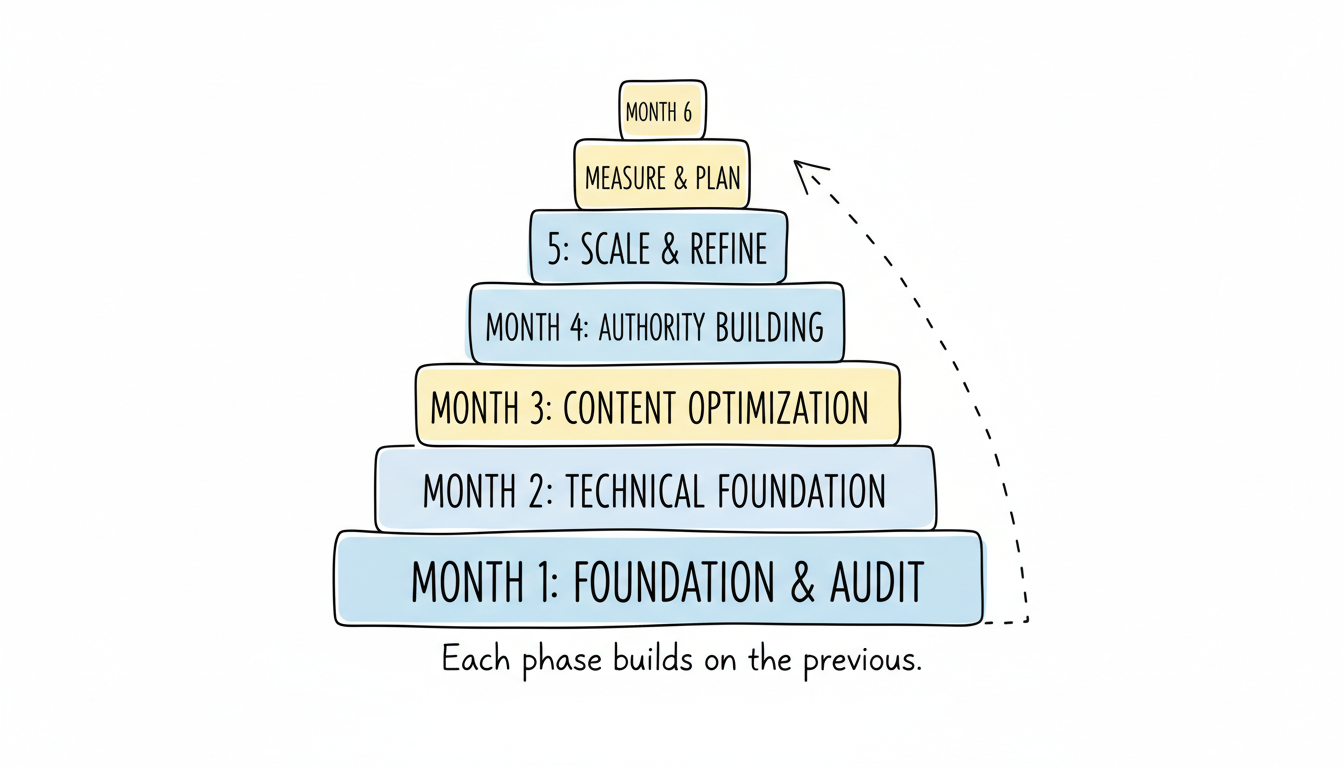
Successful AEO programs follow structured implementation phases. Jumping into optimization without proper foundation leads to wasted effort and unclear results. This roadmap provides month-by-month actions to systematically build AI search visibility.
Use this guide to plan resources, set realistic milestones, and ensure each phase builds on previous work.
The AI search landscape is growing rapidly. ChatGPT now serves 400M+ monthly active users, Perplexity processes 780M+ monthly queries, and research from Princeton and Georgia Tech shows that structured content achieves up to 40% higher visibility in AI-generated responses. These numbers underscore why a systematic AEO implementation plan is essential in 2026.
Month 1: Foundation and Audit
The first month establishes your starting point and strategic direction.
Week 1-2: Baseline Assessment
Technical audit tasks:
Task | Purpose | Output |
AI crawler access check | Verify GPTBot, ClaudeBot, PerplexityBot can crawl | robots.txt recommendations |
Schema markup audit | Assess existing structured data | Gap analysis document |
Page speed assessment | Identify performance barriers | Priority fix list |
Mobile rendering check | Ensure mobile-first compatibility | Issue documentation |
Visibility baseline tasks:
- Test 20-30 priority keywords across ChatGPT, Perplexity, Claude
- Document current citation frequency and competitors cited
- Screenshot baseline responses for comparison
Consider using AI citation tracking tools to automate the monitoring of your brand mentions across different AI platforms from the start.
Entity Health Check and Knowledge Graph Audit
Before diving into content optimization, assess your brand's entity presence across the knowledge sources that AI systems rely on. This step is critical because AI models build responses from entity relationships, not just keyword matches.
Entity audit checklist:
- Knowledge Graph presence: Search Google for your brand name and check whether a Knowledge Panel appears. If it does not, your entity is not well-established in Google's Knowledge Graph.
- Wikipedia and Wikidata: Verify whether your brand has a Wikipedia article or Wikidata entry. These are primary sources AI models reference for entity disambiguation.
- Entity disambiguation: Test whether AI platforms confuse your brand with unrelated entities. For niche terms like "AEO," SERP pollution from unrelated industries (such as customs and trade) is common.
- Answerability audit: Run 20-30 brand and topic queries across ChatGPT, Perplexity, and Claude. Document which queries return your brand, which return competitors, and which produce no relevant citation.
Strengthening your entity foundation ensures that AI systems can correctly identify and reference your brand. Learn more about Knowledge Graph optimization to accelerate this process.
AEO vs GEO: Choosing Your Strategy
Before committing resources, understand the distinction between AEO and GEO to set the right priorities for your roadmap.
AEO (Answer Engine Optimization) targets citation-driven platforms like ChatGPT, Perplexity, and Claude where users ask direct questions and receive sourced answers. The goal is earning citations and click-throughs from AI responses.
GEO (Generative Engine Optimization) is the broader discipline covering all generative AI outputs, including Google AI Overviews, AI-generated summaries, and conversational assistants. GEO encompasses AEO but also includes optimizing for zero-click AI experiences.
How to decide:
- Pursue AEO first if your audience uses AI chat tools for research and your business depends on referral traffic from citations.
- Pursue GEO first if Google AI Overviews are already impacting your organic traffic and brand visibility in search results matters most.
- Pursue both simultaneously if you have the resources and your audience spans both AI search and traditional search channels.
This roadmap covers both, but the tactical emphasis in months 2-3 shifts depending on your primary strategy.
Week 3-4: Strategy Development
Strategic planning deliverables:
- Content inventory: Catalog existing content by topic and format
- Opportunity mapping: Match content gaps to high-potential queries
- Competitive analysis: Document which competitors appear for target queries
- Priority matrix: Rank opportunities by impact vs. effort
End of Month 1 checkpoint:
- Technical audit complete
- Baseline visibility documented
- Entity health assessment completed
- AEO vs GEO strategic direction chosen
- 90-day priority roadmap approved
Month 2: Technical Foundation
Month two focuses on removing technical barriers to AI discovery.
Technical Implementation Tasks
Robots.txt configuration:
# Allow AI crawlers
User-agent: GPTBot
Allow: /

User-agent: ClaudeBot
Allow: /

User-agent: PerplexityBot
Allow: /
Schema markup priorities:
Week | Schema Type | Implementation Scope |
Week 1 | Organization | Company-wide |
Week 2 | FAQ | Top 10 FAQ pages |
Week 3 | Article | Blog posts |
Week 4 | HowTo | Procedural content |
Platform-Specific Optimization Setup
Each major AI platform has different citation preferences and technical requirements. Understanding these differences early allows you to tailor your technical foundation accordingly.
Platform | Citation Preference | Key Technical Factor | Content Signal |
ChatGPT | Authoritative, well-structured pages | GPTBot crawl access, clean HTML | Domain authority, factual depth |
Perplexity | Recent, citation-rich sources | PerplexityBot access, fast load times | Source recency, inline citations |
Claude | Comprehensive, well-organized content | ClaudeBot access, structured data | Thoroughness, clear hierarchy |
Google AI Overviews | Top-ranking, schema-rich pages | Standard Googlebot access, Core Web Vitals | E-E-A-T signals, featured snippet format |
Platform prioritization depends on your audience. B2B companies often see higher returns from ChatGPT and Perplexity, while consumer brands should prioritize Google AI Overviews. Explore the future of platform-specific AI search in 2026 to align your technical setup with audience behavior.
Speakable Schema and Voice Search
With voice assistants increasingly powered by AI models, implementing Speakable schema markup positions your content for voice search results.
Speakable schema identifies the sections of a page most suitable for text-to-speech playback. Implementation priorities:
- Mark concise answer paragraphs: Tag 2-3 sentence direct answers within each page as speakable content.
- Format for voice readability: Avoid abbreviations, complex punctuation, and visual-only elements in speakable sections.
- Target question-based queries: Voice searches are predominantly question-format queries, so align speakable sections with FAQ-style answers.
Site architecture tasks:
- Implement breadcrumb navigation if missing
- Add FAQ sections to high-priority pages
- Create clear heading hierarchies (H1-H4)
- Add internal links between related content
End of Month 2 checkpoint:
- All AI crawlers permitted
- Core schema types implemented
- Platform-specific technical requirements addressed
- Speakable schema added to priority pages
- Navigation structure optimized
Month 3: Content Optimization
Month three transforms existing content for AI extraction.
Content Restructuring Framework
Page-level optimization sequence:
- Lead with answers - Move key information to first paragraph
- Add structured sections - Clear H2/H3 hierarchy
- Include FAQ blocks - 3-5 questions per page
- Add context markers - Definitions, statistics, examples
- Update metadata - Titles, descriptions optimized for queries
This is where understanding different SearchGPT content format approaches becomes critical for structuring your pages effectively.
Answer-First Writing Standards
AI platforms extract and cite content that directly answers user queries. Adopting answer-first writing standards across your content ensures maximum citability.
Key principles for answer-first content:
- 40-60 word direct answers: Every page and major section should open with a concise, self-contained answer in the first paragraph. This is the text AI models are most likely to extract and cite.
- Information density scoring: Evaluate each paragraph for fact-to-word ratio. Aim for at least one specific data point, definition, or actionable detail per 50 words. Remove filler phrases like "it is important to note that" or "as we all know."
- Front-load specifics: Place numbers, names, dates, and concrete details in the first sentence of each section rather than burying them in supporting paragraphs.
- Eliminate content fluff: Audit existing pages for introductory throat-clearing, redundant transitions, and vague statements. Replace with factual content that AI systems can extract as standalone answers.
Pages with queries that trigger AI Overviews have seen up to 80% CTR drops in organic results. Writing in an answer-first format positions your content to capture visibility within those AI-generated responses rather than losing it.
Priority Content Categories
Optimize in this order:
Priority | Content Type | Reason |
1 | Product/service pages | Highest conversion value |
2 | Core how-to guides | High query match potential |
3 | FAQ and help content | Natural Q&A format |
4 | Industry definitions | Informational query targets |
5 | Case studies | Authority and trust signals |
Monthly Optimization Targets
Realistic month 3 targets:
- 15-20 pages fully restructured
- FAQ schema added to 10+ pages
- Internal linking updated across optimized pages
End of Month 3 checkpoint:
- High-priority pages optimized
- Answer-first writing standards applied
- Initial schema implementation verified
- Monitoring for first citations
Month 4: Authority Building
Month four expands beyond on-site optimization.
Third-Party Mention Strategy
Authority building tasks:
Activity | Target | Purpose |
Industry publications | 2-3 pitches | Expert mentions |
Podcast appearances | 1-2 bookings | Brand citations |
Data-driven content | 1 release | Citation-worthy research |
Partner collaborations | 2-3 mentions | Cross-referencing |
Expert positioning tasks:
- Update author bios with credentials
- Create dedicated team/about pages with expertise details
- Ensure consistent NAP (Name, Address, Phone) across web
- Claim and optimize industry profiles
Building authority through knowledge graph optimization helps establish your entity relationships that AI systems reference.
Expanding Platform Coverage
Cross-platform optimization:
- Review how content appears in Google AI Overviews
- Test visibility in Claude and Perplexity specifically
- Identify platform-specific optimization opportunities
- Adjust strategy based on platform performance differences
Understanding the future of platform-specific AI search in 2026 will help you allocate resources to the platforms with highest ROI potential.
End of Month 4 checkpoint:
- Third-party mention campaign launched
- Author/expert pages enhanced
- Platform-specific patterns identified
Month 5: Scaling and Refinement
Month five expands successful patterns.
Scaling What Works
Analysis and replication:
- Identify pages generating citations
- Document what differentiates successful pages
- Apply patterns to similar content
- Create templates for new content
Expanded content targets:
- 20-30 additional pages optimized
- New content created using proven formats
- Legacy content updated with winning structures
Comparison Content Strategy
Comparison and alternatives content is one of the highest-performing content types for AI citations. When users ask AI platforms questions like "What is the best X?" or "X vs Y," the models draw heavily from well-structured comparison pages.
Building your comparison content library:
- "vs" pages: Create direct head-to-head comparisons for your product or service against top competitors. Structure these with consistent criteria (pricing, features, use cases) so AI models can extract clean, balanced answers.
- "Alternatives to" pages: Build listicle-style pages covering alternatives to major players in your space. These capture high-intent queries that AI platforms frequently field.
- Category roundups: Publish "best of" guides for your industry category. Include specific evaluation criteria, pros and cons, and clear recommendations.
Comparison content earns AI citations because it directly answers evaluative queries with structured, factual information that models can confidently reference.
Process Documentation
Build repeatable processes:
- Content optimization checklist
- Schema implementation standards
- Internal linking guidelines
- Quality assurance procedures
Performance Optimization
Refinement tasks:
- A/B test different content structures
- Compare citation rates by page format
- Identify underperforming optimized pages
- Iterate based on data
End of Month 5 checkpoint:
- Scaling playbook documented
- Comparison content library started
- Additional pages optimized
- Clear patterns identified
Month 6: Measurement and Strategy Refresh
Month six assesses results and plans the next phase.
Six-Month Review
Performance assessment:
Metric | Baseline | Month 6 | Change |
Citation frequency | [baseline] | [current] | [delta] |
Keywords with visibility | [baseline] | [current] | [delta] |
AI referral traffic | [baseline] | [current] | [delta] |
Competitive position | [baseline] | [current] | [delta] |
ROI calculation:
- Total investment (agency + internal resources)
- Attributed traffic value
- Lead/conversion attribution
- Brand visibility value estimation
New AEO Kpis for 2026
Traditional SEO metrics do not fully capture AEO performance. Add these emerging KPIs to your measurement framework at the 6-month review:
- Share of Model (SoM): The percentage of relevant AI-generated responses that mention or cite your brand versus competitors. This is the AEO equivalent of Share of Voice and is becoming the primary metric for AI visibility programs.
- Zero-click measurement: Track queries where AI platforms provide a complete answer without sending traffic to your site. Understanding your zero-click exposure helps quantify brand impressions that do not appear in analytics.
- Brand search volume as AEO proxy: Monitor branded search volume trends. Increases in brand searches often correlate with higher AI visibility, as users who encounter your brand in AI responses subsequently search for you directly.
- AI referral traffic attribution: Segment analytics to isolate traffic from AI platforms. Look for referral sources from chat.openai.com, perplexity.ai, and other AI interfaces. Set up UTM-tagged links where possible to improve attribution accuracy.
Use these KPIs alongside traditional metrics to build a complete picture of how your AEO program is performing across the AI search ecosystem.
Next Phase Planning
Strategic decisions:
- Continue current approach or adjust
- Expand to additional content areas
- Increase or maintain investment level
- Add platforms or double down on performers
End of Month 6 checkpoint:
- Comprehensive results report
- New AEO KPIs baselined
- ROI documentation
- Next phase strategy approved
Resource Planning Guide
Plan resources realistically for each phase.
Typical resource requirements:
Month | Internal Hours/Week | External Support |
1 | 10-15 | Audit support |
2 | 8-12 | Technical implementation |
3 | 12-20 | Content optimization |
4 | 8-12 | PR/outreach support |
5 | 15-25 | Scaling content work |
6 | 5-10 | Analysis and planning |
Common Implementation Mistakes
Avoid these roadmap pitfalls.
Timing mistakes:
- Skipping month 1 audit (leads to misdirected effort)
- Rushing technical foundation (creates ongoing issues)
- Starting authority building before on-site optimization
- Expecting results before month 3-4
Resource mistakes:
- Underestimating content optimization time
- Not allocating internal review resources
- Stopping after initial implementation (requires ongoing work)
Frequently Asked Questions
What Is the Difference Between AEO and GEO?
AEO (Answer Engine Optimization) focuses on optimizing content to be cited by AI-powered answer engines like ChatGPT, Perplexity, and Claude. GEO (Generative Engine Optimization) is a broader discipline that encompasses optimizing for all generative AI outputs, including AI Overviews, AI-generated summaries, and conversational AI responses. AEO is a subset of GEO focused specifically on citation-driven answer platforms. Most organizations benefit from pursuing both, starting with whichever aligns with their primary audience behavior.
How Do I Measure AEO Success?
Key AEO metrics for 2026 include Share of Model (how often your brand appears in AI responses vs. competitors), AI referral traffic attribution, citation frequency across platforms, zero-click measurement, and brand search volume as a proxy for AI-driven awareness. Track these monthly against your Month 1 baseline. Traditional metrics like organic traffic and keyword rankings remain relevant but do not capture the full picture of AI visibility.
Which AI Platforms Should I Optimize for First?
Start with the platforms your audience uses most. ChatGPT has 400M+ monthly active users and favors well-structured, authoritative content. Perplexity processes 780M+ monthly queries and heavily weights source recency and citations. Google AI Overviews reaches the broadest search audience. For B2B companies, ChatGPT and Perplexity often deliver higher ROI. For consumer brands, Google AI Overviews should be the priority. Use analytics data to confirm where your audience spends time.
When Will I See Results from AEO Implementation?
Most organizations begin seeing initial AI citations by month 3-4 of a structured implementation. Meaningful, consistent visibility typically develops by month 5-6. Full ROI assessment is best done at the 6-month mark. Results compound over time as authority signals strengthen and content optimizations accumulate. Patience is essential -- unlike paid search, AEO results build incrementally.
For teams ready to operationalize this, a structured AEO experimentation framework turns visibility work into a repeatable test program with hypotheses, cohort design, and citation metrics.
Key Takeaways
Follow this implementation roadmap for structured AEO success:
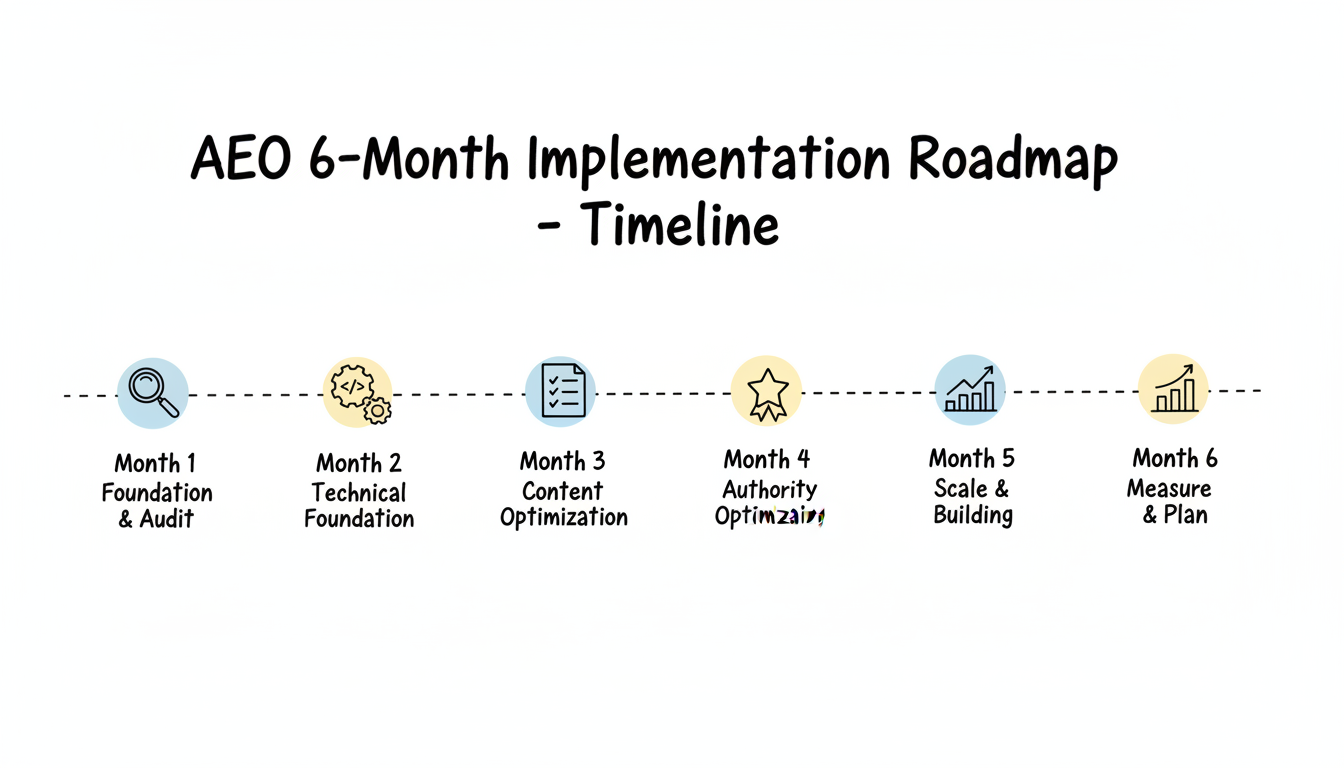
- Month 1: Audit and strategy -- establish baseline, entity health check, choose AEO vs GEO direction
- Month 2: Technical foundation -- remove barriers, set up platform-specific optimization, implement Speakable schema
- Month 3: Content optimization -- apply answer-first writing standards, restructure pages for AI extraction
- Month 4: Authority building -- expand beyond on-site work
- Month 5: Scale and refine -- replicate successful patterns, build comparison content library
- Month 6: Measure and plan -- assess results with new AEO KPIs, plan next phase
Sequential implementation builds each phase on previous work. Skipping phases or rushing timelines typically produces weaker results than disciplined execution of this roadmap.