
Traditional keyword research focuses on search volume and ranking difficulty. AEO keyword research requires a different approach—identifying queries where AI systems seek authoritative sources to cite and where your organization can provide definitive answers. This guide outlines frameworks for discovering and prioritizing AEO keyword opportunities.
AEO is sometimes confused with GEO (Generative Engine Optimization). While AEO encompasses all answer engines—including voice assistants and traditional featured snippets—GEO focuses specifically on generative AI outputs. AEO keyword research applies to both disciplines, as the foundational query analysis is the same.
How AEO Keywords Differ from SEO Keywords
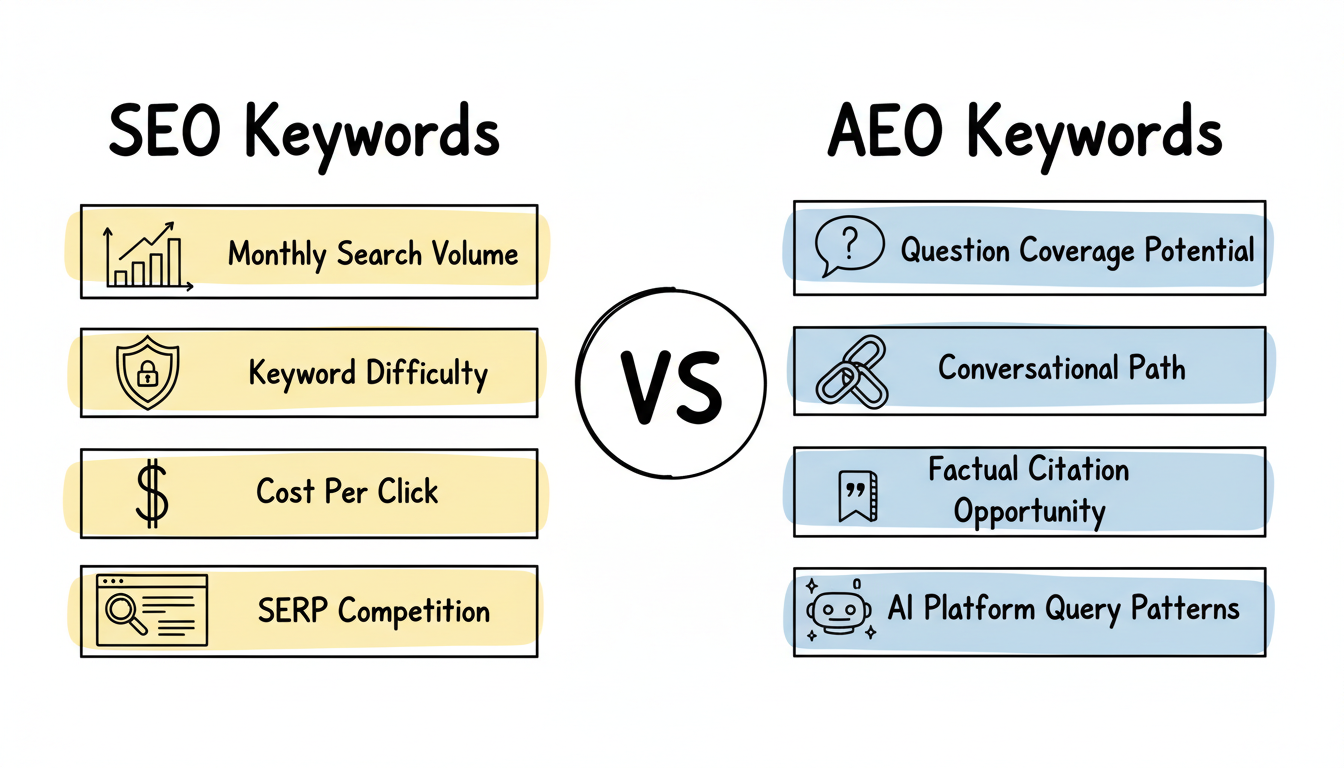
AEO keyword research extends beyond traditional search metrics.
Traditional SEO keyword factors:
- Monthly search volume
- Keyword difficulty
- Cost per click
- SERP competition
AEO-specific factors:
- Question coverage potential
- Conversational path positioning
- Factual citation opportunity
- AI platform query patterns
While search volume still matters, AEO success depends more on becoming the authoritative answer for specific questions than ranking for high-volume terms.
How Llms Find and Cite Your Content (and Why It Matters for Keyword Research)
To do AEO keyword research effectively, it helps to understand how large language models (LLMs) built by organizations like OpenAI (ChatGPT) and Anthropic (Claude) actually retrieve and synthesize content when generating answers.
Modern AI answer engines use a process called Retrieval Augmented Generation (RAG). Think of RAG as the AI equivalent of checking its sources before answering a question. When a user asks a query, the system first searches an index of web content to find relevant pages, then uses the LLM to synthesize those sources into a coherent response—often with citations back to the original content. This is how platforms like Perplexity, Google Gemini, and ChatGPT ground their answers in real-world information rather than relying solely on training data.
The critical difference for keyword research: LLMs do not match keywords the way traditional search indexes do. They interpret semantic meaning, entity relationships, and topical authority signals. A page optimized for an exact-match keyword may be invisible to AI systems if it lacks the depth, structure, and entity coverage that signal genuine expertise. Knowledge graphs—structured representations of entity relationships—are another layer AI systems use to understand how concepts connect. Structuring your content around well-defined entities (people, organizations, concepts, products) increases the probability that AI systems will select your content for citation.
The implication for AEO keyword research is clear: target question clusters and entity-rich topics rather than isolated keyword strings. Build content that demonstrates comprehensive understanding of a topic area, and structure it so AI systems can easily parse and extract authoritative answers.
Featured Snippets and Zero-Click Search: The AEO Keyword Bridge
Featured snippets are the predecessor to AI-generated answers. Keywords that currently trigger featured snippets are high-probability AEO targets because they already demonstrate that search engines consider the query answerable with a direct response.
This connects directly to the rise of zero-click search—as more users get answers directly on the SERP or from AI systems without clicking through to websites, optimizing for answer-ready formats becomes critical. Pages that win featured snippets often get cited in Google AI Overviews, making this a dual-benefit strategy.
Practical tip: Use Semrush or Ahrefs to filter keywords by "SERP features: Featured snippet" to build an AEO keyword candidate list from existing featured snippet opportunities. Consider this Step 0 in your AEO keyword research process—a pre-filter that identifies queries already validated as answer-ready. For a deeper look at how AI Overviews are reshaping search behavior, see our analysis of Google AI Overview SEO impact.
AEO Keyword Research Frameworks
Several frameworks help identify valuable AEO opportunities.
Question-First Research
AI users ask questions conversationally. Start research by identifying questions your audience asks.
Question discovery sources:
- AI platform testing (ask ChatGPT (OpenAI), Claude (Anthropic), Google Gemini, Perplexity what questions users ask)
- "People Also Ask" boxes in Google results
- Forum discussions (Reddit, Quora, industry forums)
- Customer service inquiries and sales call transcripts
- Review site comments and questions
Question categorization:
- Definition questions ("What is...")
- Comparison questions ("How does X compare to Y...")
- Process questions ("How do I...")
- Best/recommendation questions ("What's the best...")
- Problem-solving questions ("Why isn't my...")
Map questions to your expertise areas and content capabilities.
Intent Mapping for AI Queries
AI query intent differs from traditional search intent. Users expect complete answers, not links to explore.
AI query intent categories:
Factual queries: Users want specific, accurate facts
- "What is the capital of France?"
- "When was [company] founded?"
- "What does [term] mean?"
Procedural queries: Users want step-by-step guidance
- "How do I file taxes?"
- "What's the process for..."
- "Steps to accomplish..."
Evaluative queries: Users want recommendations
- "Best software for..."
- "Is [product] worth it?"
- "Should I choose X or Y?"
Exploratory queries: Users want comprehensive overviews
- "Tell me about..."
- "Explain the history of..."
- "What are the key factors in..."
Prioritize intent categories matching your content strengths and business goals. AEO keyword research should also build topical authority—covering a topic cluster comprehensively rather than targeting isolated keywords. LLMs favor citing sources that demonstrate deep, consistent expertise across a topic area. Understanding these patterns helps inform your broader AI SEO strategy and positions your content for maximum citation potential.
Conversational Path Mapping
2026 AEO emphasizes conversational paths—the follow-up questions users ask after initial queries.
Conversational path research:
- Start with primary questions in your domain
- Identify logical follow-up questions (2nd, 3rd, 4th level)
- Map content opportunities across the conversation
- Create interconnected content answering full paths
Example conversational path:
- "What is AEO?" (awareness)
- "How does AEO differ from SEO?" (comparison)
- "How do I implement AEO?" (process)
- "What tools track AEO performance?" (evaluation)
- "Which AEO agency should I hire?" (decision)
Organizations covering complete conversational paths position themselves as comprehensive authorities AI systems cite repeatedly.
AEO Keyword Research Process
Follow this systematic process for AEO keyword discovery.
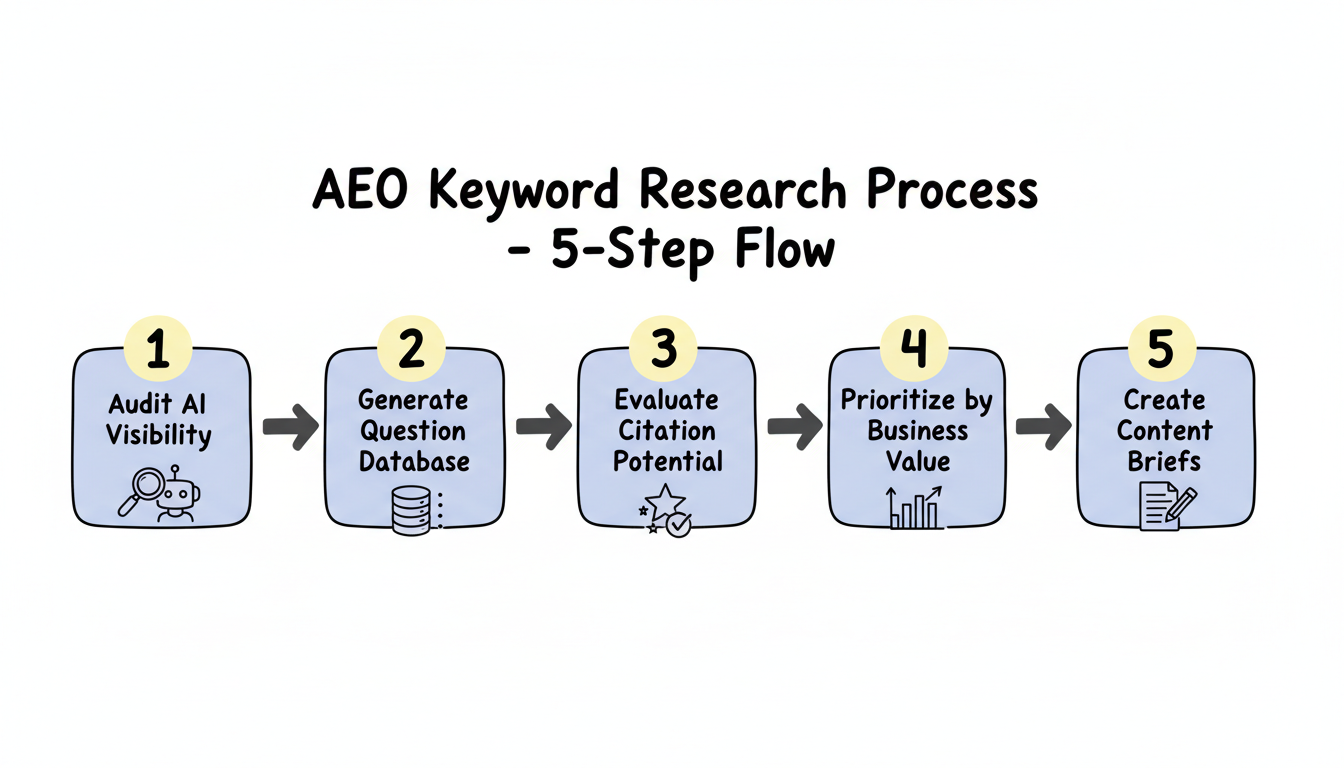
Step 1: Audit Existing AI Visibility
Before researching new opportunities, understand current positioning.
Visibility audit activities:
- Query AI platforms (ChatGPT, Claude, Google Gemini, Perplexity, and Google AI Overviews) for your brand and products
- Test competitor queries to see who gets cited
- Document queries where you appear versus competitors
- Identify gaps where competitors dominate
This baseline reveals where you already have authority and where opportunities exist. Consider leveraging AI citation tracking tools to monitor your visibility across multiple platforms systematically.
Step 2: Generate Question Database
Build a comprehensive database of relevant questions.
Database building techniques:
- Export "People Also Ask" data from SEO tools
- Scrape forum threads for common questions
- Analyze customer support ticket themes
- Review competitor FAQ sections
- Use AI tools to generate question variations
Aim for 200-500 questions per major topic area initially.
Step 3: Evaluate Citation Potential
Not all questions warrant AEO investment. Evaluate based on citation opportunity.
High citation potential indicators:
- Questions requiring factual, authoritative answers
- Topics where expertise and trust matter
- Queries with clear "right" answers you can provide
- Questions competitors answer poorly or incompletely
- Topics aligned with your proven expertise
Lower citation potential:
- Highly subjective questions
- Rapidly changing information (unless you update constantly)
- Topics outside your demonstrated expertise
- Questions with dominant, authoritative incumbents
Focus resources on winnable opportunities.
Step 4: Prioritize by Business Value
Balance citation potential with business outcomes.
Business value criteria:
- Relevance to revenue-generating products/services
- Position in customer journey (awareness vs. decision)
- Competitive advantage potential
- Content production feasibility
- Measurement capability
Prioritize questions where AI visibility directly supports business goals. This prioritization should align with your AI SEO implementation checklist to ensure technical readiness matches content strategy.
Step 5: Create Content Briefs
Transform prioritized questions into actionable content plans.
Content brief elements:
- Primary question and conversational path questions
- Target AI platforms (ChatGPT, Claude, Google Gemini, Perplexity, Google AI Overviews) and their preferences
- Required expertise and source citations
- Structured data requirements
- Internal linking opportunities
- Success metrics and measurement approach
Detailed briefs ensure content creation teams execute effectively.
Technical SEO Prerequisites: Making Your Content Discoverable by AI
Even the best AEO keyword research is wasted if AI systems cannot access and parse your content. Technical SEO provides the foundation that makes your content eligible for AI citation.
- Crawlability: Ensure AI crawlers (GPTBot, ClaudeBot, PerplexityBot) are not blocked in your robots.txt. Verify with server log analysis that these bots are successfully accessing your key content pages.
- Schema markup: Implement FAQ schema, HowTo schema, and Article schema on pages targeting AEO keywords. These structured data for AI search types help AI systems parse your content's structure and extract direct answers more reliably.
- Site architecture: Flat URL structures, clear heading hierarchies (H1 > H2 > H3), and internal linking between topically related pages strengthen topical authority—a key factor in whether LLMs select your content for citation.
- MCP servers: An emerging integration point where AI tools can directly query structured site content. For technically advanced implementations, MCP (Model Context Protocol) servers allow AI systems to interact with your data programmatically, relevant for organizations with large structured datasets.
AEO Keyword Research Tools
Several tools support AEO keyword discovery.
Traditional SEO Tools with AEO Applications
- Semrush/Ahrefs: Question keyword databases, PAA extraction
- AnswerThePublic: Question visualization and discovery
- AlsoAsked: Hierarchical PAA mapping
These tools provide question data requiring AEO-specific interpretation.
AEO-Specific Tools
- AI visibility trackers: Monitor brand mentions across AI platforms
- Citation analysis tools: Identify which sources AI systems cite for queries
- Structured data validators: Ensure content meets AI processing requirements
Emerging AEO tools and software provide insights traditional SEO tools miss. You can also explore free AI SEO tools to get started without budget constraints.
AEO Keyword Research Tools: Building Your Complete Research Stack
Beyond dedicated AEO platforms, several widely available tools can be adapted for AEO keyword research when used with the right approach.
Google Search Console
Google Search Console (GSC) is the most reliable free source for discovering AEO keyword opportunities you are already close to winning. GSC query data reveals the exact question-based queries users already find you for. Filter by queries containing "how", "what", "why", "best", and "vs" to surface AEO-ready keywords. Because GSC shows actual impression and click data for queries where your pages appear, it provides ground-truth data no third-party tool can replicate. Start here to identify low-hanging fruit—queries where you already have visibility but could improve your answer quality for AI citation.
Google Keyword Planner
Google Keyword Planner remains valuable for estimating search volume for question-based keywords identified through other methods. Use it to prioritize which AEO keywords also have meaningful traditional search demand, creating a dual-benefit strategy. Important limitation: volume data reflects traditional Google search behavior, not AI query volume. However, keywords with strong traditional volume that also match AI query patterns represent the highest-priority targets for your AEO content calendar.
Google Trends
Use Google Trends to validate whether emerging AEO-related terms (e.g., "AI search optimization", "answer engine") are growing in interest over time. This helps distinguish fleeting topics from sustained trends worth investing content resources in. Compare terms like "AEO" against "GEO" or "AI SEO" to understand relative search interest and inform your keyword prioritization.
These tools complement the traditional SEO tools (Semrush, Ahrefs, AnswerThePublic, AlsoAsked) and AEO-specific platforms mentioned above. The most effective approach combines multiple tools to build a comprehensive research stack.
Manual Research Methods
Don't underestimate manual research value.
Effective manual approaches:
- Systematic AI platform querying across ChatGPT, Claude, Google Gemini, Perplexity, and Google AI Overviews
- Competitor citation monitoring
- Customer conversation analysis
- Industry forum monitoring
Manual research often reveals opportunities tools miss.
Common AEO Keyword Research Mistakes
Avoid these errors undermining AEO keyword strategy.
Over-relying on search volume: High-volume keywords may not generate AI citations if authoritative incumbents dominate.
Ignoring conversational context: Isolated keyword targeting misses conversational path opportunities where comprehensive coverage builds authority.
Neglecting expertise alignment: Targeting questions outside your demonstrated expertise rarely succeeds—AI systems evaluate source credibility.
Static research: AI platform behaviors evolve rapidly. Research conducted in early 2026 may need updating by mid-year.
Single-platform focus: Different AI platforms surface different questions. Research across ChatGPT, Claude, Google Gemini, Perplexity, and Google AI Overviews to ensure comprehensive coverage. For guidance on optimizing for Claude AI specifically, see our dedicated guide.
Measuring AEO Keyword Success
Track performance for researched and targeted keywords.
Success metrics:
- Citation appearances for target questions
- Brand mention frequency in AI responses
- Share of answers—the percentage of relevant AI-generated responses that cite or mention your brand, analogous to "share of voice" in traditional marketing
- Conversational path coverage percentage
- Traffic from AI-referred visitors
- Conversion rates from AI traffic
Regular measurement validates research effectiveness and guides iteration. Use AI citation tracking tools to automate monitoring across platforms.
FAQs
How Many AEO Keywords Should I Target Initially?
Start with 20-30 high-priority questions across your core expertise areas. Expand as you demonstrate success and build content production capacity.
Should I Abandon Traditional Keyword Research for AEO?
No. Traditional SEO keywords remain valuable—many support AEO indirectly. Integrate AEO research with existing keyword strategies rather than replacing them.
How Often Should I Update AEO Keyword Research?
Quarterly comprehensive reviews with monthly monitoring of AI platform changes. The field evolves rapidly, requiring ongoing research investment.
How Is AEO Keyword Research Different from Traditional SEO Keyword Research?
AEO keyword research prioritizes question-based queries, conversational phrasing, and intent clusters over individual keyword volume. Traditional SEO targets high-volume exact-match keywords for ranking in blue links. AEO research focuses on how AI systems interpret queries—targeting topics where your content can serve as a citable source in AI-generated answers across ChatGPT, Claude, Gemini, and Perplexity.
What Tools Can I Use for AEO Keyword Research?
Start with Google Search Console to find question-based queries you already rank for. Use AnswerThePublic and AlsoAsked to discover question clusters. Semrush and Ahrefs help identify featured snippet opportunities that double as AEO targets. Google Keyword Planner estimates search volume for prioritization. Test your target keywords directly in ChatGPT, Claude, and Perplexity to see which queries trigger AI-generated answers.
What Role Do Featured Snippets Play in AEO Keyword Research?
Featured snippets are a strong signal that a keyword is AEO-ready. Keywords that trigger featured snippets already demonstrate that search engines consider the query answerable with a direct response. Pages winning featured snippets are frequently cited in Google AI Overviews and other AI answer engines. Filtering your keyword list by featured snippet opportunities is an efficient way to build an AEO keyword candidate list.
How Do I Test Whether My Content Appears in AI Search Results?
Manually query your target keywords in ChatGPT, Claude, Google Gemini, Perplexity, and Google AI Overviews. Check whether your brand or URL is cited in the response. Track citation frequency over time using a spreadsheet or dedicated AEO tracking tools. Focus on question-format queries that match your content's expertise areas, and test variations of phrasing to understand how different AI platforms interpret the same topic.
For categories with no measurable demand yet, see zero search volume keywords.