
An AEO marketing audit reveals where your brand stands in AI search visibility and identifies specific improvements needed. Unlike traditional SEO audits focused on rankings, AEO audits evaluate whether AI platforms can access, understand, and cite your content effectively.
This checklist provides a systematic framework for assessing your answer engine optimization readiness across technical, content, and authority dimensions.
Why Conduct an AEO Audit?
AI platforms now influence purchasing decisions for millions of users daily. Without understanding your current AI visibility, you're optimizing blindly. An AEO audit establishes baselines, identifies gaps, and prioritizes improvements.
What audits reveal:
- Current citation frequency across AI platforms
- Technical barriers preventing AI access
- Content gaps limiting citation opportunities
- Authority signals AI systems recognize
- Competitive positioning in AI responses
What Is Zero-Click Search and Why AEO Audits Matter
Over 60% of Google searches now end without a click to any website. This phenomenon, known as zero-click search, is driven by AI Overviews, featured snippets, and Search Generative Experience (SGE) results that answer queries directly on the search results page. For brands relying on organic traffic, this shift fundamentally changes the value equation of search visibility.
AI Overviews and SGE represent the next evolution of this trend. Rather than simply highlighting a snippet, these systems synthesize information from multiple sources and present a consolidated answer. If your content is not structured for AI extraction, you lose visibility in this rapidly growing search surface.
This is precisely why an AEO audit matters more than ever. Traditional SEO audits evaluate whether your pages rank - but they miss the AI citation layer entirely. An AEO audit goes further by assessing whether AI platforms can find, understand, and cite your content as a trusted source. In the zero-click era, being cited by an AI system may deliver more brand value than a traditional blue-link ranking. Building a comprehensive AEO strategy is the best response to this fundamental shift in how users discover information.
Technical Infrastructure Audit
Technical factors determine whether AI crawlers can access and process your content.
Crawler Access Checklist
Robots.txt configuration:
- GPTBot (OpenAI) allowed access
- ClaudeBot (Anthropic) allowed access
- PerplexityBot allowed access
- GoogleBot allowed for AI Overviews
- No blanket AI crawler blocks
Check your robots.txt for these directives. Blocked access eliminates AI visibility regardless of content quality.
Content Rendering
- Important content renders without JavaScript
- Pages load in under 3 seconds
- Core Web Vitals pass thresholds
- Mobile rendering functions properly
- Content isn't hidden behind login walls
Structured Data Implementation
- Organization schema present and accurate
- Article schema on blog content
- FAQPage schema on FAQ sections
- HowTo schema on instructional content
- Product schema on product pages
- Schema validates without errors
Validation: Test structured data using Google's Rich Results Test or Schema.org validators.
Content Structure Audit
AI systems extract specific passages to cite. Content structure determines extraction success.
Content Inventory and Audit Scoping
Before diving into individual page assessments, scope your audit by building a complete content inventory. Start by cataloging every indexable page on your site, then categorize each by traffic volume, revenue impact, and AI citation potential.
Use a content mapping approach to identify your topical clusters. Group related pages by theme - such as product pages, how-to guides, comparison content, and thought leadership - so you can spot coverage gaps where competitors may be earning AI citations that you are missing. Conducting thorough AEO keyword research during this phase helps you identify which queries to prioritize in your audit.
Apply this prioritization matrix to decide which pages to audit first:
- High traffic + Low AI visibility: Audit immediately - these pages have proven demand but are not being cited by AI platforms
- High revenue + Any AI visibility: Audit next - these pages directly impact business outcomes
- Low traffic + High AI potential: Queue for optimization - these pages cover topics AI platforms frequently answer
- Low traffic + Low AI potential: Deprioritize - revisit after higher-impact pages are optimized
This scoping exercise ensures your audit effort focuses where it will generate the greatest return.
Answer Optimization
- Priority pages open with direct answer statements
- Headers use question-based formats matching user queries
- Definition paragraphs provide clear, standalone explanations
- Content includes extractable sentences AI can quote
- FAQ sections provide complete standalone answers
Content Completeness
- Topics covered comprehensively without gaps
- Related questions anticipated and addressed
- Multiple perspectives included where relevant
- Supporting evidence and examples provided
- Content updated within last 12 months
Comparison Content
- Comparison pages exist for key competitors
- Tables present clear feature comparisons
- Honest assessment of strengths and limitations
- "Best for" recommendations included
- Comparisons updated as products evolve
Authority Signals Audit
AI platforms evaluate source credibility when selecting citations, relying heavily on the E-E-A-T framework (Experience, Expertise, Authoritativeness, Trustworthiness) to determine which sources deserve citation priority. These authority signals are critical for establishing your expertise, which is why many businesses invest in AEO services to build comprehensive credibility frameworks.
Brand Consistency
- Consistent business information across platforms
- Accurate profiles on business directories
- Wikipedia presence (if notable)
- Knowledge bases contain correct information
- Brand positioning consistent across properties
- Brand recognized as a distinct entity in Google Knowledge Graph
- Consistent entity attributes across Wikidata, schema.org markup, and directory listings
External Validation
- Expert credentials visible on content
- Industry publications reference your brand
- Review platforms contain genuine reviews
- Original research published and cited
- Community presence (Reddit, Quora, forums)
Trust Signals
- HTTPS implemented site-wide
- Privacy policy accessible
- Contact information clearly displayed
- About page establishes expertise
- Author bios demonstrate credentials
E-E-A-T Audit Checklist
E-E-A-T (Experience, Expertise, Authoritativeness, Trustworthiness) is Google's quality framework that AI systems - including NLP models like BERT and RankBrain - use when evaluating which sources to cite. Dedicating a specific audit section to E-E-A-T ensures your content meets the credibility threshold AI platforms require. Score each pillar on a 0-5 scale for a total E-E-A-T sub-score of 0-20 points that feeds into your Authority Score. For deeper guidance on aligning content with these signals, see our guide on AEO content optimization.
Experience (0-5 points):
- Content includes first-hand case studies or original data
- Original screenshots, recordings, or artifacts demonstrate real usage
- Author bylines identify practitioners with hands-on experience
- Personal insights and lessons learned are woven into guidance
Expertise (0-5 points):
- Author credentials and certifications are displayed prominently
- Content demonstrates deep subject coverage beyond surface-level advice
- Technical accuracy is verified by qualified reviewers
- Specialized terminology is used correctly and explained clearly
Authoritativeness (0-5 points):
- Backlink profile includes links from recognized industry sources
- Content is cited by other industry publications and researchers
- Brand receives media mentions in relevant trade publications
- Domain has topical authority demonstrated by depth of coverage
Trustworthiness (0-5 points):
- Editorial policy and content review process are documented
- Correction history and update logs are transparent
- Sources and references are cited within content
- Disclosure of affiliations, sponsorships, and potential conflicts
Visibility Assessment
Track your current AI citation presence. Understanding how your content appears across platforms like ChatGPT vs Perplexity helps you identify which AI ecosystems require focused optimization efforts.
Platform Coverage
Query each platform with 10-20 priority questions about your topic area.
- ChatGPT: Record citations and context
- Perplexity: Document mentions and sources
- Google AI Overviews: Note appearances
- Claude: Check citation frequency
- Gemini: Assess visibility
- Bing Copilot: Assess citation presence and brand mentions
Competitive Comparison
For the same queries:
- Document competitor citations
- Note positioning (primary vs. secondary)
- Compare sentiment of mentions
- Identify visibility gaps
Voice Search and Conversational Query Audit
Voice assistants like Google Assistant, Alexa, and Siri pull answers from AI-processed content, making voice search an increasingly important AEO surface. As more users rely on spoken queries, your audit must assess whether your content is optimized for conversational, long-tail question phrases that mirror natural language patterns.
Use this voice search audit checklist:
- Conversational query coverage: Identify the long-tail question phrases your audience speaks aloud (e.g., "what is the best way to audit my AEO performance?") and verify your content provides direct, concise answers
- Featured snippet targeting: Confirm that priority pages are structured to win featured snippets, since these are the primary source voice assistants use for spoken responses
- Answer-first writing methodology: Each section should lead with a direct answer statement before providing supporting detail - this format serves both voice and text-based AI search
- Testing methodology: Query Google Assistant, Alexa, and Siri with your 10-20 priority questions. Document which assistant reads your content, which reads a competitor's, and which provides no answer
Voice search readiness is a forward-looking dimension of your AEO audit. Brands selling products online should pay particular attention, as voice commerce is growing rapidly - our guide to AEO for ecommerce covers the purchasing use cases in detail.
Baseline Documentation
Create a baseline report capturing:
- Citation frequency per platform
- Queries where you appear
- Queries where competitors appear but you don't
- Sentiment analysis of mentions
- Areas of strength and weakness
- Sentiment analysis of how AI platforms characterize your brand (positive, neutral, negative framing)
- Brand positioning relative to competitors in AI-generated summaries
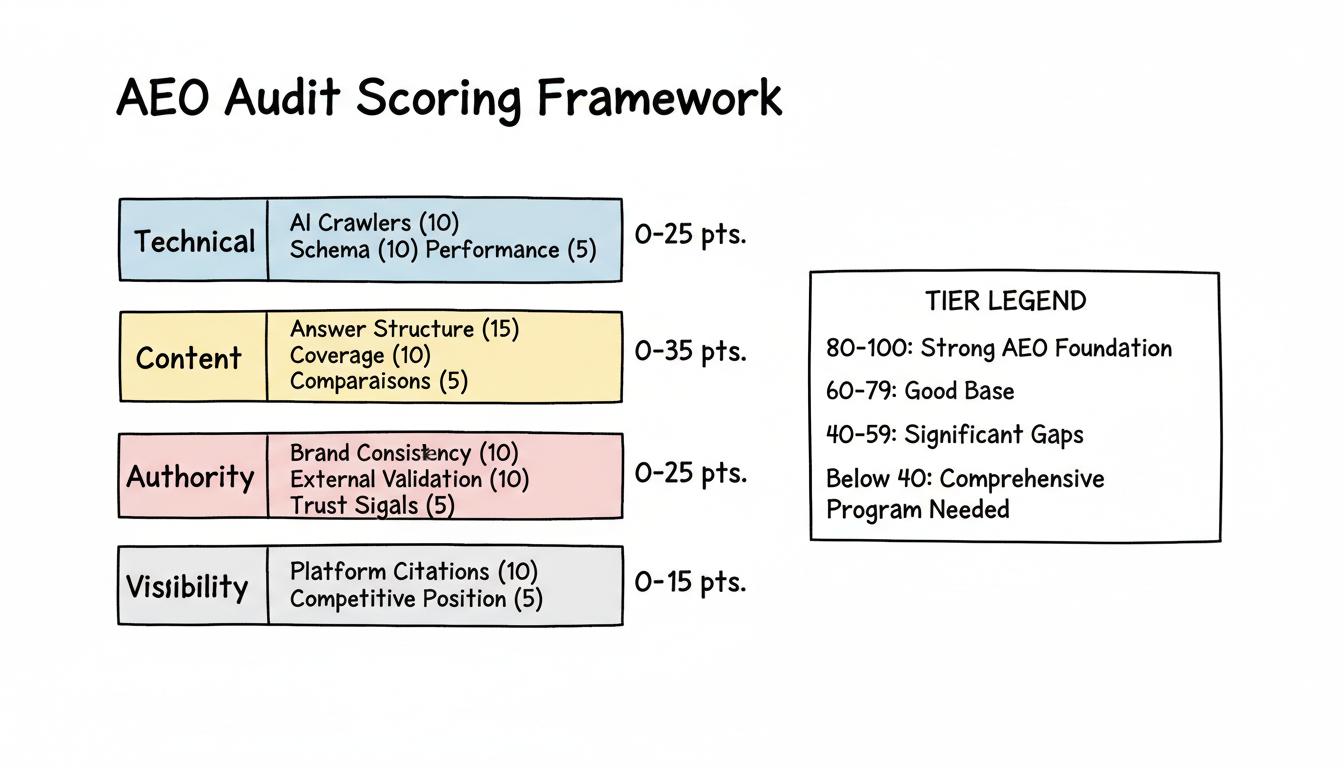
Scoring Your Audit
Assign points to assess overall readiness.
Technical Score (0-25 Points)
- All AI crawlers allowed: 10 points
- Schema fully implemented: 10 points
- Performance passing thresholds: 5 points
Content Score (0-35 Points)
- Answer-optimized structure: 15 points
- Comprehensive coverage: 10 points
- Fresh content (under 12 months): 5 points
- Comparison content present: 5 points
Authority Score (0-25 Points)
- Consistent brand information: 10 points
- External validation present: 10 points
- Trust signals complete: 5 points
Visibility Score (0-15 Points)
- Citations on 2+ platforms: 10 points
- Competitive positioning: 5 points
Score interpretation:
- 80-100: Strong AEO foundation
- 60-79: Good base, specific improvements needed
- 40-59: Significant gaps requiring attention
- Below 40: Comprehensive AEO program needed
Prioritizing Improvements
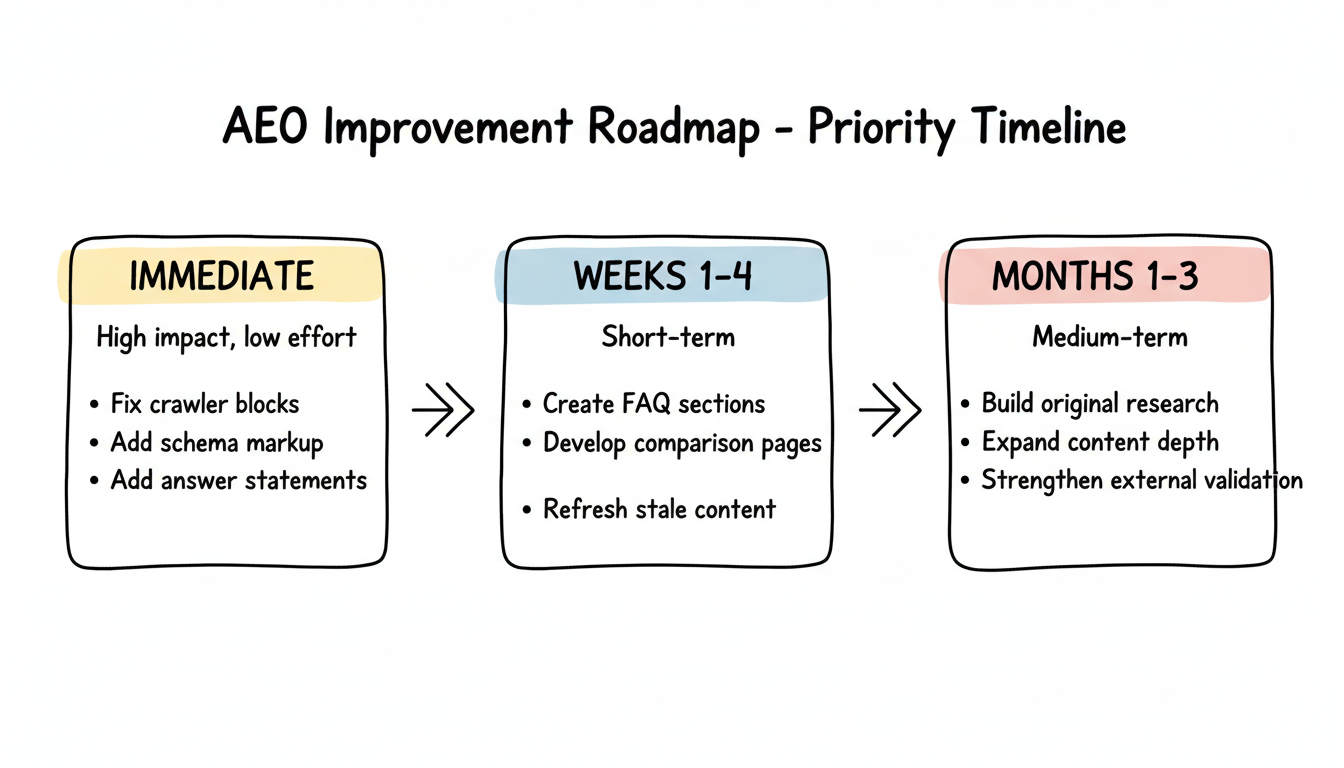
Based on audit findings, prioritize actions. Many organizations discover that leveraging AEO tools can accelerate the implementation of these improvements.
Immediate priorities (high impact, low effort):
- Fix crawler access blocks
- Implement missing schema markup
- Add answer statements to existing content
Short-term priorities (weeks 1-4):
- Create FAQ sections for priority pages
- Develop missing comparison content
- Update stale content with fresh information
Medium-term priorities (months 1-3):
- Build original research capabilities
- Expand content comprehensiveness
- Strengthen external validation signals
Ongoing Monitoring
AEO audits aren't one-time activities.
Monthly reviews:
- Track citation frequency changes
- Note competitive positioning shifts
- Identify new visibility opportunities
Tools and measurement: Supplement manual reviews with AI citation tracking tools. Maintain a prompt testing log where you periodically query ChatGPT, Perplexity, and Gemini with priority keywords and document citation appearances. For automated tracking, platforms like Otterly, Profound, and other AEO monitoring services can measure citation frequency, sentiment, and competitive positioning over time. Explore our roundup of AEO tools for recommendations on monitoring platforms suited to different budgets.
Quarterly reassessments:
- Repeat full audit checklist
- Compare against baseline
- Adjust priorities based on results
Frequently Asked Questions
How Often Should I Conduct an AEO Audit?
Conduct comprehensive audits quarterly. Perform monthly quick checks on citation frequency and competitive positioning to catch significant changes.
Can I Audit Without Paid Tools?
Yes. This checklist works with manual processes - querying AI platforms directly and documenting results. Paid tools add automation and efficiency but aren't required.
What'S the Most Critical Audit Finding?
Blocked crawler access. If AI platforms can't reach your content, nothing else matters. Always check robots.txt configuration first.
What Is E-E-A-T and Why Does It Matter for AEO Audits?
E-E-A-T stands for Experience, Expertise, Authoritativeness, and Trustworthiness. It is Google's quality framework that AI systems also use when selecting sources to cite. An AEO audit should evaluate each E-E-A-T pillar because AI platforms prioritize content from sources demonstrating real-world experience and verified expertise over generic information.
How Is an AEO Audit Different from a Traditional SEO Audit?
A traditional SEO audit focuses on rankings, backlinks, and technical crawlability for organic search results. An AEO audit adds layers specific to AI visibility: entity clarity, structured data for AI extraction, voice search readiness, AI crawler access, citation tracking across platforms like ChatGPT and Perplexity, and zero-click search optimization. To understand the foundational concepts, see our explainer on what is AEO.
What Tools Can I Use to Track AI Citations?
Start with manual prompt testing by querying ChatGPT, Perplexity, and Gemini with your priority keywords and documenting citation appearances in a spreadsheet. For automation, tools like Otterly, Profound, and specialized AEO audit platforms can monitor AI citation frequency, sentiment, and competitive positioning over time.
Should My AEO Audit Include Voice Search Optimization?
Yes. Voice assistants like Google Assistant, Alexa, and Siri pull answers from AI-processed content, making voice search a critical AEO surface. Your audit should test how voice assistants answer questions about your topic area and whether your content is selected as the spoken response.
How Long Does a Full AEO Audit Typically Take?
A full AEO audit takes one to four weeks depending on site size and content volume. Manual platform queries, schema validation, and competitive comparison require the most time. Smaller sites with clean technical foundations complete faster, while large catalogs with many pages demand more extensive inventory and scoring work.
Where Should I Start If My Audit Score Is Below 40?
A score below 40 signals the need for a comprehensive AEO program. Begin by unblocking AI crawler access in robots.txt, then implement core structured data like Organization and Article schema. Next, add direct answer statements to priority pages before building comparison and authority signals over the following months.
How Do I Prove My AEO Audit Is Working?
Track citation frequency across ChatGPT, Perplexity, Gemini, and AI Overviews against your baseline report. Rising citations on priority queries and improved competitive positioning show progress. Monthly checks catch shifts early, while quarterly reassessments confirm whether your score moves into a higher readiness band.
Can Small Businesses Benefit from an AEO Audit?
Yes. Small businesses gain brand visibility in AI answers without paying for rankings. A manual audit using this checklist requires no paid tools, just direct platform queries and documentation. Fixing crawler access, adding schema, and writing answer-first content can earn citations that compete with larger, better-funded competitors.