
AEO marketing requires dedicated investment, but "how much" depends on your current search visibility, competitive landscape, and AI visibility goals. This guide provides budget benchmarks and allocation frameworks for organizations at different stages of AEO maturity.
Why AEO Budget Investment Is Accelerating in 2026
The shift toward AI-powered search is fundamentally changing how marketing budgets are allocated. According to industry research, 62% of marketers report declining click-through rates from traditional search engines, creating urgency for brands to establish visibility in AI surfaces like Google AI Overviews, ChatGPT, Perplexity, Gemini, and Microsoft Copilot.
CMO surveys indicate that 94% of marketing leaders plan to increase AEO and GEO (Generative Engine Optimization) budgets in 2026, with the average enterprise now allocating 12% of digital marketing spend to answer engine optimization. This acceleration is driven by economics: Customer Acquisition Cost (CAC) has risen approximately 40% since 2023 across paid channels, making organic AI visibility a cost-efficient alternative for sustainable growth.
Despite the momentum, 45% of marketers identify budget constraints as their top barrier to AEO adoption, while only 20% have started meaningful implementation. This gap represents a significant competitive advantage for early movers. Organizations that invest now benefit from compounding authority signals before the space becomes saturated. For a detailed look at what agencies charge for these services, see our guide on AEO agency pricing and service tiers.
AEO Budget Benchmarks by Company Size
Investment levels vary significantly based on organization size and existing digital marketing infrastructure. Industry surveys show the average enterprise allocates approximately 12% of digital marketing spend to AEO, though this varies by maturity and vertical.
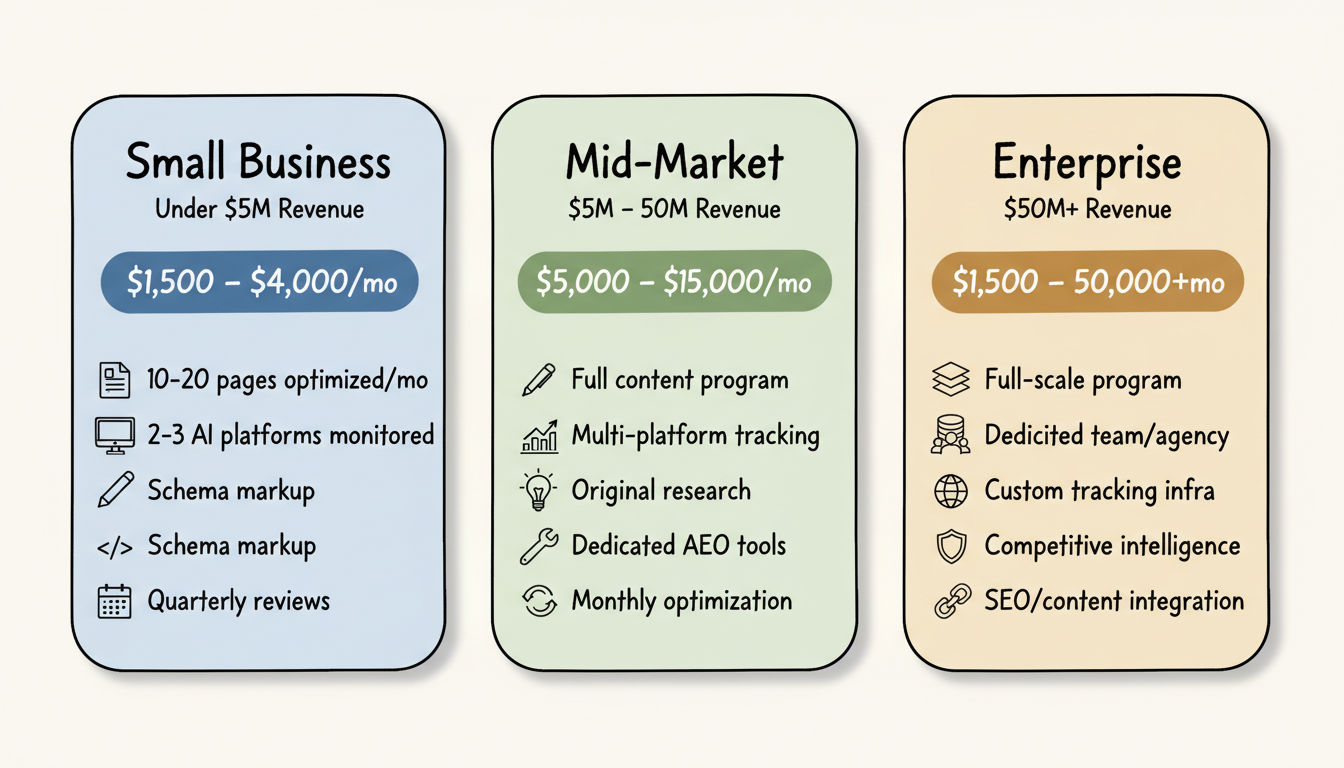
Small Business (Under $5M Revenue)
Typical monthly AEO investment: $1,500 - $4,000
What this covers:
- Content optimization for priority pages (10-20 pages/month)
- Basic visibility monitoring across 2-3 AI platforms
- Schema markup implementation
- Quarterly strategy reviews
Allocation breakdown:
Category | Percentage | Monthly Amount |
Content optimization | 50% | $750 - $2,000 |
Technical implementation | 25% | $375 - $1,000 |
Monitoring/tools | 15% | $225 - $600 |
Strategy/planning | 10% | $150 - $400 |
Mid-Market ($5M - $50M Revenue)
Typical monthly AEO investment: $5,000 - $15,000
What this covers:
- Comprehensive content optimization program
- Multi-platform visibility tracking across Google AI Overviews, ChatGPT, and Perplexity
- Original research/thought leadership content
- Dedicated AEO tools and dashboards
- Monthly strategy optimization
Allocation breakdown:
Category | Percentage | Monthly Amount |
Content creation/optimization | 45% | $2,250 - $6,750 |
Technical implementation | 20% | $1,000 - $3,000 |
Tools/monitoring | 15% | $750 - $2,250 |
Strategy/consulting | 15% | $750 - $2,250 |
Testing/experimentation | 5% | $250 - $750 |
Enterprise ($50M+ Revenue)
Typical monthly AEO investment: $15,000 - $50,000+
What this covers:
- Full-scale AEO program across product lines
- Dedicated AEO team or agency partnership
- Custom tracking infrastructure
- Competitive intelligence across Google AI Overviews, ChatGPT, Perplexity, and Gemini
- Multi-language/region optimization
- Integration with broader SEO/content programs
Allocation breakdown:
Category | Percentage | Monthly Amount |
Content programs | 40% | $6,000 - $20,000 |
Technology/tools | 20% | $3,000 - $10,000 |
Personnel/agency | 25% | $3,750 - $12,500 |
Strategy/research | 10% | $1,500 - $5,000 |
Innovation/testing | 5% | $750 - $2,500 |
Budget Allocation Framework
Beyond total investment, where you allocate budget determines results. Understanding the difference between SEO vs AEO helps ensure your budget allocation aligns with the unique requirements of answer engine optimization.
Content Investment (40-50% of Budget)
Content drives AEO success. Most budgets should weight content creation and optimization heavily.
Content budget priorities:
- Existing page optimization - Restructuring current content for AI extraction
- Gap content creation - New content targeting priority queries
- Authority content - Thought leadership establishing expertise
- Technical content - How-to guides, tutorials, educational resources
Technical Investment (20-25% of Budget)
Technical implementation enables content to perform. Implementing AEO schema markup priority elements should be a foundational technical investment.
Technical budget priorities:
- Schema markup - FAQPage, HowTo, speakable, and Organization schema types each serve a distinct role in AI extraction. FAQPage enables direct Q&A surfacing, HowTo structures step-by-step processes, speakable identifies content suitable for voice assistants, and Organization establishes entity authority.
- Site structure - Topic clustering, internal linking
- Speed/accessibility - Core Web Vitals, crawlability
- Structured data maintenance - Ongoing validation and updates
Tools and Monitoring (15-20% of Budget)
Measurement enables optimization. Underinvesting in tracking limits improvement.
Tools budget priorities:
- AI visibility monitoring - Platform-specific tracking
- Competitive intelligence - Competitor citation tracking
- Content analytics - Performance by content type
- Attribution tracking - AI referral conversion measurement
The 70/20/10 Framework for AEO Budget Allocation
Beyond percentage-based category splits, the 70/20/10 rule offers a complementary framework for prioritizing AEO spend by risk and maturity level. This approach helps teams balance proven tactics with forward-looking experimentation.
Allocate 70% to proven AEO tactics: structured content optimization, structured data for AI search including FAQPage, HowTo, speakable, and Organization schema types, and E-E-A-T signal building through authoritative content and expert citations.
Dedicate 20% to emerging opportunities: voice search optimization, AI bot crawlability improvements, and platform-specific citation monitoring across Google AI Overviews, ChatGPT, and Perplexity.
Reserve 10% for experimental initiatives: testing new AI platforms as they emerge, piloting AI-native content formats, and exploring novel distribution channels.
When evaluating whether your AEO spend is generating sufficient return, use the LTV:CAC ratio benchmark of 3:1 as a threshold. If your lifetime customer value from AI-referred traffic exceeds three times the acquisition cost, the investment is performing well. Review and adjust these allocations quarterly, as the AI search landscape shifts rapidly and last quarter's emerging opportunity may become this quarter's proven tactic.
ROI Expectations and Timeline
AEO investment should produce measurable returns, but timelines differ from traditional SEO.
Expected ROI Timeline
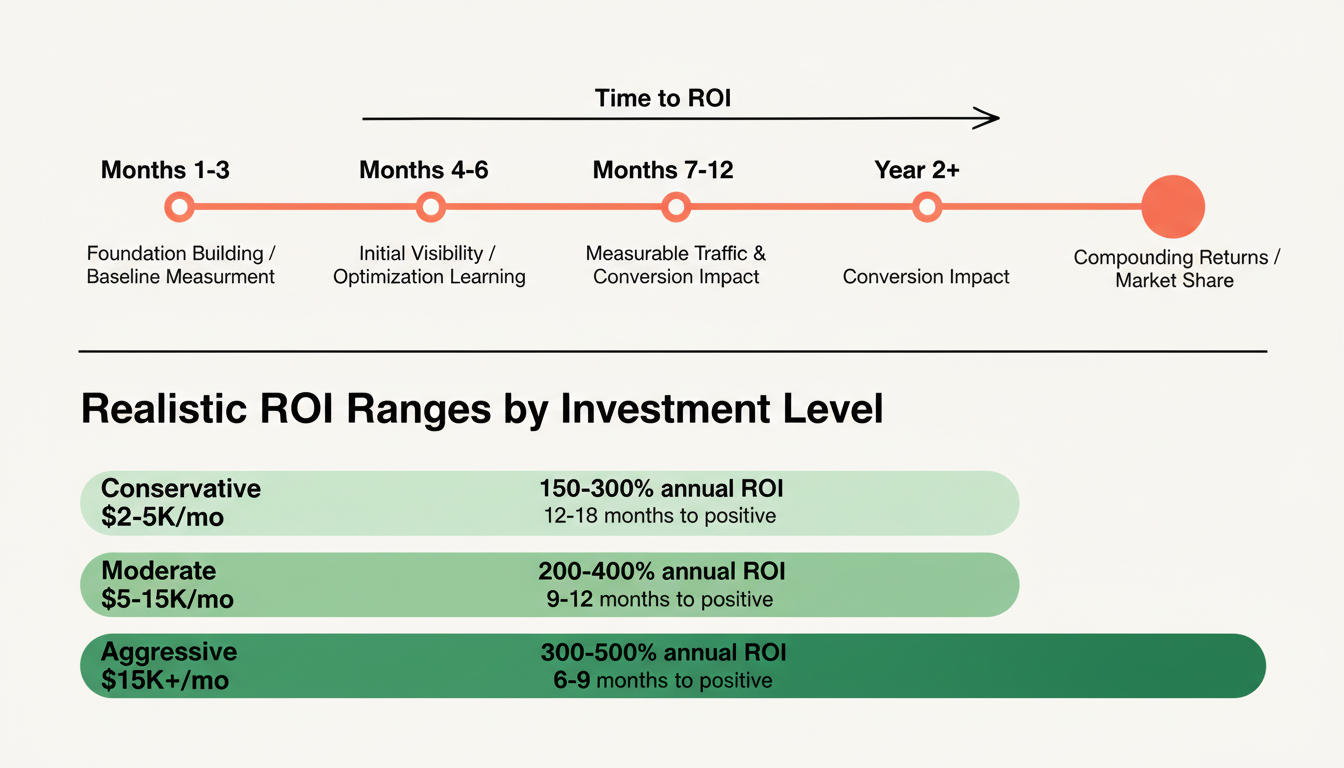
Investment Month | Expected Progress |
Months 1-3 | Foundation building, baseline measurement |
Months 4-6 | Initial visibility improvements, optimization learning |
Months 7-12 | Measurable traffic/conversion impact |
Year 2+ | Compounding returns, market share gains |
ROI Metrics to Track
Leading indicators (months 1-6):
- Citation frequency across AI platforms
- Query coverage (% of priority queries with visibility)
- Content optimization completion rate
Lagging indicators (months 6-12):
- AI referral traffic volume
- Conversion rate from AI referrals (industry benchmarks show AI referral traffic converts at approximately 2x the rate of traditional search visits)
- Revenue attributed to AI visibility
How to Track AEO ROI with UTM Parameters and GA4
Accurate ROI measurement starts with proper tracking infrastructure. Set up UTM parameters specifically for AI-referred traffic using source tags like utm_source=chatgpt, utm_source=perplexity, or utm_source=google-ai-overview with utm_medium=ai-referral to distinguish these sessions from traditional organic traffic. For a step-by-step walkthrough, see our AEO analytics setup guide.
In GA4, create custom segments to isolate AI-driven sessions and compare their conversion rates against traditional organic traffic. This segmentation reveals the true incremental value of AEO investment. Industry benchmarks show AI referral traffic converts at approximately twice the rate of traditional search in comparable session groups, making precise attribution essential for justifying budget increases.
Beyond session-level tracking, adopt Return on Content Investment (ROCI) as a framework: divide total revenue attributed to AI-cited content by total content production and optimization cost. This gives a clearer picture than generic ROI calculations because it ties returns directly to the content assets driving AI visibility. Use AI citation tracking tools to monitor brand mentions across AI platforms and feed that data into your ROCI calculations. You can also benchmark your numbers against industry averages using our AEO ROI calculator.
Realistic ROI Ranges
Investment Level | Expected Annual ROI |
Conservative ($2-5K/mo) | 150-300% (12-18 months to positive) |
Moderate ($5-15K/mo) | 200-400% (9-12 months to positive) |
Aggressive ($15K+/mo) | 300-500% (6-9 months to positive) |
Higher investment accelerates results through more content, faster optimization, and better tools. Working with an answer engine optimization agency can help maximize ROI by ensuring budget is allocated to high-impact initiatives.
Common AEO Budget Challenges and How to Overcome Them
Even with strong intent to invest, teams frequently encounter obstacles that stall AEO programs. Understanding these common AEO challenges upfront helps you build a budget that accounts for real-world friction.
Budget constraints (45% of marketers): Nearly half of marketing teams cite limited budget as the primary barrier to AEO adoption. Rather than waiting for a large dedicated allocation, start with a pilot of 5-8% of your existing SEO budget reallocated to AEO activities. Focus this initial investment on high-impact, low-cost tactics like schema markup implementation and restructuring existing content for AI extraction. Measure results over one quarter, then use the data to justify scaling.
Lack of internal expertise (~40%): AEO is a new discipline, and most marketing teams lack specialized knowledge. Take a phased approach: begin with structured data and schema markup, which are well-documented and produce measurable results quickly. Then layer in content optimization for AI platforms and platform-specific monitoring as your team builds competency. External training or a short-term agency engagement can accelerate the learning curve without requiring a permanent headcount increase.
Difficulty measuring ROI: Without clear metrics, budget holders resist ongoing investment. Point stakeholders back to the UTM/GA4 tracking framework and the ROCI metric described above. Additionally, adopt an AEO maturity model that categorizes your organization as low, medium, or high readiness. This helps set realistic budget expectations tied to current capabilities rather than aspirational outcomes.
One final consideration: in year one, weight your AEO budget toward content optimization -- restructuring and enhancing existing assets -- rather than net-new content creation. This approach delivers faster returns because you are improving pages that already have domain authority and indexation history.
Budget Scaling Strategy
Start appropriately and scale based on results.
Starting Point Guidelines
If you have no AEO presence: Start with 10-15% of current SEO budget allocated to AEO. Focus on foundational optimization before scaling.
If you have basic AEO: Scale to 20-25% of search marketing budget. Expand content and monitoring scope.
If you're AEO-mature: Maintain 25-30% of search budget for ongoing optimization while investing in competitive advantages.
Scaling Triggers
Scale up when:
- Visibility improvements plateau (need more content)
- Competitors gain ground (defensive investment)
- ROI exceeds 200% (profitable to accelerate)
- New AI platforms emerge (coverage expansion)
Maintain when:
- Steady visibility growth continues
- ROI meets expectations
- Market position is stable
Budget Reallocation from SEO
Many organizations fund AEO by reallocating traditional SEO budget as AI search grows. This reallocation should be informed by a cross-platform AI search ROI analysis to determine which platforms deliver the best returns.
Suggested transition timeline:
Year | SEO Budget | AEO Budget |
2025 | 90% | 10% |
2026 | 75-80% | 20-25% |
2027 | 65-70% | 30-35% |
These percentages reflect expected AI search adoption trends, not prescriptive mandates.
Frequently Asked Questions About AEO Marketing Budgets
What Is AEO in Marketing?
AEO, or Answer Engine Optimization, is the practice of optimizing your content to appear as cited answers in AI-powered search platforms like Google AI Overviews, ChatGPT, and Perplexity. Unlike traditional SEO that targets blue-link rankings, AEO focuses on structuring content so AI systems can extract, summarize, and cite it directly. It involves schema markup, entity optimization, and building authority signals that AI models recognize.
How Much Does AEO Cost per Month?
AEO costs vary by company size and scope. Small businesses typically invest $500 to $2,000 per month on foundational AEO activities like schema markup and content restructuring. Mid-market companies allocate $2,000 to $8,000 monthly for comprehensive optimization across multiple AI platforms. Enterprise organizations may spend $10,000 or more per month, including dedicated AI visibility monitoring, platform-specific strategies, and ongoing content optimization programs. Start with a pilot budget and scale based on measured ROI.
What Is the 70/20/10 Rule for AEO Budgets?
The 70/20/10 rule is a budget allocation framework adapted for AEO spending. Allocate 70% to proven tactics like structured data, content optimization, and E-E-A-T signal building. Dedicate 20% to emerging opportunities such as voice search optimization and AI bot crawlability improvements. Reserve 10% for experimental initiatives like testing new AI platforms. Review and adjust these ratios quarterly as AI search evolves.
Is AEO Worth the Investment in 2026?
Industry data strongly supports AEO investment in 2026. Research shows 94% of CMOs plan to increase their AEO budgets, and AI-referred traffic converts at roughly twice the rate of traditional search visits. With 62% of marketers reporting declining organic click-through rates from conventional search, AEO represents a forward-looking strategy to maintain visibility. Early adopters gain a compounding advantage as AI platforms increasingly favor well-optimized, authoritative content.
Key Takeaways
AEO budget planning requires realistic expectations and strategic allocation:
- Budget by company size - Small businesses start at $1,500-4,000/month; mid-market at $5,000-15,000; enterprise at $15,000-50,000+
- Weight content heavily - 40-50% of budget should fund content creation and optimization
- Plan for 6-12 month payback - AEO compounds but requires runway before significant ROI
- Track leading indicators early - Citation frequency and visibility coverage show progress before revenue impact
- Scale based on results - Start conservatively, increase investment as ROI proves out
AEO investment today positions your brand for the AI-first search landscape already emerging. The question isn't whether to invest, but how much runway you can afford while competitors establish positions.