
Last Updated: March 2026
The marketing landscape has reached an inflection point. With ChatGPT serving over 800 million weekly users, Perplexity processing more than 100 million queries per week, and Google's AI Overviews appearing for over 16% of searches, the brands that adapt their marketing strategies for AI-powered search are capturing disproportionate rewards.
The data tells a compelling story: visitors who discover brands through AI-generated recommendations convert at significantly higher rates than traditional organic traffic. Research from Quolity.ai indicates AI-referred visitors convert at 4.4 times the rate of standard organic search visitors. Some industry studies suggest even higher multiples for specific verticals.
This guide explores how AEO marketing—the strategic integration of Answer Engine Optimization into your broader marketing mix—creates these conversion advantages and how to build an AEO marketing strategy that captures high-intent traffic from AI platforms.
With 69% of searches now ending in zero clicks, the traditional SEO playbook of ranking to earn clicks is losing ground. AEO marketing addresses this shift by optimizing for visibility within the AI-generated answer itself—converting the citation into the click.
What Is AEO Marketing?
AEO marketing extends beyond technical optimization to encompass a complete marketing philosophy centered on earning AI recommendations. While traditional AEO optimization strategies focus on the tactical elements of appearing in AI-generated answers, AEO marketing integrates these tactics into a comprehensive go-to-market strategy.
The AEO Marketing Framework
AEO marketing operates at three levels:
Strategic Level: Positioning your brand as the authoritative answer to questions your ideal customers ask AI systems. This involves identifying the conversational queries driving purchase decisions and creating content ecosystems that establish expertise.
Tactical Level: Implementing the technical and content optimizations that improve AI citation likelihood—schema markup, content structure, entity optimization, and authority building. A comprehensive technical AEO optimization approach ensures your content is accessible and parseable by AI systems.
Operational Level: Measuring AI visibility, tracking citations across platforms, and continuously optimizing based on performance data. Many organizations use AEO optimization metrics to quantify their AI search performance and guide strategic decisions.
AEO Marketing vs. Traditional Digital Marketing
Traditional digital marketing focuses on interruption and awareness—paid ads, social media impressions, email campaigns. While these channels remain valuable, they require continuous investment and face increasing competition and ad fatigue.
AEO marketing creates a different value proposition: earning placement in AI-generated recommendations that users explicitly request. Understanding what is AEO vs SEO helps clarify how this new discipline complements traditional search marketing while addressing the unique characteristics of AI-powered search platforms.
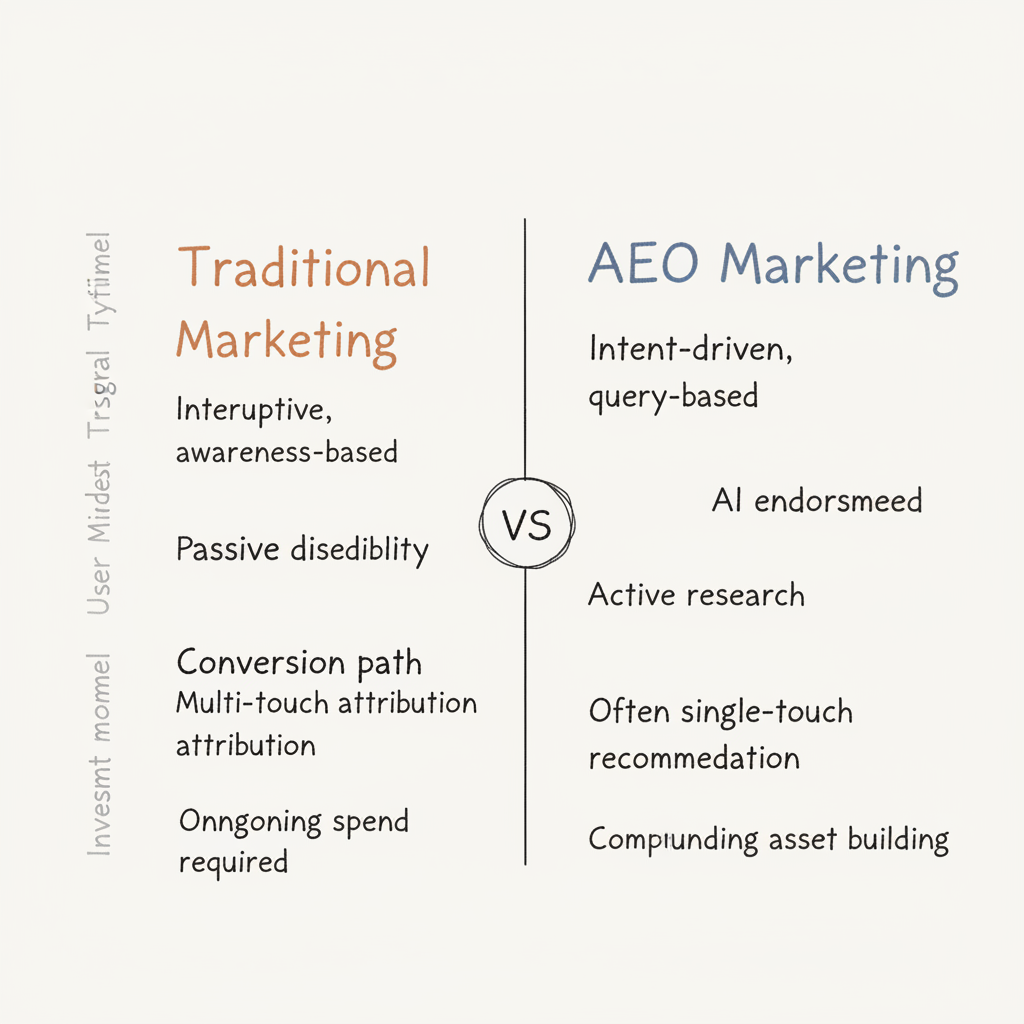
The key differences:
Dimension | Traditional Marketing | AEO Marketing |
Traffic type | Interruptive, awareness-based | Intent-driven, query-based |
Trust signal | Brand credibility | AI endorsement |
User mindset | Passive discovery | Active research |
Conversion path | Multi-touch attribution | Often single-touch recommendation |
Investment model | Ongoing spend required | Compounding asset building |
Why AEO Marketing Matters Now
Several converging trends make AEO marketing essential in 2026:
AI Search Adoption Acceleration: AI-powered search tools have moved from early adopter curiosity to mainstream usage. ChatGPT's 800+ million weekly active users represent a significant portion of research and purchase behavior. Current AI-powered search engine statistics demonstrate the rapid growth of this channel.
Zero-Click Search Growth: With 69% of Google searches in 2025 ending without a click to a third-party website, AI Overviews and conversational AI are accelerating the decline of click-through traffic. Brands must appear in the answer itself, not just in linked results.
High-Intent Query Capture: Users asking AI assistants detailed questions about products, services, and solutions are typically further along in their buying journey than general search users.
Competitive Window: Early movers in AEO marketing establish authority signals that compound over time, creating increasingly difficult barriers for late entrants.
The Conversion Rate Advantage
The conversion rate improvements associated with AEO traffic stem from several interconnected factors that fundamentally change the user journey. Understanding AEO conversion rate dynamics helps marketers appreciate the value of AI-referred visitors beyond raw traffic volume.
Why AI-Referred Traffic Converts Higher
Implicit Endorsement Effect: When an AI system recommends a brand, users perceive this as a curated, objective selection rather than paid placement. Research into consumer psychology shows that perceived objectivity significantly increases trust and purchase likelihood.
Intent Alignment: Users querying AI systems with specific questions have typically already identified a need. “What CRM should a small consulting firm use?” indicates much stronger purchase intent than a generic “CRM software” search.
Reduced Comparison Shopping: AI recommendations often provide context about why a particular solution fits the user’s needs, reducing the impulse to compare multiple options. Users who receive a confident, reasoned recommendation are more likely to act on it directly.
Authority Transfer: AI systems are perceived as knowledgeable and unbiased. When ChatGPT or Perplexity cites your content or recommends your product, some of that perceived authority transfers to your brand.
Research on AI Referral Conversion Rates
While comprehensive industry benchmarks are still emerging, available data points toward significant conversion advantages:
Quolity.ai’s research indicates AI-referred visitors convert at 4.4x the rate of traditional organic traffic. This aligns with the intent and trust factors described above. When evaluating AEO marketing ROI, these conversion premiums significantly impact the overall value of AI visibility investments.
Industry-specific studies suggest even higher multipliers in considered purchase categories:
- B2B SaaS: 3.5x to 6x conversion improvement
- Professional services: 4x to 8x conversion improvement
- E-commerce (high-ticket items): 2.5x to 5x conversion improvement
- Local services: 5x to 10x conversion improvement
The variation reflects how different purchase decisions benefit from AI recommendation credibility. For SaaS companies specifically, AEO for SaaS companies strategies can capture high-intent traffic at critical decision points.
The Compounding Value of AI Citations
Unlike paid advertising, which stops generating results when spend stops, AI citations create compounding value:
Knowledge Persistence: AI models retain information about authoritative sources. Once established as a trusted source for specific topics, your content continues generating citations in relevant queries.
Cross-Platform Reach: Optimizing for one AI platform often improves visibility across others. Content structured for ChatGPT visibility typically performs well in Perplexity and AI Overviews as well. A multi-platform AEO strategy ensures comprehensive coverage across the AI search ecosystem.
Authority Accumulation: Consistent AI citations reinforce entity authority, making future citations more likely. This creates a virtuous cycle that accelerates over time.
Optimizing Landing Pages for AI-Referred Traffic
Understanding why AI-referred traffic converts higher is only half the equation. The other half is ensuring your landing pages are optimized to capture that conversion potential. AI-referred visitors arrive with distinct psychology—they are pre-educated, high-intent, and have already received context from the AI engine. They need confirmation and a clear next step, not re-education.
Here is a checklist for optimizing landing pages for AI-referred visitors:
- Mirror the AI answer in your headline. If ChatGPT cited your “5-step AEO audit process,” your landing page headline should reference that same framework. Headline-to-citation alignment reduces bounce rates by confirming the visitor is in the right place.
- Place trust signals above the fold. AI-referred visitors have been implicitly “recommended” by an AI system. Reinforce that endorsement with social proof, credentials, client logos, and authority markers visible without scrolling.
- Simplify conversion paths. Reduce form fields and eliminate unnecessary steps. AI visitors convert at significantly higher rates when friction is minimized—single-CTA pages outperform multi-CTA layouts for this traffic source.
- Prioritize page speed. AI platforms pre-load metadata before sending users to your site. A slow page breaks the trust chain established by the citation. Target sub-2-second load times for AI-referred landing pages.
- Identify dark traffic. Many AI-referred visitors arrive as “direct” in GA4 because AI platforms do not always pass referral data. Use referral pattern analysis, custom events, and behavioral signals (high engagement, fast conversion) to identify and segment these visitors.
- Align content depth with visitor intent. AI visitors have already consumed a summary—they want depth, specifics, and proof points. Lead with data, case references, and actionable detail rather than introductory overviews.
Brands that align their post-click experience with the pre-click AI context see measurable lifts in conversion rates, turning the 4.4x advantage into realized revenue. For detailed examples, see AEO success stories and case studies.
How RAG Powers AI Citations (and Why It Drives Conversions)
To understand why AEO marketing delivers higher conversion rates, it helps to understand the technical mechanism behind AI citations: Retrieval-Augmented Generation, or RAG.
Think of RAG as a research assistant who pulls the most relevant sources from a library before writing a summary. When a user asks an AI engine a question, three steps occur:
- Retrieval: The AI queries an index of web content, pulling candidate pages based on relevance, authority, and freshness signals.
- Ranking: Retrieved candidates are scored and ranked. Factors include structured data quality, entity coverage, E-E-A-T signals, factual density, and recency.
- Generation and citation: The AI synthesizes an answer from the top-ranked sources and attributes claims to specific pages—these are the citations users see and click.
Content that ranks high in the retrieval step earns citations. And cited content receives pre-qualified traffic because the AI has already validated it as authoritative—this is the technical foundation of the 4.4x conversion advantage.
Several factors make content more “citation-worthy” in the RAG pipeline:
- Structured data and schema markup: Help AI systems understand content type, entities, and relationships. For implementation guidance, see structured data for AI search.
- Clear entity definitions: Explicit definitions of key concepts improve retrieval matching.
- Factual density: Content with specific data points, statistics, and verifiable claims ranks higher in retrieval.
- E-E-A-T signals: Author credentials, editorial standards, and source citations strengthen authority scoring.
- Recency: Freshly updated content receives retrieval boosts, particularly for time-sensitive queries.
An emerging trend is contextual RAG, where AI engines personalize retrieval based on user context—location, industry, past queries. This means the same content may convert differently for different audiences, making audience-specific landing pages and content variants increasingly valuable for AEO marketing strategy.
Surferseo’s AEO Marketing Strategies Framework
SurferSEO, a leading SEO platform, has developed a comprehensive framework for AEO marketing that provides actionable guidance for implementation.
Strategy 1: Content Structure Optimization
AI systems process and cite well-structured content more effectively. The framework emphasizes:
Clear Hierarchy: Using proper heading structures (H1 through H4) that signal topic organization and enable AI systems to extract relevant sections.
Direct Answer Formatting: Positioning concise, direct answers near the top of content sections, followed by supporting detail. AI systems can extract the direct answer for citation while users who want more depth can continue reading. Implementing clear definitions AEO advantage techniques ensures your explanations are citation-worthy.
Question-Answer Patterns: Explicitly framing content around questions users ask, then providing structured answers. This alignment with natural language queries improves citation likelihood. Using question-based headers AEO makes content more discoverable by AI systems processing conversational queries.
Summary Sections: Including executive summaries, key takeaways, or TL;DR sections that AI can cite directly without needing to summarize longer content.
Strategy 2: Entity Authority Building
AI systems evaluate source credibility through entity signals:
Author Expertise: Creating detailed author profiles that demonstrate relevant credentials, experience, and published work. AI systems increasingly reference author expertise when determining citation worthiness.
Brand Entity Development: Building consistent brand presence across authoritative platforms—Wikipedia mentions, industry directory listings, professional association memberships. Effective Google Knowledge Graph optimization and understanding what is knowledge graph SEO principles are essential for establishing entity authority.
Citation Networks: Earning references from other authoritative sources. When respected publications cite your content, AI systems recognize this validation. This is a key component of off-page AEO optimization.
Knowledge Graph Presence: Ensuring your brand appears correctly in knowledge graphs (Google Knowledge Panel, Bing entity data) with accurate, comprehensive information. For technical implementations, leveraging Wikipedia Wikidata knowledge graph connections can strengthen entity signals.
Strategy 3: Technical AI Accessibility
Ensuring AI crawlers can access and process your content:
Crawler Configuration: Configuring robots.txt to allow AI crawler access (GPTBot, PerplexityBot, ClaudeBot) while managing crawl frequency to avoid server load issues.
Schema Markup Implementation: Adding comprehensive structured data (FAQ, HowTo, Article, Organization schemas) that helps AI systems understand content type and context. Using schema markup validators AEO tools ensures proper implementation, and understanding how to optimize article schema AI platforms improves citation likelihood.
Site Architecture: Organizing content with clear navigation paths, logical URL structures, and internal linking that signals topic relationships.
Performance Optimization: Maintaining fast page loads and strong Core Web Vitals, which affect both traditional SEO and AI crawler efficiency.
Strategy 4: Comprehensive Topic Coverage
AI systems prefer citing sources that demonstrate deep topic expertise:
Topic Cluster Development: Creating interconnected content hubs that cover all aspects of key topics. A pillar page surrounded by cluster content signals comprehensive authority.
Question Gap Analysis: Identifying questions users ask about your topics that existing content doesn’t adequately answer, then creating content specifically addressing those gaps. Conducting an AEO content audit helps identify these opportunities systematically.
Depth Over Breadth: Prioritizing thorough coverage of core topics over shallow coverage of many topics. AI systems recognize and reward expertise depth.
Regular Updates: Maintaining content freshness through regular reviews and updates. Outdated information reduces citation likelihood. Understanding content freshness signals answer engines helps prioritize update cycles.
Strategy 5: Multi-Platform Optimization
Different AI platforms have different preferences:
ChatGPT Optimization: Focus on domain authority, readability, and clear organizational structure. ChatGPT correlates citations with high domain ratings and accessible content.
Perplexity Optimization: Emphasize comprehensive, detailed content. Perplexity shows strong correlation between word count/content depth and citation frequency. Implementing Perplexity optimization multi-source citation strategies improves visibility on this growing platform.
AI Overview Optimization: Maintain strong traditional SEO fundamentals while adding structured data. AI Overviews pull from content that already performs well in traditional search. Understanding the differences in Google AI Overview vs traditional SERP helps inform optimization priorities.
Voice Assistant Optimization: Create conversational content that answers specific questions concisely—voice responses favor brief, direct answers. Comprehensive voice search AEO optimization addresses the unique requirements of voice-activated AI assistants.
Strategy 6: Monitoring and Measurement
The SurferSEO framework emphasizes continuous measurement through their AI Tracker and similar tools:
Citation Tracking: Monitoring brand mentions across AI platforms to understand current visibility and changes over time. Implementing AEO measurement tracking guide practices ensures comprehensive visibility into AI search performance.
Competitor Benchmarking: Comparing AI visibility against competitors to identify gaps and opportunities. Competitive AI search benchmarking reveals where competitors are earning citations you’re missing.
Query Analysis: Understanding which queries trigger AI responses mentioning your brand and which don’t.
Performance Correlation: Connecting AI citations to traffic and conversion outcomes to demonstrate ROI. Using an AEO ROI calculator helps quantify the business impact of AI visibility improvements.
Strategy 7: Continuous Optimization
AEO marketing requires ongoing refinement:
A/B Testing: Testing different content structures, formats, and approaches to identify what improves citation rates.
Algorithm Adaptation: Adjusting strategies as AI systems evolve. What works today may need modification as models are updated.
Content Refresh Cycles: Establishing regular schedules for reviewing and updating content to maintain freshness signals.
Competitive Response: Monitoring competitor AEO activities and responding strategically to maintain positioning.
Hubspot’s 3-Pillar AEO Marketing Framework
HubSpot has contributed significantly to AEO marketing thinking, including the development of their AEO Grader tool and a complementary strategic framework.
Pillar 1: Content Quality and Authority
HubSpot’s framework begins with foundational content excellence:
E-E-A-T Optimization: Ensuring content demonstrates Experience, Expertise, Authoritativeness, and Trustworthiness—the signals Google and AI systems use to evaluate source credibility.
Original Research: Creating proprietary data and insights that provide unique value. AI systems prioritize citing original sources over aggregated information.
Expert Authorship: Featuring recognized experts in your content creation process, with clear attribution and credential visibility. Consulting with an AEO expert can accelerate your optimization efforts.
Source Citation: Referencing authoritative external sources within your content, demonstrating research rigor and connection to established knowledge.
Pillar 2: Technical Optimization
The technical foundation enabling AI visibility:
Structured Data Excellence: Comprehensive schema markup implementation beyond basics—using the full range of relevant schema types and ensuring validation.
Semantic HTML: Using proper HTML semantics that help AI systems understand content relationships and hierarchy.
Mobile-First Design: Ensuring content renders properly across devices, as AI systems process content in various contexts.
Accessibility Compliance: Building content that meets accessibility standards, which often aligns with AI parsing requirements.
Pillar 3: Distribution and Amplification
Getting content in front of AI training and retrieval systems:
Multi-Channel Publishing: Distributing content across platforms where AI systems gather information—not just your website but also social platforms, industry publications, and third-party sites.
Backlink Development: Earning links from authoritative sources that signal credibility to AI systems evaluating source trustworthiness.
Social Signals: Building social proof through engagement, shares, and discussion that indicate content resonates with audiences.
Community Platform Authority: Reddit, Quora, and LinkedIn are primary citation sources for AI engines, with Reddit appearing in 21–46.7% of responses across platforms. Strategic engagement on these community platforms—providing genuine, expert answers—is an essential component of AEO marketing strategy.
PR and Media: Earning coverage in recognized publications that AI systems weight heavily in authority assessments.
The HubSpot AEO Grader
HubSpot’s AEO Grader tool provides practical assessment capabilities:
AI Visibility Score: Measuring how often your brand appears in AI-generated responses for relevant queries.
Content Analysis: Evaluating how well your content structure supports AI parsing and citation.
Competitive Comparison: Benchmarking your AI visibility against competitors.
Recommendation Engine: Providing specific, actionable suggestions for improvement.
The tool represents the growing ecosystem of AEO-specific measurement solutions that help marketers quantify and optimize AI visibility. Additional options include various AEO tools software platforms and best generative engine optimization tools.
AEO Marketing vs. SEO Marketing
Google’s Danny Sullivan has stated that “SEO for AI is still SEO”—the fundamentals haven’t changed. However, AEO marketing adds specific considerations that extend traditional SEO. Understanding the nuances between AEO services vs SEO services helps clarify where additional specialization is needed.
Where They Overlap
Quality Content: Both SEO and AEO reward comprehensive, well-written content that genuinely helps users. Following AI SEO best practices 2026 ensures your content meets current quality standards.
Technical Foundation: Site speed, mobile-friendliness, crawlability, and structured data benefit both traditional and AI search visibility.
Authority Signals: Backlinks, brand mentions, and domain authority influence both traditional rankings and AI citation likelihood.
User Experience: Content that satisfies users performs well in both contexts.
Where AEO Marketing Adds Requirements
Content Structure: AEO places additional emphasis on clear organization, direct answers, and extractable content blocks. Following AEO content guidelines ensures your content structure supports AI parsing and citation.
Entity Optimization: AEO requires more focus on knowledge graph presence, author entities, and brand disambiguation.
Platform-Specific Tactics: Each AI platform has unique preferences that require targeted optimization. Understanding different AI search platform strengths weaknesses analysis helps prioritize optimization efforts across platforms.
Citation Tracking: AEO requires new measurement approaches beyond traditional rank tracking.
Conversational Optimization: AEO demands content that aligns with natural language queries and follow-up questions.
Integration Strategy
Effective marketing strategies integrate SEO and AEO rather than treating them as separate initiatives:
Unified Content Strategy: Create content that serves both traditional search visibility and AI citation goals simultaneously. Using AI content optimization tools and free AI content optimization tools can streamline this dual-purpose approach.
Shared Technical Foundation: Implement technical optimizations that benefit both—proper schema markup helps traditional featured snippets and AI parsing.
Combined Authority Building: Link building and PR efforts improve both traditional domain authority and AI-perceived credibility.
Holistic Measurement: Track both traditional rankings and AI citations to understand complete search visibility.
Platform-Specific AEO Marketing Tactics
Effective AEO marketing requires understanding and optimizing for each major AI platform’s unique characteristics. A comprehensive AI search engine comparison and AI-powered search engines comparison reveal important differences in how platforms select and present content.
ChatGPT Marketing Optimization
ChatGPT’s citation patterns correlate with specific content characteristics:
Domain Authority Focus: ChatGPT shows strong preference for high-authority domains. Research indicates correlation coefficients around 0.16 between domain rating and citation frequency. ChatGPT cites Wikipedia in 48% of responses and heavily favors authoritative .edu and .gov domains.
Readability Optimization: Clear, accessible content receives more citations. Flesch readability scores correlate with ChatGPT visibility.
Structured Organization: Well-organized content with clear hierarchies performs better than dense, unstructured text.
Text Over Video: ChatGPT rarely cites YouTube content (under 1% citation rate), so prioritize text-based content for ChatGPT visibility.
Tactics:
- Build domain authority through strategic link acquisition
- Write at appropriate readability levels for your audience
- Use clear heading structures and logical organization
- Create comprehensive text content rather than relying on video
Perplexity Marketing Optimization
Perplexity rewards different characteristics:
Content Depth: Word count shows the strongest correlation with Perplexity citations (0.19 coefficient). Comprehensive, detailed content performs best. Perplexity relies on Reddit as a source in 46.7% of queries, making community-generated content a critical citation channel.
Source Diversity: Perplexity aggregates multiple sources, so appearing as one of several authoritative voices on a topic matters.
YouTube Integration: Unlike ChatGPT, Perplexity cites video content relatively often (18% when relevant). Video content strategy matters for Perplexity visibility.
Recency Signals: Perplexity values up-to-date information. Regular content updates improve visibility.
Tactics:
- Create long-form, comprehensive content
- Update content regularly to maintain freshness
- Develop video content alongside written content
- Build presence as one of the go-to sources in your space
Google AI Overviews Marketing
AI Overviews now appear in approximately 16% of desktop searches, leveraging Google’s existing search infrastructure:
Traditional SEO Foundation: Content that ranks well traditionally is more likely to appear in AI Overviews—understanding Google AI Overview's impact on SEO is essential for planning.
Featured Snippet Optimization: Strong overlap exists between featured snippet content and AI Overview sources—listicle-format content accounts for 32% of all AI Overview citations. Optimize for position zero. Targeting paragraph featured snippets AI search and using long-tail keywords for featured snippet success improves AI Overview inclusion.
Schema Markup: Comprehensive structured data improves AI Overview parsing and inclusion.
YouTube Integration: AI Overviews frequently include video content (25% citation rate when applicable).
Some users want to understand Google AI Overview turn on off options, and businesses evaluating disabling Google AI Overviews when and how should consider the visibility implications. For local businesses specifically, Google AI Overview local businesses optimization presents unique opportunities.
Tactics:
- Maintain strong traditional SEO performance
- Optimize specifically for featured snippets
- Implement comprehensive schema markup
- Develop YouTube presence alongside web content
Microsoft Copilot Marketing
Copilot integrates with Bing’s search ecosystem:
Bing Optimization: Content performing well in Bing search is more likely to appear in Copilot responses.
Microsoft Ecosystem: Presence across Microsoft properties (LinkedIn, GitHub for technical content) may influence Copilot citations. Understanding Microsoft Copilot optimization strategies and the role of Microsoft Graph Copilot in enterprise contexts helps target business users. For teams specifically, Copilot Teams optimization addresses collaborative work scenarios.
Enterprise Focus: Copilot’s enterprise user base may weight B2B-oriented content differently.
Tactics:
- Don’t neglect Bing optimization
- Build presence on Microsoft-owned platforms
- Create content that serves enterprise research needs
Voice Assistant Marketing
Voice search adds unique requirements:
Concise Answers: Voice responses are brief. Content must provide direct, succinct answers that can be spoken naturally.
Conversational Language: Content should match how people speak, not just how they type.
Local Optimization: Voice search heavily indexes local queries. Local businesses must maintain accurate directory presence.
Question Focus: Voice queries are almost always questions. Content must explicitly address likely questions.
Tactics:
- Include brief, direct answers at the start of content sections
- Write in conversational, natural language
- Maintain accurate local business listings
- Structure content around questions users actually ask
Emerging Platforms
The AI search landscape continues evolving with new platforms:
SearchGPT: Understanding SearchGPT vs ChatGPT search differences helps optimize for OpenAI’s dedicated search experience. Following a comprehensive SearchGPT optimization guide addresses this emerging platform’s unique requirements. Monitoring SearchGPT market share trends helps prioritize investment.
You.com: Alternative search engines like You.com require platform-specific approaches. You com AI search optimization strategies address this privacy-focused platform’s characteristics.
When multiple platforms conflict in their preferences, applying platform tactics conflict resolution frameworks helps prioritize effectively.
Measuring AEO Marketing ROI
Demonstrating AEO marketing value requires appropriate measurement frameworks. Tracking AEO statistics trends provides context for your own performance metrics.
AI Visibility Metrics
Citation Frequency: How often your brand appears in AI responses for target queries. Track this across platforms over time.
Share of Voice: Your citation frequency compared to competitors for the same queries. Even if absolute citations are low, improving relative position matters.
Query Coverage: The breadth of queries that trigger your brand mentions. Expanding coverage indicates growing authority.
Citation Quality: Where in AI responses your mentions appear (primary recommendation vs. alternative mention) and with what sentiment.
Tools for AI Visibility Tracking
Several tools have emerged for AEO measurement:
SurferSEO AI Tracker: Monitors brand visibility across AI platforms, providing citation tracking and competitive analysis.
HubSpot AEO Grader: Evaluates AI visibility and provides optimization recommendations.
GrackerAI: Enterprise-focused AI visibility platform with comprehensive tracking (pricing from approximately $249/month to enterprise tiers).
FluxSEO: Budget-friendly option starting around $49/month for basic AI visibility monitoring.
Additional platforms include specialized generative engine optimization tool options and comprehensive search atlas features pricing for integrated SEO/AEO tracking.
Manual Tracking: For smaller operations, systematic manual queries across platforms can provide baseline visibility data.
Traffic Attribution
Connecting AI citations to website traffic:
Referral Tracking: Monitor traffic from chat.openai.com, perplexity.ai, and similar platforms in analytics. Implementing Google Analytics 4 for AI search tracking provides granular visibility into AI-referred visitor behavior.
UTM Parameters: Where possible, use tracked links in content likely to be cited.
Search Console Data: Monitor query patterns that may indicate AI-influenced searches.
Direct Traffic Analysis: Some AI-referred visitors arrive as direct traffic. Analyze direct traffic patterns alongside AI visibility changes.
Conversion Tracking
Measuring AI referral conversion impact:
Segmented Analysis: Compare conversion rates for traffic from AI platforms versus other sources.
Cohort Analysis: Track how users who discover your brand through AI perform over time.
Attribution Modeling: Consider AI visibility’s role in multi-touch conversion paths.
Revenue Attribution: Connect AI-referred traffic to actual revenue outcomes.
ROI Calculation Framework
A practical ROI framework for AEO marketing:
Investment Tracking:
- Agency fees or internal resource allocation
- Tool and platform costs
- Content creation investment
- Technical implementation costs
Return Measurement:
- Traffic value (AI-referred visits × estimated visit value)
- Conversion value (AI-referred conversions × average conversion value)
- Brand value (harder to quantify but real—AI recommendations build brand equity)
Benchmark Comparisons:
- Cost per AI-referred visit vs. cost per paid visit
- Conversion rate from AI referrals vs. other channels
- Customer lifetime value from AI-acquired customers
When evaluating provider options, understanding AI SEO agency pricing and comparing AEO services packages helps set realistic budget expectations. For organizations considering external help, knowing how to choose AEO agency partners ensures alignment on goals and methodology.
Building Your AEO Marketing Strategy
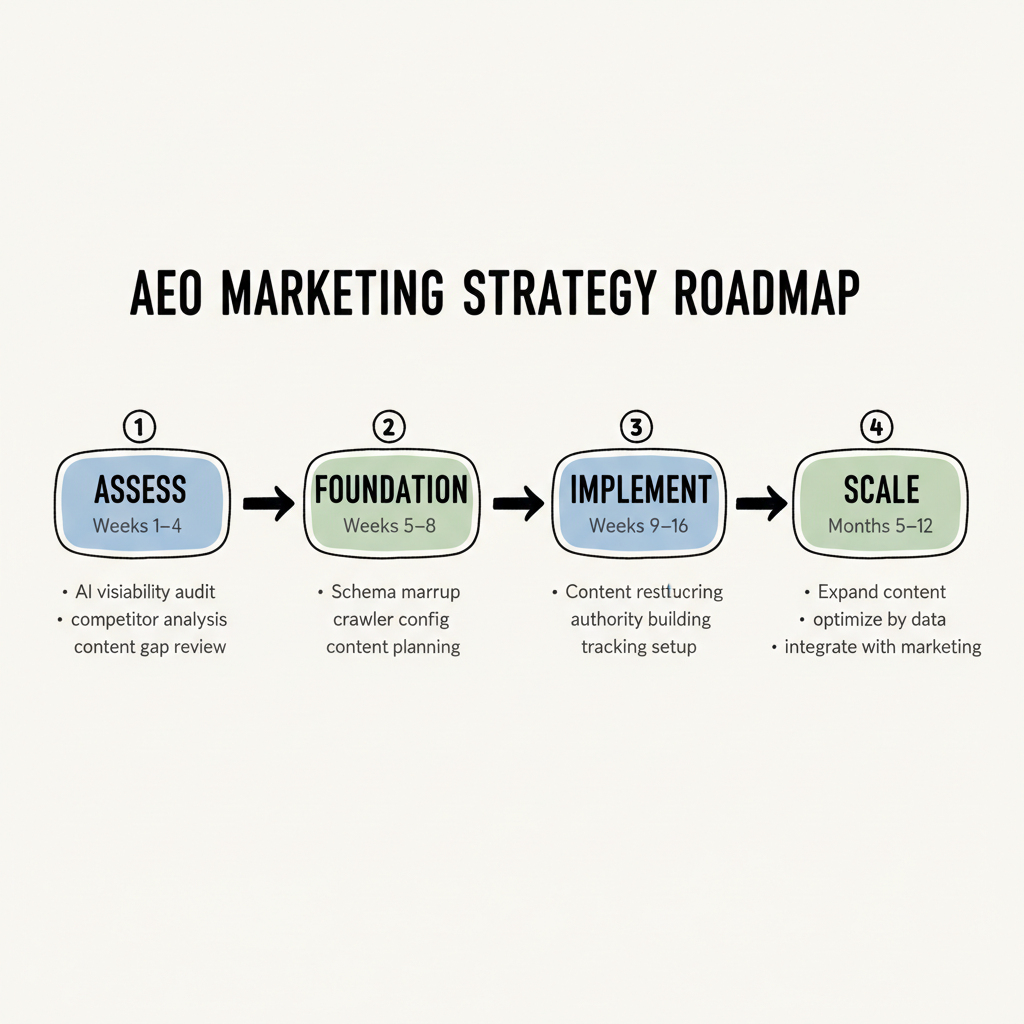
Implementing effective AEO marketing requires a structured approach. Using an AEO marketing strategy template can accelerate planning and ensure comprehensive coverage.
Phase 1: Assessment (Weeks 1-4)
Current State Analysis:
- Audit existing AI visibility across platforms
- Analyze competitor AI presence
- Evaluate current content for AI optimization readiness
- Assess technical foundation (schema, crawler access, site structure)
Conducting a comprehensive AEO technical audit identifies infrastructure gaps that may limit AI crawler access or content understanding.
Opportunity Identification:
- Map high-value queries to your business
- Identify content gaps where competitors earn citations you don’t
- Prioritize platforms based on audience behavior
- Quantify potential impact of improved AI visibility
Understanding AI search user demographics helps prioritize platforms where your target audience searches. Analyzing AI search ranking factors reveals which optimizations offer the highest impact for your content type.
Goal Setting:
- Define specific AI visibility targets
- Establish measurement baselines
- Set realistic timelines for improvement
- Align AEO goals with broader marketing objectives
Phase 2: Foundation (Weeks 5-8)
Technical Implementation:
- Configure AI crawler access appropriately
- Implement comprehensive schema markup
- Optimize site structure for AI parsing
- Address performance issues affecting crawlability
Content Audit and Planning:
- Evaluate existing content for optimization potential
- Prioritize content for AEO optimization
- Develop content calendar for new AEO-focused content
- Create content templates that support AI citation
Authority Assessment:
- Evaluate current entity presence
- Identify authority-building opportunities
- Plan for author expertise development
- Map citation opportunities in industry publications
Phase 3: Implementation (Weeks 9-16)
Content Optimization:
- Restructure priority existing content for AI visibility
- Create new content targeting high-opportunity queries
- Implement question-answer formatting
- Add summary sections and direct answer blocks
Following proven approaches to optimize content for generative AI ensures your content meets the structural and semantic requirements of AI citation systems. Understanding search engine optimization AI principles helps balance traditional SEO with AI-specific requirements.
Authority Building:
- Develop author profiles and credentials visibility
- Pursue industry publication placements
- Build citation network through outreach
- Strengthen brand entity signals
Technical Refinement:
- Expand schema implementation
- Optimize internal linking for topic clusters
- Address any remaining crawler access issues
- Implement monitoring and tracking
Phase 4: Scale (Months 5-12)
Content Expansion:
- Scale content production for broader query coverage
- Develop content in multiple formats (text, video, audio)
- Create platform-specific content variations
- Build comprehensive topic cluster coverage
Measurement and Optimization:
- Analyze performance data
- Identify what’s working and scale it
- Address underperforming areas
- Adapt to algorithm changes
Integration:
- Align AEO with broader marketing campaigns
- Coordinate with paid media strategies
- Integrate with sales enablement
- Connect to overall brand building efforts
Organizations without in-house expertise may consider white label AEO services to accelerate implementation, or engage a GEO services agency specializing in generative engine optimization.
Common AEO Marketing Mistakes
Avoid these frequent errors:
Mistake 1: Treating AEO as Separate from SEO AEO builds on SEO fundamentals. Attempting AI optimization without solid traditional SEO foundations typically fails.
Mistake 2: Optimizing for a Single Platform AI search is fragmented across multiple platforms. Focusing exclusively on ChatGPT or AI Overviews leaves opportunities elsewhere. When deciding SearchGPT vs Google AI when to prioritize each, consider your audience distribution and conversion data across platforms.
Mistake 3: Neglecting Content Quality No amount of technical optimization compensates for thin, unhelpful content. AI systems increasingly recognize and penalize low-quality content.
Mistake 4: Expecting Immediate Results AEO marketing is a long-term strategy. Building authority and earning consistent citations takes months, not days.
Mistake 5: Ignoring Measurement Without tracking AI visibility and attribution, you can’t demonstrate ROI or optimize effectively.
Mistake 6: Over-Optimizing for AI Content that feels obviously optimized for AI citation can feel unnatural to human readers. Balance AI optimization with user experience.
Mistake 7: Static Content Approach AI systems value freshness. Content must be regularly updated to maintain visibility.
The Future of AEO Marketing
AEO marketing will continue evolving as AI search matures:
Increased AI Search Adoption: Current estimates suggest AI search tools capture 6% of search traffic, potentially growing to 10-14% by 2028. Early AEO investment positions brands for this growth.
Platform Proliferation: New AI search tools will continue emerging, requiring broader optimization strategies. Understanding distinctions like AEO vs GEO helps navigate the expanding landscape of AI-powered search experiences.
Sophistication of AI Evaluation: AI systems will become better at evaluating source quality, making authority and expertise even more important.
Integration with Commerce: AI shopping assistants will increasingly influence purchase decisions, making product-specific AEO crucial for e-commerce.
Personalization: AI responses will become more personalized, requiring content strategies that address diverse user contexts.
Agentic AI: When AI Agents Buy, Not Just Recommend
The next frontier of AEO marketing is agentic AI—autonomous AI agents that perform multi-step workflows including research, comparison, evaluation, and purchase, rather than simply answering questions.
Agentic AI compresses the traditional awareness-consideration-decision funnel. When an AI agent can autonomously complete a purchase on behalf of a user, being cited is no longer enough—you must be selected. The optimization shift moves from “get cited” to “get chosen,” and the selection criteria are fundamentally machine-readable: structured attributes like price, reviews, specifications, and availability.
Practical implications for AEO marketers:
- Machine-readable product information: Comprehensive schema markup with product attributes, pricing, and availability becomes a competitive requirement, not a nice-to-have.
- Competitive pricing transparency: AI agents compare options programmatically. Opaque pricing or gated information means exclusion from agent-driven selections.
- API-accessible service details: Brands that make their offerings accessible through APIs and structured feeds position themselves for agent-based commerce.
- Review and reputation signals: Agentic AI weighs aggregate review data heavily. Building genuine review volume across platforms strengthens agent selection probability.
Agentic search is the defining trend of 2026. Early movers who optimize for agent-based commerce—not just conversational citations—gain first-mover advantage as adoption scales. Organizations exploring agentic AI tools can begin preparing their content and product infrastructure for this shift.
Organizations investing in knowledge infrastructure early, including LLM search optimization and understanding how to implement LLM optimization, will benefit from compounding authority signals. Many are also exploring agentic AI tools that automate aspects of content optimization and monitoring.
Learning from AEO success stories case studies provides practical insights into what works across industries. Organizations can benefit from AEO training programs and AEO training workshops to build internal capabilities. Conducting cross-platform AI search ROI analysis helps prioritize where to invest optimization efforts for maximum return.
The emergence of specialized approaches like generative engine optimization guide frameworks and GEO search optimization strategies reflects the maturation of this discipline. Understanding distinctions between what is an answer engine and traditional search engines helps frame optimization approaches appropriately.
Frequently Asked Questions
What Is the Difference Between AEO and Traditional SEO?
Traditional SEO optimizes content to rank in search engine results pages, driving clicks to your website. AEO (Answer Engine Optimization) optimizes content to be cited directly within AI-generated answers from platforms like ChatGPT, Perplexity, and Google AI Overviews. The key difference is conversion quality—AEO-referred visitors arrive pre-educated by the AI’s answer, resulting in conversion rates up to 4.4 times higher than traditional organic traffic.
How Does AEO Marketing Improve Conversion Rates?
AEO marketing improves conversions by earning citations in AI-generated answers, which pre-qualify visitors before they reach your site. AI engines like ChatGPT and Perplexity validate your content as authoritative, creating an implicit endorsement. Visitors who click through from AI citations have higher purchase intent and shorter decision cycles because the AI has already addressed their initial questions and positioned your brand as a trusted source.
What Is Retrieval-Augmented Generation and Why Does It Matter for AEO?
Retrieval-Augmented Generation (RAG) is the process AI engines use to combine their pre-trained knowledge with real-time web content retrieval. When a user asks a question, the AI retrieves relevant web pages, ranks them by authority and relevance, then generates an answer citing the top sources. RAG matters for AEO because understanding this retrieval process helps you optimize content structure, entity coverage, and authority signals to increase your citation probability.
How Do You Track Conversions from AI Search Traffic?
Track AI search conversions in GA4 by monitoring referral traffic from known AI domains including chat.openai.com, perplexity.ai, and google.com (AI Overviews). Create custom segments for these sources and compare conversion rates against organic traffic. Note that many AI-referred visitors appear as “direct” traffic—use AI citation tracking tools and monitor unexplained spikes in direct visits with high engagement and conversion patterns.
The window for establishing AI search leadership is narrowing. As more brands invest in AEO marketing, early movers gain compounding advantages—authority accumulates, citations build on citations, and AI systems learn to trust established sources. The conversion rate advantages of AI-referred traffic are real and significant. Brands appearing in AI recommendations capture high-intent users who are predisposed to trust and act on those recommendations.