
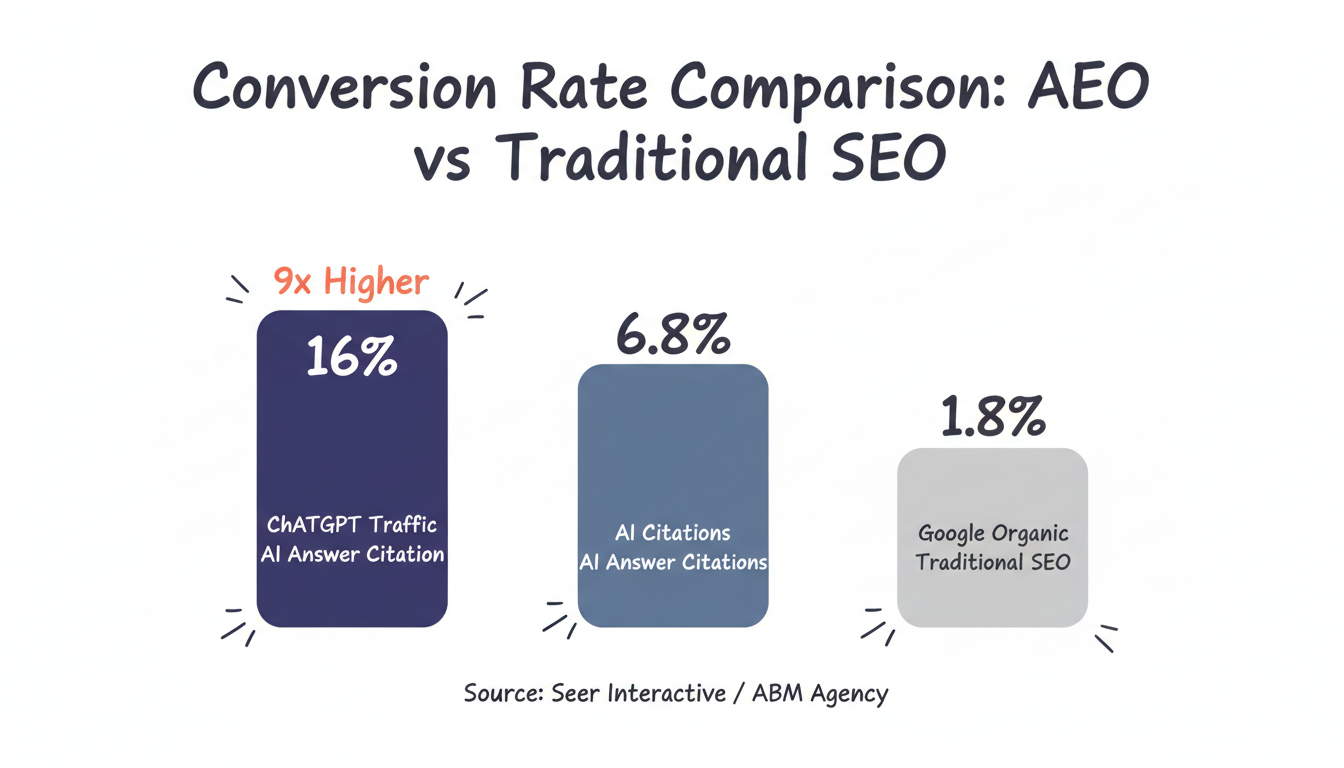
Answer Engine Optimization (AEO) is delivering conversion rates that traditional SEO struggles to match. Early data shows ChatGPT traffic converting at 16% compared to Google organic's 1.8%—nearly 9x higher. For some brands, the gap is even wider. AEO—also known as generative engine optimization (GEO) or large language model optimization (LLMO)—represents a fundamental shift in how brands capture high-intent traffic from AI-powered search platforms.
This guide explores why AEO marketing drives such dramatic conversion improvements and how to implement strategies that capture this high-intent traffic.
Why AEO Matters: The Zero-Click Search Shift
The search landscape is undergoing a seismic transformation. Zero-click searches—queries where the user gets their answer directly on the search results page without clicking through to any website—now account for an estimated 69% of all Google searches, up from 56% just a few years ago. This trend is accelerating as AI-generated answers become the default response format.
Gartner predicts that 25% of traditional organic search traffic will shift to AI-generated answers by 2026. With over 800 million weekly active users on ChatGPT alone, the scale of AI-driven search is no longer theoretical. These users are asking questions, getting direct answers, and only clicking through to sources that AI engines explicitly cite.
This shift renders traditional click-based SEO metrics increasingly insufficient. Ranking on page one matters less when the AI summary answers the query before users ever see blue links. The disciplines of generative engine optimization (GEO) and large language model optimization (LLMO) have emerged alongside AEO to address this reality, each focusing on slightly different aspects of AI visibility. For teams evaluating generative engine optimization tools, the overlap between these disciplines means many tools serve all three approaches.
The implication for marketers is clear: in a zero-click environment, the quality of traffic matters far more than volume. And that is precisely where AEO conversion rates excel. When a user does click through from an AI citation, they arrive with context, trust, and intent—which is why the conversion data is so striking. Understanding the Google AI Overview SEO impact on traditional traffic patterns helps quantify this shift for your own brand.
The Conversion Rate Advantage
The conversion data emerging from AEO-optimized content is remarkable.
According to analysis from digital marketing researcher Avinash Kaushik, Seer Interactive reports ChatGPT traffic converts at 16% versus Google organic's 1.8%—a dramatic difference that highlights the high-intent nature of AI-referred visitors. A fintech B2B company documented 8x conversion growth and a 25x traffic increase over 8 months by adopting an AEO-first content strategy, further validating these patterns across industries. Explore more AEO success stories and case studies to see how different verticals are achieving similar results.
Reported conversion benchmarks:
Traffic Source | Conversion Rate | Notes |
ChatGPT referrals | 16.0% | Seer Interactive data |
Google organic | 1.8% | Traditional SEO baseline |
AI Answer Citations | 6.8% | ABM Agency research |
According to The Digital Elevator's AEO framework, Ahrefs reports AI traffic as their highest converting channel despite being less than 1% of total traffic, with conversion rates exceeding 10%.
Why AI Traffic Converts Better
Several factors explain the conversion advantage:
Intent clarity: Users asking AI specific questions have already moved past research phase. When they click through to cited sources, they're seeking validation or deeper detail—not starting their journey.
Trust transfer: Being cited by an AI system transfers credibility. Users perceive cited sources as vetted and authoritative.
Friction reduction: AI answers reduce cognitive load. Users arrive at cited sites with context already established, making conversion paths shorter.
What Is AEO Marketing?
According to Spearpoint's AEO guide, Answer Engine Optimization is the strategic practice of structuring content to earn citations and mentions within AI-generated responses across platforms like ChatGPT, Perplexity AI, Google AI Overviews, and other conversational search interfaces.
AEO vs traditional SEO:
Factor | Traditional SEO | AEO Marketing |
Goal | Rank on page 1 | Get cited in AI answers |
Focus | Keywords | Direct answers |
Success metric | Position rankings | Citation frequency |
Traffic type | Link clicks | Citation referrals |
User intent | Variable | High and specific |
According to O8 Agency's AEO guide, AEO focuses on organizing and fine-tuning content so AI-powered answer engines can easily understand, cite, and use it to directly answer user questions.
The Shift To "Share of Answer"
The industry is experiencing a fundamental measurement shift.
According to ABM Agency's AEO research, unlike SEO agencies that focus on ranking webpages on blue links, AEO agencies focus on ensuring brand content is synthesized into direct answers provided by AI. Their recommendation: stop measuring "Share of Voice" and start measuring "Share of Answer."
New AEO metrics:
- Citation frequency across AI platforms
- Share of Answer for target queries
- AI Brand Perception Score
- Citation position (primary vs. supporting)
- Referral conversion rates from AI sources
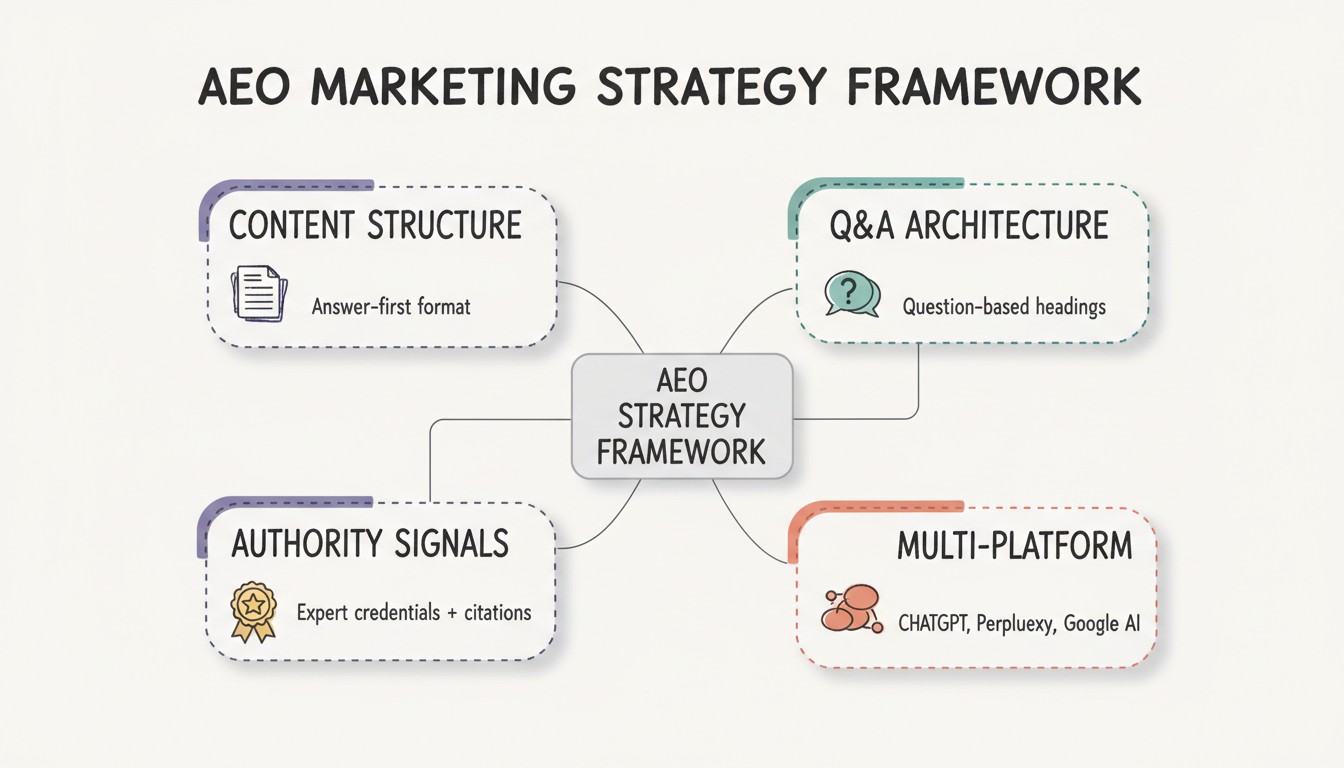
AEO Marketing Strategy Framework
1. Content Structure for Citation
AI systems extract and synthesize information differently than traditional search crawlers.
According to Nativz's AEO services research, AEO-optimized brands see significant boosts in AI Overview visibility. The key is structuring content so AI systems can parse, quote, and cite it effectively.
Content structure principles:
- Lead with direct answers to specific questions
- Use clear question-based headings
- Present information in extractable formats
- Include authoritative data and statistics
- Maintain consistent, expert tone
A critical concept here is information gain: AI engines prioritize content that offers original data or a unique point of view over rehashed material. The Seer Interactive conversion data and ABM Agency research cited in this post are examples of information gain—proprietary findings that AI systems are more likely to extract and cite because they cannot be found elsewhere. Additionally, consensus building matters: when multiple pages on your site reinforce the same core claim with consistent data, AI systems treat that claim as more authoritative and are more likely to cite your domain as the source.
2. Question-Answer Architecture
According to O8's optimization framework, instead of generic headings like "Implementation Tips," use specific questions like "How do you implement schema markup for better AEO results?" This approach helps AI engines understand exactly what question your content answers.
Question-based content approach:
- Identify questions your audience asks AI
- Structure content around those specific questions
- Provide direct answers within first 100 words
- Expand with supporting detail and evidence
- Include related questions and answers
3. Authority Signal Development
AI systems evaluate source credibility before citation. Building authority signals increases citation probability.
Authority factors:
- Expert author credentials
- Cited sources and references
- Industry backlinks and mentions
- Consistent topical expertise
- Regular content updates
E-E-A-T and AI Crawler Access
Google and AI systems evaluate content trustworthiness through the E-E-A-T framework: Experience, Expertise, Authoritativeness, and Trustworthiness. Each dimension maps directly to the authority factors above. Original research data demonstrates Experience and Expertise. Properly cited sources and transparent methodology build Trustworthiness. Consistent topical depth and industry recognition establish Authoritativeness.
Beyond content quality, technical access matters. AI systems use two categories of crawlers, and understanding the distinction is essential for AEO:
- Training bots scrape content to build and refine AI models. These include GPTBot, Google-Extended, and CCBot. Some publishers choose to block these if they are concerned about their content being used in model training.
- Retrieval bots fetch content in real-time to generate cited answers. These include PerplexityBot, Google's AI Overview fetcher, and similar agents. Blocking retrieval bots means your content cannot be cited—effectively opting out of AEO entirely.
Review your robots.txt to ensure retrieval bots are not accidentally blocked. Many default configurations block all bots indiscriminately, which silently removes your content from AI citation eligibility.
Featured snippets remain a valuable bridge between traditional SEO and AEO. Content that wins featured snippets is disproportionately cited by AI engines, making snippet optimization a high-leverage tactic. See practical AEO optimization examples for implementation patterns that address both E-E-A-T signals and crawler access configuration.
4. Multi-Platform Optimization
Different AI platforms have different citation patterns.
Platform-specific considerations:
According to Cyclewerx Marketing's AEO analysis, AEO requires optimizing for multiple AI engines including ChatGPT, Google AI Overviews, Bing Copilot, and Perplexity—each with distinct preferences for how they read, interpret, and recommend content.
Platform | Citation Preference |
ChatGPT | Authoritative, well-structured content |
Perplexity | Real-time sources with clear citations |
Google AI Overviews | Traditional authority signals + structured data |
Bing Copilot | Microsoft ecosystem integration |
Voice Search and Conversational Query Optimization
Voice commerce is projected to exceed $80 billion and continues growing rapidly. Voice queries are inherently conversational and question-based, which means voice assistants like Siri, Alexa, and Google Assistant pull from the same answer engine infrastructure that AEO targets.
Optimizing for voice search requires targeting long-tail question phrases, using natural conversational language, and structuring content as direct spoken answers. The optimal format is a concise, self-contained response in the 40-60 word range that a voice assistant can read aloud without modification.
An important distinction exists between single Q&A optimization and conversational flow optimization. AI assistants increasingly handle multi-turn dialogues—follow-up questions that build on the initial query. Content that anticipates the next logical question and provides a clear path to related answers performs better in these multi-turn interactions. The question-answer architecture discussed earlier in this guide directly supports this pattern by organizing content around natural question sequences.
Schema Markup and Structured Data for AI Citation
Structured data helps AI systems extract and attribute content accurately. Implementing the right schema types increases the likelihood that AI engines will parse your content correctly and cite it with proper attribution. For a comprehensive guide to implementing structured data for AI search, start with these core schema types:
FAQPage schema marks up question-and-answer pairs and is frequently surfaced in AI Overviews and voice assistant responses. This is one of the highest-impact schema types for AEO because it explicitly tells AI systems which questions your content answers.
HowTo schema structures step-by-step processes that AI engines can quote directly. Instructional content with HowTo markup is more likely to be extracted as a complete, cited procedure rather than paraphrased.
Article schema provides core metadata including headline, author, datePublished, and dateModified. These credibility signals help AI systems assess content freshness and authority—two factors that influence citation ranking.
Speakable schema identifies specific sections of your content that are suitable for voice assistant text-to-speech output. As voice search grows, Speakable markup ensures the right sections of your content are selected for audio delivery.
Beyond schema types, content formatting patterns matter for AI extraction. Semantic triples—clear subject-verb-object claims like "ChatGPT traffic converts at 16%"—are the atomic units that AI systems extract most reliably. Structure your key claims as direct, unambiguous statements in 40-60 word answer blocks within each section. This length is optimal for AI extraction: long enough to provide complete context, short enough to quote directly.
References to Knowledge Graph entities within your content strengthen topical authority. When your content explicitly names recognized entities (companies, concepts, standards) and describes their relationships, AI systems can connect your content to their knowledge graphs, increasing citation probability. Consider using AEO tools and software to audit your schema implementation and identify gaps in structured data coverage.
Measuring AEO Marketing Success
Core AEO Kpis
According to Spearpoint's metrics framework, citation frequency and AI brand score represent core AEO metrics—tracking how often your brand gets mentioned and cited across answer engines provides directional indicators of visibility and authority recognition.
Essential metrics:
- Citation Rate: How often you're cited when relevant queries are asked
- Share of Answer: Your brand's citation share vs. competitors
- AI Referral Traffic: Visitors arriving via AI platform citations
- Citation Conversion Rate: Conversion rate from AI-referred traffic
- Brand Perception Score: How AI systems describe your brand
Attribution Challenges
AI traffic attribution remains imperfect. Google Analytics doesn't always distinguish AI referrals cleanly, and UTM parameters don't apply to AI-generated citations. When implementing AI search citation tracking, brands need specialized monitoring approaches beyond standard analytics.
Measurement approaches:
- Monitor referral traffic from known AI domains
- Track conversion patterns for high-intent queries
- Conduct regular AI brand audits across platforms
- Correlate content updates with citation changes
Common AEO Marketing Mistakes
Mistake 1: Treating AEO as Separate from SEO
According to Elsner Technologies' AEO company analysis, the best AEO companies integrate answer engine optimization with traditional SEO for visibility across all search types—conventional and AI-powered.
Better approach: View AEO as an extension of SEO, not a replacement. Strong traditional SEO foundations improve AEO outcomes. Understanding the relationship between GEO, SEO, and AEO helps integrate these strategies effectively.
Mistake 2: Ignoring Platform Differences
Each AI platform cites sources differently. Optimizing for one doesn't guarantee visibility across others.
Better approach: Audit your brand presence across multiple AI platforms and optimize for each.
Mistake 3: Focusing Only on Traffic Volume
AI traffic may represent a small percentage of total traffic but converts at dramatically higher rates.
Better approach: Weight AEO performance by conversion value, not just traffic volume.
Frequently Asked Questions
What Is AEO Marketing and How Does It Differ from SEO?
AEO marketing, or answer engine optimization, focuses on getting your content cited by AI-powered answer engines like ChatGPT, Perplexity, and Google AI Overviews. Unlike traditional SEO, which drives clicks to your website through blue-link rankings, AEO prioritizes being the quoted source in AI-generated responses. The key shift is from optimizing for ranking position to optimizing for citation authority and answer visibility across multiple AI platforms.
Why Do AEO Conversions Outperform Traditional SEO Conversions?
AI-referred visitors arrive with higher purchase intent because answer engines pre-qualify them. When an AI tool cites your brand in response to a specific query, the user has already received context about your offering. Research from Seer Interactive shows AI-referred traffic converts at roughly 16%, compared to 1.8% for traditional organic search. This intent-rich traffic translates directly to better conversion rates and lower cost per acquisition.
What Structured Data Should I Use for Answer Engine Optimization?
Implement FAQPage schema for question-and-answer content, HowTo schema for step-by-step guides, and Article schema with complete author and date metadata. Speakable schema marks sections suitable for voice assistant readback. Structure your content in 40-60 word answer blocks using clear subject-verb-object patterns that AI systems can extract as direct quotations. These schema types help AI engines parse and accurately attribute your content.
How Do I Measure AEO Performance and Track AI Citations?
Track AI referral traffic in GA4 by filtering for LLM-specific referral domains. Monitor your "Share of Answer" metric—how often your brand appears in AI responses for target queries. Use server logs to identify AI bot crawl activity from GPTBot, PerplexityBot, and ClaudeBot. Combine citation frequency data with conversion tracking to calculate the true ROI of your answer engine optimization efforts.
Getting Started with AEO Marketing
According to Marketing Illumination's AEO best practices, businesses should create detailed content with structured data to appear in AI answers—because users increasingly find products through AI answers, not by clicking on search results. Following proven AEO best practices for 2026 helps ensure your implementation delivers measurable results.
Initial AEO audit steps:
- Search your brand name in ChatGPT, Perplexity, and Google AI Mode
- Document how AI describes your brand and competitors
- Identify questions where you should appear but don't
- Analyze content structure of cited competitors
- Prioritize high-conversion queries for optimization
Key Takeaways
AEO marketing represents a fundamental shift in how brands capture high-intent traffic:
- Conversion rates dramatically exceed traditional SEO - ChatGPT traffic converting at 16% vs. 1.8% for Google organic demonstrates the high-intent nature of AI-referred visitors
- AEO complements rather than replaces SEO - Strong traditional SEO foundations improve AI citation probability; integrate both strategies
- Measurement requires new metrics - Citation frequency, Share of Answer, and AI Brand Perception Score replace traditional ranking metrics
- Content structure matters for citation - Direct answers, question-based architecture, and extractable formats improve AI system comprehension
- Multi-platform optimization is essential - ChatGPT, Perplexity, Google AI Overviews, and Bing Copilot each have distinct citation preferences
The dramatic conversion advantage of AEO-optimized content makes this one of the highest-ROI marketing investments available. Brands that build citation authority now will capture disproportionate value as AI search adoption continues expanding.