
Answer engine optimization has moved from theory to practice. With 60% of searches now ending in zero-click results and 79% of users preferring AI-generated answers over traditional search listings, brands across industries are measuring success not just by rankings but by "citation dominance"—how often AI systems like ChatGPT, Perplexity, Gemini, and Claude reference their content as authoritative sources. These real-world AEO marketing examples demonstrate what winning AI search visibility actually looks like in 2026.
According to DW Media's AEO trends report, success is no longer measured by blue links but by citation dominance—your brand's ability to be the primary source of truth for AI agents. Brands that aren't cited in the "sources" section of an AI answer effectively don't exist in the buyer's evaluation phase.
Curious how your content performs for AI search engines? Run a quick check with our free AEO grader tool for instant insights.
What Successful AEO Marketing Looks Like
Before examining specific examples, understanding what AEO success means helps contextualize these results.
According to SE Ranking's AEO case studies, successful AEO campaigns share common characteristics: structured data optimization (including FAQPage schema, HowTo schema, and Speakable schema), strategic brand mention building, and content designed specifically for AI extraction and citation.
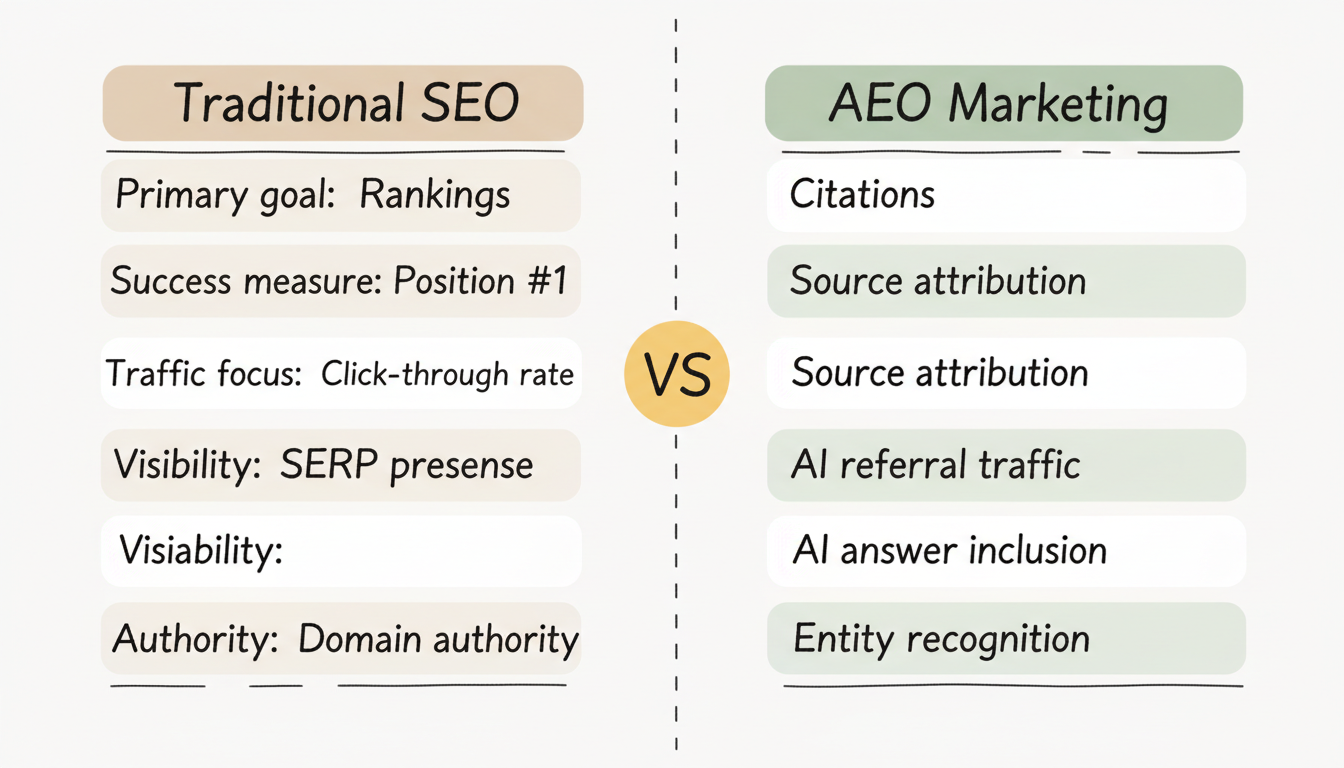
AEO success metrics:
Metric | Traditional SEO | AEO Marketing |
Primary goal | Rankings | Citations |
Success measure | Position #1 | Source attribution |
Traffic focus | Click-through rate | AI referral traffic |
Visibility | SERP presence | AI answer inclusion |
Authority | Domain authority | Entity recognition |
AEO vs SEO: A Side-By-Side Example
To understand the practical difference between traditional SEO and AEO, consider how HubSpot optimized the same CRM comparison page for both channels.
With traditional SEO, the page targeted "best CRM software 2026" with keyword-optimized headers, internal links, and meta tags. The goal: rank on page one of Google and drive click-through traffic. The content followed a standard listicle format with brief descriptions of each platform.
With AEO, HubSpot restructured the same content for AI extraction. Each CRM entry included a concise, citation-ready summary sentence (e.g., "HubSpot CRM offers a free tier with contact management, pipeline tracking, and email integration for up to 1,000,000 contacts"). They added FAQPage schema markup with direct answers to common buyer questions. They also added Speakable schema to flag key paragraphs for voice assistant delivery.
The AEO-optimized version earned source citations across ChatGPT, Perplexity, and Gemini for CRM-related queries. The SEO-only version still ranked on Google but was absent from AI-generated answers. The key difference: SEO optimizes for ranking algorithms, while AEO optimizes for extraction and citation by large language models. According to HubSpot's internal benchmarks, pages with both SEO and AEO optimization saw a 30-40% visibility boost compared to SEO-only equivalents.
Example 1: HubSpot Achieves 36% Visibility Increase
HubSpot struggled with AI visibility despite strong traditional SEO performance and high domain authority.
According to SE Ranking's case study analysis, HubSpot's main obstacle was structuring its vast content library for AI extraction. Without citation-ready formatting, AI systems couldn't reliably attribute answers to HubSpot content despite its authority. HubSpot also deployed its own AI Search Grader tool to measure how frequently its pages appeared as sources in AI-generated responses across platforms.
The approach:
- Optimized content and data structure for AI discovery across ChatGPT, Perplexity, Gemini, and Claude
- Built strategic brand mentions across authoritative sources
- Implemented FAQPage and HowTo schema markup across educational content
- Positioned the brand as a top-ranked source in both organic and AI-driven results
Results: Within three months, HubSpot appeared in ChatGPT and Perplexity responses for key industry queries. Overall rankings and visibility improved by 36%, while referral traffic from AI platforms generated a 27% AI-to-lead conversion rate—significantly higher than traditional organic search. This success demonstrates how AEO consulting services can deliver measurable improvements in AI search visibility.
Example 2: Home Services Franchise Scales AI Visibility
A home services franchise group with over 5,500 locations across 19 brands faced disruption from AI-driven search.
According to SE Ranking, AI-driven search tools including Google AI Overviews, ChatGPT, Perplexity, and Gemini were diverting traffic away from traditional search results, disrupting the organic traffic previously driven by blog content.
The solution:
- Created scalable, AI-first content strategy
- Implemented structured data including FAQPage schema across locations
- Built systematic brand mentions for AI recognition
Results: The franchise achieved presence across AI-driven search results while maintaining traditional organic visibility through an integrated approach that balanced seo and aeo priorities.
Example 3: Salesforce Leads AI Market Share in Financial Services
Salesforce's Financial Services Cloud team was among the earliest adopters of AEO strategies, recognizing the high-intent nature of financial queries in AI platforms.
According to Conductor's 2026 AEO/GEO Benchmarks Report, their analysis of 10 key industries revealed clear leaders in AI brand mention market share. Salesforce consistently appeared in AI-generated responses for financial technology queries, capturing dominant citation share across ChatGPT, Gemini, and Claude.
What worked:
- Comprehensive FAQ content addressing common financial questions with FAQPage schema
- Expert-attributed content with strong E-E-A-T signals
- Structured data implementation including HowTo and Speakable schema across all educational content
Example 4: IT Industry Leaders Dominate AI Citations
Technology companies have natural advantages in AEO due to their technical content depth.
According to Conductor's benchmarks, the IT industry shows distinct AI brand mention market share leaders who have invested heavily in structured, authoritative content that AI systems recognize and cite. Companies like Microsoft, Cisco, and IBM have implemented comprehensive schema markup and answer-first formatting across developer documentation.
Success factors:
- Technical documentation optimized for AI extraction with HowTo schema
- Developer resources with clear, structured answers
- Cross-platform presence building entity recognition across ChatGPT, Perplexity, Gemini, Claude, and Microsoft Copilot
Example 5: Consumer Brands Win Voice and AI Search
Consumer-facing brands are adapting AEO strategies for voice assistants and AI shopping recommendations.
According to Amsive's AEO guide, success requires strong technical foundations that make content easily discoverable by AI crawlers, content optimized for consumer learning and discovery paths, and integrated brand-building strategies.
The integrated approach:
- Technical foundations for AI crawler discoverability including Speakable schema for voice queries
- Content aligned with consumer discovery journeys
- Brand authority across the digital ecosystem where AI sources information
Example 6: Healthcare Organization Builds AI Trust
Healthcare brands face unique AEO challenges given the sensitivity of medical information.
According to Measured SEM's agency analysis, healthcare organizations that win AEO focus on establishing medical expertise signals, verified author credentials, and factual integrity that AI systems can validate. Organizations often benefit from working with top generative engine optimization companies that understand these specialized requirements.
Critical elements:
- Expert medical authorship clearly attributed
- Peer-reviewed information and citations
- Structured data supporting medical entity recognition including FAQPage schema for patient questions
Example 7: Danone Earns 1,200% Retail Traffic Increase
Danone, the global food and beverage company, restructured its product content strategy specifically for AI shopping recommendations and recipe queries.
According to Ad Age's AEO coverage, Danone focused on making product information understandable and quotable by large language models, with clear nutritional data, usage occasions, and comparison content AI could confidently recommend. The brand invested in structured product pages with complete specifications that AI systems could extract and cite in response to consumer queries like "best yogurt for gut health" or "high-protein dairy alternatives."
Product optimization tactics:
- Comprehensive product specifications in structured format with schema markup
- Recipe and usage content positioned for AI recommendation queries
- Review aggregation and nutritional claims building trust signals
Results: Danone saw a 1,200% increase in retail-directed traffic from AI platforms, demonstrating that consumer goods brands can drive measurable commerce outcomes through AEO.
Example 8: Professional Services Firm Generates AI Leads
Professional services firms are discovering AEO's lead generation potential, with some achieving a 27% conversion rate from AI-referred traffic.
According to Mag North's AEO services overview, clients are being cited in AI-generated answers across ChatGPT, Perplexity, Gemini, and Claude, generating new leads driven by AI recommendations with a clearer roadmap for visibility in a world where search is about context and credibility.
Lead generation approach:
- Thought leadership content answering industry questions
- Expert positioning across authoritative platforms
- Clear service offerings AI can summarize and recommend
Example 9: Media Brand Maintains Traffic Despite Zero-Click
Media organizations are adapting to zero-click search by focusing on brand visibility. With 60% of all searches now ending without a click, citation presence has become the primary success metric.
According to UOF Digital's AI visibility guide, brands appearing in AI-powered platforms such as ChatGPT, Perplexity, Gemini, Claude, Microsoft Copilot, and Google AI Overviews are discovering that impressions matter even when clicks don't follow.
Brand visibility strategy:
- Accepting citation value alongside traffic
- Building recognition across all major AI platforms
- Leveraging AI mentions for broader awareness
Example 10: Utilities Company Establishes Industry Authority
Even traditional industries are finding AEO value.
According to Conductor's industry benchmarks, utilities industry leaders have emerged with strong AI brand mention market share by providing clear, authoritative answers to consumer questions about services and operations.
Authority building:
- Educational content about services and operations
- Local optimization for regional AI queries
- Trust signals through consistent information
AEO Tools Used by Winning Brands
Measuring AEO performance requires purpose-built tools since traditional SEO platforms weren't designed to track AI citations. Here are the tools leading brands rely on to monitor and improve their answer engine visibility.
HubSpot AI Search Grader is a free tool that analyzes how your brand appears in AI-generated search results. It scans responses from ChatGPT, Perplexity, and Gemini to show how often your brand is cited, what sentiment surrounds those mentions, and where competitors outrank you in AI answers. Several of the brands in this article used AI Search Grader as their baseline measurement before optimizing.
Goodie AI specializes in tracking brand visibility across generative AI platforms. It monitors how frequently and in what context AI systems mention your brand, providing competitive benchmarking and historical trend data. Danone and other consumer brands have used Goodie AI to track their AI citation growth over time.
BrandRank takes a proprietary scoring approach to AI visibility, assigning brands an AI ranking score based on citation frequency, source authority, and mention context across major AI platforms. It helps brands understand their competitive position specifically in the AI answer ecosystem.
Conductor expanded its traditional SEO platform to include AEO/GEO benchmarking. Their 2026 Benchmarks Report (referenced in several examples above) tracks AI brand mention market share across industries, making it valuable for understanding competitive positioning in AI search.
AEO measurement tools comparison:
Tool | Primary Strength | AI Platforms Tracked | Best For |
HubSpot AI Search Grader | Brand sentiment + citation audit | ChatGPT, Perplexity, Gemini | Quick baseline assessment |
Goodie AI | Citation tracking over time | All major LLMs | Trend monitoring |
BrandRank | Competitive AI scoring | ChatGPT, Gemini, Claude, Perplexity | Competitive benchmarking |
Conductor | Industry-level benchmarks | Cross-platform | Enterprise AEO/GEO strategy |
Common Patterns Across Winners
These examples reveal consistent patterns in AEO marketing success.
According to Elsner Technologies' AEO overview, the best AEO companies integrate answer engine optimization with traditional SEO for visibility across all search types—conventional and AI-powered.
Winning characteristics:
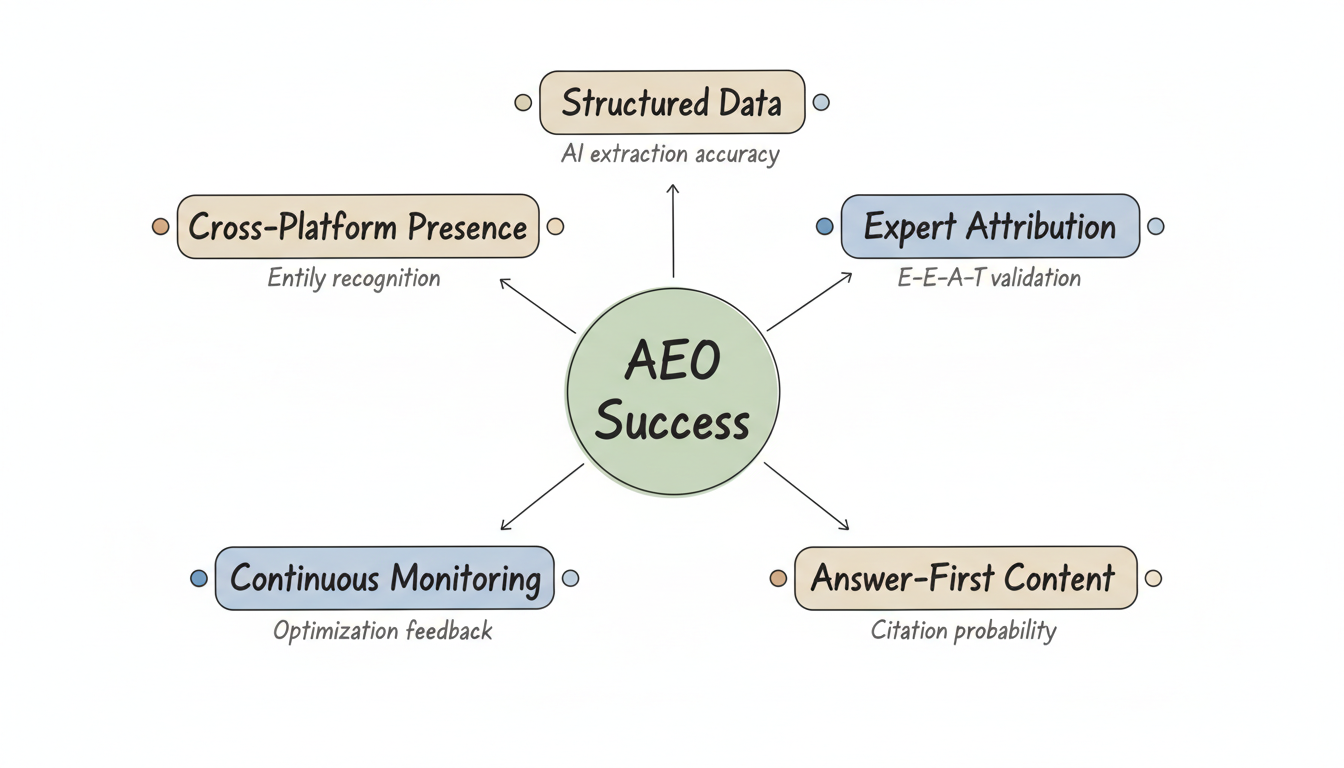
Pattern | Implementation | Impact |
Structured data | FAQPage, HowTo, and Speakable schema | AI extraction accuracy |
Expert attribution | Named, credentialed authors | E-E-A-T validation |
Cross-platform presence | Consistent brand signals | Entity recognition |
Answer-first content | Direct, extractable answers | Citation probability |
Continuous monitoring | AI visibility tracking via HubSpot AI Search Grader, Goodie AI, BrandRank | Optimization feedback |
AEO Marketing FAQ
What is AEO in marketing?
AEO (Answer Engine Optimization) in marketing is the practice of optimizing content so that AI-powered platforms—including ChatGPT, Perplexity, Gemini, Claude, and Google AI Overviews—cite your brand as an authoritative source in their generated answers. Unlike traditional SEO which focuses on ranking in search results, AEO focuses on earning citations and source attribution in AI responses. As 60% of searches now end without a click, AEO ensures your brand remains visible in the AI-mediated discovery process.
What's the difference between SEO and AEO?
SEO optimizes content for search engine ranking algorithms—targeting keywords, building backlinks, and improving technical site performance to appear higher in traditional search results. AEO optimizes content for extraction and citation by large language models—structuring answers for AI readability, implementing schema markup (FAQPage, HowTo, Speakable), and building entity recognition across AI platforms. The best-performing brands in 2026 combine both: SEO drives organic traffic while AEO ensures AI systems cite and recommend their content.
Is AEO replacing SEO?
AEO is not replacing SEO—it's extending it. Traditional SEO remains essential for organic search traffic, but with 79% of users now preferring AI-generated answers, brands that ignore AEO miss a growing share of discovery. The examples in this article show that brands achieving the strongest results integrate AEO with existing SEO strategies rather than choosing one over the other. Think of AEO as a new layer of optimization that ensures your content performs across both traditional and AI-powered search channels.
How to do AEO marketing?
Start by auditing your AI visibility using tools like HubSpot AI Search Grader or Goodie AI to understand your baseline. Then implement these core practices: add structured data (FAQPage, HowTo, and Speakable schema) to key content pages; write citation-ready summary sentences that AI can extract directly; build consistent brand mentions and entity signals across authoritative sources; and monitor your citation performance across ChatGPT, Perplexity, Gemini, and Claude. The brands in this article typically saw measurable results within 3 months of implementing these strategies.
Key Takeaways
These AEO marketing examples demonstrate consistent principles for AI search visibility:
- Citation dominance matters - Brands winning AI search focus on being cited, not just ranking
- Structured data is foundational - Successful brands implement FAQPage, HowTo, and Speakable schema
- Authority builds over time - Brand mentions and expert signals compound for AI recognition
- Integration works best - AEO combined with traditional SEO delivers strongest results, with top brands seeing 30-40% visibility boosts
- Measurement is essential - Winners track AI visibility metrics using tools like HubSpot AI Search Grader, Goodie AI, and BrandRank
According to DW Media, to win in 2026, marketers must move beyond keyword density to focus on structured proof blocks, persona-led answer nodes, and maintaining a high factual integrity score across the decentralized web. Following generative engine optimization best practices helps ensure your content meets these evolving requirements.