
AEO stands for Answer Engine Optimization—the practice of optimizing content to appear in AI-generated answers across platforms like ChatGPT, Google AI Overviews, Perplexity, Claude, and voice assistants. As AI systems increasingly provide direct answers instead of links, AEO has become essential for maintaining brand visibility in the evolving search landscape. With over 57% of Google searches now ending without a click, the shift toward answer engines is accelerating faster than ever.
This guide explains what AEO means, why it matters, and how it fits into modern digital marketing strategy.
What AEO Means
Answer Engine Optimization focuses on making your content the source that AI systems choose when generating responses to user queries. Unlike traditional SEO, which aims to rank pages in search results, AEO aims to get your content featured in the answer itself.
The core distinction: SEO gets you on page one. AEO gets you in the answer box before users scroll.
When someone asks ChatGPT "What's the best project management software for small teams?" or speaks a question to their voice assistant, AEO determines which brands and content get mentioned in the response.
How Answer Engines Differ from Search Engines
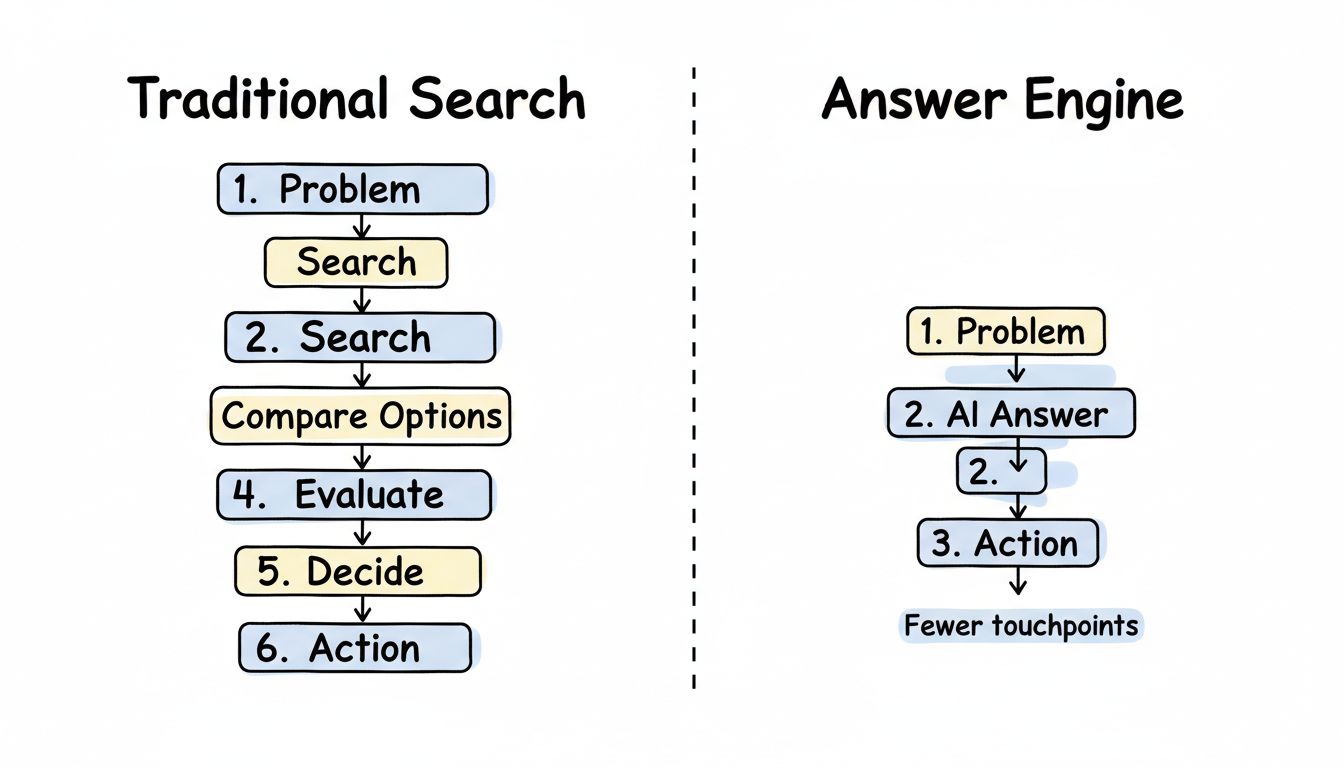
Traditional search engines return lists of links. Users browse options, click through, and evaluate information themselves.
Answer engines collapse this process. They synthesize information from multiple sources and deliver a direct response. The user experience shifts from "searching" to "delegating"—asking an AI-powered search assistant to find and summarize information on their behalf.
Traditional search funnel: Problem → Search → Compare options → Evaluate → Decide → Action
Answer engine funnel: Problem → AI Answer → Action
This compression means fewer touchpoints where brands can influence decisions. If your content isn't included in the AI's synthesized answer, you may never reach the user at all.
The Zero-Click Search Shift: Why AEO Matters Now
The rise of AEO is driven by a fundamental change in how people find information: the zero-click search. A zero-click search occurs when a user's query is answered directly on the search results page—or by an AI assistant—without requiring a click to any website.
According to a Bain & Company study, 57% of Google searches now end without the user clicking on any result. This figure has been climbing steadily as Google AI Overviews, featured snippets, and knowledge panels provide increasingly complete answers inline. The impact of Google AI Overviews on SEO is reshaping how marketers think about organic visibility.
Gartner has predicted a 25% decline in traditional search volume by 2026, driven by the adoption of AI-powered answer engines. ChatGPT alone has surpassed 400 million users, signaling that consumers are rapidly shifting to platforms that deliver synthesized answers rather than link lists.
Long-tail queries—the specific, conversational questions that make up the majority of search volume—are particularly affected. These are exactly the queries that AI Overviews and answer engines handle best, which means the CTR (click-through rate) on traditional organic results for these terms is declining fastest.
The strategic takeaway is clear: AEO is not a speculative future trend. It is the direct response to zero-click erosion that is already underway. Brands that optimize for answer engines today protect their visibility as the search landscape continues to shift.
Why AEO Matters in 2026
Several factors make AEO increasingly critical for businesses.
AI Answers Dominate Search Results
Google AI Overviews now appear at the top of most search results, providing synthesized answers before traditional organic listings. Understanding Google AI Overview ranking factors helps optimize for this prominent placement. Users read these summaries without scrolling further or clicking through to websites.
Growing AI Search Adoption
ChatGPT, Perplexity, and other AI assistants have moved from experimental tools to mainstream information sources. Millions of users now ask AI systems questions they previously typed into Google.
Voice Search Integration
Smart speakers and voice assistants rely on answer engines to respond to spoken queries. With voice search, there's typically only one answer delivered—making AEO visibility even more critical.
Named Answer Engines & Voice Assistants
The answer engine ecosystem spans both text-based and voice-based platforms. On the text side, the major players include ChatGPT (OpenAI), Google Gemini, Perplexity, Claude (Anthropic), and Bing Copilot (Microsoft). Each processes queries differently, but all rely on extracting authoritative content from the web to generate responses.
On the voice side, smart assistants like Siri (Apple), Alexa (Amazon), and Google Assistant serve as answer engines for spoken queries. Voice queries tend to be longer, more conversational, and more question-formatted than typed searches—reinforcing the connection between AEO and long-tail query optimization. For a deeper dive into optimizing for these platforms, see our guide on voice search optimization.
Personalized Responses
AI answer engines deliver personalized responses based on user context, past interactions, and query specifics. The same question can yield different answers for different users, meaning AEO success requires content that performs across multiple contexts.
AEO vs SEO: Key Differences
While AEO and SEO overlap, they differ in important ways.
Aspect | SEO | AEO |
Goal | Rank pages in search results | Get cited in AI-generated answers |
Target | Search engine algorithms | AI content retrieval systems |
Success metric | Rankings, organic traffic | AI citations, mention frequency |
Content format | Keyword-optimized pages | Extractable, direct answers |
Key tactics | Backlinks, keywords, technical SEO | Schema markup, E-E-A-T, structured content |
AEO doesn't replace SEO. Strong organic rankings still correlate with AI visibility—research shows most AI citations come from top-ranking content. However, AEO adds additional optimization requirements beyond traditional SEO. Both disciplines share structured data and E-E-A-T as common foundations, and AEO extends the playing field to include featured snippets, People Also Ask boxes, and knowledge panels as stepping stones toward full AI citation. For a detailed breakdown, see our AEO vs GEO vs SEO comparison.
AEO in Practice: Real-World Examples
Understanding AEO in theory is one thing—seeing it work in the real world is another. Several well-known brands illustrate how answer engine visibility plays out in practice.
NerdWallet is a notable example. Despite experiencing declines in traditional organic traffic as AI answers absorbed many of the queries they previously ranked for, NerdWallet's revenue continued to grow. The reason: AI engines frequently cite NerdWallet's content in financial answers, preserving the brand's authority and driving qualified traffic through AI-mediated discovery rather than direct clicks.
Stack Overflow initially saw significant traffic losses as developers turned to AI assistants for coding answers. However, Stack Overflow adapted by restructuring content for extractability—ensuring that their answers were formatted in clean, citable blocks that AI systems preferred to reference. This pivot illustrates a key AEO lesson: content that is easy for AI to extract and attribute tends to recover visibility faster.
These examples highlight how knowledge panels and featured snippets serve as a bridge between traditional SEO and AEO. Content that already earns these SERP features is primed for AI citation, making them valuable leading indicators of AEO readiness.
Core AEO Principles
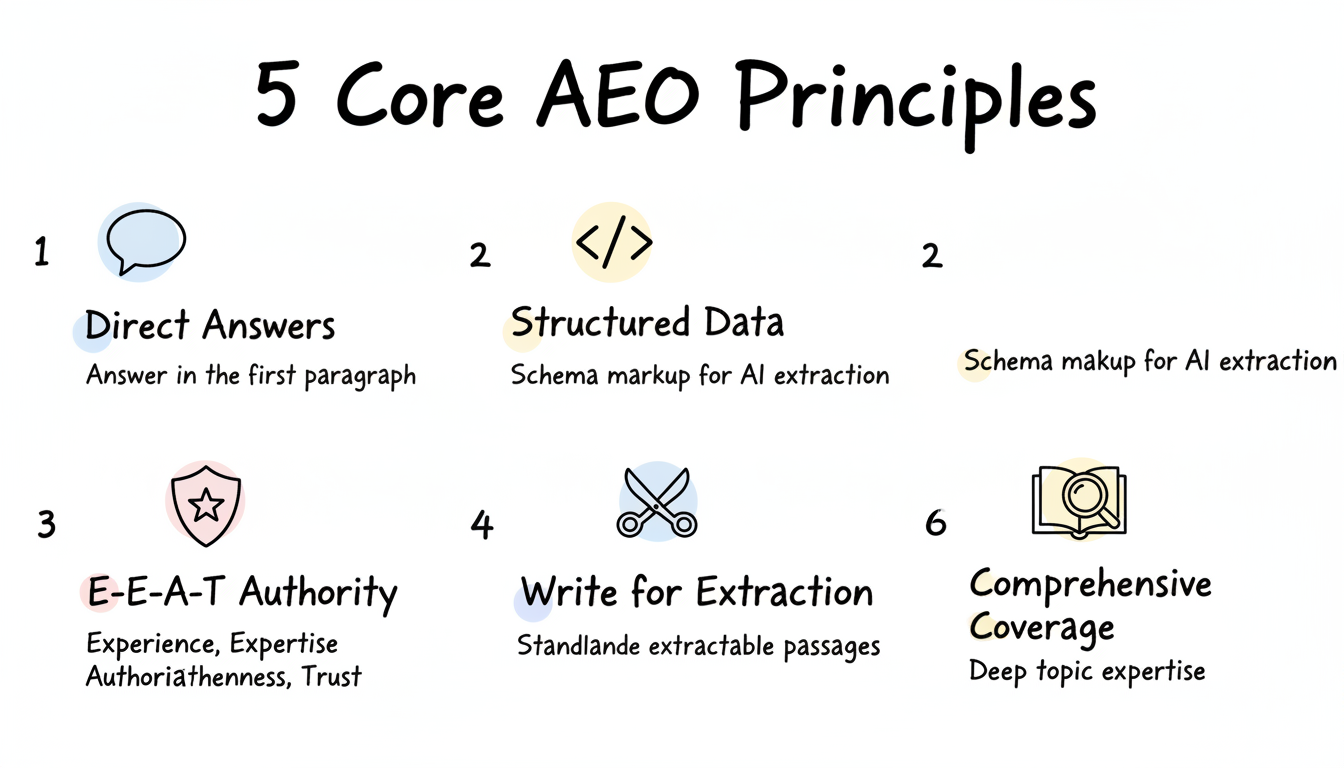
Effective Answer Engine Optimization follows several key principles.
Provide Direct Answers
AI systems look for clear, concise responses to questions. Content structured with direct answers in the first paragraph performs better than content that builds to conclusions gradually.
Use Structured Data
Schema markup helps AI systems understand your content's context, entities, and relationships. FAQ schema, HowTo schema, and organization markup improve extraction accuracy when optimizing content for generative AI.
Build Content Authority
AI systems prioritize content from authoritative sources. E-E-A-T signals (Experience, Expertise, Authoritativeness, Trustworthiness) influence which content gets selected for AI responses.
Write for Extraction
AI systems pull specific passages from longer content. Ensure key information exists in standalone, extractable segments rather than spread across multiple paragraphs.
Cover Topics Comprehensively
While individual answers should be concise, overall topic coverage should be comprehensive. AI systems favor sources that demonstrate deep expertise across related questions. Tracking AEO optimization metrics helps measure how comprehensively your content addresses user queries.
Getting Started with AEO
Organizations new to AEO should begin with these steps:
- Audit current AI visibility – Search for your brand and key topics in ChatGPT, Perplexity, and Google AI Overviews to understand current positioning
- Identify content gaps – Find questions where competitors get cited but you don't
- Restructure existing content – Add FAQ sections, direct answer paragraphs, and schema markup to high-value pages
- Prioritize content extractability – Write atomic paragraphs with clear question-answer pairs so LLMs can cite specific passages. Each key point should be self-contained and independently meaningful.
- Target long-tail, question-based queries – Focus on conversational queries that trigger AI overviews and answer engine responses. These are the queries most likely to generate AI citations.
- Monitor progress – Track AI mentions and citations over time to measure optimization impact. Tools like SEMrush (AI visibility features) and Profound can help automate AEO tracking. See our roundup of best AEO tools for more options.
For a complete walkthrough from audit to execution, follow our AEO implementation roadmap.
How to Measure AEO Success
Traditional SEO metrics like rankings and organic traffic tell only part of the story in an AI-driven search landscape. AEO requires its own measurement framework to track whether your content is being cited, extracted, and surfaced by answer engines.
Visibility & Citation Metrics
The core AEO metrics center on how often and how prominently your content appears in AI-generated answers:
- AI Visibility Score – How frequently your content appears in AI-generated responses across platforms like ChatGPT, Perplexity, Claude, and Google AI Overviews.
- Citation Count – The number of times AI engines explicitly reference or link to your domain when generating answers.
- Share of Voice in AI Answers – Your brand's proportion of AI citations relative to competitors for target queries. This is the AEO equivalent of traditional share of voice in organic search.
Tools for AEO Tracking
Several tools are emerging to help marketers track AEO performance:
- SEMrush – Now includes AI visibility features that track how content appears in AI-generated search results and overviews.
- Profound – A dedicated AEO tracking platform that monitors citations across major AI answer engines.
- Manual Citation Auditing – Regularly querying ChatGPT, Perplexity, and Claude with your target keywords and documenting which brands get cited. While time-intensive, this provides ground-truth validation.
Beyond tools, content extractability serves as a qualitative metric. Ask: can an LLM pull a clean, citable answer from your content? If your key points are buried in long paragraphs or require context from multiple sections, your extractability score is low.
Monitoring People Also Ask boxes and featured snippets remains valuable as a leading indicator—content that earns these SERP features correlates strongly with AI citation likelihood. For a deeper look at measuring AEO performance, see our dedicated guide.
Traditional SEO Metrics | AEO Metrics |
Keyword rankings | AI visibility score |
Organic traffic | Citation count |
Click-through rate | Share of voice in AI answers |
Bounce rate | Content extractability |
Featured snippet wins | AI engine mention frequency |
The Future of AEO
As AI systems handle more information discovery, AEO will become increasingly central to digital marketing strategy. The discipline continues evolving as AI capabilities expand and user behaviors shift toward AI-assisted decision making.
Organizations that build AEO capabilities now position themselves for visibility in an AI-first search landscape.
FAQs
Is AEO the Same as GEO?
AEO (Answer Engine Optimization) and GEO (Generative Engine Optimization) are related but distinct. AEO focuses on answer engines that provide direct responses. GEO focuses on generative AI that synthesizes content from multiple sources. In practice, the terms are often used interchangeably, and optimization tactics overlap significantly.
Does AEO Replace SEO?
No. AEO complements SEO rather than replacing it. Strong SEO remains foundational—most AI citations come from top-ranking content. AEO adds additional optimization for how AI systems extract and present information.
What Does AEO Stand for in Marketing?
AEO stands for Answer Engine Optimization. In marketing, it refers to the practice of structuring your content so that AI-powered platforms like ChatGPT, Claude, Perplexity, and Google AI Overviews can extract and cite your answers directly. Unlike traditional SEO which focuses on ranking in search results, AEO focuses on becoming the cited source in AI-generated responses, which is critical as zero-click searches now exceed 57% of all queries.
How Is AEO Different from GEO and SEO?
AEO (Answer Engine Optimization) targets AI answer engines like ChatGPT and Perplexity. GEO (Generative Engine Optimization) focuses specifically on generative AI search results like Google AI Overviews. SEO (Search Engine Optimization) targets traditional organic search rankings. In practice, all three overlap significantly—they share foundations like structured data, E-E-A-T, and quality content—but AEO and GEO place greater emphasis on content extractability and direct-answer formatting.
How Do You Measure AEO Success?
AEO success is measured through metrics that differ from traditional SEO. Key indicators include AI visibility score (how often your content appears in AI answers), citation count (how frequently AI engines reference your domain), and share of voice across platforms like ChatGPT, Perplexity, and Claude. Tools like SEMrush and Profound offer AEO tracking features. You should also monitor featured snippets and People Also Ask appearances, as these correlate with AI citation likelihood.
What Are Examples of Answer Engines?
Answer engines are AI-powered platforms that generate direct responses instead of link lists. Major text-based answer engines include ChatGPT (OpenAI), Claude (Anthropic), Perplexity, Google Gemini, and Bing Copilot. Voice-based answer engines include Siri (Apple), Alexa (Amazon), and Google Assistant. Google AI Overviews also function as an answer engine layer within traditional search. Each platform uses large language models to synthesize information, making content extractability and structured data essential for citation.