
Traditional SEO measurement focuses on rankings, clicks, and conversions. Answer Engine Optimization (AEO) and Generative Engine Optimization (GEO) require fundamentally different measurement approaches. When your content gets cited by ChatGPT or synthesized into a Google AI Overview, the attribution path looks nothing like a standard organic click.
This comprehensive guide covers how to measure AEO and GEO performance in 2026—the metrics that matter, the tools that track them, and how to build attribution models that prove AI search ROI.
Why Traditional SEO Metrics Fall Short
Standard SEO dashboards track rankings, impressions, clicks, and conversions. These metrics assume users click through to your website. But AI search fundamentally changes this model.
The Zero-Click Challenge
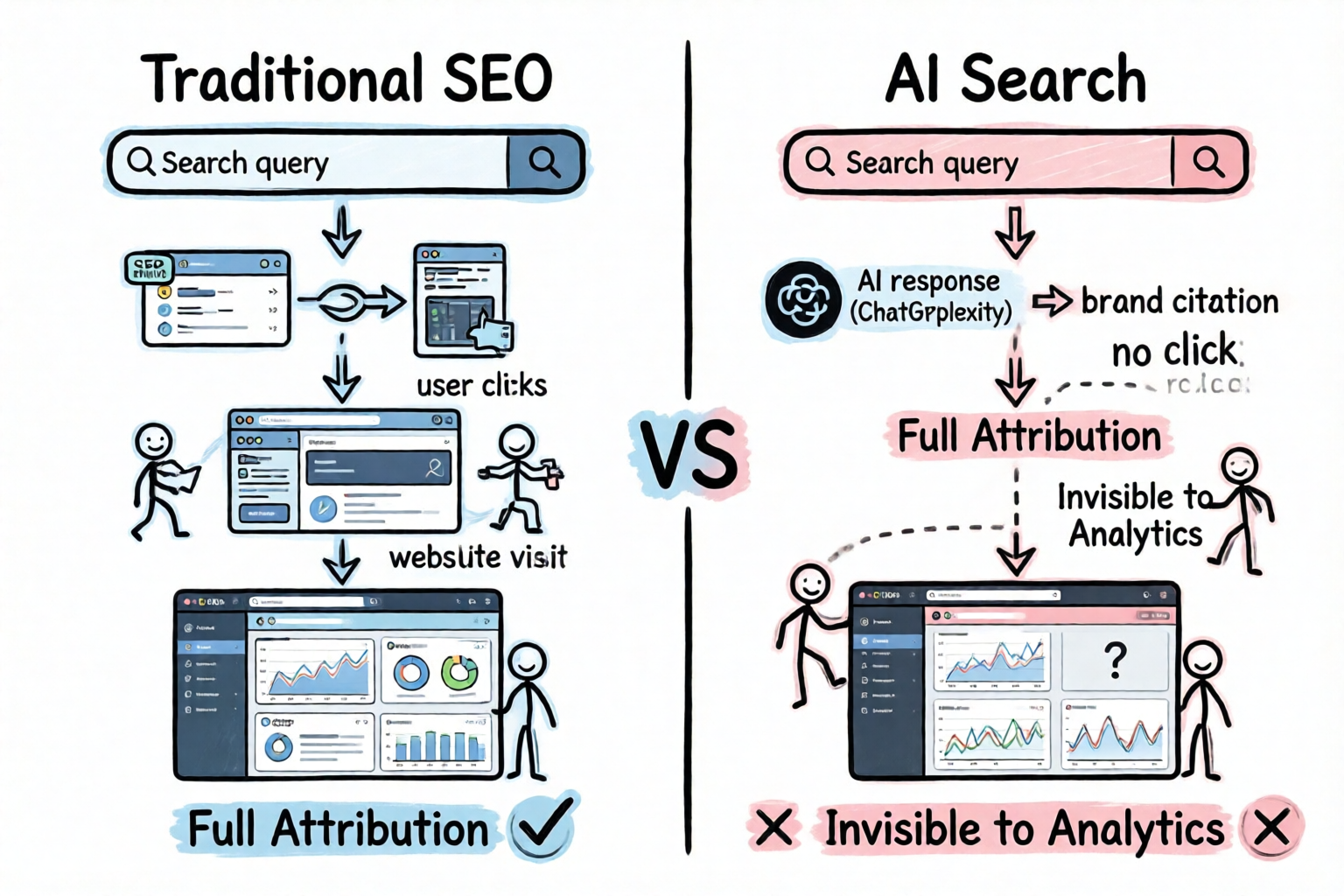
When ChatGPT answers a user’s question by citing your content, where does that appear in Google Analytics? Nowhere. When Perplexity synthesizes your research into a direct answer, you might get a citation link—but most users never click it.
Consider the attribution gaps:
Scenario | Traditional Metric | AEO Reality |
Featured snippet displays your answer | Shows as impression | User gets answer, may not click |
ChatGPT cites your content | No tracking | Brand exposure, no click data |
AI Overview includes your information | May show as impression | Citation visible, click optional |
Perplexity references your data | No Google data | External platform, separate tracking |
Traditional metrics miss the majority of AI search value. Users increasingly get what they need without clicking through—yet your brand still benefits from visibility, authority, and trust signals.
The Brand Awareness Blind Spot
AI citations build brand awareness that traditional attribution misses entirely. When a user asks ChatGPT “what’s the best project management tool for startups” and your brand appears in the response, you’ve gained exposure equivalent to a top-of-funnel ad impression. Standard analytics record nothing.
This blind spot leads companies to undervalue AEO investments because they can’t see the returns in familiar dashboards. Implementing proper AI citation tracking tools helps bridge this gap and demonstrate the full value of your answer engine optimization efforts.
The AEO Metrics Framework
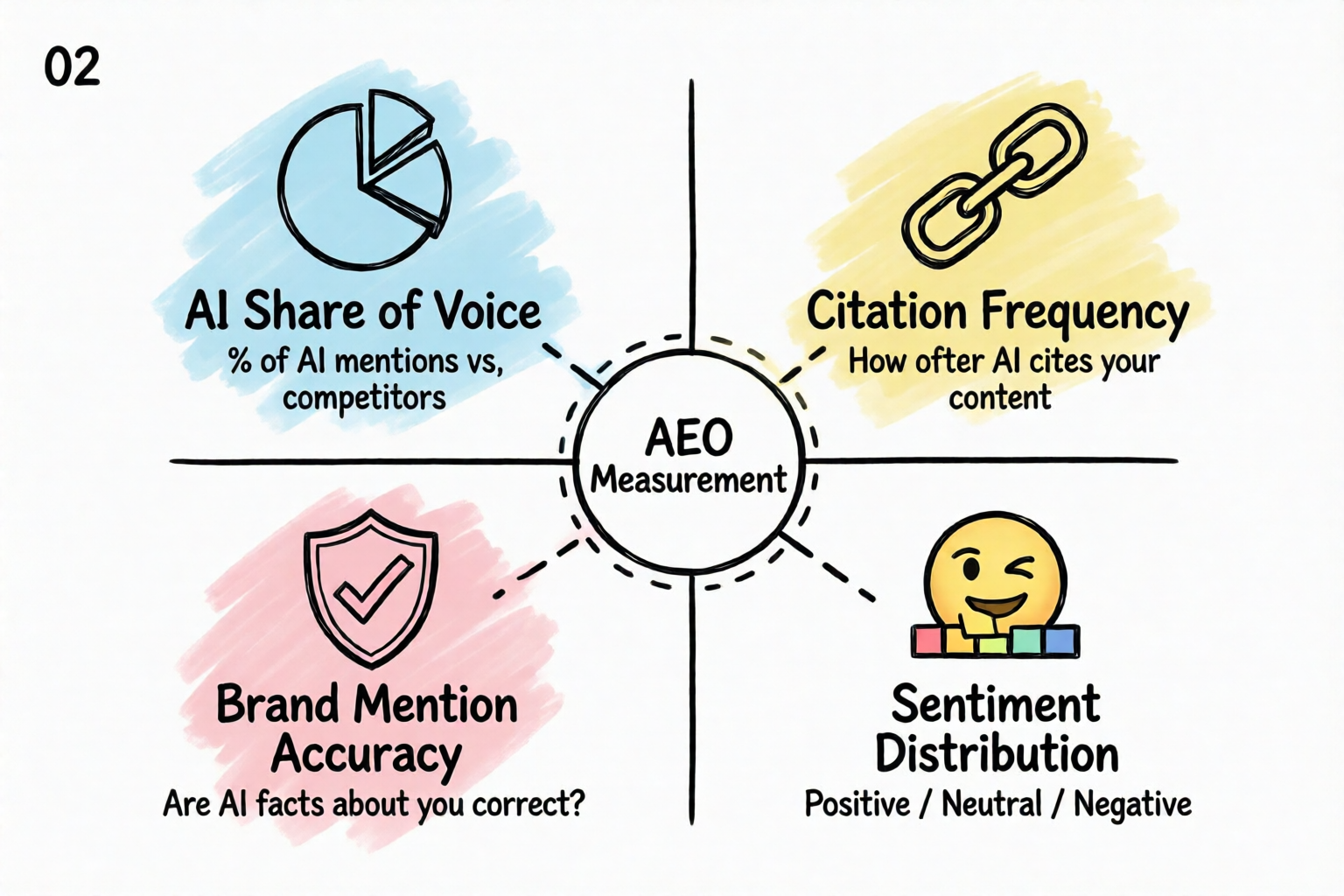
Effective AEO measurement requires new metrics designed for AI search behaviors.

Primary AEO Metrics
AI Share of Voice (AI SOV)
AI Share of Voice measures how often your brand appears in AI-generated responses compared to competitors. Unlike traditional SOV based on search rankings, AI SOV tracks actual mentions and citations across AI platforms.
Calculation: (Your AI mentions for target keywords / Total AI mentions for target keywords) × 100
Track AI SOV by:
- Platform (ChatGPT, Perplexity, Gemini, Claude)
- Topic cluster
- Query type (informational, comparison, recommendation)
Citation Frequency
Citation frequency counts how often AI systems link to your content as a source. This metric matters most for platforms like Perplexity and Google AI Overviews that display source links.
Track citations by:
- Total citations per week/month
- Citation rate (citations / total responses you’re monitoring)
- Citation position (first cited vs. mentioned later)
Brand Mention Accuracy
Not all AI mentions are positive or accurate. Brand mention accuracy measures whether AI systems represent your brand correctly.
Monitor for:
- Correct product/service descriptions
- Accurate pricing information
- Up-to-date company details
- Proper competitive positioning
Inaccurate AI mentions can damage reputation—tracking accuracy lets you identify and address misinformation.
Sentiment Distribution
AI responses carry tone and sentiment that influence user perception. Track whether your brand mentions appear in positive, neutral, or negative contexts.
Categories to monitor:
- Recommendations (positive signal)
- Neutral mentions (informational)
- Caveats or concerns (negative signal)
- Comparisons (context-dependent)
Secondary AEO Metrics
Featured Snippet Capture Rate
For traditional search engines, featured snippet ownership indicates AEO success. Track:
- Snippets captured vs. targeted
- Snippet volatility (how often ownership changes)
- Snippet click-through rates when available
People Also Ask Presence
PAA boxes indicate your content answers related questions effectively. Monitor:
- PAA appearances for target topics
- Position within PAA sequences
- Expansion rates (users clicking your PAA answers)
Voice Search Answer Rate
For queries commonly asked via voice assistants, track whether your content provides the spoken answer. This requires periodic manual auditing since voice platforms provide limited analytics.
Tools for AEO Tracking
The market has developed specialized tools for AI visibility measurement. Here’s what’s available in 2026.
Dedicated AI Visibility Platforms
Scrunch AI
Scrunch AI tracks brand presence across ChatGPT, Claude, Perplexity, Gemini, and Meta AI. Key features include:
- Daily AI brand score calculation
- Competitor share of voice comparison
- Citation tracking with source links
- Sentiment analysis of mentions
- Pricing: Starting at $300/month
Otterly AI
Otterly AI provides affordable entry-level AI visibility tracking. Monitors ChatGPT, Perplexity, Google AI Overviews, and Copilot with:
- Weekly visibility reports
- Keyword-based tracking
- Basic competitor comparison
- Pricing: Starting at $29/month
Goodie AI
Goodie AI specializes in prompt-based visibility tracking, monitoring how brands appear in response to specific prompt patterns:
- Custom prompt library building
- Response variation tracking
- Citation analysis
- Pricing: Contact for enterprise pricing
Traditional SEO Tools with AI Features
Semrush AI Toolkit
Semrush expanded into AI visibility with tracking across ChatGPT, Perplexity, Gemini, and Google AI Mode:
- Integrated with traditional SEO workflows
- Unified dashboard with organic data
- AI citation tracking
- Pricing: Starting at $99/month (add-on to existing plans)
Ahrefs Brand Radar
Ahrefs Brand Radar monitors mentions across ChatGPT, Claude, Gemini, and Google AI Overviews:
- Brand mention tracking
- Competitive intelligence
- Integration with Ahrefs backlink data
- Pricing: Starting at $129/month
Conductor
Conductor’s AI visibility module provides enterprise-grade tracking with:
- Multi-platform monitoring
- Workflow integration
- Team collaboration features
- Custom reporting
- Pricing: Enterprise pricing
Comparison Matrix
Tool | Platforms Tracked | Citation Tracking | Sentiment Analysis | Starting Price |
Scrunch AI | 5 platforms | Yes | Yes | $300/month |
Otterly AI | 4 platforms | Yes | Limited | $29/month |
Semrush AI Toolkit | 4 platforms | Yes | Limited | $99/month |
Ahrefs Brand Radar | 4 platforms | Yes | No | $129/month |
Conductor | 5+ platforms | Yes | Yes | Enterprise |
Choose based on budget, required platforms, and integration needs with existing workflows.
Additional AEO Tracking Tools to Consider
Beyond the major platforms listed above, several newer tools have entered the AEO tracking space and are worth evaluating. For a comprehensive breakdown of all available options, see our full AEO tools and software comparison.
Profound — A dedicated AEO tracking platform that monitors brand visibility across multiple LLMs simultaneously. Profound provides citation source analysis and competitive benchmarking dashboards, making it well-suited for brands that need to track visibility across ChatGPT, Perplexity, Gemini, and Claude in a single view.
Graphite — Focused on enterprise brands, Graphite offers AEO monitoring that tracks mention frequency and context accuracy across AI platforms. Its strength lies in measuring not just whether your brand appears, but whether the information presented is accurate and contextually appropriate.
SE Ranking — An established SEO suite that has added a newer AEO tracking module. SE Ranking provides brand mention monitoring across answer engines, integrating AI visibility data alongside traditional rank tracking and site audit features for teams already using the platform.
Gauge — A citation tracking tool with a GEO (Generative Engine Optimization) focus. Gauge measures a visibility score and tracks competitor displacement in AI responses, helping brands understand not just their own citation rates but how they compare to direct competitors in AI-generated answers.
Building AEO Attribution Models
Tracking metrics is step one. Building attribution models that connect AEO visibility to business outcomes is step two.
The Multi-Touch Challenge
AI search creates attribution complexity because:
- Users may see your brand in AI responses multiple times before converting
- AI visibility influences trust even when users later search your brand directly
- Click-through rates from AI citations are often low, but brand recall is high
Traditional last-click attribution dramatically undervalues AEO contributions. Understanding the key differences between SEO and AEO helps explain why conventional attribution models fall short for answer engine optimization.
Recommended Attribution Approaches
Brand Search Lift
Track branded search volume changes correlated with AI visibility improvements. When AI mentions increase, branded searches should follow if AEO drives awareness. Use Google Trends to correlate branded search lift with periods of increased AI citation activity—this provides a directional signal even when direct click attribution is unavailable.
Implementation:
- Establish baseline branded search volume
- Track AI visibility metrics weekly
- Correlate visibility increases with branded search changes
- Account for other brand marketing activities
Assisted Conversion Tracking
For users who do click through from AI citations, track their conversion behavior compared to other channels:
- Time to conversion
- Conversion rate by AI platform
- Average order value
- Customer lifetime value
Survey-Based Attribution
Add “How did you hear about us?” questions that include AI search options:
- “AI search (ChatGPT, Perplexity, etc.)”
- “Google AI Overview”
- “Voice assistant recommendation”
Survey data provides attribution insight that analytics cannot capture. For self-reported attribution, specifically include “AI assistant (ChatGPT, Perplexity, Claude, Gemini)” as a dedicated option in your lead capture and post-purchase survey forms—this captures the growing segment of users who discover brands through LLM conversations but arrive at your site via direct navigation or branded search.
Attribution Model Framework
Build a weighted attribution model that accounts for AI touchpoints:
Touchpoint | Attribution Weight | Rationale |
AI citation with click | 30-40% | Direct engagement |
AI citation without click | 10-15% | Brand awareness |
Featured snippet view | 15-20% | High visibility position |
Brand search following AI exposure | 40-50% | Demonstrated intent |
Adjust weights based on your conversion data and customer journey research.
How to Set Up GA4 for AI Referral Tracking
Google Analytics 4 does not natively separate AI-referred traffic from other sources. To measure AEO performance in GA4, you need to create custom channel groups and events that isolate visits originating from AI platforms.
Creating a Custom AI Channel Group
In GA4, navigate to Admin > Data display > Channel groups and create a new custom channel group called “AI Search.” Define the channel conditions using source-matching regex to capture traffic from known AI referrers:
chatgpt\.com|perplexity\.ai|claude\.ai|gemini\.google\.com|copilot\.microsoft\.com|you\.com|phind\.com
Set the channel condition to match when the session source matches this pattern. This groups all AI-referred sessions into a single channel for comparison against organic, paid, and direct traffic. For a detailed walkthrough of the full analytics configuration, see our AEO analytics setup guide.
Custom Events for AI-Referred Sessions
Create custom events in GA4 to track engagement quality from AI-referred visitors. Set up event triggers for scroll depth (25%, 50%, 75%, 100%), time-on-page thresholds (30s, 60s, 120s), and key conversion actions. Compare these engagement signals between your AI Search channel and organic search to understand whether AI-referred traffic converts differently.
UTM Tagging for Self-Reported Attribution
For campaigns where you control the link (email, social, partner sites), use UTM parameters that flag AI-influenced journeys: utm_source=ai_search&utm_medium=chatgpt. While you cannot UTM-tag organic AI citations, this approach works for tracking users who self-report AI discovery through survey landing pages or gated content forms.
Building a Prompt Audit Workflow
Automated tools provide scale, but a manual prompt audit gives you ground-truth data on how AI platforms actually represent your brand. This workflow complements tool-based tracking and follows AEO best practices for measurement accuracy.
Building Your Question Library
Start by compiling 50–100 prompts that your target audience would realistically ask AI assistants. Include category-level queries (“what are the best AEO tracking tools”), brand-adjacent queries (“how to measure AI search visibility”), and direct brand queries (“what does [your brand] do”). Organize prompts by topic cluster and intent type so you can track citation rates per category over time.
Monthly Citation Audit Process
Each month, run your full prompt library across ChatGPT, Perplexity, Gemini, and Claude. For each response, record: whether your brand is cited, whether a link is included, the citation position (first source, second source, etc.), and whether the information is accurate. Use a scoring rubric: cited with link (3 points), cited without link (2 points), mentioned in passing (1 point), absent (0 points).
Calculating Your Citation Rate
Citation rate formula: (number of queries where your brand is cited / total queries tested) × 100
Track this metric monthly to identify directional trends. Because LLMs use Retrieval-Augmented Generation (RAG) to pull real-time context, the same prompt can yield different citations across sessions. This makes AEO measurement inherently probabilistic rather than deterministic—focus on 30–60 day trend windows rather than point-in-time snapshots.
Setting AEO Benchmarks
Without industry benchmarks, it’s difficult to know whether your AEO performance is strong or weak. Here’s what research tells us about current performance levels.
Key Research Benchmarks for AEO Measurement
Recent research highlights why AEO measurement requires its own tracking infrastructure separate from traditional SEO. Only 12% of AI-cited sources overlap with Google’s organic top 10 results (Ahrefs study), which means ranking well in traditional search does not guarantee visibility in AI responses. The average Google search query is 4.2 words compared to 22 words for a typical ChatGPT prompt (Semrush), so measurement must account for long-form, conversational intent queries that traditional keyword trackers miss.
Currently, 21% of Google searches display AI Overviews (Ahrefs), quantifying the growing surface area where AEO visibility directly impacts traffic. Across 5.6 million LLM citations analyzed by Goodie AI, the most-cited domains are Wikipedia, Reddit, Reuters, YouTube, and Forbes—benchmark your citation rate against these category leaders and the differences between AEO, GEO, and SEO measurement approaches to set realistic targets for your industry.
Industry Benchmarks (2026)
AI Share of Voice by Industry
Industry | Leader SOV | Average SOV | Laggard SOV |
SaaS/Technology | 25-35% | 10-15% | <5% |
E-commerce | 20-30% | 8-12% | <3% |
Financial Services | 15-25% | 5-10% | <3% |
Healthcare | 10-20% | 3-8% | <2% |
Local Services | 30-50% | 15-25% | <10% |
Industries with fewer competitors show higher achievable SOV.
Citation Rates
Across industries, average citation rates in AI responses range from 2-8% of monitored queries. Leaders achieve 15-25% citation rates for their core topics.
Brand Mention Accuracy
Industry average accuracy hovers around 70-80%. Top performers maintain 90%+ accuracy through active entity optimization and Knowledge Graph management.
Setting Your Targets
Establish targets based on:
- Baseline measurement: Track current performance for 4-6 weeks before setting targets
- Competitive context: Compare to direct competitors, not industry averages
- Resource investment: Aggressive targets require proportional investment
- Topic focus: Set higher targets for core topics, lower for adjacent areas
Reasonable first-year targets:
- AI SOV: 10-15% improvement over baseline
- Citation frequency: 25-50% increase
- Brand mention accuracy: 90%+ maintenance
- Featured snippet capture: 20-30% of targeted queries
Reporting and Dashboards
Effective AEO reporting communicates value to stakeholders unfamiliar with AI search metrics.
Executive Dashboard Elements
For leadership reporting, focus on:
Visibility Trend
- AI SOV over time (line chart)
- Comparison to top 3 competitors
- Platform breakdown
Business Impact Indicators
- Branded search correlation
- AI-attributed conversions (where trackable)
- Estimated reach/impressions
Action Items
- Top opportunities (high-volume queries without visibility)
- Risk areas (declining visibility, accuracy issues)
Operational Dashboard Elements
For team-level tracking, add:
Detailed Metrics
- Citation tracking by page/content piece
- Keyword-level performance
- Platform-specific trends
Content Performance
- Which content earns most citations
- Content gaps (queries where competitors appear, you don’t)
- Update priorities based on visibility data
Technical Indicators
- Schema validation status
- Entity recognition signals
- Freshness scores
Reporting Cadence
Report Type | Frequency | Audience |
Executive summary | Monthly | Leadership |
Performance review | Bi-weekly | Marketing team |
Operational tracking | Weekly | SEO/Content team |
Alert monitoring | Daily | SEO specialists |
Implementing Your AEO Tracking System
Follow this step-by-step process to build a comprehensive AEO measurement system.
Minimal Viable vs. Scaled Setup
Before diving into tool selection, assess where your organization falls on the AEO measurement maturity curve. A minimal viable setup requires only GA4 with a custom AI channel group plus a monthly manual prompt audit using a spreadsheet—this costs nothing beyond time and provides directional data within the first month. A scaled setup adds dedicated tracking tools (Scrunch AI, Otterly AI, or Profound), automated monitoring with alerting, and integrated dashboards that combine AI visibility data with traditional SEO and conversion metrics. Start minimal, prove value with initial data, then invest in scaling as AEO becomes a measurable revenue driver.
Step 1: Define Your Tracking Universe
Before selecting tools, define what you’re measuring:
Keyword selection:
- Identify 50-100 priority keywords for AI visibility tracking
- Include brand terms, product terms, and category terms
- Cover informational, comparison, and transactional query types
Competitor identification:
- Select 5-10 direct competitors to benchmark against
- Include both traditional competitors and AI-visible competitors (they may differ)
Platform prioritization:
- Rank AI platforms by audience relevance
- Google AI Overviews for general search traffic
- ChatGPT for conversational research queries
- Perplexity for citation-heavy research use cases
Step 2: Establish Baseline Metrics
Spend 4-6 weeks collecting baseline data before optimization:
Metric | Baseline Period | Measurement Frequency |
AI Share of Voice | 6 weeks | Weekly snapshots |
Citation frequency | 6 weeks | Daily aggregation |
Brand mention accuracy | 4 weeks | Weekly audits |
Sentiment distribution | 4 weeks | Weekly analysis |
Document current performance across all priority keywords and platforms. If you’re working with limited resources, consider how to allocate your AI search optimization budget across tracking tools and content improvements.
Step 3: Configure Tracking Tools
Set up your selected tools with consistent parameters:
Keyword configuration:
- Use exact-match keyword tracking where possible
- Include question-format variations (how, what, why, when)
- Configure alerts for significant visibility changes
Competitor tracking:
- Add all identified competitors to monitoring dashboards
- Set up competitive share of voice reports
- Configure head-to-head comparison views
Integration setup:
- Connect AI tracking tools to existing SEO platforms
- Set up data exports for unified dashboards
- Configure automated reporting schedules
Step 4: Build Analysis Workflows
Create repeatable processes for data analysis:
Weekly analysis (30 minutes):
- Review AI SOV trends
- Check for visibility alerts
- Identify new citation opportunities
Monthly analysis (2 hours):
- Deep-dive into platform-specific performance
- Analyze content piece effectiveness
- Update competitive positioning assessment
Quarterly analysis (half day):
- Comprehensive benchmark review
- Strategy adjustment recommendations
- Tool and process optimization
Common Measurement Mistakes
Avoid these pitfalls when implementing AEO measurement.
Mistake 1: Treating AI Metrics Like SEO Metrics
AI visibility fluctuates more than search rankings. Don’t panic over day-to-day variation—look at weekly and monthly trends.
Mistake 2: Ignoring Platform Differences
Each AI platform has different citation behaviors. ChatGPT may cite you while Perplexity doesn’t. Track and optimize for each platform separately. For detailed platform comparison, review the differences in Perplexity vs ChatGPT for SEO strategies.
Mistake 3: Measuring Without Acting
Tracking metrics without optimization processes wastes resources. Build workflows that connect measurement insights to content and technical improvements.
Mistake 4: Over-Relying on Tools
AI visibility tools provide estimates, not exact counts. Use multiple data sources and manual verification to validate automated tracking.
Mistake 5: Forgetting Accuracy
High visibility with low accuracy damages brand reputation. Always track mention accuracy alongside volume metrics.
Frequently Asked Questions About AEO Measurement
What Is the Best Way to Measure AEO Performance?
The most reliable approach combines three layers: automated citation tracking tools that monitor brand mentions across ChatGPT, Perplexity, Gemini, and other AI platforms; GA4 custom channel groups that filter AI-referred traffic separately from organic search; and a monthly prompt audit using a library of 50–100 category-relevant queries to calculate your citation rate over time.
How Do I Track If AI Assistants Are Citing My Website?
Start by manually querying ChatGPT, Perplexity, and Gemini with prompts your audience would use. Record whether your brand appears, with or without a link. For ongoing monitoring, tools like Scrunch AI, Otterly AI, and Profound automate this across multiple AI platforms and provide citation frequency dashboards. Check server logs for GPTBot and PerplexityBot crawl activity as an indirect signal.
Why Do AEO Metrics Differ from Traditional SEO Metrics?
AEO measurement is inherently probabilistic. The same prompt can produce different citations across sessions because LLMs use retrieval-augmented generation with variable context windows. Only 12% of AI-cited sources overlap with Google organic top-10 results, meaning SEO rank alone does not predict AI visibility. AEO requires tracking directional trends over 30–60 day windows rather than point-in-time positions. For more on these distinctions, see our comparison of AEO vs GEO vs SEO.
What Is a Citation Rate in AEO and How Do I Calculate It?
Citation rate measures how often AI platforms mention your brand when responding to relevant queries. The formula is: (number of queries where your brand is cited / total queries tested) × 100. Run at least 50 category-relevant prompts monthly across multiple AI platforms and track your citation rate trend over time to identify whether your AEO efforts are improving visibility. See real-world examples in our AEO success stories collection.
FAQs
How Often Should I Check AI Visibility Metrics?
Monitor weekly for trend analysis, monthly for strategic reporting. Daily monitoring is only necessary if you’re actively optimizing or experiencing significant changes.
Which AI Platform Should I Prioritize for Tracking?
Start with Google AI Overviews (highest search volume correlation) and ChatGPT (largest user base). Add Perplexity if your audience includes researchers or technical users.
Can I Track AI Visibility for Free?
Manual monitoring is free but time-intensive. Check AI platforms directly for your brand mentions. For scalable tracking, paid tools are necessary.
How Long Before I See AEO Improvements in Metrics?
Content optimization changes typically show in AI visibility within 2-4 weeks. Authority-building efforts may take 3-6 months to impact citation rates significantly.
Should I Integrate AEO Tracking with My Existing SEO Dashboard?
Yes. Tools like Semrush and Ahrefs offer integrated views. Even if using separate AI tracking tools, import data into unified dashboards for holistic performance views.
What’s the Relationship Between AEO Metrics and Traditional SEO Metrics?
Strong correlation exists, but they’re not identical. Google AI Overview citations show 93.67% overlap with top 10 organic results. However, other AI platforms like ChatGPT and Perplexity have their own citation patterns that don’t directly mirror search rankings. Track both traditional SEO and AEO metrics for complete visibility understanding.