
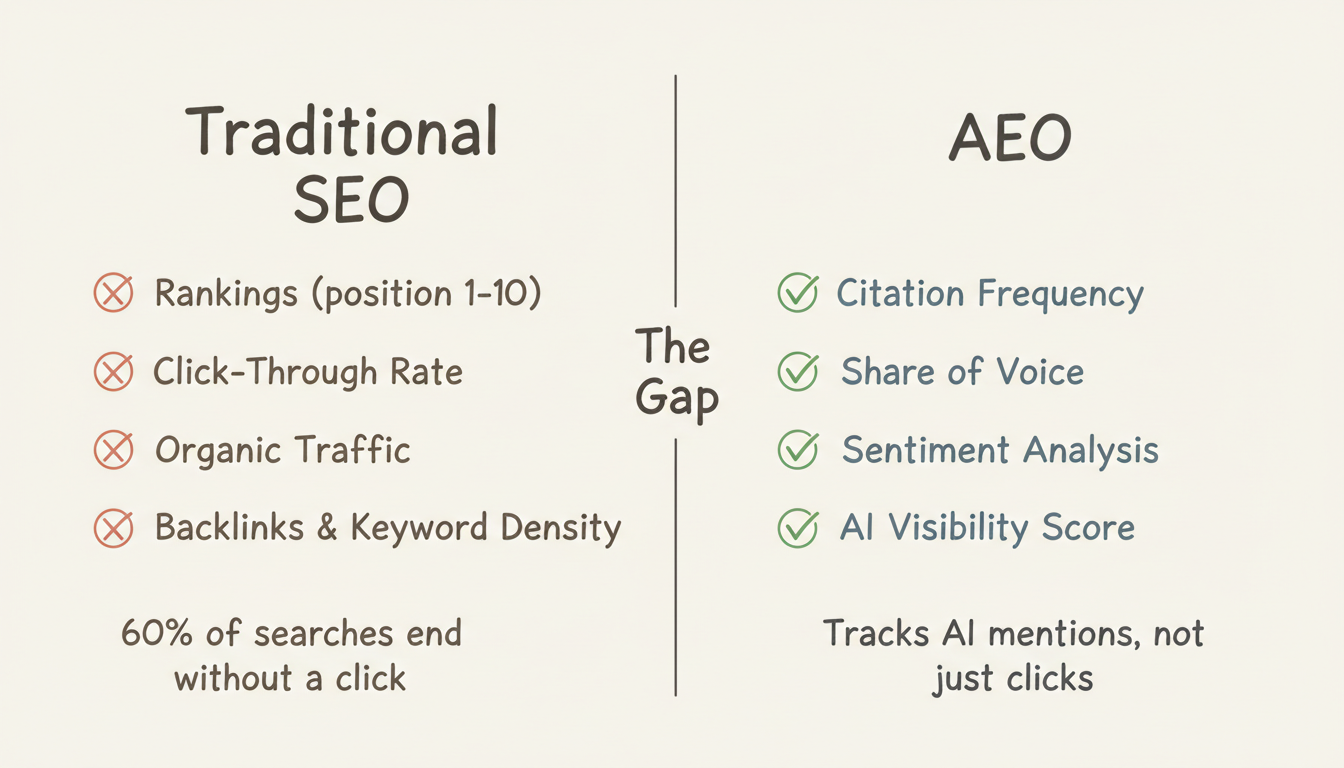
AEO metrics and KPIs require fundamentally different approaches than traditional SEO measurement. While SEO tracks rankings, click-through rates, and organic traffic, Answer Engine Optimization measures how often AI platforms cite your content, how they describe your brand, and whether those mentions influence business outcomes.
This guide provides a comprehensive framework for measuring AEO success, covering the essential metrics, tracking methodologies, and tools needed to quantify your visibility across ChatGPT, Perplexity, Google AI Overviews, and other AI platforms. Whether you are building your first AEO dashboard or refining an existing program, see real-world applications in our AEO optimization examples to understand how these metrics translate into practice.
Why Traditional SEO Metrics Fall Short
Traditional SEO metrics don't capture AI visibility effectiveness. Understanding this gap clarifies what AEO measurement requires, particularly as AI SEO best practices in 2026 continue to evolve beyond conventional ranking signals.
The Zero-Click Reality
AI platforms often provide complete answers without sending users to websites. When ChatGPT answers a question citing your brand, or Perplexity references your content in a synthesized response, traditional click-based metrics miss this entirely. Research shows 60% of searches now end without clicks—a dramatic increase from 26% just two years ago.
To measure zero-click impact effectively, track three specific indicators: (1) impression-to-click ratio in Google Search Console for queries that trigger AI Overviews, (2) branded search volume trends as a proxy for AI-driven awareness, and (3) direct traffic correlation against AI citation frequency over time. These zero-click interactions represent a growing share of how users discover brands, making them essential to quantify rather than simply acknowledge. For more on how AI Overviews reshape organic traffic, see our analysis of Google AI Overview SEO impact.
What traditional metrics miss:
- Brand mentions within AI-generated responses
- Citations that influence decisions without generating clicks
- Sentiment and context of how AI describes your brand
- Competitive positioning within AI answers
Different Correlation Factors
Research analyzing citation patterns across AI platforms reveals that classic SEO metrics show weak correlations with AI citations. Domain Rating shows the highest correlation with ChatGPT citations at 0.161, while factors like backlinks and keyword density show negative correlations. Understanding these nuances is critical when implementing generative engine optimization strategies that differ from traditional approaches.
Citation correlation insights by platform:
- ChatGPT favors domain trust and content readability (Flesch Score)
- Perplexity and AI Overviews weight word and sentence count higher
- Traditional SEO factors like backlinks show minimal positive correlation
- Content comprehensiveness matters more than keyword optimization
This data confirms that AEO requires distinct measurement approaches, which is why many organizations turn to AEO implementation services to properly establish tracking frameworks.
Core AEO Metrics to Track
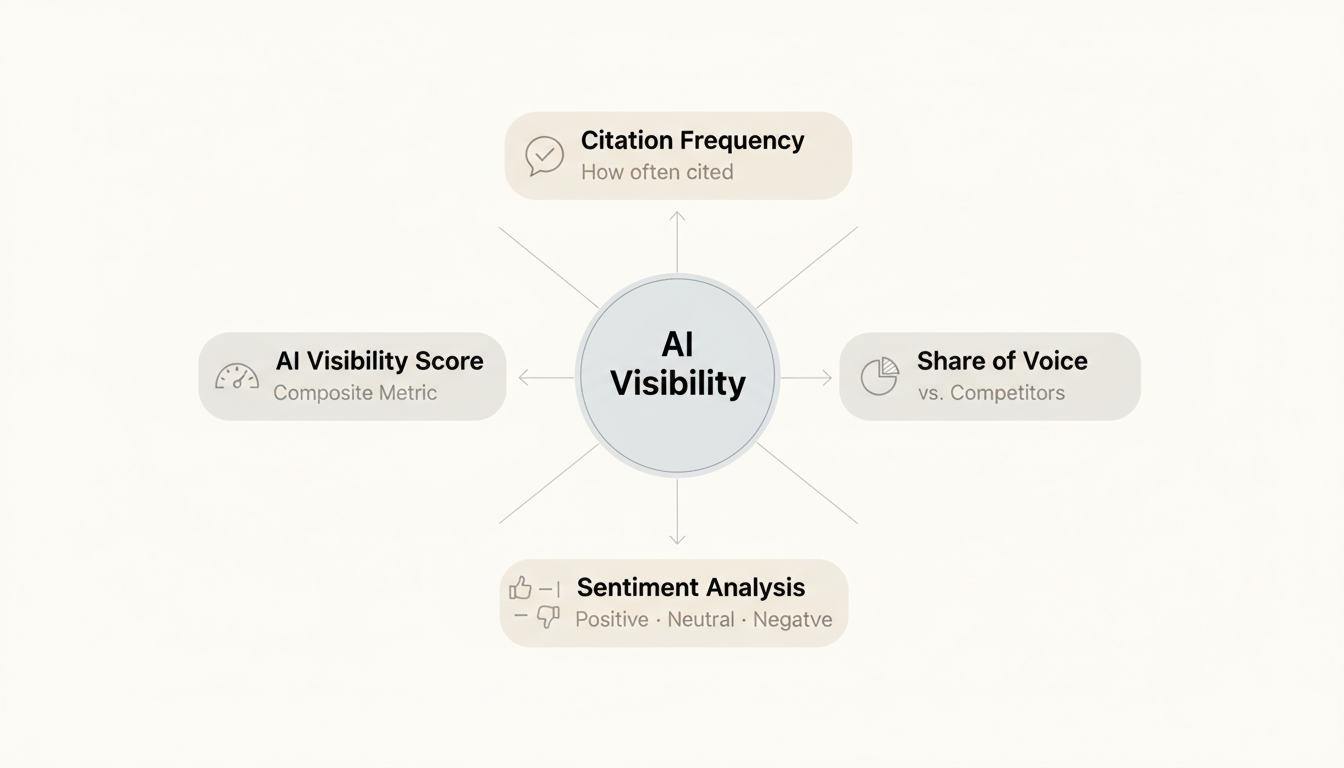
Four primary metrics form the foundation of AEO measurement.
1. Citation Frequency
Citation frequency measures how often AI platforms reference your content or brand when answering relevant queries. This is the closest equivalent to traditional rankings in the AI search context.
What to measure:
- Number of citations across target query sets
- Citation frequency trends over time
- Platform-specific citation rates (ChatGPT vs. Perplexity vs. AI Overviews)
- Query categories where you earn citations
Tracking approach: Develop a priority query set covering your core topics—typically 50-100 queries per product line or topic area. Query AI platforms systematically and document when your brand or content appears in responses. Understanding how to check if your site appears in Google AI Overviews provides a starting point for this monitoring.
Benchmarking: Compare citation frequency against previous periods to establish trends. Also benchmark against competitors to understand relative visibility.
2. Share of Voice
Share of voice measures your citation presence relative to competitors for the same query sets. When users ask AI about your category, how often does your brand appear compared to alternatives?
What to measure:
- Percentage of queries where you're mentioned vs. competitors
- Frequency of being the primary citation vs. secondary mention
- Category-specific share of voice
- Changes in competitive positioning over time
Why it matters: A brand earning citations in 40% of category queries holds a significant visibility advantage over competitors appearing in 15%. Share of voice reveals competitive dynamics traditional SEO metrics don't capture, highlighting the fundamental SEO vs AEO key differences that measurement must account for.
Beyond first-party content, measure your brand share of voice (bSOV) across third-party domains that AI engines frequently cite. Guest posts, industry publications, and review sites often carry more weight in AI-generated answers than first-party brand content. Track which external domains mention your brand and how frequently those domains appear as AI citation sources. This first-party versus third-party content distribution strategy reveals where your brand's AI authority actually originates and where to invest for maximum citation impact.
3. Sentiment Analysis
AI platforms don't just mention brands—they describe them. Sentiment analysis measures whether those descriptions position you favorably, neutrally, or negatively.
What to measure:
- Positive, neutral, and negative mention ratios
- Context surrounding brand mentions
- How AI characterizes your strengths and weaknesses
- Sentiment trends over time
- Sentiment compared to competitors
Tracking approach: Review the actual text of AI responses mentioning your brand. Document the context: Are you recommended? Mentioned with caveats? Described accurately? Sentiment analysis reveals perception patterns beyond simple presence, which ties directly to AI overview authority signals that influence how platforms present your brand.
4. AI Visibility Score
AI visibility score provides a composite metric combining citation frequency, sentiment, and positioning into a single benchmark. Think of it as your overall "AI market share."
Components typically included:
- Citation frequency weighted by query importance
- Positioning within responses (primary vs. secondary mention)
- Sentiment adjustment
- Platform coverage breadth
Using visibility scores: Track visibility scores monthly to identify trends. Compare against competitors to understand relative positioning. Use score changes to evaluate optimization effectiveness, which becomes particularly important when choosing between AEO optimization software solutions.
Secondary AEO Metrics
Beyond core metrics, secondary measures provide deeper insight into AEO performance.
Citation Quality
Not all citations are equal. Citation quality measures the depth and impact of your AI visibility, particularly when implementing AEO optimization techniques for conversion.
Quality indicators:
- Primary citation (featured prominently) vs. secondary mention
- Link inclusion vs. text-only mention
- Description accuracy and completeness
- Recommendation context (endorsed vs. listed)
High-quality citations drive greater influence than passing mentions.
Platform Coverage
Platform coverage tracks which AI platforms cite your content and identifies gaps in visibility. This becomes especially important when evaluating platforms like Perplexity AI-powered search engines alongside traditional options.
Key platforms to monitor:
- ChatGPT (largest user base with 400M+ weekly active users)
- Google AI Overviews (highest query volume)
- Perplexity (growing research-focused audience)
- Claude, Gemini, Copilot (additional coverage)
Inconsistent coverage across platforms signals optimization opportunities.
Query Expansion
Query expansion measures whether your citation presence is growing across new query types beyond your initial target set.
What to track:
- New queries triggering brand mentions
- Citation expansion into adjacent topics
- Query categories where visibility is emerging
- Long-tail query performance
Growing query coverage indicates increasing AI recognition of your authority, which often requires strategic application of generative AI for structured data to maximize discoverability.
Source Attribution
Source attribution identifies which specific content earns citations and which gets overlooked.
What to analyze:
- URLs most frequently cited by AI platforms
- Content types earning citations (blogs, documentation, guides)
- Page characteristics of high-citation content
- Content gaps where competitors earn citations
Understanding which content performs guides optimization priorities and informs decisions around off-page AEO optimization investments.
Community consensus signals also play a growing role in source attribution. AI engines like Perplexity and ChatGPT weigh Reddit threads, forum discussions, and user-generated content when determining consensus answers. Track your brand mentions and sentiment across Reddit, Quora, and industry forums as leading indicators of AI citation likelihood. Pages or brands that appear frequently in community discussions with positive sentiment tend to earn higher-quality AI citations, making community monitoring an essential layer of source attribution analysis.
Entity Authority Metrics: Knowledge Graphs, Entity-Based SEO, and Brand Recognition
Entity authority measures how strongly AI models associate your brand with specific topics and categories. Unlike traditional domain authority, entity authority reflects whether AI systems recognize your brand as a definitive source for particular subject areas. This distinction makes entity-based SEO a critical measurement dimension for AEO programs.
When AI platforms answer category-level questions, they draw on knowledge graph data and entity relationships to determine which brands to cite. A brand with strong entity authority for "marketing analytics" will appear in AI responses to questions about that topic even when the query doesn't include the brand name. Tracking whether your brand has a Google Knowledge Panel is one of the most visible indicators of entity recognition, as it signals that Google's knowledge graph has established your brand as a distinct, authoritative entity.
What to measure for entity authority:
- Knowledge graph presence: Does your brand appear in Google's Knowledge Panel? How complete and accurate is the information?
- Entity association score: Prompt AI models with category queries (e.g., "best tools for X") and track how often your brand appears, its position, and which descriptors the AI uses. Track whether associations are positive, neutral, or negative.
- Word associations and brand descriptors: Document the specific adjectives and qualifiers AI models attach to your brand. Are you described as "leading," "affordable," "enterprise-grade," or something less favorable? These word associations reveal how AI perceives your positioning.
- AI Brand Score: Create a composite metric combining citation frequency, entity association strength, and sentiment into a single brand-level KPI. This AI Brand Score provides a holistic view of your brand's standing across AI platforms.
How to track entity authority: Use tools like InLinks for entity SEO optimization and Kalicube Pro for brand entity measurement and Knowledge Panel management. Run monthly entity audits by querying AI platforms with 20-30 category-level prompts and documenting brand presence, position, and descriptor accuracy. Compare results against competitors to identify entity authority gaps.
Baseline and target example: If your brand currently appears in 10% of category-level AI responses, set a 6-month target of 25% with positive descriptors in at least 80% of mentions. Track entity authority alongside citation frequency to understand whether increased visibility reflects genuine topic association or incidental mentions.
Content Retrievability & Extractability: Can AI Actually Parse Your Content?
Before any AEO metric becomes meaningful, a prerequisite condition must be met: AI crawlers must be able to access, parse, and extract useful passages from your content. Content retrievability and extractability form the foundational measurement layer that determines whether your content is even eligible for AI citation.
Content retrievability measures whether AI-specific crawlers—GPTBot (OpenAI), ClaudeBot (Anthropic), PerplexityBot, and Google-Extended—can access and index your pages. Many organizations unknowingly block these bots through robots.txt rules or server configurations, effectively making their content invisible to AI platforms regardless of its quality.
What to measure for retrievability:
- AI bot crawl frequency: Check server logs for GPTBot, ClaudeBot, PerplexityBot, and Google-Extended user agents. Track crawl frequency per bot and identify pages that receive zero AI crawls.
- Content extraction rate: Calculate the percentage of crawled pages that actually earn AI citations. A low extraction rate (pages crawled but never cited) signals structural issues that prevent AI systems from pulling usable passages.
- Average citation length: Monitor whether AI platforms quote full passages from your content or paraphrase loosely. Direct quotes indicate high extractability; heavy paraphrasing suggests the AI couldn't find a clean, self-contained passage to cite.
Extractability depends heavily on content structure. Atomic paragraphs—self-contained passages of one to three sentences that fully answer a specific question—dramatically increase citation likelihood. AI systems prefer pulling complete, coherent passages rather than stitching together information from multiple paragraphs. Audit your highest-priority pages for atomic paragraph density and measure the correlation between paragraph structure and citation frequency.
Digital provenance is an emerging trust signal in this space. Technologies like SynthID (Google DeepMind) and Adobe's Content Authenticity Initiative help AI systems distinguish human-authored content from AI-generated material. While still early, monitoring your content's provenance signals and ensuring clear authorship attribution positions you for measurement frameworks that will likely weight content authenticity more heavily over time.
Practical measurement approach: Run a monthly retrievability audit by analyzing server logs for AI bot activity, cross-referencing crawled URLs against cited URLs, and scoring content structure against extractability criteria. Pages with high crawl rates but zero citations are your highest-priority optimization targets.
Voice Search Metrics: Measuring AEO Performance Across Voice Assistants
Voice search represents the overlooked AEO measurement channel. While most teams track text-based AI citations across ChatGPT, Perplexity, and Google AI Overviews, few measure their visibility in voice assistant responses from Siri, Alexa, and Google Assistant. Voice answers are inherently single-answer and zero-click—the assistant reads one response, making the measurement stakes fundamentally different from text AI where multiple sources may be cited.
What to measure for voice AEO:
- Voice query appearance rate: Test target queries through voice assistants and document how often your brand or content is cited in spoken responses. Unlike text AI, voice provides only one answer, making position zero capture rate the critical metric.
- Speakable schema implementation coverage: Speakable is a Schema.org markup that designates specific content sections as suitable for text-to-speech reading. Track the percentage of your pages that implement Speakable schema and correlate implementation against voice citation rates.
- Voice-specific featured snippet wins: Google Assistant often pulls voice answers from featured snippets. Monitor featured snippet ownership for voice-formatted queries (typically conversational, question-based) as a leading indicator of voice AEO performance.
- Platform-specific source preferences: Each voice assistant has different source preferences. Siri leans on Apple's partnerships and web search, Alexa draws from Bing and Amazon's ecosystem, and Google Assistant prioritizes featured snippets and Knowledge Graph data. Track performance across each platform independently.
How voice differs from text AEO: Voice answers are brief (typically under 30 seconds of spoken content), conversational in tone, and single-source. There is no "list of citations" in a voice response. This means voice AEO measurement focuses on binary outcomes—you either are the answer or you are not—rather than the frequency and positioning metrics used for text AI.
Voice AEO measurement starter checklist:
- Identify your top 25 voice-format queries (conversational, question-based)
- Test each query weekly across Google Assistant, Siri, and Alexa
- Document which source each assistant cites for each query
- Implement Speakable schema on your highest-priority content pages
- Track position zero ownership for voice-triggering featured snippets in Google Search Console
Structured Data Types That Drive AEO Performance
Structured data implementation directly influences how AI engines parse, prioritize, and cite your content. Measuring schema coverage and its correlation with citation rates provides actionable optimization levers for AEO programs. For deeper guidance on schema implementation strategies, see our guide on structured data for AI search.
Key schema types to audit and measure:
- FAQ schema: The most frequently cited schema type for AEO. AI engines use FAQ markup to identify question-answer pairs that can be directly quoted in responses. Measure implementation coverage across eligible pages and track citation rate differences between FAQ-marked and unmarked content.
- HowTo schema: Step-by-step structured data that AI engines parse for instructional queries. Measure the percentage of how-to content with proper HowTo markup and correlate against citation rates for procedural queries.
- Speakable schema: As discussed in the voice search section above, Speakable markup signals which content sections are optimized for text-to-speech. Track implementation across priority pages.
- Article schema: Ensures AI engines correctly identify author, publication date, and topic context. Measure completeness of Article schema across blog content.
- Product schema: For commercial content, Product markup helps AI engines surface accurate pricing, availability, and review data in shopping-related AI responses.
Schema implementation score: Calculate the percentage of eligible pages with appropriate schema types implemented. Track this score monthly alongside citation rates to identify which schema types correlate most strongly with AI visibility improvements. A comprehensive list of AEO tools and software can help automate schema auditing at scale.
Attribution: Connecting AEO to Business Outcomes
Measurement without business connection produces data without value. Attribution links AEO metrics to outcomes that matter, demonstrating the practical AEO vs digital marketing impact.
AI Referral Traffic
Where trackable, AI platforms send direct traffic. Google Analytics 4 can segment traffic from AI sources.
Traffic sources to segment:
- chatgpt.com / ai.com (OpenAI)
- perplexity.ai
- claude.ai (Anthropic)
- AI-specific referrers in platform data
What to measure:
- Volume of AI-referred visits
- Conversion rates from AI traffic vs. other sources
- Engagement metrics for AI-referred visitors
- Revenue attribution where possible
Research indicates AI referral traffic often shows higher intent and engagement than traditional search traffic, which factors into AI search conversion funnel optimization strategies. Specific conversion data reinforces this pattern: Seer Interactive found that ChatGPT referral traffic converts at 16% compared to just 1.8% for Google organic search. Semrush data shows AI-referred visitors are 4.4x more valuable than traditional organic visitors. In one Ahrefs case study, just 0.5% of total traffic from AI sources drove 12% of signups. With Gartner predicting a 25% drop in traditional search volume by 2026, these conversion rate differentials make AI referral tracking one of the highest-priority measurement activities.
Brand Search Correlation
AI visibility influences brand search behavior. Users discovering your brand through AI mentions often search directly afterward.
Correlation tracking:
- Monitor branded search volume trends
- Note timing correlations with AI visibility changes
- Compare branded search growth against competitors
- Track branded search queries indicating AI discovery
Survey-Based Attribution
Direct surveys provide attribution data analytics can't capture, offering insight that complements AI SEO software ROI testing methodologies.
Survey approaches:
- Include "How did you hear about us?" in conversion flows
- List AI assistants as discovery options
- Ask specifically about AI recommendation influence
- Survey new customers about their research process
Survey data reveals AI's role in customer journeys that don't generate trackable clicks.
Lead Quality Indicators
AI-discovered leads may exhibit different characteristics than other sources.
Quality metrics to compare:
- Conversion rates from AI-attributed leads
- Sales cycle length
- Average deal size
- Customer retention rates
Understanding quality differences justifies AEO investment, particularly when evaluating enterprise vs SMB AEO strategy approaches.
AEO Measurement Tools
Several tool categories support AEO measurement. Selecting the right platform often benefits from consulting an AEO agency selection guide to understand tool-agency integration.
Dedicated AI Visibility Platforms
Purpose-built platforms provide systematic AI visibility tracking.
Enterprise options:
- Bluefish: Comprehensive visibility, diagnostics, and governance
- Conductor: Integrated SEO and AEO measurement
- Profound: Deep AI response analytics
Mid-market options:
- Semrush AI Toolkit: Multi-platform tracking at $99/month
- SE Visible (SE Ranking): Specialized AI visibility monitoring
- Peec AI: Multilingual visibility tracking
Entry-level options:
- Otterly.AI: Basic tracking from $29/month
- Rankscale.ai: Credit-based tracking from $20/month
For detailed pricing comparisons, review comprehensive AI SEO tools pricing analysis.
SEO Platforms with AEO Features
Major SEO platforms have added AI visibility capabilities.
Integrated options:
- Semrush AI SEO Toolkit
- Ahrefs Brand Radar
- Surfer SEO AI Tracker
These provide unified traditional and AI visibility measurement, which helps address platform tactics conflict resolution when managing both channels.
Manual Monitoring Approaches
Budget-constrained teams can implement manual monitoring, often complemented by tools from the free AI SEO tech stack.
Manual process:
- Define priority query sets (50-100 queries)
- Query AI platforms weekly or monthly
- Document citations in spreadsheet tracking
- Note competitor presence and sentiment
- Track trends over time
Manual monitoring provides visibility insight without tool investment.
Setting AEO Kpis
Effective AEO programs require clear KPIs aligned to business objectives. Understanding the clear definitions AEO advantage helps establish meaningful targets. Content from authors with demonstrated E-E-A-T (Experience, Expertise, Authoritativeness, Trustworthiness) signals tends to earn higher citation rates across AI platforms. AI engines weight content from recognized subject matter experts more heavily, making author entity recognition, citation source diversity, and content freshness measurable trust indicators that should factor into your KPI-setting framework.
Visibility Kpis
Citation frequency targets:
- Baseline: Current citation rate for priority queries
- Target: Percentage improvement over defined period
- Example: Increase citation frequency from 15% to 30% within 6 months
Share of voice targets:
- Baseline: Current competitive position
- Target: Specific share of voice percentage
- Example: Achieve 40% share of voice in category queries
Quality Kpis
Sentiment targets:
- Baseline: Current positive/neutral/negative ratios
- Target: Improved positive sentiment percentage
- Example: Increase positive sentiment from 60% to 80%
Citation quality targets:
- Baseline: Current primary vs. secondary citation ratio
- Target: Increased primary citation percentage
- Example: Increase primary citations from 25% to 40%
Business Impact Kpis
Traffic KPIs:
- AI referral traffic volume
- AI referral conversion rates
- AI-attributed revenue
Brand KPIs:
- Branded search growth
- Survey-attributed discovery
- Lead quality from AI sources
Review Cadence
AEO KPIs require appropriate review frequency, particularly when implementing comprehensive LLM optimization guides.
Recommended cadence:
- Weekly: Quick visibility checks for major queries
- Monthly: Full metrics review and trending
- Quarterly: KPI evaluation and strategy adjustment
- Annually: Goal setting and benchmark updates
Topic clusters and pillar pages serve as measurable AEO authority signals that should be reviewed during quarterly evaluations. Track internal linking depth (average links per content cluster), topical coverage breadth (percentage of subtopics with dedicated pages), and cluster-level citation rates to identify which content architectures perform best in AI answers. These topic cluster metrics help prioritize where to invest in content expansion for maximum AEO impact.
Common Measurement Mistakes
Learning from measurement failures improves tracking effectiveness.
Tracking Too Few Queries
Small query sets produce unreliable data. AI responses vary significantly—tracking 10-20 queries creates noise that obscures trends.
Fix: Track 50-100 queries per major topic area for statistically meaningful patterns.
Ignoring Sentiment
Citation counts without sentiment context miss crucial insight. A brand mentioned frequently but negatively faces different challenges than one mentioned rarely but positively.
Fix: Include sentiment analysis in all citation tracking.
Platform Tunnel Vision
Focusing on single platforms misses the full picture. ChatGPT visibility doesn't guarantee Perplexity visibility. The AEO vs GEO SEO quick comparison illustrates why multi-platform measurement matters.
Fix: Track across multiple platforms to identify coverage gaps.
Neglecting Attribution
Visibility metrics without business connection produce activity metrics rather than results metrics, which becomes particularly problematic when evaluating AEO marketing examples for ROI justification.
Fix: Invest in attribution approaches—even imperfect attribution beats none.
Expecting Traditional SEO Correlations
Assuming SEO success translates to AEO success leads to misallocation. High-ranking content may not earn AI citations, especially when comparing what is GEO search engine optimization versus AEO approaches.
Fix: Measure AEO independently rather than inferring from SEO metrics.
Building Your Measurement Framework
Implement AEO measurement progressively. For location-based businesses, also review how to do GEO SEO for complementary measurement frameworks.
Phase 1: Foundation (Week 1-2)
- Define priority query sets
- Establish baseline visibility through manual queries
- Document current competitive positioning
- Select initial tracking tool or implement manual process
Phase 2: Systematic Tracking (Month 1-2)
- Implement regular monitoring cadence
- Add sentiment analysis to citation tracking
- Begin AI referral traffic segmentation
- Establish initial KPIs based on baselines
Phase 3: Attribution Development (Month 2-4)
- Add survey-based attribution
- Correlate branded search with visibility changes
- Track lead quality by source
- Connect visibility improvements to business metrics
Phase 4: Optimization Loop (Ongoing)
- Review KPIs against targets monthly
- Adjust strategies based on measurement insights
- Expand query coverage as visibility grows
- Refine attribution methodology
FAQs
How Often Should I Measure AEO Metrics?
Weekly quick checks for major queries catch significant changes. Monthly comprehensive reviews provide trending data. Quarterly evaluations assess strategy effectiveness and adjust KPIs.
What'S a Good Citation Frequency Benchmark?
Benchmarks vary significantly by industry and competition. Establish your current baseline, then target 50-100% improvement over 6 months for meaningful progress. Compare against competitors rather than absolute standards.
Can I Measure AEO Without Paid Tools?
Yes. Manual monitoring through systematic queries and spreadsheet tracking provides valuable insight without tool investment. Paid tools offer automation and efficiency but aren't required for basic measurement.
How Do I Connect AEO to Revenue?
Combine multiple attribution approaches: segment AI referral traffic in analytics, include AI discovery options in conversion surveys, correlate branded search growth with visibility changes, and track lead quality differences for AI-attributed sources.
How Do You Measure AEO Performance?
Measure AEO performance by tracking four core metrics: citation frequency (how often AI engines reference your content), AI share of voice (your brand mentions vs. competitors), entity authority (how strongly AI associates your brand with target topics), and content retrievability (whether AI crawlers can access and parse your pages). Use tools like Otterly.ai or Semrush Copilot to automate tracking across ChatGPT, Perplexity, and Google AI Overviews.
What Is the Difference Between AEO Metrics and Traditional SEO Metrics?
Traditional SEO metrics focus on rankings, click-through rates, and organic traffic volume. AEO metrics measure citation frequency in AI-generated answers, entity authority in knowledge graphs, content extractability by AI crawlers, and voice search appearance rates. The key shift is from measuring clicks to measuring mentions—AI answers often deliver value through brand visibility and trust signals without requiring a click.
What Tools Track AEO Metrics and Kpis?
Leading AEO tracking tools include Otterly.ai for citation monitoring, Semrush Copilot for AI visibility scoring, and Ahrefs Brand Radar for AI crawler traffic analysis. For entity authority, InLinks and Kalicube Pro measure knowledge graph presence. HubSpot AEO Grader provides free content readiness audits. Enterprise teams use platforms like Conductor or Profound that combine citation tracking with competitive benchmarking across multiple AI engines. For a full comparison, see our guide to AEO tools and software and AI citation tracking tools.
How Do AI Search Conversion Rates Compare to Traditional Organic Search?
AI search traffic converts significantly higher than traditional organic. Seer Interactive found ChatGPT referral traffic converts at 16% compared to 1.8% for Google organic search. Semrush data shows AI-referred visitors are 4.4x more valuable. While AI currently drives lower traffic volume, the conversion quality makes citation-driven traffic one of the highest-ROI channels to measure and optimize through AEO.