
Organizations with established SEO programs face a strategic question: how to adapt existing content and processes for AI search visibility without abandoning what already works. This guide covers Answer Engine Optimization (AEO) migration for digital marketing—not Authorized Economic Operator migration in customs/trade. The SEO to AEO migration isn't about replacing SEO—it's about layering answer engine optimization capabilities onto existing foundations. The transition requires content restructuring, process updates, and organizational alignment. As Google AI Overview advertising expands and platforms like Perplexity explore revenue sharing with publishers, the commercial ecosystem around AI search is rapidly maturing—making this migration strategically urgent.
According to Search Engine Journal's enterprise SEO trends, almost every enterprise organization will have to elevate, restructure, and integrate their SEO departments deeper within their marketing teams. These shifts require marketers to become more involved in creating authoritative, informative, and well-structured content to be found and cited by AI engines.
Why Migration Matters Now
User behavior shifts demand strategic adaptation for visibility.
According to Haven Creative's 2026 trends analysis, users are migrating to AI chatbots for answers. It's time to pivot from SEO to Answer Engine Optimization (AEO)—the strategic process of creating content recognized as the primary source of truth for AI-driven search tools.
Migration urgency indicators:
Signal | What It Means |
Traffic decline despite rankings | AI Overviews capturing clicks |
Competitors in AI answers | You're losing visibility |
Audience using ChatGPT/Perplexity | Search behavior shifting |
Featured snippet losses | AI citations replacing snippets |
The Zero-Click Reality: Why SEO-To-AEO Migration Is Urgent
Zero-click searches represent the single largest threat to traditional organic traffic, and the data shows the problem is accelerating. When Google AI Overviews appear for a query, click-through rates to organic results drop by an estimated 34.5% (Shelly Palmer, 2025). Meanwhile, 62% of marketers report declining organic search traffic as AI-synthesized answers satisfy user intent directly on the results page (Acquia, 2026 Marketing Trends Survey).
The mechanism is straightforward: AI models synthesize a direct answer from multiple sources and present it at the top of the search results page. The user gets what they need without ever visiting the source website. For informational queries—the bread and butter of content marketing—this means your content can be consumed without generating a single pageview.
The behavioral shift driving this trend is conversational search. Users now query AI platforms in natural language: "how do I migrate my website from SEO to AEO" rather than typing keyword fragments like "AEO migration steps." These long-tail, question-based queries are precisely the entry points AI models use to select which sources to cite. Content optimized for short keyword fragments increasingly misses this conversational intent entirely.
Comparing 2024 to 2026, click-through rates for informational queries have declined measurably as AI Overviews expanded from limited rollout to near-universal coverage in English-language markets. The Google AI Overview SEO impact data shows that pages not structured for AI extraction are losing visibility at an accelerating rate.
The window to establish AI citation authority is narrowing. As more competitors restructure their content for answer engine visibility, the early-mover advantage in AI citation selection diminishes. Organizations that delay migration risk being permanently displaced from the AI answer layer—a position that becomes harder to reclaim as AI models reinforce their source preferences over time.
AEO vs GEO vs SEO: Understanding the Triple Threat Framework
A complete migration strategy must account for three distinct but overlapping disciplines: SEO, AEO, and GEO. Each targets a different output format and success metric, and optimizing for only one leaves you invisible in the others.
SEO (Search Engine Optimization) targets traditional ranked results—ten blue links on a search engine results page. AEO (Answer Engine Optimization) targets direct answers where your content is selected as the single authoritative response to a user question in platforms like Google AI Overviews and Perplexity. GEO (Generative Engine Optimization) targets AI-synthesized responses where models combine information from multiple sources into a generated summary, as seen in ChatGPT, Gemini, and Microsoft Copilot. For a deeper comparison and the best generative engine optimization tools available, see our dedicated guide.
Dimension | SEO | AEO | GEO |
Target | Ranked results page | Direct answer box | AI-generated summary |
Output format | Link listing | Cited excerpt | Synthesized paragraph |
Success metric | Ranking position | Citation selection | Inclusion in synthesis |
Content style | Keyword-optimized | Answer-first, quotable | Fact-dense, structured |
Primary platforms | Google, Bing | AI Overviews, Perplexity | ChatGPT, Gemini, Copilot |
The next frontier beyond these three is agentic AI—autonomous AI agents that research, compare, and transact on behalf of users. These agents will require yet another layer of optimization: machine-readable structured data, API-accessible content, and transactional schema that allows agents to take action, not just retrieve information. Forward-thinking migration strategies should account for this trajectory by investing in comprehensive structured data and entity clarity now.
The AEO Migration Framework
Systematic migration preserves SEO value while adding AEO capabilities.
According to ProofWrite's AEO guide, unlike traditional SEO which aims to rank a webpage within a list of results, AEO aims to be the single, direct answer synthesized by AI models like ChatGPT, Perplexity, and Google Gemini. Technical elements like site speed still matter for SEO, but for AEO, the clarity of your information architecture is key.
Migration phases:
AEO Migration Framework
├── Phase 1: Assessment (Week 1-2)
│   ├── Audit current AI visibility
│   ├── Identify content gaps
│   ├── Map competitor AI citations
│   └── Prioritize high-value content
│
├── Phase 2: Content Restructuring (Week 3-6)
│   ├── Add answer-first sections
│   ├── Implement FAQ schema
│   ├── Create extraction-ready formats
│   └── Update heading structures
│
├── Phase 3: Technical Updates (Week 4-6)
│   ├── Schema markup enhancement
│   ├── Entity optimization
│   ├── Author attribution
│   └── Freshness signals
│
└── Phase 4: Process Integration (Ongoing)
    ├── Update content guidelines
    ├── Train content teams
    ├── Add AEO metrics tracking
    └── Iterate based on results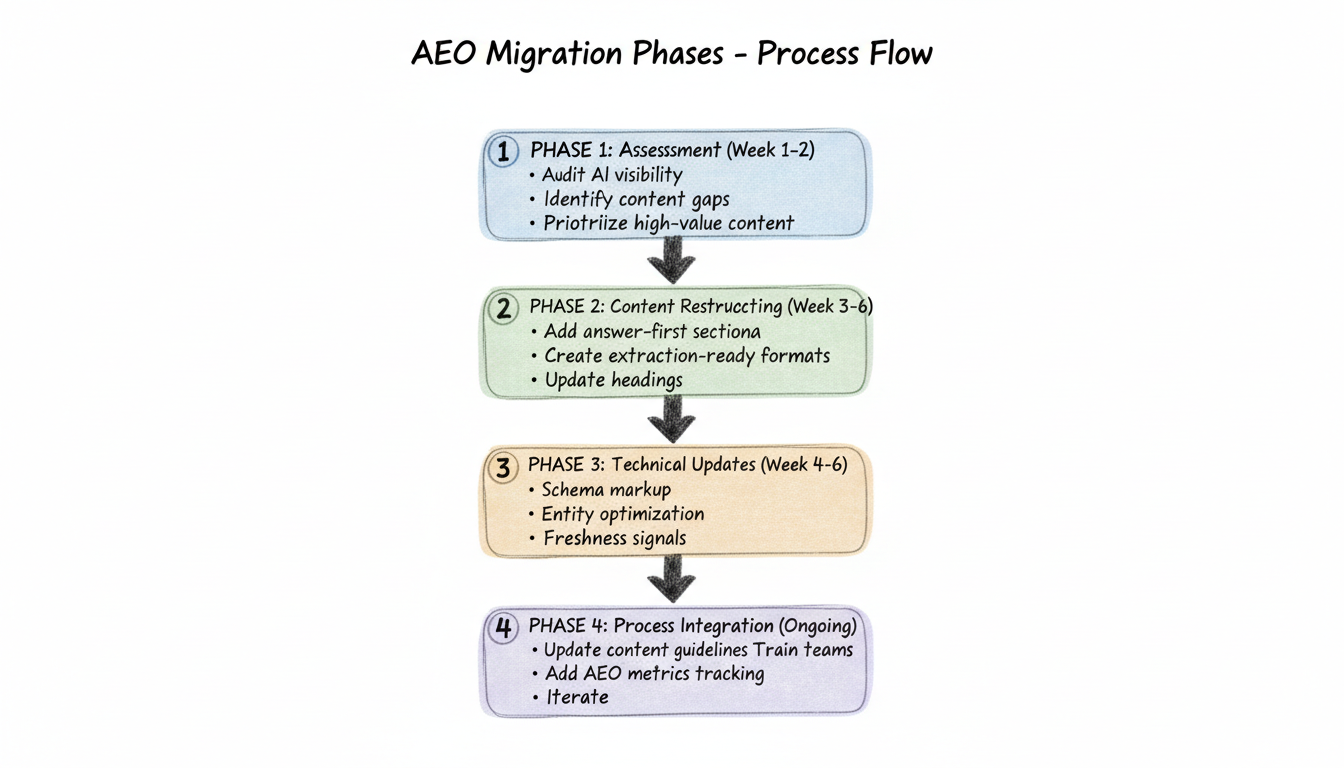
Content Restructuring Priorities
Not all content needs immediate migration—prioritize strategically.
According to StubGroup's GEO guide, content directly answering questions in the first 100 words performs significantly better in AI citations. AI prioritizes structured data, clear hierarchies, citations to authoritative sources, statistics over qualitative claims, and content answering specific user queries.
When planning your migration, consider conducting an AEO marketing audit to identify which pages should be restructured first based on their existing performance and AI visibility potential.
Content prioritization matrix:
Content Type | Migration Priority | Restructuring Focus | Information Gain Potential |
High-traffic pillar pages | Immediate | Answer-first sections, FAQ schema | High—add original data, benchmarks |
How-to/tutorial content | Immediate | Step-by-step structure, HowTo schema | High—add screenshots, unique workflows |
Product/service pages | High | Feature summaries, comparison tables | Medium—add proprietary metrics |
Blog archive | Medium | Quick answer blocks, updated statistics | Medium—add expert commentary |
News/time-sensitive | Lower | Freshness signals, author attribution | Lower—focus on timeliness |
When prioritizing content for migration, focus on long-tail question-based keywords rather than short-tail search volume alone. These conversational queries are the primary entry points for AI answer selection, and content that directly addresses them earns citation priority.
Restructuring Existing Content
Transform traditional SEO content into AEO-ready formats.
According to Matter Design's AEO readiness guide, SEO has always been about earning space in a ranked list. AEO is about being selected as the answer. This fundamental shift requires restructuring content from ranking-optimized to citation-optimized.
Content transformation checklist:
- Add direct answer in first 100 words before context
- Convert long paragraphs to bulleted/numbered lists
- Add comparison tables for multi-option topics
- Include FAQ sections with schema markup
- Update statistics with current data and sources
- Add author attribution with credentials
- Implement structured heading hierarchy
For technical guidance on structuring answers, review best practices for optimizing FAQ schema for Google AI Overviews, which applies equally to other AI answer engines.
Building E-E-A-T and Knowledge Graph Authority for AI Citation
AI models select sources based on trust signals, and E-E-A-T (Experience, Expertise, Authoritativeness, Trustworthiness) has become the foundational framework for evaluating which content deserves citation. Building E-E-A-T and Knowledge Graph authority is not optional for organizations serious about AI visibility—it is the prerequisite.
E-E-A-T as the Trust Foundation for AI
Google's E-E-A-T framework evaluates content across four dimensions: first-hand Experience with the topic, demonstrated Expertise through credentials and depth, Authoritativeness established through recognition and backlinks, and Trustworthiness reflected in accuracy, transparency, and site security. AI models trained on web data inherit these quality signals when selecting sources to cite.
Content from authors with demonstrable expertise and first-hand experience receives higher citation probability in AI responses. Tactical steps to strengthen E-E-A-T signals include: adding detailed author bios with verifiable credentials, publishing original research and proprietary data, featuring case studies with measurable outcomes, and contributing bylined content to authoritative external publications in your domain.
Knowledge Graph and Entity Validation
Google's Knowledge Graph is the entity database that AI models reference to validate brands, authors, and concepts. When your organization or author entity exists in the Knowledge Graph, AI models have higher confidence citing your content because they can verify the entity behind it. For a step-by-step approach, see our guide on how to get a Google Knowledge Panel.
Steps to establish Knowledge Graph presence include: implementing consistent Organization and Person schema markup across all properties, establishing Wikipedia and Wikidata entries for your brand and key authors, optimizing your Google Business Profile with complete and accurate information, and maintaining NAP (Name, Address, Phone) consistency across all business directories and citations.
Information Gain: Standing Out from AI-Generated Content
Information gain refers to unique data, proprietary insights, and contrarian perspectives that AI cannot synthesize from existing sources. As AI-generated content floods the web, the content that stands out—and gets cited—is content that offers something no other source provides.
Information density is a related quality signal: AI models prefer dense, fact-rich content over filler paragraphs. Every sentence should advance the reader's understanding. Tactical guidance for maximizing information gain includes: publishing original survey data and benchmarks from your own operations, including screenshots and visual evidence that validate claims, featuring direct expert quotes from named practitioners, and presenting contrarian analysis backed by data that challenges conventional wisdom.
Writing for AI Extraction: Quotability, Structure, and Voice Search
Content that gets cited by AI models shares specific structural characteristics. Understanding these patterns allows you to engineer your content for maximum extractability without sacrificing readability for human audiences.
The 40-Word Quotable Summary Rule
AI models extract 30-50 word declarative statements as direct answers. This quotability—sometimes called snip-ability—is the single most important structural factor for AI citation selection. Every H2 section in your content should open with a concise declarative summary that can stand alone as a complete answer.
For example, instead of writing "In this section, we'll explore the various ways that organizations can approach the complex challenge of restructuring their existing content libraries," write: "Content restructuring for AEO requires converting each page to an answer-first format, where the direct response appears in the first 100 words before supporting context and evidence." The second version is a self-contained answer that AI can extract verbatim.
Inverted Pyramid 2.0 for AI Content
The traditional inverted pyramid—lead with the most important information—requires adaptation for AI. In AI-optimized content, lead with the direct answer, follow with supporting context and evidence, and close with nuance and caveats. This structure ensures that even if an AI model only extracts the opening, the answer is complete and accurate.
This principle extends beyond individual sections to your overall site architecture. Building topical authority through content clusters—where each post links to a broader topic hub—signals comprehensive domain coverage to AI models. A single well-structured article is good; a cluster of interlinked articles covering every facet of a topic is what establishes citation authority.
Voice Search and Conversational Optimization
Voice search queries are longer and more conversational than typed queries, typically following natural language patterns like "What is the best way to migrate from SEO to AEO" rather than abbreviated keyword strings. Optimizing for these patterns means structuring content around complete questions and providing concise, spoken-word-friendly answers.
Speakable schema markup allows you to designate specific content sections as voice-ready, signaling to search engines which portions of your page are suitable for text-to-speech playback. This structured data option is particularly valuable for FAQ sections and key definitions. Additionally, Core Web Vitals—including Interaction to Next Paint (INP)—remain critical trust signals. Fast page load and responsive interaction signal quality to both voice assistants and AI agent crawlers that evaluate sources for citation.
Organizational Alignment
AEO migration requires cross-functional coordination.
According to Search Engine Journal, AI-driven engines like Google AIO, ChatGPT, and Perplexity have introduced diverse ways of searching for and consuming information. Organizations must integrate SEO departments deeper within marketing, creative, and branding teams. Personalization strategy should be coordinated across these teams as well—contextually relevant content improves both user experience and AI citation likelihood. Organizations should also begin evaluating content licensing considerations as AI platforms negotiate data usage agreements with publishers.
Team alignment requirements:
AEO Organizational Integration
├── Content Teams
│   ├── Training on answer-first writing
│   ├── Updated style guides
│   └── AEO checklist integration
│
├── Technical Teams
│   ├── Schema implementation support
│   ├── CMS template updates
│   └── Performance optimization
│
├── Analytics Teams
│   ├── AI visibility tracking setup
│   ├── Citation monitoring tools
│   └── Reporting dashboard updates
│
└── Leadership
    ├── KPI alignment with AEO goals
    ├── Budget allocation
    └── Success metric definition
Migration shouldn't sacrifice existing rankings.
According to ALM Corp's SEO trends analysis, SEO has evolved into Search Everywhere Optimization, requiring visibility across Google, AI platforms (ChatGPT, Perplexity), YouTube, social media, and review platforms. The brands that dominate search understand that SEO is no longer a technical checklist—it's a comprehensive visibility strategy.
SEO preservation guidelines:
Protection Area | How to Maintain |
URL structure | Don't change existing URLs |
Meta optimization | Keep title/description optimization |
Internal linking | Maintain and enhance link structure |
Backlink profile | Continue authority building |
Technical foundation | Preserve crawlability, speed |
Technical Implementation Additions
Beyond the schema and entity work described above, the technical implementation phase of your migration should include these additional items:
- Core Web Vitals / INP optimization: Interaction to Next Paint (INP) has replaced First Input Delay as Google's responsiveness metric. Ensure all migrated pages meet the "good" threshold (under 200ms) as this affects both traditional ranking and AI crawler trust signals.
- Knowledge Graph entity validation: Verify that your Organization and Person entities resolve correctly in Google's Knowledge Graph using the Knowledge Graph Search API. Unresolved entities reduce AI citation confidence.
- Speakable schema markup: Add Speakable structured data alongside existing FAQ and HowTo schema to designate voice-ready content sections. This is especially relevant for FAQ answers and key definitions.
- Structured data for AI search: Implement comprehensive schema markup including Article, FAQPage, HowTo, and Organization types to maximize machine readability across all AI platforms.
For a complete list of recommended AEO tools and software, see our dedicated guide covering audit, monitoring, and optimization platforms.
Measuring Migration Success
Track both SEO and AEO metrics throughout transition.
According to NoGood's future of search analysis, search marketing in 2026 now includes AEO—optimizing for AI citations and answer engines. The marketers succeeding in AI search all built strong traditional SEO first.
Understanding the Google AI Overview ranking factors helps identify which traditional SEO signals still matter and which new signals to prioritize during migration.
A critical new KPI to track is Share of Model (SoM)—the percentage of AI responses in your category that mention your brand. SoM measures your visibility in the AI answer layer the same way Share of Voice measures traditional search visibility. Tools for AI citation tracking like Otterly.ai, Profound, and Peec AI can automate this monitoring across ChatGPT, Perplexity, Google AI Overviews, and Microsoft Copilot.
It is worth noting that 45% of organizations cite budget as the main barrier to AEO adoption (Conductor, 2025), which makes the phased migration approach described in this post the practical path forward—you can demonstrate ROI at each phase before securing additional investment.
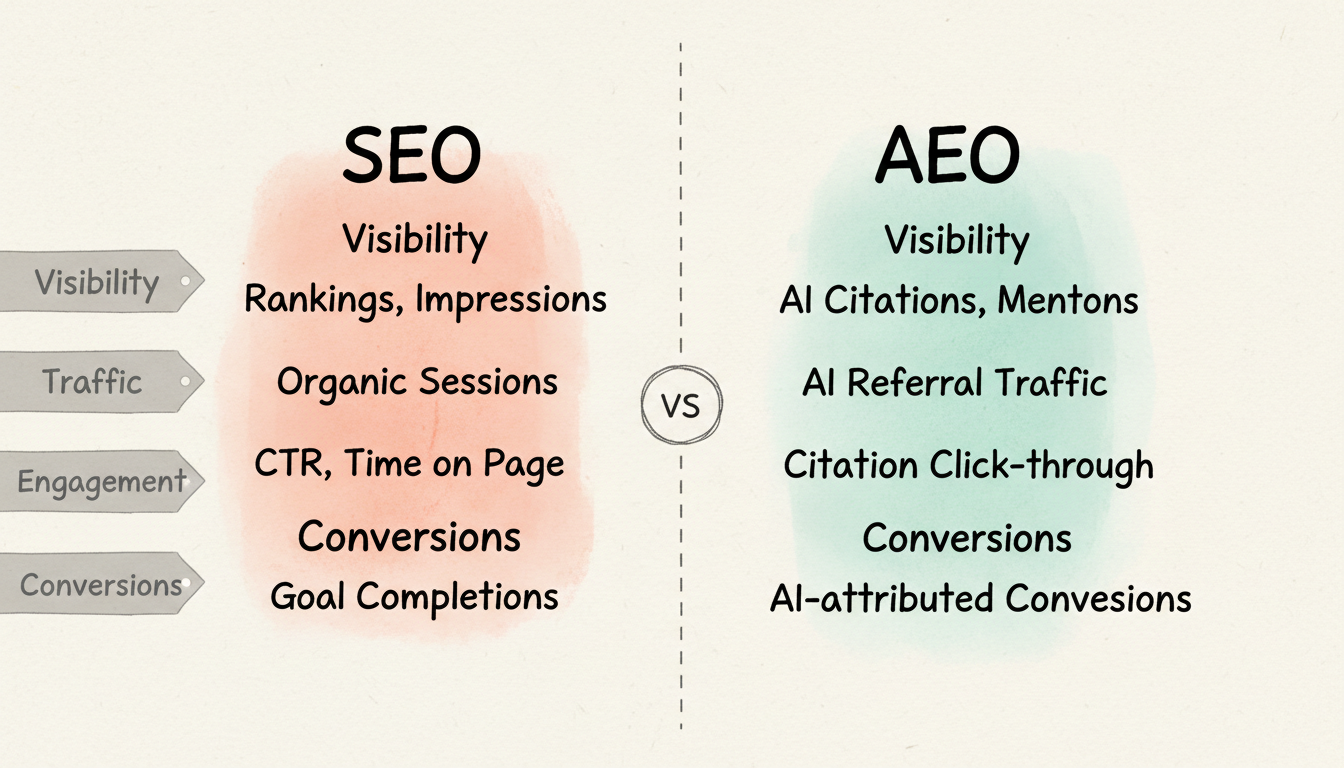
Migration metrics dashboard:
Metric Category | SEO Metrics | AEO Metrics |
Visibility | Rankings, impressions | AI citations, Share of Model |
Traffic | Organic sessions | AI referral traffic |
Engagement | CTR, time on page | Citation click-through |
Conversions | Goal completions | AI-attributed conversions |
Common Migration Mistakes
Avoid errors that compromise either SEO or AEO outcomes.
According to Loudface's Webflow SEO guide, AI systems don't trust sites that search engines don't already respect. For websites, AEO is primarily an editorial and architectural challenge, not a technical one.
Mistakes to avoid:
- Abandoning SEO basics for AEO experimentation
- Restructuring content without preserving URL authority
- Implementing schema without validation
- Ignoring mobile experience during updates
- Skipping content freshness updates
Frequently Asked Questions About SEO to AEO Migration
What Is the Difference Between AEO and GEO?
Answer Engine Optimization (AEO) focuses on making your content the direct answer to user questions in AI-powered search tools like Google AI Overviews and Perplexity. Generative Engine Optimization (GEO) targets AI-synthesized responses where models combine information from multiple sources. AEO optimizes for citation and extraction; GEO optimizes for inclusion in generated summaries. A complete migration strategy should address both.
How Long Does an SEO to AEO Migration Take?
A phased SEO-to-AEO migration typically takes 3-6 months depending on site size and content volume. The assessment phase takes 2-4 weeks, content restructuring 4-8 weeks, technical implementation 2-4 weeks, and process alignment is ongoing. Prioritize high-traffic pages with informational intent first, as these face the greatest zero-click search impact from AI Overviews.
Will Migrating to AEO Hurt My Existing SEO Rankings?
No—a well-executed AEO migration is additive to SEO, not a replacement. The core practices overlap: structured data, E-E-A-T signals, fast page speed, and quality content benefit both traditional search rankings and AI citation selection. The key is preserving existing URL structures, internal links, and backlink equity while layering on answer-first content formatting and enhanced schema markup.
What Tools Can I Use to Track AI Citations of My Content?
AI citation tracking is an emerging category. Tools like Otterly.ai, Profound, and Peec AI monitor brand mentions across ChatGPT, Perplexity, Google AI Overviews, and Microsoft Copilot. You can also manually audit by querying AI platforms with your target keywords and checking whether your content is cited. Track Share of Model (SoM)—the percentage of AI responses mentioning your brand in your category. For a full list of options, see our guide to AI citation tracking tools.
Key Takeaways
Successful AEO migration layers new capabilities onto SEO foundations:
- Migration not replacement - AEO adds to SEO, doesn't replace it
- Systematic approach - Phase migration through assessment, restructuring, technical, process
- Prioritize strategically - High-traffic, answer-focused content first
- Preserve SEO value - Don't break what already works
- Align organization - Content, technical, and analytics teams need coordination
According to ProofWrite, AI search engines prioritize content based on trust signals and verified citations rather than keyword density or backlink volume alone—making the migration from traditional SEO to integrated AEO essential for sustained visibility.