
Answer engine optimization focuses on making your content the source that AI systems and voice assistants reference when providing direct answers. Unlike traditional SEO where rankings determine visibility, AEO determines whether your content gets selected as the answer users receive. As platforms like ChatGPT (built by OpenAI), Perplexity, and Google AI Overviews (Google's AI-generated answer summaries at the top of search results) reshape how users find information, answer engine optimization has become essential for maintaining brand visibility.
This guide covers practical answer engine optimization techniques you can implement to improve answer engine visibility, including how AEO compares to GEO and SEO, the role of E-E-A-T, measurement frameworks, and real-world case studies.
Why AEO Optimization Matters
User behavior has fundamentally shifted. Instead of browsing search results, users increasingly expect direct answers. Voice assistants, AI chat interfaces, and featured snippets satisfy queries before clicks happen.
Research indicates that companies now receive significant organic traffic from LLMs like ChatGPT, Perplexity, and Claude—sometimes exceeding traffic from traditional search. This shift means brands need to optimize for being cited, recommended, and directly referenced when users ask questions in their category.
Answer engine optimization matters because:
- Zero-click results dominate many search categories
- Voice search continues expanding across devices
- Google AI Overviews appear on growing percentages of queries
- User expectations center on immediate, direct answers
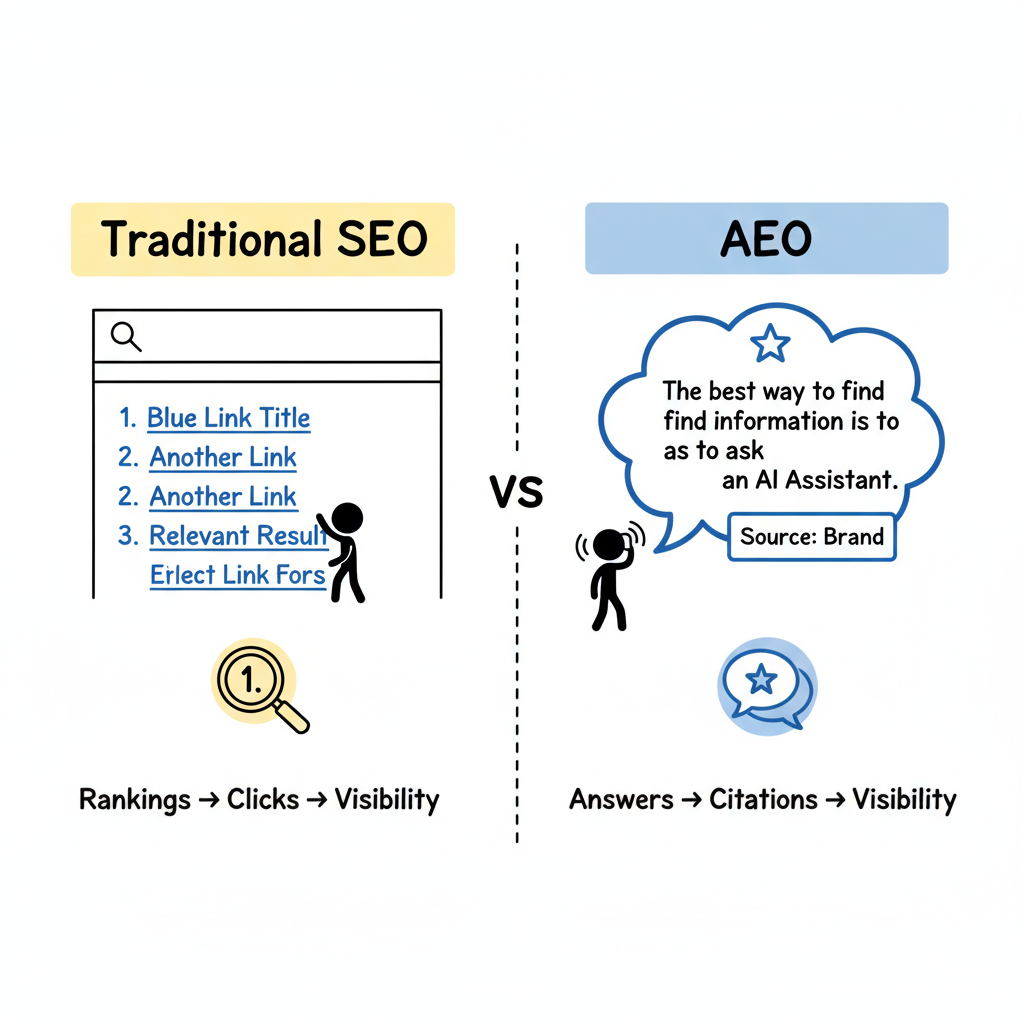
Organizations that ignore AEO optimization lose visibility even when they technically "rank" in traditional results. Backlinks remain critical for answer engine optimization because AI systems use link-based authority signals to decide which sources to cite. The shift is from "links for ranking" to "links for citation authority."
AEO vs GEO vs SEO -- What Is the Difference?
As AI-powered search grows, three distinct but overlapping disciplines have emerged: SEO, AEO, and GEO. Understanding the differences helps you allocate resources and build a comprehensive strategy.
SEO (Search Engine Optimization) focuses on improving organic rankings in traditional search engines like Google and Bing. The goal is earning clicks from search engine results pages through keyword targeting, technical optimization, and link building.
AEO (Answer Engine Optimization) targets answer engines broadly -- platforms that provide direct answers to user queries. This includes Google AI Overviews, featured snippets, voice assistants like Siri and Alexa, and AI chat platforms like ChatGPT and Perplexity. The goal is becoming the cited source when these systems generate answers.
GEO (Generative Engine Optimization) is a subset of AEO focused specifically on generative AI outputs. GEO tactics optimize content to be retrieved and cited by large language models during their response generation process. If you are exploring GEO tools, see our guide on the best generative engine optimization tools available today.
AEO and GEO share many tactics -- structured data, E-E-A-T optimization, citation-friendly formatting -- but GEO focuses specifically on LLM-generated responses while AEO encompasses traditional answer boxes, voice search, and featured snippets as well.
Comparison across key dimensions:
- Goal: SEO = organic traffic; AEO = answer engine visibility; GEO = generative AI citations
- Platforms targeted: SEO = Google, Bing SERPs; AEO = featured snippets, voice, AI Overviews, ChatGPT; GEO = ChatGPT, Perplexity, Gemini
- Key tactics: SEO = keywords, backlinks, technical SEO; AEO = structured data, concise answers, schema; GEO = citation optimization, entity coverage, RAG-friendly formatting
- Primary metric: SEO = rankings and clicks; AEO = answer appearances; GEO = citation frequency
- Content format: SEO = long-form optimized pages; AEO = question-answer pairs, extractable paragraphs; GEO = factual, well-sourced, entity-rich content
Most brands need all three. SEO builds the foundation of organic authority, AEO ensures your content gets selected as the answer, and GEO fine-tunes your presence in generative AI outputs. They are complementary strategies, not competing ones.
Core AEO Optimization Techniques
Structure Content for Extraction
AI systems extract content at the paragraph level. They look for clear, quotable statements rather than processing entire articles. Answer engines use Retrieval-Augmented Generation (RAG) -- they retrieve relevant web pages, then feed that content to the LLM to generate answers. This is why your content's structure and clarity directly impacts whether it gets selected as source material. Structure appropriately:
Lead with the answer. Place the direct answer immediately after each heading. Elaboration can follow, but the core answer should come first.
Keep paragraphs concise. Aim for under 80 words per paragraph. This improves extraction accuracy and voice search compatibility, similar to best practices for long-tail keywords and featured snippets.
Write standalone statements. Each paragraph should make sense when extracted alone. Avoid statements that require surrounding context to understand.
Use clear headers. Match how users phrase questions. Question-format headers (H2, H3) signal to AI systems exactly what your content answers.
Implement Schema Markup
Structured data helps answer engines understand your content's meaning and context. Implementing structured data for AI search is one of the highest-impact AEO tactics:
- FAQ Schema marks question-answer pairs explicitly
- HowTo Schema structures step-by-step instructions
- Article Schema provides author attribution and publication details
- Organization Schema establishes entity information
Schema markup doesn't guarantee selection, but it removes ambiguity that might cause AI systems to skip your content. Ensuring schema markup alignment with visible content is critical for avoiding conflicts that could hurt visibility.
Create FAQ Sections
FAQ sections serve multiple AEO optimization purposes:
They explicitly format questions and answers in patterns AI systems recognize. They cover question variations users might phrase differently. They provide concise, extractable responses that work for voice and text.
Effective FAQ sections:
- Address actual questions your audience asks
- Provide complete answers in 40-60 words
- Cover both primary questions and logical follow-ups
- Use natural language matching voice search patterns
Optimize for Voice Search
Voice queries differ from typed searches. They're longer (typically 7-10 words), more conversational, and often include local intent.
For voice optimization:
- Use natural, conversational language
- Answer questions directly before adding detail
- Include local business information where relevant
- Ensure content works when read aloud
Content should deliver useful answers even when partially extracted as spoken responses.
Build Topical Authority
Answer engines prefer sources with established expertise. Authority signals include:
Comprehensive coverage. Create thorough content around core topics rather than thin pages targeting individual keywords.
Consistent accuracy. Maintain and update content to remain current. Outdated information reduces trust signals.
Expert attribution. Credit content to recognized experts with verifiable credentials.
Cross-platform presence. Build presence on platforms AI systems crawl—LinkedIn, industry publications, relevant directories.
The E-E-A-T Framework for Answer Engine Trust
E-E-A-T stands for Experience, Expertise, Authoritativeness, and Trustworthiness -- Google's quality rater framework that answer engines also rely on to determine source credibility. While E-E-A-T was originally designed for traditional search quality assessment, it has become equally important for answer engine optimization because AI systems need to determine which sources to trust and cite.
Here is how each pillar maps to AEO success:
Experience: Answer engines favor content backed by first-hand data, original research, and case studies from your domain. Content that demonstrates real-world experience with a topic is more likely to be selected as a source because it provides unique insights that cannot be found elsewhere.
Expertise: Author bylines with credentials, expert quotes, and depth of technical detail signal to AI systems that the content comes from a knowledgeable source. Including author bios with relevant qualifications strengthens this signal.
Authoritativeness: Backlinks from authoritative sources, brand mentions across the web, and citations in other AI answers all build the authority signals that answer engines use when selecting sources. The more your content is referenced by trusted third parties, the more likely it is to be cited in AI-generated responses.
Trustworthiness: HTTPS, transparent sourcing, factual accuracy, and consistent information across your web presence all contribute to trust. AI systems penalize sources with conflicting or outdated information.
Actionable E-E-A-T checklist for AEO:
- Add detailed author bios with verifiable credentials to all content
- Cite primary sources and link to original research
- Publish original data, surveys, or case studies that AI models can reference
- Earn editorial backlinks from authoritative industry publications
- Keep all content factually current -- update statistics and claims regularly
- Ensure consistent NAP (Name, Address, Phone) data across all platforms
AEO Optimization Implementation
Start with High-Impact Opportunities
Focus initial efforts on:
- Top-performing pages that already rank well
- Pages ranking on page one without featured snippets
- Content addressing common customer questions
- Pages where competitors currently win answer positions
These represent quick wins—content already performing that needs optimization for answer engine extraction.
Follow a Phased Approach
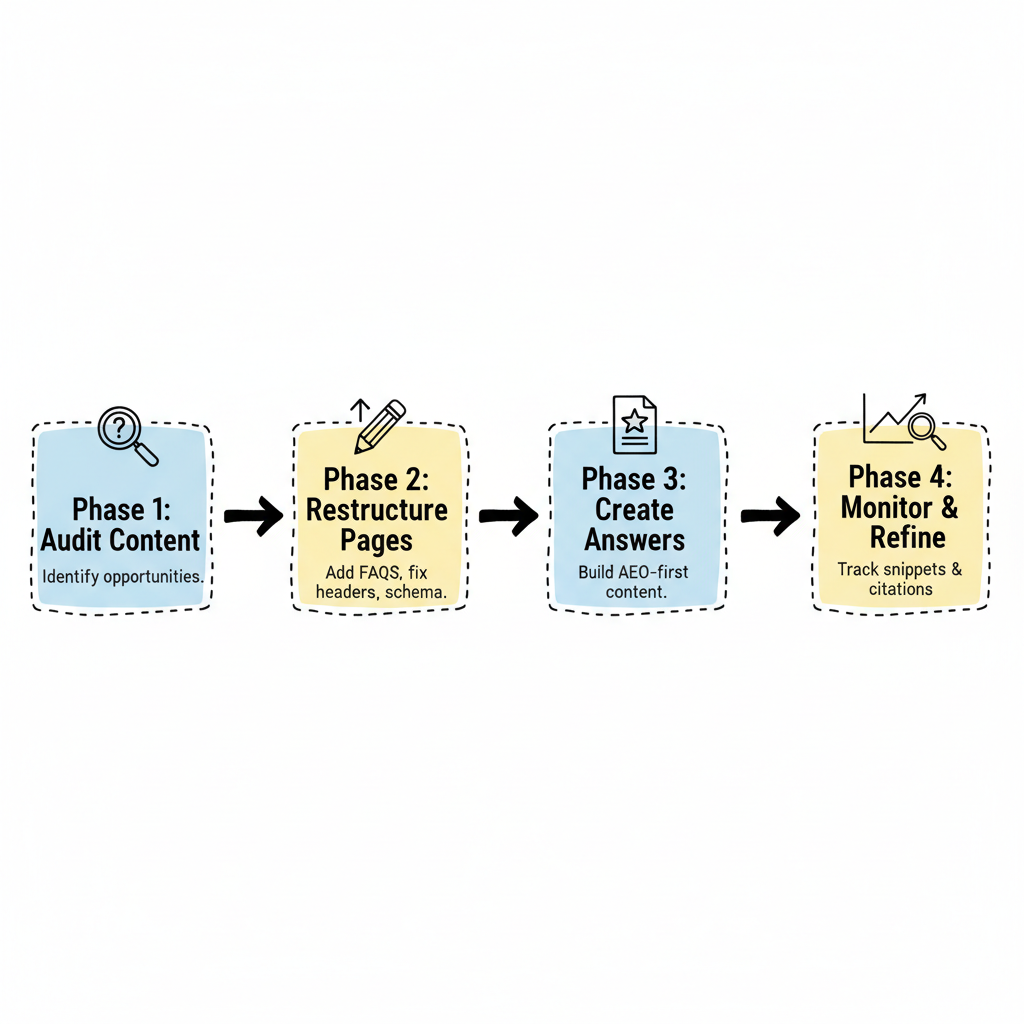
AEO optimization works best as systematic process:
Phase 1: Audit existing content. Identify which pages could become answer-ready with structural improvements. Consider running an AEO technical audit to uncover specific optimization opportunities.
Phase 2: Restructure priority pages. Add FAQ sections, improve headers, break long paragraphs, implement schema.
Phase 3: Create answer-optimized content. Build new content with AEO principles from the start.
Phase 4: Monitor and refine. Track featured snippet appearances and AI citations, adjust based on results.
Phased timelines prevent overwhelm while ensuring steady progress.
Measure AEO Success
AEO measurement differs from traditional SEO metrics:
- Featured snippet tracking through rank tracking tools
- Voice search monitoring via analytics and manual testing
- AI citation testing across ChatGPT, Perplexity, and other platforms
- AI referral traffic in analytics (filter by AI platform domains)
Regular manual testing across AI platforms reveals visibility that automated tools might miss. Understanding AI search success metrics by industry helps you benchmark your performance appropriately.
Measuring AEO Success -- Kpis and Tools
Beyond basic tracking, a structured measurement framework helps you quantify answer engine optimization performance and demonstrate ROI. Here are five named KPIs every AEO strategy should track:
Visibility Score: How often your brand appears in AI-generated answers for target queries. Track this by testing a set of core queries across Google AI Overviews, ChatGPT, and Perplexity on a regular cadence and logging appearance rates.
Citation Score: How frequently answer engines cite your content as a source. This goes beyond mere appearance -- it measures whether AI platforms link back to or explicitly name your brand when generating answers. Use AI citation tracking tools to automate this measurement across platforms.
Share of Answer: Your brand's percentage of AI answer real estate compared to competitors, analogous to share of voice in traditional marketing. If five brands are cited across 100 AI answers for your target queries, your share of answer is the percentage that reference you.
Sentiment Score: Whether AI answers reference your brand positively, neutrally, or negatively. A brand can have high visibility but negative sentiment if AI models surface critical reviews or complaints. Monitor sentiment alongside volume.
Assisted Conversions: Revenue and conversions driven by AI answer visibility, even without a direct click. Users see your brand in an AI answer, then search directly for you or convert later. Attribute these via assisted conversion paths in GA4 by analyzing the touchpoints that precede direct searches and branded queries.
Tools for AEO measurement: Semrush provides position tracking with AI Overview monitoring. Conductor (which many enterprises already use) offers AI search visibility dashboards. Google Search Console shows AI Overview impressions. Dedicated AEO tools and software platforms are emerging that consolidate citation tracking, share of answer, and sentiment analysis into unified dashboards.
AEO in Practice -- Case Studies and Data Points
Understanding answer engine optimization in theory is one thing -- seeing it in practice grounds the strategy in real outcomes. Here are key data points and case studies that illustrate the AEO opportunity.
The Search Landscape Shift
The data paints a clear picture of where search is heading. According to Gartner, traditional search volume is projected to drop 25% by 2026 as users shift to AI-powered answers. Zero-click searches rose from approximately 56% in 2024 to an estimated 69% in 2025, meaning more than two-thirds of queries now resolve without the user clicking through to a website. Meanwhile, ChatGPT now serves over 800 million weekly active users, making it a major discovery channel that brands cannot afford to ignore. To understand how these shifts affect your specific vertical, explore the Google AI Overview SEO impact across industries.
Nerdwallet Case Study
NerdWallet provides one of the most compelling AEO case studies. Despite experiencing a 20% decline in organic search traffic, NerdWallet grew revenue by 35% by maintaining strong visibility in AI answer engines. Their strategy centered on deep E-E-A-T content with expert financial authors, comprehensive structured data across their pages, and an authoritative backlink profile built over years of consistent publishing. The lesson: traffic loss from zero-click does not equal revenue loss if your brand is the cited answer.
Adobe Example
Adobe leveraged structured content and product schema to maintain visibility across Google AI Overviews and ChatGPT product recommendations. By ensuring their product pages, tutorials, and documentation were structured for extraction and richly marked up with schema, Adobe maintained citation presence even as traditional click-through rates declined. For more practical AEO optimization examples, see our dedicated case study collection.
Key Takeaway from the Data
Perhaps the most important statistic for AEO practitioners: 99% of URLs appearing in Google AI Mode results also rank in the top 20 organic results. This confirms that AEO and SEO are complementary, not competing. Strong organic foundations remain essential -- AEO adds the optimization layer that determines whether your ranking content also gets cited in AI-generated answers.
Key Takeaways
Answer engine optimization positions your content to be selected as the direct answer users receive across AI assistants, voice search, and featured snippets.
The core principle: Structure content so AI systems can confidently extract, understand, and cite it when answering user questions.
Where to start: Focus on high-performing existing content. Add FAQ sections, improve structure, implement schema markup.
The ongoing commitment: AEO optimization requires continuous updates as AI systems evolve. Brands that treat it as ongoing process maintain long-term visibility.
Organizations implementing AEO strategies typically see improved visibility across the growing channels where users expect direct answers.
Frequently Asked Questions
How Long Does AEO Optimization Take to Show Results?
Results vary by platform. Featured snippet improvements may appear within weeks as Google recrawls content. AI platform citations take longer as models refresh their knowledge bases. Expect gradual improvement over months rather than overnight transformation.
Does AEO Optimization Replace Traditional SEO?
No. AEO complements SEO. Strong traditional rankings correlate with better AI citations because authority signals transfer across platforms. Build SEO foundations first, then layer AEO optimization.
What Tools Help with AEO Optimization?
Schema generators help implement structured data. Rank tracking tools monitor featured snippets. AI visibility platforms like Conductor track citations across multiple AI systems. Manual testing across ChatGPT, Perplexity, and similar platforms provides direct visibility feedback.
Where Should I Start with Limited Resources?
Start with FAQ schema on your top 10 pages. Add FAQ sections addressing common customer questions. Restructure paragraphs to lead with direct answers. These changes require minimal technical resources but significantly improve answer engine readiness.
What Is the Difference Between AEO and GEO?
AEO (Answer Engine Optimization) focuses on getting your content selected as the source for answers across platforms like Google AI Overviews, ChatGPT, and Perplexity. GEO (Generative Engine Optimization) is a subset specifically targeting generative AI outputs. AEO is the broader discipline -- it includes traditional featured snippets and voice search alongside AI-generated answers.
What Tools Can I Use for Answer Engine Optimization?
Key tools for AEO include Semrush for tracking AI Overview appearances, Conductor for monitoring AI search visibility, and dedicated AEO platforms that measure citation scores and share of answer. Google Search Console also shows AI Overview impressions. Pair these with structured data testing tools to validate your schema markup is correctly implemented.
How Does E-E-A-T Affect Answer Engine Optimization?
E-E-A-T (Experience, Expertise, Authoritativeness, Trustworthiness) is foundational to AEO success. Answer engines prioritize sources that demonstrate real-world experience, subject matter expertise, and trustworthy information. Strengthen your E-E-A-T by adding expert author bylines, citing primary research, earning authoritative backlinks, and publishing original data that AI models can reference confidently.
Is AEO Replacing SEO?
AEO is not replacing SEO -- it is extending it. According to Gartner, traditional search may decline by 25% by 2026, but 99% of URLs cited in AI answers also rank in the top 20 organic results. Strong SEO fundamentals (quality content, backlinks, technical performance) remain the foundation. AEO adds a layer of optimization for how that content gets cited and surfaced in AI-powered answer experiences.