
Answer engine optimization requires systematic attention across multiple dimensions—technical infrastructure, content structure, authority signals, and measurement. In an era where over 60% of searches end without a click, optimizing for Large Language Models (LLMs) and zero-click experiences is no longer optional. This 50+ point checklist provides a comprehensive implementation guide covering every factor that influences AI citation success, from generative engine optimization tools to entity density and EEAT signals.
Use this checklist to audit your current position, prioritize improvements, and track progress toward AI visibility goals. Unlike traditional SEO checklists focused solely on click-through rates, this guide addresses the citation-based visibility model that defines Answer Engine Optimization (AEO) and distinguishes it from broader Generative Engine Optimization (GEO) strategies. For real-world applications of these principles, see our AEO optimization examples.
Why AEO Matters: Zero-Click Searches and the Rise of Llms
The search landscape has fundamentally shifted. Over 60% of Google searches now end without a click to an external website—these are zero-click searches, and their prevalence is accelerating as AI-powered answer engines become the default interface for information retrieval.
Large Language Models (LLMs) are the AI systems powering this transformation. ChatGPT, Perplexity, Claude, and Google AI Overviews all use LLMs to synthesize answers from across the web, presenting users with direct responses instead of traditional blue links. When an LLM cites your content, you gain visibility even in zero-click experiences—but only if your content is structured, authoritative, and optimized for extraction.
Traditional SEO focused on earning clicks through high rankings. AEO focuses on earning citations—being the source that AI systems reference when constructing answers. This is a fundamentally different optimization target. Your content must be not just findable, but quotable, structured, and authoritative enough that LLMs select it as a trusted citation source.
It is important to distinguish AEO from GEO (Generative Engine Optimization). While GEO encompasses the broader discipline of influencing how generative AI models represent your brand across all outputs, AEO specifically targets citation-based answer positioning. AEO is a focused subset of GEO—it is about being the cited answer, not just appearing in generative output.
Brands that fail to optimize for answer engines risk becoming invisible in the zero-click era. As AI-driven search continues to capture a larger share of user queries, the click-through rate (CTR) for traditional organic results will continue to decline. AEO ensures your content remains visible where users are actually finding answers.
Technical Infrastructure (Points 1-12)
Technical factors determine whether AI crawlers can access and process your content. Google's AI algorithms, including BERT and RankBrain, evaluate content quality and answer relevance—but they can only assess what they can access.
Crawler Access Configuration
- 1. GPTBot allowed in robots.txt — OpenAI's crawler must access your content for ChatGPT visibility
- 2. ClaudeBot allowed in robots.txt — Anthropic's crawler enables Claude citations
- 3. PerplexityBot allowed in robots.txt — Required for Perplexity AI mentions
- 4. GoogleBot unrestricted — Essential for Google AI Overviews inclusion
- 5. No blanket AI crawler blocks — Review robots.txt for unintentional restrictions
- 6. Sitemap submitted and current — AI crawlers use sitemaps for content discovery
Page Performance
- 7. Core Web Vitals passing — LCP under 2.5s, FID under 100ms, CLS under 0.1
- 8. Mobile rendering functional — All content accessible on mobile devices
- 9. Page load under 3 seconds — Slow pages reduce crawler efficiency
- 10. No JavaScript rendering dependencies — Critical content should render without JS
Structured Data Implementation
- 11. Organization schema deployed — Establishes entity identity for AI systems
- 12. Schema validates without errors — Test with Google Rich Results Test or Schema.org validators
- 13. Minimize DOM complexity — Ensure critical content is available in raw HTML, not hidden behind JavaScript rendering, so AI crawlers can extract answers without executing scripts
- 14. Add BreadcrumbList schema — Clarify site hierarchy for both search engines and AI crawlers, improving contextual understanding of your content's position within your site. For guidance on prioritizing schema types, see our guide on structured data for AI search
Content Structure (Points 13-28)
Content structure determines extraction success when Large Language Models (LLMs) select passages to cite.
Answer Optimization
- 13. Direct answer statements lead priority pages — First paragraph answers the core question
- 14. Question-based headers present — Match conversational query patterns users ask AI
- 15. Standalone definition paragraphs — Create sentences AI can quote without context
- 16. FAQ sections on key pages — Comprehensive question-answer pairs ready for extraction
- 17. How-to content structured with steps — Numbered instructions AI can synthesize
- 18. HowTo schema on instructional content — Markup enhances AI understanding
Topic Coverage
- 19. Comprehensive topic depth — Cover subjects thoroughly without gaps
- 20. Related questions anticipated — Address follow-up queries users commonly ask
- 21. Multiple perspectives included — Present balanced viewpoints where relevant
- 22. Supporting evidence provided — Include data, examples, and citations
- 23. Content freshness maintained — Update pages within 12 months minimum
- 24. Article schema on blog content — Establish content type for AI classification
- 25. Entity density optimization — Use precise, established terminology consistently. Refer to concepts by their canonical names (e.g., "Answer Engine Optimization" not just "AEO") to improve entity recognition by LLMs
- 26. Search intent alignment — Map each content section to a specific search intent (informational, navigational, commercial, transactional) to match how AI systems categorize queries
- 27. Internal linking as a content structure signal — Use descriptive internal links to connect related topics, helping Large Language Models (LLMs) understand your site's topical depth and authority
Comparison and Evaluation Content
- 25. Competitor comparison pages exist — Address "vs" and "alternative" queries
- 26. Feature comparison tables present — Clear structured comparisons AI can extract
- 27. Honest strengths and limitations — Balanced assessment builds credibility
- 28. "Best for" recommendations included — Help AI make appropriate suggestions
Authority Signals (Points 29-40)
AI platforms evaluate source credibility when selecting citations. EEAT (Experience, Expertise, Authoritativeness, Trustworthiness) plays a central role in how both traditional search engines and LLMs assess which sources deserve citation.
Brand Consistency
- 29. Consistent NAP across platforms — Name, address, phone identical everywhere
- 30. Accurate business directory listings — Google Business Profile, Bing Places, industry directories
- 31. Wikipedia presence (if applicable) — Establishes notable entity status
- 32. Knowledge panel information correct — Verify Google Knowledge Panel accuracy
- 33. Consistent brand positioning — Same messaging across all properties
External Validation
- 34. Expert credentials visible — Author bios demonstrate qualifications
- 35. Industry publication citations — External references validate expertise
- 36. Review platform presence — Genuine reviews on G2, Capterra, Trustpilot
- 37. Original research published — Proprietary data AI can't find elsewhere
- 38. Community engagement — Presence on Reddit, Quora, industry forums
Trust Signals
- 39. HTTPS site-wide — Security baseline for AI trust assessment
- 40. Privacy policy and contact info — Transparency signals legitimate operation
EEAT and AEO: Building Trust for Answer Engines
Google's EEAT framework—Experience, Expertise, Authoritativeness, Trustworthiness—has become a critical factor not just for traditional search rankings, but for AI citation selection. LLMs are specifically trained to reduce hallucination risk by favoring authoritative, well-sourced content. When an AI system must choose between multiple sources for a citation, EEAT-aligned content consistently wins.
This means the same credibility signals that Google evaluates are also used by ChatGPT, Perplexity, Claude, and other answer engines when determining which sources to cite. Backlinks from high domain-authority sites, expert authorship, and factual accuracy all serve as trust signals for both traditional search and AI answer engines.
Add these EEAT-specific items to your optimization checklist:
- Add first-person experience signals — Include case studies, original data, and practitioner insights that demonstrate hands-on expertise. LLMs prioritize content that reflects genuine experience over generic summaries
- Display author credentials with linked bios — Author pages with relevant expertise, certifications, and publication history strengthen the expertise signal for both search engines and AI systems
- Earn backlinks from high domain-authority sites — Backlinks remain one of the strongest authoritativeness signals. AI systems trained on web data inherit these trust relationships
- Cite trusted primary sources — Reference research papers, official documentation, and industry reports. LLMs evaluate citation quality when assessing source credibility and misinformation risk
- Maintain factual accuracy and update outdated claims — Regularly verify statistics, update outdated references, and correct inaccuracies. This reduces hallucination risk when AI systems cite your content and strengthens overall Trustworthiness
Entity Clarity (Points 41-45)
AI must understand what your brand is before recommending it. Entity density is a measurable factor in AI citation selection—Large Language Models use entity co-occurrence patterns to assess topical relevance and determine whether a page is a strong match for a given query.
- 41. Clear category positioning — Explicitly state what industry/category you serve
- 42. Product/service definitions — Unambiguous descriptions of offerings
- 43. FAQPage schema on FAQ sections — Structured markup for question-answer content
- 44. Product schema on product pages — Entity relationships for offerings
- 45. Same-as links to authoritative profiles — Connect entity across platforms, including Wikipedia and Wikidata for entity disambiguation
Voice Search Optimization for AEO
Voice search and answer engines are deeply connected. Voice assistants—Siri, Alexa, Google Assistant—pull answers from the same structured, concise content that AEO targets. As voice search queries continue to grow, optimizing for spoken interactions directly reinforces your answer engine visibility.
Voice search queries differ fundamentally from typed searches. They tend to be longer, more conversational, and phrased as complete questions. Here is how the two compare:
| Text Search Query | Voice Search Query |
|---|---|
| AEO checklist | "What is an AEO optimization checklist?" |
| best AEO tools | "What are the best tools for answer engine optimization?" |
| structured data SEO | "How do I add structured data to my website for SEO?" |
| EEAT ranking factors | "Why does EEAT matter for search rankings?" |
Add these voice-search-specific items to your AEO checklist:
- Write in conversational, natural language — Mirror the way people actually speak when asking questions. Avoid overly formal or jargon-heavy phrasing in answer paragraphs
- Target long-tail question phrases — Optimize for queries starting with "how do I," "what is the best," and "why does" to capture voice search intent
- Provide concise, direct answers in 40-60 word blocks — Place these answer blocks immediately below question-based H2/H3 headers so voice assistants and LLMs can extract clean responses
- Optimize for local voice queries — Add LocalBusiness schema and ensure NAP (Name, Address, Phone) consistency across all platforms to capture "near me" voice searches
Measurement and Monitoring (Points 46-50)
Tracking enables optimization refinement and ROI demonstration. As zero-click searches continue to grow, measuring AEO success requires looking beyond traditional ranking metrics.
Visibility Tracking
- 46. Baseline visibility documented — Record current citations before optimization
- 47. Priority queries identified — Track 50-100 brand-relevant questions
- 48. Competitive benchmarks established — Monitor competitor citation frequency
- 49. Platform coverage measured — Track visibility across ChatGPT, Perplexity, Claude, Gemini, AI Overviews
- 50. Regular monitoring cadence — Monthly reviews minimum, weekly for active optimization
AEO Measurement Tools and Performance Tracking
Effective AEO measurement requires a combination of traditional SEO tools and AI-specific tracking methods. Here are the key tools and approaches for monitoring your answer engine performance:
- Google Search Console — Monitor position zero appearances, People Also Ask inclusions, and click-through rate changes. Track which queries trigger featured snippets and AI Overview citations for your content. People Also Ask boxes are a critical discovery vector—optimizing for PAA increases the surface area where your content can appear
- Semrush — Track featured snippet ownership, SERP feature visibility, and keyword position changes. Use the Position Tracking tool to monitor your presence in AI-generated search features. See our guide to AEO tools and software for detailed tool comparisons
- Moz — Benchmark domain authority scores and analyze backlink profiles. Domain authority remains a strong proxy for how LLMs evaluate source credibility
- AI-specific citation tracking — Manually test your target queries in ChatGPT, Perplexity, and Claude to verify whether your content is cited. Track citation frequency monthly to measure AEO progress. For automated approaches, explore AI citation tracking tools that can monitor citations at scale
Beyond traditional rankings, measure AEO success through: citation frequency across AI platforms, brand mention tracking in LLM outputs, conversion rates from AI-referred traffic, and changes in zero-click visibility for your target queries.
Implementation Priority Matrix
Not all checklist items carry equal weight. Prioritize based on impact and effort.
Critical Priority (Address First)
Items 1-6 (crawler access) block all other optimization. Fix immediately.
High Priority (Week 1-2)
Items 7-12 (technical performance), 13-16 (answer optimization), 29-33 (brand consistency).
Medium Priority (Week 3-4)
Items 17-24 (topic coverage), 34-38 (external validation), 41-45 (entity clarity).
Ongoing Priority (Continuous)
Items 25-28 (comparison content), 39-40 (trust signals), 46-50 (measurement). EEAT optimization is also an ongoing priority—author credentials, backlink acquisition, and content accuracy require continuous attention.
Scoring Your Checklist Completion
Calculate your AEO readiness score:
Technical Infrastructure (12 points): 1 point per item Content Structure (16 points): 1 point per item Authority Signals (12 points): 1 point per item Entity Clarity (5 points): 1 point per item Measurement (5 points): 1 point per item
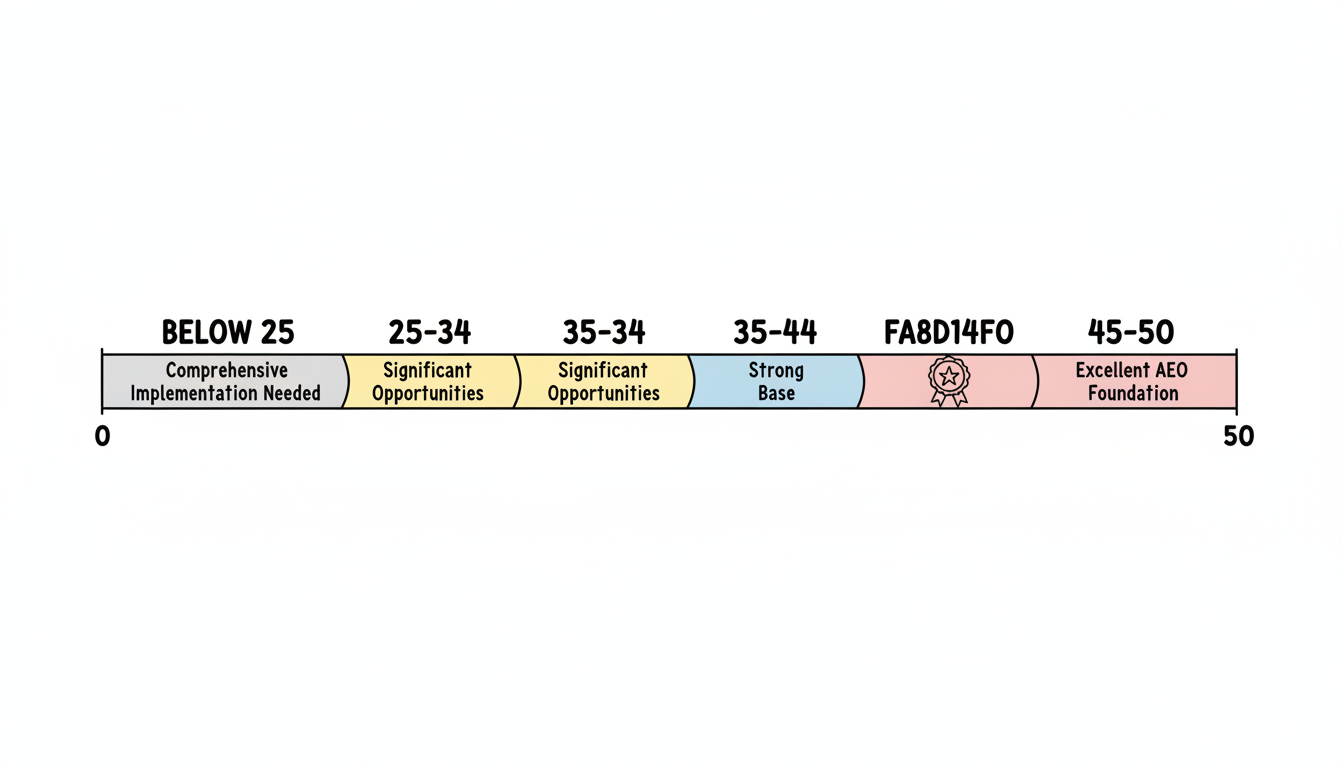
Score Interpretation:
- 45-50 points: Excellent AEO foundation—focus on refinement
- 35-44 points: Strong base—address specific gaps
- 25-34 points: Significant opportunities—prioritize high-impact items
- Below 25 points: Comprehensive implementation needed—start with critical priorities
Common Implementation Mistakes
Skipping technical basics: Content optimization fails if crawlers can't access pages. Always verify crawler access first.
Inconsistent execution: Partially implementing structured data or sporadic content updates reduce effectiveness. Complete implementations fully.
Neglecting measurement: Without tracking, you can't identify what works. Before optimization, conduct a comprehensive AEO content audit to establish baselines.
Optimizing low-value content: Focus on high-traffic, commercially important pages first rather than comprehensive but unfocused optimization.
Ignoring platform differences: ChatGPT, Perplexity, and Google AI Overviews have different preferences. Many organizations now use a generative engine optimization tool to monitor all platforms consistently.
Using This Checklist Effectively
Initial audit: Work through all 50+ points documenting current state. Calculate baseline score.
Prioritization: Use the priority matrix to sequence improvements based on impact and available resources.
Implementation sprints: Address items in focused 2-week sprints rather than scattered efforts. When implementing structured markup, prioritize AEO schema markup that directly supports answer extraction.
Progress tracking: Re-assess monthly. Track score improvements and citation changes.
Continuous refinement: AI algorithms evolve constantly. Schedule quarterly content audits to update statistics, refresh examples, and add new checklist items as AI search evolves. Freshness signals matter—both traditional search engines and LLMs favor recently updated content. Review this checklist quarterly for new requirements as the relationship between SEO and generative AI continues to evolve.
FAQs
How Long Does Full Checklist Implementation Take?
Comprehensive implementation typically requires 60-90 days for organizations with existing content foundations. Technical fixes can complete within days; authority building takes months.
Which Items Deliver Fastest Results?
Crawler access configuration (items 1-6) and answer optimization (items 13-16) often show results within 2-4 weeks as AI systems process changes.
Can Small Teams Complete This Checklist?
Yes. Prioritize critical and high-priority items first. Small teams can achieve 35+ scores focusing on highest-impact factors before comprehensive implementation.
Should We Address All 50 Points Before Expecting Results?
No. Results typically begin appearing after addressing critical and high-priority items. Comprehensive completion accelerates and sustains visibility improvements.
What Is the Difference Between AEO and GEO?
AEO (Answer Engine Optimization) focuses on making your content the direct, cited answer in AI-powered search results like Google AI Overviews, ChatGPT, and Perplexity. GEO (Generative Engine Optimization) is the broader discipline of influencing how generative AI models represent your brand across all outputs. AEO is a subset of GEO, targeting citation-worthy answer positioning specifically.
How Do I Optimize Content for Voice Search and Answer Engines?
Write in natural, conversational language that mirrors how people speak. Structure answers in 40-60 word blocks directly below question-based H2/H3 headers. Target long-tail question phrases like "how do I" and "what is the best." Add LocalBusiness schema for local voice queries and ensure your NAP data is consistent across all platforms.
What Tools Can I Use to Track AEO Performance?
Use Google Search Console to monitor featured snippet and People Also Ask appearances. Semrush and Moz track SERP feature ownership and domain authority. For AI-specific tracking, manually test your target queries in ChatGPT, Perplexity, and Claude to verify whether your content is cited. Track citation frequency monthly to measure AEO progress over time.
Why Does EEAT Matter for Answer Engine Optimization?
LLMs are designed to minimize hallucination by citing trustworthy sources. Google's EEAT framework (Experience, Expertise, Authoritativeness, Trustworthiness) directly aligns with how AI systems evaluate content credibility. Pages demonstrating first-hand experience, expert authorship, authoritative backlinks, and factual accuracy are significantly more likely to be selected as AI citation sources.