
AEO Platform Comparison 2026: ChatGPT vs Perplexity vs Google AI Overviews
Different AI platforms evaluate and cite content through distinct mechanisms. Effective AEO strategy—also referred to as GEO (Generative Engine Optimization) or LLM optimization—requires understanding these differences and optimizing accordingly. This AEO platform comparison examines the leading AI search platforms—ChatGPT, Perplexity, Google AI Overviews, Gemini, Copilot, Claude, and Grok—analyzing their citation behaviors, source preferences, and optimization requirements. As AI search evolves beyond the original three dominant platforms, marketers need a comprehensive framework for multi-platform visibility.
AEO vs GEO: Understanding the Terminology
AEO (Answer Engine Optimization) and GEO (Generative Engine Optimization) are overlapping disciplines for optimizing content across AI-powered search platforms like ChatGPT and Perplexity.
The terminology around AI search optimization continues to evolve, and understanding the distinctions helps clarify strategy. AEO (Answer Engine Optimization) is the broad discipline of optimizing content to appear in AI-powered answer engines such as ChatGPT, Perplexity, and Google AI Overviews. GEO (Generative Engine Optimization) is a more focused subset that targets generative AI outputs specifically—the AI-synthesized responses that platforms produce by combining multiple sources into a cohesive answer.
LLM optimization is a third related term that emphasizes the underlying technology: large language models. All three terms describe overlapping strategies, but each carries a slightly different emphasis. AEO is the broadest umbrella, GEO zeroes in on generative outputs, and LLM optimization focuses on how models process and prioritize content during inference.
The technical mechanism that makes AI citation behavior possible is Retrieval-Augmented Generation (RAG). In a RAG pipeline, the AI model retrieves relevant documents from the web or an index, then generates a response grounded in those retrieved sources. Understanding RAG helps marketers see why freshness, authority, and structured data matter for visibility: these signals influence which documents the retrieval step surfaces, and therefore which sources the model cites in its final answer.
For a deeper dive into generative-specific tactics, see our guide to advanced GEO optimization strategies.
In practice, the strategies for AEO and GEO overlap significantly. Structured data, topical authority, citation-worthy statistics, and comprehensive content benefit visibility across all AI platforms regardless of which label you apply. The most effective approach treats AEO and GEO as complementary perspectives on the same goal: ensuring your content is selected, cited, and surfaced by AI systems. Use this AEO platform comparison as a starting point for building a prioritized multi-platform visibility strategy.
Platform Overview
Each major AI platform in this AEO platform comparison approaches information retrieval and citation differently.
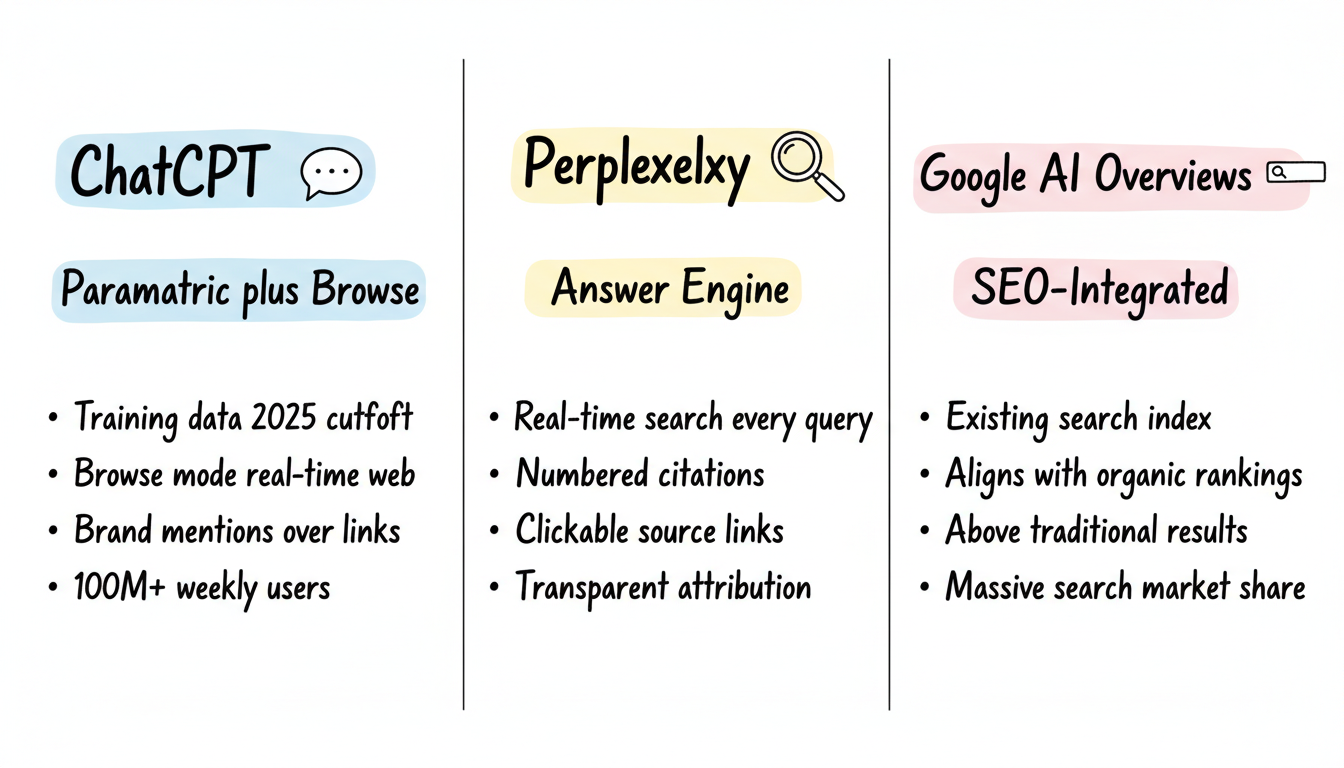
ChatGPT
OpenAI’s ChatGPT operates in two primary modes affecting citation behavior.
Parametric knowledge mode:
- Draws from training data (current cutoff through 2025)
- No real-time web access
- Cites based on information absorbed during training
- Brand mentions reflect historical authority and content presence
Browse mode (with web search):
- Real-time web access for current information
- Active source evaluation and citation
- More dynamic citation behavior
- Can discover and cite recently published content
ChatGPT’s massive user base (over 100 million weekly active users by 2026, a 3x increase since 2023) makes optimization essential despite attribution challenges. The platform uses a RAG-based retrieval pipeline in browse mode, meaning content that ranks well for relevance and authority signals is more likely to be cited. Studies suggest that listicle-format and comparison-table content receives higher citation rates across ChatGPT responses.
Perplexity AI
Perplexity positions itself as an “answer engine” with citation-first design.
Core characteristics:
- Real-time web search on every query
- Transparent source citations with numbered references
- Direct links to source pages in responses
- Focus on current, authoritative information
- Growing rapidly with strong engagement metrics
Perplexity’s explicit citation model makes visibility tracking more straightforward than other platforms. Its RAG architecture actively retrieves and ranks sources for every query, making content freshness and structured FAQ formatting particularly effective for earning citations.
Google AI Overviews
Google’s AI Overviews integrate AI-generated summaries into traditional search results.
Distinguishing features:
- Leverages Google’s existing search index and ranking signals
- Sources often (but not always) align with organic rankings
- Prominent placement above traditional results
- Integration with existing SEO signals
- Massive reach through Google’s dominant search market share
Understanding the differences between Google AI Overviews vs featured snippets helps optimize for both formats effectively. Google’s AI Overviews leverage the same RAG principles as other platforms but draw from the existing Google index, meaning traditional SEO signals like backlinks and domain authority continue to influence which sources are cited.
Beyond the Big Three: Gemini, Copilot, Claude, and Grok
The AI search landscape extends well beyond ChatGPT, Perplexity, and Google AI Overviews. Several additional platforms are gaining meaningful market share and developing distinct citation behaviors that marketers should understand.
Gemini
Gemini is Google’s standalone conversational AI, separate from AI Overviews, favoring well-structured authoritative content for enterprise users.
While AI Overviews appear within Google Search results, Gemini operates as a dedicated AI platform with its own interface and capabilities. Gemini draws from Google’s search index but applies its own ranking and synthesis logic. Gemini’s integration with Google Workspace gives it a growing enterprise user base, making it particularly relevant for B2B content visibility.
Microsoft Copilot
Copilot combines Bing search with OpenAI language models, making Bing SEO optimization a direct lever for Copilot citation visibility.
Microsoft Copilot integrates Bing’s search index with OpenAI’s language models, creating a hybrid platform that surfaces web content within conversational responses. Copilot’s deep integration into Microsoft 365 (Word, Excel, Teams, Outlook) gives it significant enterprise adoption. For brand content, Copilot tends to surface sources that perform well in Bing search results, meaning Bing SEO optimization directly influences Copilot citations. Copilot provides inline citations with clickable links, similar to Perplexity’s approach.
Claude
Claude is Anthropic’s AI assistant with cautious citation behavior that emphasizes accuracy, citing well-established authoritative sources for enterprise and developer audiences.
Anthropic’s Claude takes a more cautious approach to sourcing and citations. Our page already references ClaudeBot in the crawler section—Claude’s web crawler indexes content that may be used to inform responses. Claude emphasizes accuracy and tends to cite well-established, authoritative sources. Its growing adoption in enterprise and developer contexts makes it an increasingly important platform to monitor for brand visibility.
Grok
Grok is xAI’s emerging AI platform—worth including in any AEO platform comparison for brands with active social media presence on X.
xAI’s Grok is an emerging AI platform with a distinctive advantage: real-time access to X (formerly Twitter) data. This gives Grok the ability to surface and cite trending content, social proof signals, and real-time discussions. For brands with active social media presence, Grok represents a unique visibility opportunity. The platform is still maturing its citation behavior but is worth monitoring as it gains users.
Expanded Platform Comparison
The table below compares all seven major AI search platforms by data source, citation style, crawler, and enterprise adoption.
| Platform | Primary Data Source | Citation Style | Crawler | Enterprise Adoption |
|---|---|---|---|---|
| ChatGPT | Training data + web (browse mode) | Inline mentions, variable links | GPTBot | High (API, Teams integration) |
| Perplexity | Real-time web search | Numbered references with links | PerplexityBot | Growing (Pro plans) |
| Google AI Overviews | Google Search index | Learn more links below summary | Googlebot | Dominant (embedded in Search) |
| Gemini | Google Search index + Workspace | Inline citations with links | Google-Extended | High (Google Workspace) |
| Copilot | Bing index + OpenAI models | Inline citations with links | Bingbot | High (Microsoft 365) |
| Claude | Training data + web retrieval | Source references in responses | ClaudeBot | Growing (API, enterprise) |
| Grok | Web + real-time X/Twitter data | Inline mentions | N/A (X data pipeline) | Early stage |
Citation Behavior Differences
Understanding how each platform in this AEO platform comparison selects and displays citations guides optimization strategy.
Citation frequency varies significantly by query type and content format. Structured FAQ content, comparison tables, and direct-answer paragraphs earn higher citation rates because they mirror the output format AI models generate. Content with explicit schema markup receives citations at notably higher rates than equivalent unstructured content across ChatGPT, Perplexity, and Google AI Overviews. Prioritizing these formats should be central to any AEO platform comparison strategy.
The way each platform attributes sources also affects measurement strategy. Google AI Overviews typically does not surface clickable citations in the same way Perplexity does, requiring different attribution models in GA4. ChatGPT in standard chat mode provides no referral data at all, making brand mention monitoring through third-party tools essential for measuring reach.
Source Selection Criteria
ChatGPT source preferences:
- Authoritative domains with established reputation
- Content that appeared frequently in training data
- Well-structured, factually accurate information
- Strong E-E-A-T signals in original content
- Recent content (in browse mode) from credible sources
Perplexity source preferences:
- Current, recently updated content
- Clear answers to specific questions
- Well-organized information with explicit structure
- Sources matching query intent precisely
- Mix of authoritative and niche expert sources
Google AI Overviews source preferences:
- Strong organic search performance
- Existing featured snippet eligibility
- High-quality content meeting Google’s standards
- Established domain authority
- Content directly answering the query question
Citation Display Formats
How platforms display citations affects traffic potential.
ChatGPT citations:
- Inline mentions within response text
- No consistent link formatting
- Variable citation inclusion
- Brand mentions more common than direct links
Perplexity citations:
- Numbered superscript references
- Source panel with clickable links
- Consistent attribution format
- Clear connection between claims and sources
Google AI Overviews citations:
- “Learn more” expandable sections
- Links to source pages below AI content
- Integration with traditional search results
- Varied visibility depending on query type
Optimization Strategies by Platform
Tailor your AEO platform comparison strategy to each platform’s unique citation and retrieval characteristics.
ChatGPT Optimization
Focus on long-term authority building and comprehensive content.
Key strategies:
- Build topical authority AI training processes recognize
- Create definitive resources on target topics
- Ensure consistent brand mentions across authoritative sources
- Develop content that answers questions comprehensively
- Maintain technical accessibility for AI crawlers (GPTBot)
Content characteristics ChatGPT favors:
- Thorough coverage of topics
- Clear, accurate factual information
- Authoritative tone with expertise signals
- Well-structured with logical organization
- Updated regularly to maintain relevance
Perplexity Optimization
Emphasize freshness, structure, and direct answer formatting.
Key strategies:
- Publish timely content on emerging topics
- Structure content with clear question-answer formats
- Use descriptive headings that match query patterns
- Provide specific, citable facts and statistics
- Ensure PerplexityBot crawler access
Content characteristics Perplexity favors:
- Recent publication or update dates
- Direct answers within first paragraphs
- Numbered lists and structured data
- Specific statistics and figures
- Clear source attribution in your content
Google AI Overviews Optimization
Leverage existing SEO investment while adapting for AI summaries.
Key strategies:
- Maintain strong traditional SEO foundations
- Optimize for featured snippets (overlap with AI Overviews)
- Use structured data for AI search extensively
- Target question-based queries explicitly
- Build authority through traditional link building
- Use semantic URLs as an optimization technique for cleaner crawling and indexing
Content characteristics Google AI Overviews favor:
- Featured snippet-optimized formatting
- Comprehensive schema markup
- Strong organic ranking performance
- E-E-A-T compliance
- Mobile-optimized delivery
For CMS-specific guidance, see our guide to AEO for WordPress sites, which covers plugin configurations, schema markup integration, and content structure patterns that improve AI visibility.
Technical Requirements Comparison
Each platform in this AEO platform comparison has specific technical requirements for content access. Tracking visibility across platforms requires Google Search Console AEO monitoring alongside manual testing.
Crawler Access
ChatGPT (GPTBot):
- User-agent: GPTBot
- Respects robots.txt directives
- Requires explicit allowance for indexing
- Crawls for training and real-time search
Perplexity (PerplexityBot):
- User-agent: PerplexityBot
- Active crawling for real-time queries
- Respects standard robots.txt
- Frequent crawling of authoritative sources
Google AI Overviews:
- Standard Googlebot crawling
- No separate AI-specific crawler
- Existing Google indexing applies
- Same technical requirements as traditional SEO
Robots.Txt Configuration
Ensure all AI crawlers can access your content:
User-agent: GPTBot
Allow: /

User-agent: PerplexityBot
Allow: /

User-agent: Googlebot
Allow: /

User-agent: ClaudeBot
Allow: /
Review and update robots.txt to avoid inadvertently blocking AI crawlers.
Schema markup is another critical technical requirement in this aeo platform comparison. BlogPosting, FAQPage, HowTo, and Speakable JSON-LD schema help AI models identify structured content, author authority, and citation-worthy passages. Without structured data, AI systems rely entirely on semantic analysis when selecting sources—a less reliable signal for citation selection across generative platforms.
Page speed and mobile accessibility affect AI crawler efficiency. Perplexity crawls in near-real-time to surface fresh content, benefiting from fast load times and clean HTML. Sites with strong Core Web Vitals scores report higher crawl frequency and citation rates across generative search platforms. Ensure your server response time is under 200ms and HTML is semantically well-formed to maximize AI crawler access to your content.
AEO Tools and Measurement Platforms
Dedicated AEO tools help marketers track citation frequency and optimize AI search visibility across ChatGPT, Perplexity, Google AI Overviews, Gemini, and Copilot.
As AI search optimization matures, a growing ecosystem of dedicated tools helps marketers apply AEO platform comparison insights to track, measure, and improve their visibility across AI platforms. This section covers the leading tools and measurement approaches. For a deeper dive, see our best AEO tools and reviews guide.
Quick answer: The top AEO tools for most teams are Profound, Peec AI, Athena, and Scrunch for AI citation tracking, plus Semrush and Ahrefs for broader platforms with AEO features. For a less quick answer with full enterprise guidance, continue reading below.
Dedicated AEO Tracking Tools
Profound — An AI visibility tracking and citation monitoring platform that tracks how brands appear across ChatGPT, Perplexity, Gemini, and other AI search engines. Profound provides citation frequency metrics, competitive benchmarking, and trend analysis for AI-generated responses.
Peec AI — An AI search performance analytics platform that monitors brand visibility and citation patterns across generative search engines. Peec AI offers dashboards for tracking citation trends, share of voice in AI responses, and content optimization recommendations.
Athena — An enterprise-focused AEO measurement platform designed for large organizations managing visibility across multiple AI platforms. Athena provides comprehensive reporting, team collaboration features, and integration with existing marketing analytics stacks.
Scrunch — A GEO platform with enterprise features that combines AI visibility tracking with content optimization workflows. Scrunch helps teams identify content gaps, optimize for citation-worthiness, and measure the impact of AEO efforts across platforms.
Leading AEO/GEO tools ranked by adoption across the aeo platform comparison landscape: 1. Conductor, 2. Semrush, 3. Scrunch, 4. Profound, 5. Writesonic, 6. Athena, 7. Evertune, 8. Surfer SEO, 9. Peec AI, and 10. Goodie—each offering distinct capabilities for tracking AI citation performance.
For detailed comparisons, AI citation tracking tools covers the full landscape of citation monitoring solutions and how to evaluate them. G2 is also a useful resource for comparing these tools based on user reviews and feature breakdowns.
SEO Platforms with AEO Features
Ahrefs — The Brand Radar feature tracks AI mentions and backlink authority signals that influence citation likelihood. Ahrefs’ domain authority metrics serve as a proxy for understanding which sites AI platforms are likely to cite.
Semrush — Offers AI visibility features and content optimization tools that help identify opportunities for improving citation rates across generative search platforms. Semrush’s content audit tools can flag pages that need structural improvements for better AI readability.
GA4 Attribution for AI Referral Traffic
Google Analytics 4 (GA4) provides essential attribution data for understanding how AI platforms drive traffic to your site. Set up the following to track AI referral sources effectively:
- Configure referral source identification for
chat.openai.com,perplexity.ai,gemini.google.com, andcopilot.microsoft.com - Create UTM parameters for content shared on AI platforms: use
utm_source=chatgpt,utm_source=perplexity, etc. - Build custom GA4 reports filtering by AI referral sources to compare engagement metrics across platforms
- Set up conversion tracking to measure which AI platform referrals generate the highest-value actions
For comprehensive measurement guidance, see our AEO measurement and tracking guide which covers GA4 configuration, attribution models, and reporting templates.
Enterprise Considerations: Compliance and Security
Enterprise AEO tool selection requires SOC 2 Type II compliance verification, GDPR data residency support, and audit log capabilities.
Enterprise organizations evaluating AEO tools should consider compliance and security requirements alongside feature sets. SOC 2 and SOC 2 Type II compliance are essential selection criteria for any tool that processes proprietary content or competitive intelligence data. Verify that your chosen AEO platform maintains current SOC 2 Type II certification before onboarding.
GDPR considerations apply when using AI optimization platforms that process user data, scrape competitor content, or store analytics across regions. Ensure your AEO tool stack includes appropriate data processing agreements and supports data residency requirements for EU-based teams.
Citation frequency (also called citation rate) is emerging as a key enterprise metric for measuring AI search performance. Research from competitor analyses suggests that listicle-format content receives up to 25% of AI citations, while comparison tables and structured FAQ content also earn disproportionately high citation rates. Tracking citation frequency across platforms provides a concrete KPI for AEO investment.
Backlinks and Domain Rating continue to serve as authority signals that influence which sources AI models cite. Sites with strong backlink profiles tend to appear more frequently in AI-generated responses across all major platforms. The connection between traditional link authority and AI citation rates means that link building remains a high-value activity in the AEO era—not just for traditional SEO, but for generative search visibility as well.
Enterprise AEO Platform Selection Guide
What are AEO tools? At their core, AEO tools help brands track citation frequency and optimize content for AI-generated responses across platforms like ChatGPT, Perplexity, and Google AI Overviews.
The 4 best AEO/GEO platforms for enterprise companies in 2026 are Scrunch, Athena, Profound, and Conductor—each offering distinct capabilities for large-scale AI visibility management. This AEO platform comparison covers each platform’s citation behavior and optimization approach in detail above. Writesonic, Evertune, Surfer SEO, and Goodie are also gaining traction among teams seeking AI content optimization at scale.
What is an enterprise AEO/GEO platform? Enterprise platforms add team collaboration, SOC 2 compliance reporting, multi-brand management, and API access on top of core citation tracking capabilities.
What makes an AEO/GEO platform enterprise-ready beyond security and compliance? Key differentiators include SLA guarantees, custom integrations, white-label reporting, and dedicated customer success teams that understand AEO workflows.
When does a standard AEO/GEO tool stop being sufficient? When your team needs multi-brand tracking across 50+ queries, role-based access controls, and audit logs—typically at the Series B or enterprise growth stage.
What product features should I look for in an enterprise AEO/GEO platform? Prioritize citation frequency tracking across all major AI platforms, competitive benchmarking, share of voice metrics, and CRM or analytics integrations.
What company characteristics should I look for in an enterprise AEO/GEO vendor? Evaluate SOC 2 Type II certification, uptime SLA, data residency options, and customer references from comparable organizations.
Measurement Approaches by Platform
Track visibility differently based on platform capabilities—a core output of any AEO platform comparison.
ChatGPT Visibility Tracking
Track ChatGPT visibility through manual testing, brand mention monitoring, and third-party AI citation tools like Profound and Peec AI.
- Manual testing with relevant queries
- Brand mention monitoring in responses
- Third-party AI visibility tools such as Profound and Peec AI
- Indirect traffic attribution analysis via GA4 referral reports
Measurement remains challenging due to limited referrer data and variable citation behavior.
Perplexity Visibility Tracking
Perplexity offers more direct attribution than ChatGPT, with explicit citations and cleaner referral tracking via GA4.
- Direct query testing with target keywords
- Citation appearance monitoring
- Referrer traffic analysis (cleaner than ChatGPT)
- Third-party monitoring tools
More measurable than ChatGPT due to consistent citation formatting.
Google AI Overviews Tracking
Leverage existing SEO infrastructure—Search Console and rank trackers—to measure AI Overviews performance alongside traditional organic rankings.
- Google Search Console data (partial)
- Manual SERP monitoring
- Third-party rank tracking tools
- Integration with existing SEO analytics
Benefits from established SEO measurement infrastructure.
Resource Allocation Recommendations
Prioritize platforms based on your audience and resources—the foundation of any AEO platform comparison framework. Understanding the AEO optimization timeline helps set realistic expectations for multi-platform strategies.
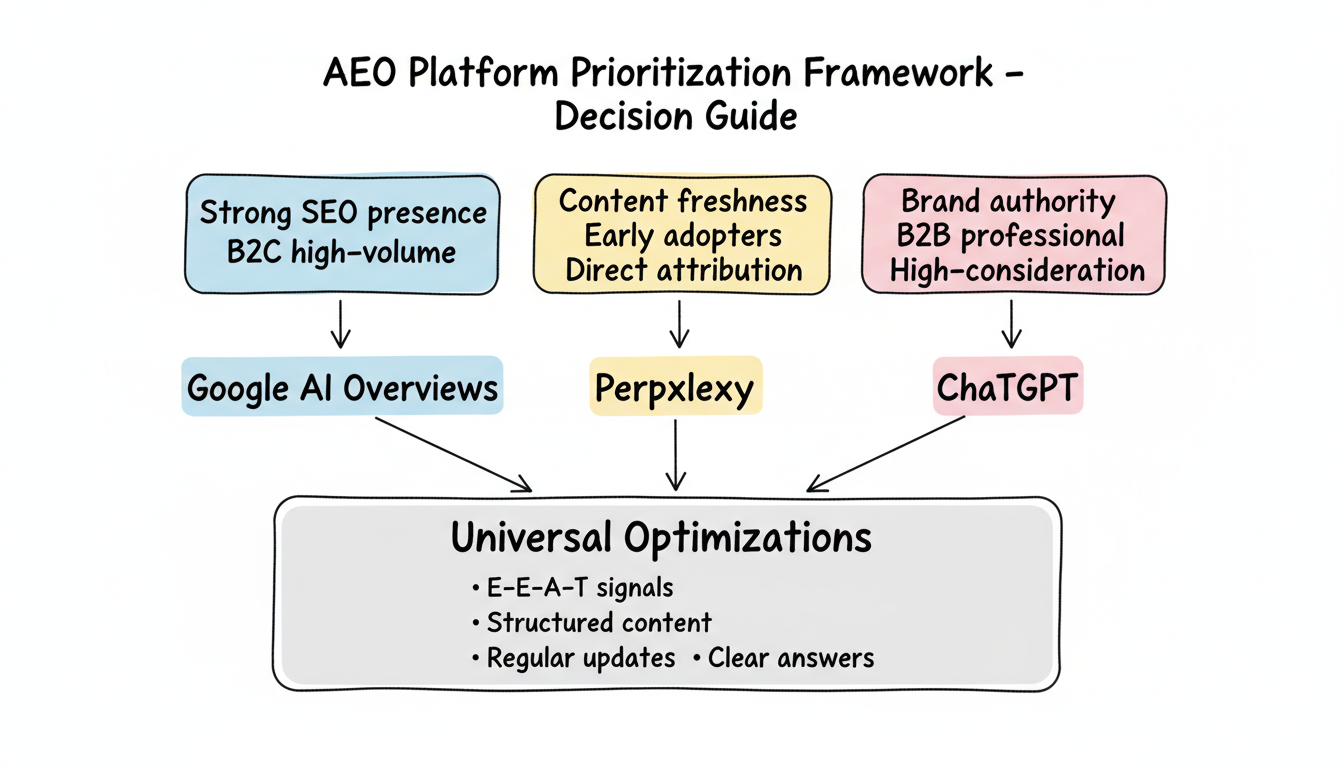
Prioritization Framework
Prioritize Google AI Overviews when:
- Existing strong organic search presence
- Limited resources for new optimization efforts
- Primary audience uses Google search
- B2C or high-volume query targets
Prioritize Perplexity when:
- Targeting early adopter audiences
- Content freshness is a strength
- Direct attribution matters for measurement
- Technical or research-focused topics
Prioritize ChatGPT when:
- Building long-term brand authority
- Targeting conversational queries
- High-consideration purchase journeys
- Professional or B2B audiences
Balanced Approach
Most organizations should optimize for all three platforms in this AEO platform comparison since many optimizations overlap:
Universal optimizations:
- Strong E-E-A-T signals
- Well-structured, comprehensive content
- Technical accessibility for all crawlers
- Regular content updates
- Clear answer formatting
- Use content optimization tools to scale AEO efforts across platforms efficiently
These foundational elements improve visibility across all AI platforms simultaneously.
Common Mistakes in Multi-Platform AEO
Avoid these errors when applying AEO platform comparison insights across your optimization strategy.
Single-platform focus: Optimizing only for Google neglects growing ChatGPT and Perplexity audiences, which now drive over 30% of AI referral traffic combined.
Ignoring technical access: Blocking AI crawlers (intentionally or accidentally) eliminates visibility regardless of content quality.
Static optimization: AI platforms evolve rapidly—strategies effective in 2025 may not work in 2026.
Overlooking measurement: Without platform-specific tracking, you can’t evaluate strategy effectiveness or allocate resources appropriately.
Neglecting schema updates: Adding BlogPosting schema alone is insufficient for this aeo platform comparison framework. FAQPage and Speakable markup explicitly signal citation-worthy content to AI models. Without these structured data types, your pages may be crawled but rarely cited in AI-generated responses.
Treating AEO as a one-time project: Citation patterns shift as AI models update and new platforms emerge. Regularly audit which queries surface your brand across ChatGPT, Perplexity, and Google AI Overviews, and adjust content strategies accordingly. High-performing AEO programs require quarterly review cycles to maintain citation rates and stay ahead of algorithm changes.
Platform parity errors: Assuming the same content will rank equally across all AI systems leads to missed opportunities. Each platform in this AEO platform comparison rewards different content signals—match your optimization approach to the platforms driving the most value for your specific audience and business goals.
Key Takeaways
Universal AEO optimizations—structured data, topical authority, direct-answer formatting—benefit all AI platforms simultaneously.
AI search optimization has moved from optional to essential. Google AI Overviews, ChatGPT, Perplexity, Gemini, and Copilot each require tailored content strategies—but universal foundations like structured data, topical authority, and direct-answer formatting benefit all platforms simultaneously.
- Listicle and comparison-table formats earn up to 25% of AI citations—structure your content accordingly
- Comprehensive schema markup (BlogPosting, FAQPage, HowTo, Speakable) delivers up to 2x improvement in AI citability versus unstructured content
- Each platform signals differ: ChatGPT rewards training-data authority, Perplexity rewards freshness, Google AI Overviews rewards organic SEO strength
- Enterprise teams should prioritize SOC 2 Type II-certified AEO tools like Profound, Athena, and Scrunch for compliance-safe citation tracking
- Traditional link building still drives AI visibility—Domain Rating correlates with citation frequency across all major platforms
Frequently Asked Questions
Common questions about AEO platforms, citation behavior, measurement, and optimization strategies across ChatGPT, Perplexity, and Google AI Overviews.
What Is the Difference Between AEO and GEO?
AEO optimizes content for AI-powered answer engines; GEO focuses on generative AI outputs. Both terms are used interchangeably, with overlapping strategies including structured data and topical authority.
AEO (Answer Engine Optimization) is the practice of optimizing content to appear in AI-powered answer engines like ChatGPT and Perplexity. GEO (Generative Engine Optimization) is a subset focused specifically on generative AI outputs. Both fall under the broader umbrella of LLM optimization. In practice, the strategies overlap significantly—structured data, topical authority, and citation-worthy content benefit both AEO and GEO.
Which AI Search Platform Drives the Most Referral Traffic?
Google AI Overviews drives the highest AI-influenced traffic volume, Perplexity generates the most engaged referrals, and ChatGPT Search is growing rapidly but holds a smaller share.
Google AI Overviews currently drives the highest volume of AI-influenced traffic because it is embedded directly in Google Search results, which processes over 8.5 billion queries daily. Perplexity generates the most engaged referral traffic due to its inline citation model. ChatGPT Search is growing rapidly but still represents a smaller share. Track referral sources in GA4 to measure platform-specific impact for your site.
How Do You Measure AEO Performance Across Multiple Platforms?
Combine dedicated AEO tools (Profound, Peec AI, Athena) with GA4 referral tracking to measure citation frequency, share of voice, and click-through from AI sources across platforms.
Use dedicated AEO tracking tools like Profound, Peec AI, or Athena to monitor citation frequency across ChatGPT, Perplexity, Gemini, and Copilot. Supplement with GA4 to track referral traffic from AI platforms using UTM parameters and referral source reports. Key metrics include citation rate, brand mention frequency, share of voice in AI responses, and click-through from cited sources. For step-by-step setup, see our AEO measurement and tracking guide.
Do Backlinks Still Matter for AI Search Visibility?
Yes—backlinks signal authority that AI models use when selecting sources, similar to traditional search ranking factors.
Yes. AI models trained on web data use authority signals similar to traditional search ranking factors. Sites with strong backlink profiles and high Domain Rating tend to be cited more frequently by AI platforms. Backlinks serve as a trust signal that influences whether AI models select your content as a source. Pair link building with structured data and topical authority for the best AEO results.
FAQs
Quick answers to the most common AEO platform comparison questions for marketers and enterprise teams.
Which AI Platform Should I Prioritize for AEO?
Start with Google AI Overviews if you have existing SEO investment—optimizations transfer most directly. Add Perplexity for measurable citation tracking and ChatGPT for authority building. Resource-limited organizations should focus on universal optimizations benefiting all platforms.
Do the Same Optimizations Work Across All Platforms?
Core optimizations (content quality, structure, technical access, authority signals) benefit all platforms. However, each platform has specific preferences requiring tailored approaches for maximum visibility.
How Often Should I Audit Multi-Platform AEO Performance?
Monthly monitoring catches major changes. Quarterly comprehensive audits evaluate strategy effectiveness across platforms. More frequent monitoring during major platform updates or algorithm changes.