
Not all schema types deliver equal value for AI visibility. Strategic schema implementation prioritizes types that align with how AI systems extract and cite content. This guide provides a decision framework for choosing which schema to implement first based on your content, industry, and AEO goals.
How AI Platforms Consume Schema Markup
Different AI platforms parse structured data for AI search in distinct ways, making it essential to understand each platform's preferences before prioritizing your schema implementation.
ChatGPT uses schema to identify authoritative entities and extract factual claims. It shows a strong preference for Organization, Person, and FAQPage schema when determining which sources to cite in conversational responses.
Perplexity crawls and indexes schema to build source citations. Speakable and Article schema improve the likelihood that your content appears as a cited source in Perplexity's answer summaries.
Google AI Overviews pulls from Knowledge Graph entries enriched by schema markup. Organization and LocalBusiness schema directly feed entity panels that AI Overviews reference when generating answers.
Claude leverages structured data for context grounding when processing web content, using schema properties to establish entity relationships and factual accuracy.
Research shows a 36% improvement in citation rates for sites with comprehensive schema versus those without structured data implementation. With 43% of consumers now regularly using AI search tools, the urgency for schema optimization continues to grow.
Schema Prioritization Framework
Implement schema in order of impact rather than complexity or tradition. Schema markup serves as the primary mechanism for feeding the Knowledge Graph and Content Knowledge Graphs used by AI systems. AI platforms use Named Entity Recognition (NER) and entity linking to map schema properties to known entities, making strategic prioritization essential for maximizing your visibility across platforms like ChatGPT and Perplexity.
Schema Markup and the Knowledge Graph
Schema markup is the primary mechanism for feeding the Knowledge Graph and Content Knowledge Graphs used by AI systems. AI platforms use Named Entity Recognition (NER) and entity linking to map schema properties to known entities in their knowledge bases.
The semantic web vision is now being realized through AI systems that perform semantic search across structured data. Emerging paradigms like the Agentic Web and NLWeb enable AI agents to interact with web content through protocols like MCP (Model Context Protocol), where structured data serves as the foundation for machine-to-machine communication.
Organizations that invest in comprehensive Knowledge Graph optimization through schema markup see up to 300% performance improvement in entity recognition accuracy. This is precisely why the tier prioritization framework below matters -- higher tiers feed more critical entity recognition pathways that AI systems rely on when generating answers.
Decision criteria:
Factor | Weight | Why It Matters |
Query alignment | High | Schema matching AI query patterns get cited |
Content coverage | High | Schema for content you actually have |
Industry fit | Medium | Some schema types matter more by sector |
Implementation effort | Low | Don't let difficulty delay high-impact types |
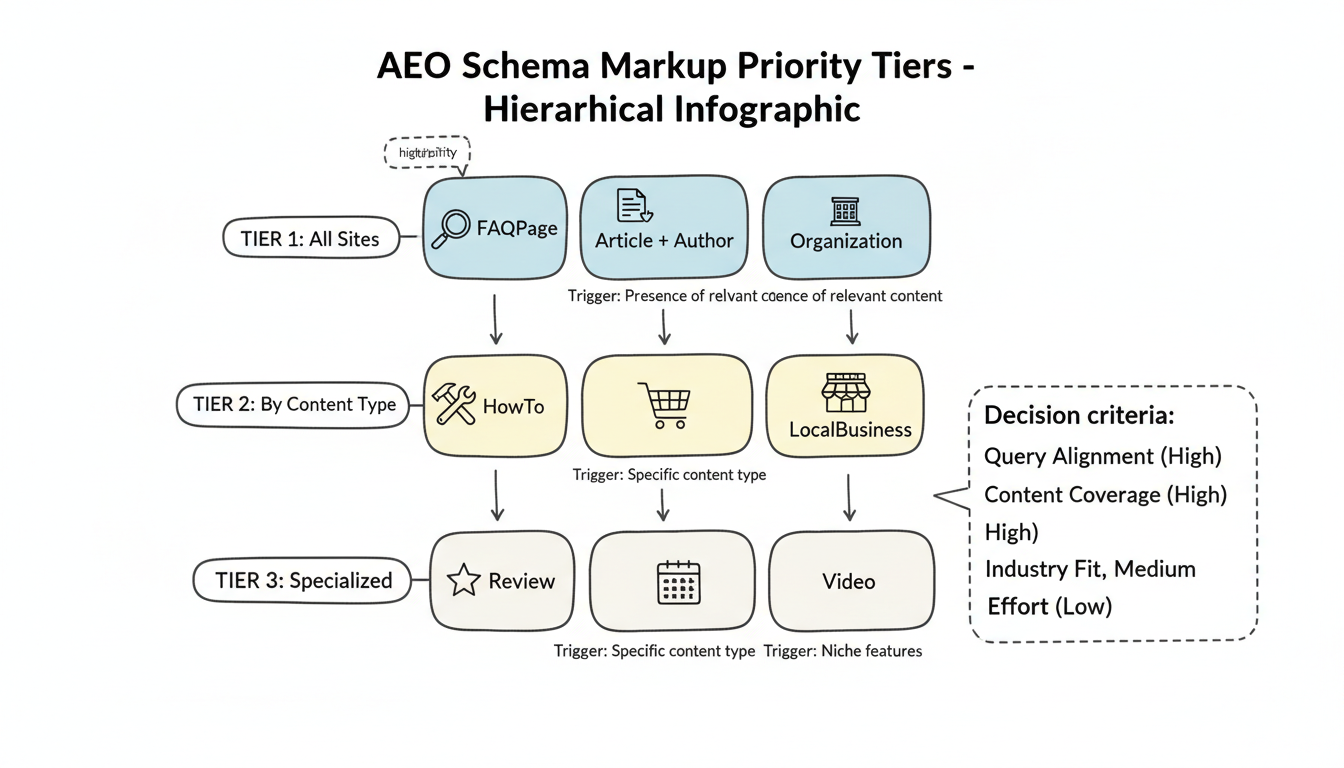
Tier 1: Implement First (All Sites)
These schema types form the foundation for AEO across all industries.
Faqpage Schema
Priority: Critical for all sites
FAQPage directly mirrors how users query AI systems. When someone asks ChatGPT "How does X work?", AI systems search for Q&A formatted content.
When to prioritize:
- You have any FAQ or Q&A content
- Your site answers common questions
- Users frequently ask questions before converting
Implementation priority:
- Service/product pages with FAQ sections
- Help center and support content
- Category pages addressing common questions
Impact measurement: Track citation frequency for FAQ-schema pages versus non-schema pages covering similar topics.
Article Schema with Author
Priority: Critical for content-producing sites
Article schema with comprehensive author attribution supports E-E-A-T signals. AI systems evaluate source authority when selecting citations.
When to prioritize:
- Publishing blog posts, guides, or educational content
- Authors have expertise credentials worth highlighting
- Building thought leadership positioning
Key fields that matter:
Field | Impact Level | Notes |
author.name | High | Required for attribution |
author.url | High | Links to author page with credentials |
author.jobTitle | Medium | Establishes expertise |
dateModified | Medium | Recency signal |
publisher.name | Medium | Organizational authority |
Organization Schema
Priority: Foundation for brand recognition
Organization schema helps AI systems identify and correctly attribute your brand across mentions. Organization schema directly feeds the Knowledge Graph, making it one of the most impactful types for establishing your brand as a recognized entity in AI systems.
When to prioritize:
- Homepage (required)
- About page
- Contact page
Key fields:
- name (exact brand name)
- url (canonical domain)
- logo
- sameAs (social profiles, Wikipedia, LinkedIn, and other authoritative profiles for brand entity consistency)
Use the sameAs property to link to your Wikipedia page, LinkedIn company profile, and other authoritative sources to establish brand entity consistency across platforms. For businesses with multiple locations, combine Organization schema with LocalBusiness for comprehensive multi-location markup coverage.
Tier 2: Implement Second (Based on Content Type)
After Tier 1, prioritize based on your actual content types.
Howto Schema
Priority: High for procedural content
HowTo schema aligns with step-based queries that AI systems frequently receive.
When to prioritize:
- Tutorial and guide content
- Documentation and instructions
- Process-oriented service pages
Best practices for AEO:
- Keep steps clear and numbered
- Each step should be independently understandable
- Include time estimates where applicable
Product Schema
Priority: High for e-commerce
Product schema helps AI systems cite your products in purchase-oriented queries.
Key fields for AEO:
Field | Why It Matters |
name | Product identification in citations |
description | AI extraction for product queries |
offers.price | Price comparison queries |
aggregateRating | Trust signal for recommendations |
brand | Brand-specific query matching |
Implementation note: Product schema matters most when AI systems recommend products. If your products are B2C and searchable, prioritize this highly.
Localbusiness Schema
Priority: High for local services
LocalBusiness schema drives AI citations for location-based queries when implementing a comprehensive local AEO optimization strategy.
When to prioritize:
- Physical business locations
- Service areas you target
- Local search visibility matters
Key fields:
- address (complete, consistent format)
- openingHours
- areaServed
- hasOfferCatalog (services offered)
Tier 3: Implement Third (Specialized Content)
These schema types serve specific content scenarios.
Review Schema
Priority: Medium (depends on content type)
Review schema supports AI citation when users ask for opinions and recommendations.
When to prioritize:
- Publishing product/service reviews
- Comparison content
- Recommendation-oriented articles
Important: Only use Review schema for actual reviews, not for testimonials about your own services (different schema type).
Event Schema
Priority: Medium (event-based businesses)
Event schema drives citations for "when" and "where" queries.
When to prioritize:
- Hosting or listing events
- Conference and webinar content
- Recurring programs or classes
Videoobject Schema
Priority: Growing importance
VideoObject schema (the correct Schema.org type name) becomes increasingly relevant as AI systems incorporate video content. Including the transcript property enables AI systems to index and cite video content directly, making your videos discoverable beyond traditional video search.
When to prioritize:
- Video content library
- Tutorial videos embedded in articles
- Video as primary content format
Key fields for AI visibility: name, description, thumbnailUrl, uploadDate, transcript, and duration. Consider pairing VideoObject with Speakable schema to mark sections optimized for text-to-speech delivery by AI assistants.
Additional Schema Types for AI Visibility
Beyond the three-tier framework, several additional schema types are gaining importance for AI search visibility.
Person schema is critical for E-E-A-T signals. It links authors to their credentials, social profiles (LinkedIn, Wikipedia), and published works. Use the sameAs property to establish brand entity consistency across platforms, helping AI systems verify author expertise when evaluating content authority.
BlogPosting schema is more specific than Article for blog content. It includes datePublished, dateModified, author, and wordCount properties that AI systems use for freshness and depth scoring when selecting sources to cite.
Speakable schema marks content sections optimized for voice search optimization and text-to-speech delivery. This is increasingly relevant as AI assistants like ChatGPT, Perplexity, and Google AI Overviews read answers aloud to users.
Course schema serves educational and SaaS content with properties like provider, coursePrerequisites, and hasCourseInstance. AI systems surface course data when users ask about learning resources or professional development.
Offer schema enhances pricing pages and product comparisons, enabling rich snippets in both traditional and AI search results. When combined with Product schema, it provides comprehensive purchase-intent data that AI systems use for recommendation queries.
Note: JSON-LD remains the recommended format for schema implementation, though Microdata and RDFa are alternative structured data formats still in use on legacy systems. JSON-LD is preferred because it separates structured data from HTML markup, simplifying maintenance and reducing errors.
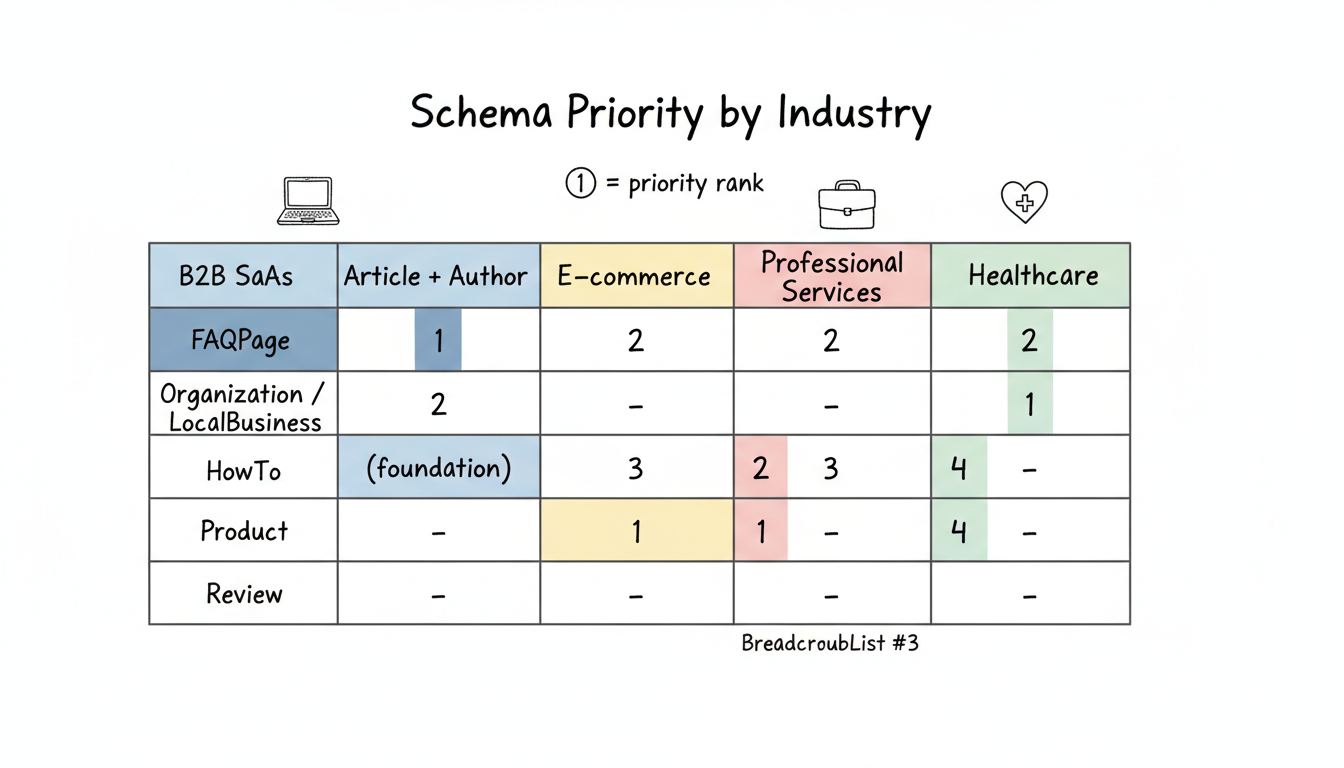
Industry-Specific Priorities
Different industries should weight schema types differently.
B2B SaaS
Priority order:
- FAQPage (addresses common questions)
- Article with Author (thought leadership)
- HowTo (documentation, guides)
- SoftwareApplication (if applicable)
- Course (for training and educational content -- a high-value addition for AEO for SaaS companies)
E-Commerce
Priority order:
- Product (primary content type)
- FAQPage (product questions)
- BreadcrumbList (navigation context)
- Review (product reviews)
- Offer and AggregateRating (for rich snippet eligibility and AI recommendation queries -- essential for AEO for e-commerce strategies)
Professional Services
Priority order:
- LocalBusiness or Organization
- FAQPage (service questions)
- Article with Author (expertise demonstration)
- Service (specific service offerings)
Healthcare/Medical
Priority order:
- Article with Author (critical for E-E-A-T)
- FAQPage (patient questions)
- MedicalWebPage (medical content specification)
- Organization (practice information)
- Person (for practitioner E-E-A-T signals -- linking physicians and specialists to their credentials, certifications, and published research)
Implementation Sequencing
Roll out schema implementation systematically.
Week 1-2: Foundation
- Organization schema on homepage
- Article schema on blog/content pages
- Basic FAQPage on high-traffic pages
Week 3-4: Expansion
- FAQPage across all FAQ content
- HowTo on procedural content
- Industry-specific types (Product, LocalBusiness, etc.)
Ongoing: Optimization
- Test schema variations
- Measure citation rates by schema type
- Expand to lower-priority content
Validation and Testing
Implement schema correctly to avoid errors that prevent AI extraction. Understanding how schema markup alignment with visible content ensures AI systems can properly extract and cite your information.
Testing tools:
- Google Rich Results Test (immediate validation)
- Schema.org Validator (specification compliance)
- Search Console Enhancement reports (live performance)
Common errors to avoid:
- Missing required fields
- Invalid JSON-LD syntax
- Schema type mismatch with content
- Duplicate or conflicting markup
Tools for Schema Implementation
Choosing the right tools depends on your site's scale and technical requirements.
CMS Plugins: RankMath offers the most comprehensive free schema for WordPress plugins, with support for advanced schema types including FAQPage, HowTo, and VideoObject. Yoast SEO is widely adopted with solid basic schema generation. Schema Pro is a premium option supporting advanced types and custom mappings. For AEO for WordPress sites, these plugins provide the fastest path to implementation.
Standalone Generators: The Google Structured Data Markup Helper provides a free visual interface for creating JSON-LD markup. The Merkle Schema Markup Generator is an advanced JSON-LD builder popular among SEO professionals for its flexibility and support for nested schema types.
Enterprise Platforms: Schema App automates schema deployment at scale with built-in Knowledge Graph integration, making it ideal for large sites with hundreds or thousands of pages. InLinks combines entity-based internal linking with automated schema generation, bridging the gap between content optimization and structured data.
Choosing the right approach: Small sites benefit most from CMS plugins, mid-market sites should combine generators with manual JSON-LD customization, and enterprise sites need platforms like Schema App for scalable automation.
As generative search optimization (GSO) continues to reduce traditional clickthrough rates and zero-click searches become the norm, schema markup becomes the primary mechanism for maintaining visibility without clicks. Projections suggest that sites without comprehensive structured data could see up to 60% visibility loss by the end of 2026.
Measuring Schema Impact on AEO
Track whether schema implementation drives citations.
Metrics to monitor:
Metric | How to Measure |
Citation frequency by page | Compare schema vs. non-schema pages |
Citation accuracy | Do AI systems extract correctly? |
Query coverage | Which questions trigger your citations? |
Competitive comparison | Schema implementation vs. competitors |
Attribution challenge: Schema impact on AI citation is difficult to isolate. Compare citation rates before and after implementation, controlling for content changes.
Frequently Asked Questions
What Is the Difference Between Schema Markup for SEO and Schema Markup for AEO?
Traditional SEO schema targets Google rich snippets and Knowledge Panel eligibility. AEO schema markup goes further by optimizing for how AI platforms like ChatGPT, Perplexity, and Google AI Overviews extract and cite information. AEO prioritizes schema types that enable Named Entity Recognition and entity linking, such as FAQPage, Person, and Organization schema, because these feed the Knowledge Graphs that AI systems query when generating answers.
Which Schema Types Have the Biggest Impact on AI Citations?
FAQPage, Article with author attribution, and Organization schema consistently deliver the strongest AI citation performance. Studies show a 36% improvement in citation rates for sites with comprehensive schema implementation. Person schema is increasingly important because AI systems verify authorship credentials through structured data, directly supporting E-E-A-T signals that platforms like Google AI Overviews use to select authoritative sources.
Do I Need Different Schema Markup for ChatGPT vs. Google AI Overviews?
While the JSON-LD format works across all platforms, each AI system weighs schema types differently. Google AI Overviews pulls heavily from Knowledge Graph data fed by Organization and LocalBusiness schema. ChatGPT prioritizes factual accuracy signals from Article and Person schema. Perplexity emphasizes source attribution through author and publisher properties. A comprehensive tier-based approach ensures coverage across all major AI answer engines.
What Tools Should I Use to Implement Schema Markup for AEO?
For WordPress sites, RankMath or Yoast SEO provide built-in schema generation with minimal technical overhead. For custom implementations, the Google Structured Data Markup Helper and Merkle Schema Markup Generator produce clean JSON-LD code. Enterprise sites benefit from platforms like Schema App or InLinks that automate schema deployment at scale and integrate with Knowledge Graph optimization strategies. Always validate with the Google Rich Results Test.
Key Takeaways
Prioritize schema markup strategically for maximum AEO impact:
- Tier 1 first: FAQPage, Article with Author, Organization—implement on all sites regardless of industry
- Content type drives Tier 2: HowTo for tutorials, Product for e-commerce, LocalBusiness for services
- Industry matters: B2B SaaS needs different schema priorities than e-commerce or professional services
- Sequence systematically: Foundation first, expansion second, optimization ongoing
- Validate everything: Errors in schema prevent the benefits you're implementing for
- Measure to refine: Track citation rates by schema type to prioritize future implementations
- Name specific AI platforms in your schema strategy -- ChatGPT, Perplexity, and Google AI Overviews each process structured data differently, making comprehensive schema coverage essential
Schema markup provides the machine-readable signals AI systems need to extract and cite your content accurately. When integrated into a broader AEO strategy, strategic prioritization ensures you implement high-impact schema types first.