
Search optimization in 2026 requires three complementary disciplines: SEO (Search Engine Optimization), AEO (Answer Engine Optimization), and GEO (Generative Engine Optimization). Each serves a different purpose in how users discover information—from traditional search rankings to featured answers to AI-generated citations. Over 60% of Google searches now end without a click to a third-party website, and AI-generated answers are accelerating this shift. Brands that rely exclusively on traditional SEO risk losing visibility as answer engines and generative AI systems become primary information sources.
According to Spoclearn's SEO 2026 playbook, SEO in 2026 is no longer just about rankings—it's about being referenced, trusted, and reused by machines. The complete formula is: SEO + AEO + GEO.
What Each Optimization Approach Does
According to Lasso Up's comparison, traditional SEO still drives traffic but no longer controls the entire funnel. AEO decides whether AI tools surface your brand as a trusted source. GEO determines if large AI models reference you or ignore you.
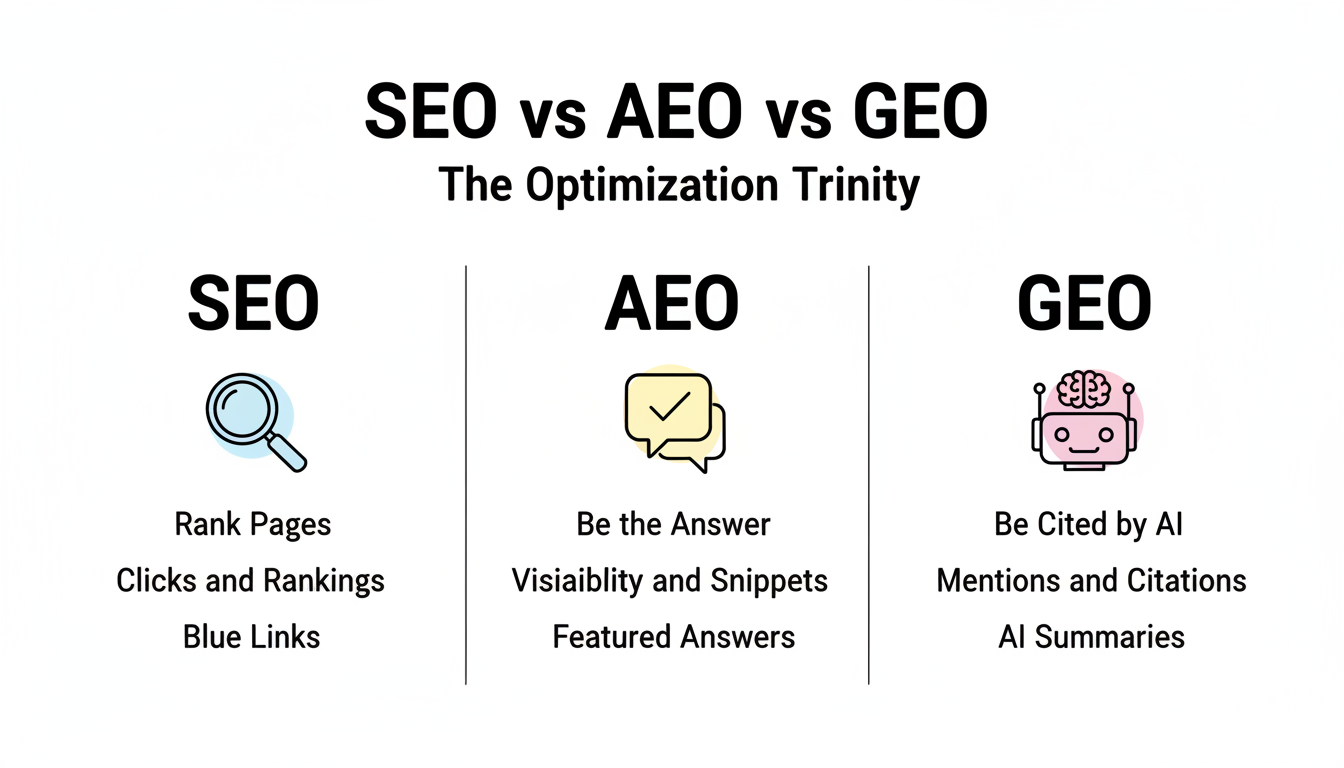
The optimization trinity:
Discipline | Primary Goal | Success Metric | Output |
SEO | Rank pages | Clicks, rankings | Blue links |
AEO | Be the answer | Visibility, snippets | Featured answers |
GEO | Be cited by AI | Mentions, citations | AI summaries |
According to Broworks' business guide, SEO builds organic authority and search rankings, GEO ensures your content is properly interpreted by generative AI engines, and AEO helps your pages become top answers in voice and AI-driven results. Together, they form a layered strategy that keeps your brand discoverable.
How E-E-A-T Applies Across SEO, AEO, and GEO
E-E-A-T—Experience, Expertise, Authoritativeness, and Trustworthiness—is Google's quality framework and the unifying quality signal across all three optimization disciplines. Whether you are optimizing for traditional search rankings, answer engine placement, or generative AI citations, E-E-A-T determines whether your content earns visibility or gets filtered out.
E-E-A-T for SEO: Traditional search optimization relies on visible author credentials, original research grounded in first-hand experience, and topical authority built through comprehensive content clusters. Technical trust signals like Core Web Vitals, HTTPS, and clean site architecture reinforce these quality indicators. Google's search quality raters explicitly evaluate whether content creators demonstrate genuine expertise in their subject area.
E-E-A-T for AEO: Answer engines prioritize content that signals expertise through structured data—FAQ schema, Article schema, and HowTo schema help AI systems identify authoritative answers. Concise, authoritative answer formatting in definition-style opening paragraphs increases extraction probability. Citation-worthy sourcing with named experts, specific data points, and verifiable claims makes content more likely to be selected as a direct answer.
E-E-A-T for GEO: Generative AI models evaluate trustworthiness based on whether content appears in widely-cited authoritative sources, whether author credentials and institutional affiliations are clearly stated, and whether the content aligns with established knowledge graph entities. Consistent NAP (Name, Address, Phone) data across all platforms strengthens local trust signals that AI systems use for brand verification.
E-E-A-T Dimension | SEO Implementation | AEO Implementation | GEO Implementation |
Experience | First-hand case studies, original data | Practitioner-written answers with real examples | Cited in industry reports and analyses |
Expertise | Author bios, credentials, content depth | Article schema with author expertise signals | Recognized subject-matter entity in knowledge graphs |
Authoritativeness | Backlink profile, domain authority | Consistent citations across answer platforms | Brand mentions in authoritative training data sources |
Trustworthiness | HTTPS, privacy policy, Core Web Vitals | Verifiable claims, named data sources | Consistent NAP data, Organization schema |
Without strong E-E-A-T signals, content may rank in traditional search but fail to earn citations in AI-generated answers—the single biggest differentiator between pages that get cited and those that do not. For technical foundations that support E-E-A-T signals, see best SEO practices for single page applications.
How AI Crawlers Work: Robots.Txt, Llms.Txt, and Platform-Specific Indexing
AI search is reducing traditional click-through rates, and to maintain visibility brands must ensure their content is crawlable and citable by AI systems—not just Google's traditional bot. Each major AI platform operates its own crawler with distinct behaviors, and understanding these mechanics is essential for effective GEO.
AI Crawlers You Need to Know
Four primary AI crawlers index web content for generative responses: GPTBot (OpenAI/ChatGPT), ClaudeBot (Anthropic/Claude), Google-Extended (Gemini), and PerplexityBot (Perplexity). Each crawler has distinct crawl frequencies, respect for robots.txt directives, and content processing approaches. GPTBot and PerplexityBot are the most aggressive crawlers, while ClaudeBot's crawling infrastructure is newer and still expanding its coverage.
Robots.Txt for AI Crawlers
Your robots.txt file controls which AI crawlers can access your content. Blocking an AI crawler means your content cannot be cited in that platform's responses—a significant visibility trade-off. Unless you have specific content licensing concerns, the recommended approach is to allow all AI crawlers access. Verify your current configuration by checking your robots.txt for User-agent directives targeting GPTBot, ClaudeBot, Google-Extended, and PerplexityBot.
Llms.Txt — The New Standard for AI Discovery
The llms.txt file is an AI-friendly index (analogous to sitemap.xml for LLMs) that provides a curated list of your most important pages with brief descriptions. AI systems use this file to understand your site's authority areas and prioritize which content to index for retrieval-augmented generation (RAG). While llms.txt is an emerging standard not yet universally adopted by all AI platforms, early adopters gain a structural advantage in AI content discovery.
AI crawler optimization checklist:
- Verify crawler access in server logs for GPTBot, ClaudeBot, Google-Extended, and PerplexityBot
- Create an llms.txt file listing your highest-authority pages with concise descriptions
- Audit robots.txt for unintentional AI crawler blocks
- Monitor AI referral traffic in GA4 (look for perplexity.ai, chat.openai.com as referral sources)
- Use AI citation tracking tools to monitor how often your content is cited across AI platforms
AEO vs GEO vs LLMO: Understanding the Full Acronym Landscape
The search optimization field has produced a proliferation of acronyms beyond SEO, AEO, and GEO. Understanding what each term means—and where they overlap—prevents confusion and helps teams focus their optimization efforts.
LLMO (Large Language Model Optimization) is the practice of optimizing content specifically for large language models like ChatGPT, Claude, and Gemini. LLMO is essentially the technical subset of GEO, focused on how LLMs retrieve and cite content through training data and retrieval-augmented generation (RAG) pipelines. If you are doing GEO, you are already doing most of LLMO.
AIO (AI Overviews) refers specifically to Google's AI-generated summary answers displayed at the top of search results pages. AIO is distinct from AEO: AEO is the broader discipline of optimizing for any answer engine (including featured snippets, voice assistants, and AI answer boxes), while AIO targets Google's specific implementation. Optimizing for AIO requires strong traditional SEO signals because Google AI Overviews heavily favor pages already ranking in the top 10 organic results. For a deeper look at this specific channel, see Google AI Overview SEO impact.
Search Everywhere Optimization is the emerging umbrella concept encompassing SEO + AEO + GEO + social search (Reddit, TikTok) + voice search. Proponents like the Digital Marketing Institute and Yext use this framing to emphasize that brands must be discoverable across all platforms where users search—not just Google.
Acronym | Full Name | Scope | Primary Platforms | Overlap |
SEO | Search Engine Optimization | Traditional search rankings | Google, Bing | Foundation for all others |
AEO | Answer Engine Optimization | Direct answer placement | Featured snippets, voice, AI answer boxes | Overlaps GEO on AI answers |
GEO | Generative Engine Optimization | AI-generated responses | ChatGPT, Perplexity, Gemini | Includes LLMO as subset |
LLMO | Large Language Model Optimization | LLM training data and RAG | ChatGPT, Claude, Gemini | Technical subset of GEO |
AIO | AI Overviews | Google AI summary answers | Google Search | Subset of AEO |
In practice, most marketing teams do not need separate strategies for each acronym. The disciplines converge on the same core principles: authoritative content, structured data, and entity clarity.
SEO: The Foundation
Search Engine Optimization remains the foundation of digital visibility. Strong SEO fundamentals support both AEO and GEO success, similar to how a comprehensive AI search measurement framework requires solid foundational metrics.
According to Conductor's 2026 AEO/GEO Benchmarks Report, even with the rise of AI search, optimizing for visibility in the traditional Google search experience remains essential for improving brand visibility and relevance.
What SEO provides:
- Technical site health (crawlability, indexing)
- Domain authority through backlinks
- Keyword relevance signals
- Content quality foundations
- Page experience metrics
SEO focus areas:
Element | Purpose |
Technical SEO | Ensure search engines can access and understand content |
On-page SEO | Optimize individual pages for target keywords |
Off-page SEO | Build authority through external signals |
Content SEO | Create valuable, relevant content |
AEO: Answer Engine Optimization
Answer Engine Optimization focuses on making content extractable as direct answers. When users ask questions, AEO-optimized content gets selected for featured snippets, voice search responses, and AI answer boxes.
According to Spoclearn, Answer Engine Optimization (AEO) focuses on making content easily extractable as direct answers by AI search engines. In 2026, most searches are resolved instantly, so AEO ensures your content appears inside AI responses and featured summaries.
What AEO requires:
- Clear, direct answers in opening sentences
- Question-format headings that match search queries
- Structured FAQ sections
- Simple, scannable formatting
- Voice search optimization
To discover AEO-worthy questions, mine Google's People Also Ask boxes, use tools like AnswerThePublic and AlsoAsked, analyze Perplexity's "Related" suggestions, and review Reddit threads for natural-language queries. AI search queries tend to be longer and more conversational than traditional keyword searches, making long-tail question targeting especially valuable for AEO.
According to Crossway Consulting's visibility guide, while traditional SEO aims to rank, AEO aims to be cited, quoted, and recommended. The structure of your content becomes critical—clear headings that match question patterns, definition-style opening paragraphs, and logical information hierarchy all signal that your content is answer-ready. Companies looking for professional implementation often turn to AEO audit services to identify optimization opportunities.
AEO optimization tactics:
Tactic | Why It Works |
Answer-first formatting | AI extracts opening content |
Question-based headings | Matches user query patterns |
Concise paragraphs | Easier for AI to lift and quote |
Schema markup | Helps engines understand structure |
FAQ sections | Direct question-answer format |
Schema markup deserves particular attention: implement Article schema for blog posts to signal content type and authorship, FAQ schema for question-answer content to enable rich results and AI extraction, and Organization schema to strengthen brand entity recognition across AI platforms. These structured data types help AI systems parse content structure and extract authoritative answers. Validate your implementation using Google's Rich Results Test and the Schema Markup Validator. For a comprehensive guide to implementation, see structured data for AI search.
GEO: Generative Engine Optimization
Generative Engine Optimization ensures AI systems like ChatGPT, Perplexity, and Google AI Overviews cite your brand when generating responses. GEO focuses on becoming part of AI-constructed narratives and recommendations.
According to Crossway Consulting, while AEO focuses on being the answer, GEO focuses on influencing how AI constructs narratives and recommendations around broader topics. GEO is about ensuring your brand is woven into the stories AI tells.
What GEO requires:
- Topical authority across subject domains
- Consistent brand information across the web
- Expert signals and credentials
- Factual, verifiable content
- Entity clarity and recognition
Entity clarity means ensuring your brand, products, and key topics are represented as distinct entities in knowledge graphs—structured databases that AI systems use to understand relationships between concepts. Strengthen entity clarity by maintaining consistent naming across all platforms, claiming your Google Knowledge Panel, and using Organization schema to define your brand's attributes.
According to LinkedIn analysis by Bilal Aslam, Gartner predicts a 50% decline in conventional search traffic by 2028, with that volume migrating entirely to generative engines. Companies investing in GEO strategies capture disproportionate visibility during the critical 2026-2028 transition period.
How Different AI Platforms Cite and Surface Content
GEO practitioners need to understand that each AI platform has different content surfacing behaviors. Optimizing for one platform does not guarantee visibility across all.
ChatGPT (OpenAI) uses the Bing index combined with GPTBot crawling and a browsing plugin for real-time retrieval. When browsing is active, ChatGPT cites sources inline with links. It prefers authoritative domains and recent content. Older content may be cited from training data, while newer content surfaces via browsing.
Perplexity performs aggressive real-time web search with numbered inline citations. It favors concise, well-structured content with clear answer formatting. Perplexity is the most citation-transparent of all major AI platforms, making it a useful benchmark for GEO performance.
Google AI Overviews / Gemini draws from Google's own search index. It strongly favors pages already ranking in the top 10 organic results, meaning E-E-A-T signals from traditional SEO carry directly into AI Overview placement.
Claude (Anthropic) relies primarily on training data with limited real-time retrieval. Brands that appear in authoritative, widely-cited sources are more likely to surface in Claude's responses. ClaudeBot crawling is newer and less established than GPTBot or PerplexityBot.
Platform | Content Source | Citation Style | Best Optimization Approach |
ChatGPT | Bing index + GPTBot + browsing | Inline links when browsing | Strong domain authority + fresh content |
Perplexity | Real-time web search | Numbered inline citations | Concise, well-structured answer formatting |
Google AI Overviews | Google search index | Source cards below overview | Top-10 organic ranking + E-E-A-T |
Claude | Training data + limited retrieval | Contextual mentions | Presence in widely-cited authoritative sources |
Test your brand's presence in each platform separately using the best generative engine optimization tools available for cross-platform monitoring.
GEO optimization tactics:
Tactic | Why It Works |
Comprehensive topic coverage | Demonstrates expertise |
Consistent entity information | Builds AI recognition |
Expert authorship signals | Establishes credibility |
Fact-dense content | Enables verification |
External authority signals | Strengthens trust |
How AEO, SEO, and GEO Work Together
According to The Ad Firm's comparison, AEO secures visibility through structured answers that influence early trust, while GEO builds influence during evaluation by shaping how options are framed. When you apply both together, you extend visibility across the full decision cycle. Organizations developing strategies for B2B AEO marketing must consider this integrated approach.
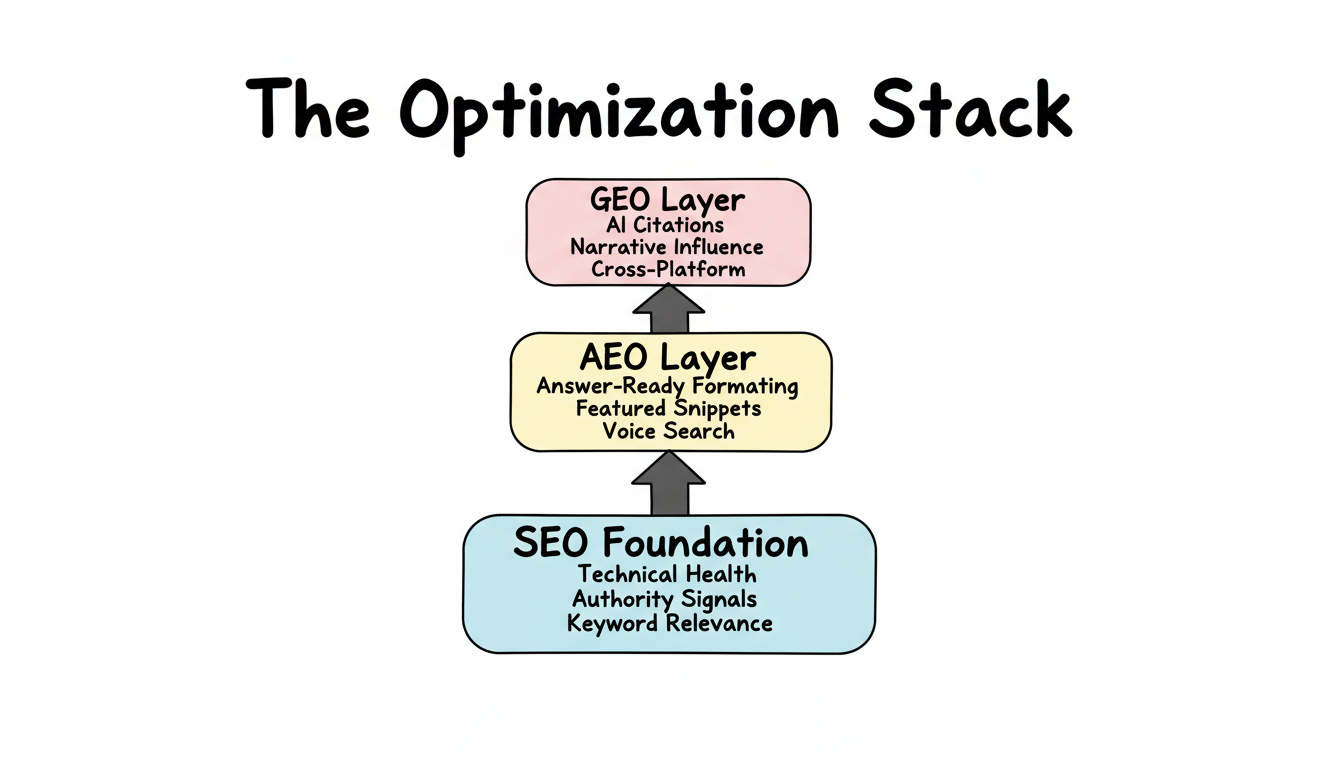
The integrated approach:
SEO Foundation
├── Technical health enables crawling
├── Authority signals support credibility
└── Keyword relevance aids discovery
    ↓
AEO Layer
├── Answer-ready formatting
├── Featured snippet optimization
└── Voice search readiness
    ↓
GEO Layer
├── AI citation optimization
├── Narrative influence
└── Cross-platform visibility
According to TRU Performance's analytics guide, traditional SEO focuses on ranking web pages in SERPs. AEO optimizes your content so AI assistants can understand, recombine, and reuse it in conversational answers. GEO overlaps with AEO but zooms in on how generative models assemble answers and brand mentions. Understanding cross-platform AI search ROI helps justify investment across all three disciplines.
Which Should You Prioritize?
According to Lasso Up, it depends on how people find and choose you. Traditional SEO still fuels discovery, AEO fuels trust and visibility, and GEO fuels long-term relevance. Ignoring any one creates blind spots.
Priority by business type:
Business Type | Primary Focus | Secondary Focus |
E-commerce | SEO | AEO |
Professional services | AEO | GEO |
SaaS/Tech | GEO | AEO |
Local business | SEO + AEO | GEO |
B2B enterprise | GEO | SEO |
According to Conductor's benchmarks, organizations must measure AI visibility as rigorously as SEO visibility—tracking citations and mentions as core KPIs—while aligning AEO/GEO and SEO strategies to ensure content earns presence across both traditional and generative results.
Frequently Asked Questions
Is SEO Being Replaced by GEO?
SEO is not being replaced by GEO—it is being expanded. Traditional SEO remains essential for organic search rankings, which still drive the majority of web traffic. GEO (Generative Engine Optimization) adds a new layer focused on earning citations in AI-generated responses from platforms like ChatGPT and Perplexity. The most effective strategy in 2026 combines both disciplines, using strong SEO foundations to support GEO visibility.
What Is AEO vs GEO vs LLMO?
AEO (Answer Engine Optimization) focuses on appearing in direct answers across all answer-capable platforms, including voice assistants and featured snippets. GEO (Generative Engine Optimization) targets AI-generated responses specifically. LLMO (Large Language Model Optimization) is the technical subset of GEO focused on how LLMs retrieve and cite content. In practice, these disciplines overlap significantly and share core tactics like structured data and authoritative content.
How Do You Do GEO and AEO?
Start with strong SEO fundamentals—technical health, quality content, and E-E-A-T signals. For AEO, structure content with clear question-answer formatting, implement FAQ schema, and write concise authoritative answers in the first paragraph. For GEO, ensure AI crawlers can access your content via robots.txt, create an llms.txt file, build topical authority through content clusters, and monitor your brand's presence across ChatGPT, Perplexity, and Gemini. Explore AEO tools and software for implementation support.
What Is the Difference Between SEO and GEO and AEO?
SEO optimizes for traditional search engine rankings on Google and Bing. AEO optimizes for direct answer placement in featured snippets, voice assistants, and AI answer boxes. GEO optimizes for citations within generative AI responses from ChatGPT, Perplexity, and similar platforms. SEO focuses on rankings, AEO on answer selection, and GEO on AI citation. All three share foundational tactics but differ in target platforms and success metrics.
Key Takeaways
Understanding AEO, SEO, and GEO is essential for 2026 search visibility:
- Three disciplines, one goal - Each optimizes for different discovery pathways
- SEO remains foundational - Technical health and authority support all other efforts
- AEO wins answers - Structured, clear content earns featured positions
- GEO earns AI citations - Authority and consistency drive AI recommendations
- Integration required - Winning brands optimize across all three
- Measurement evolving - Track rankings, snippets, and AI citations using tools like Otterly.ai or AIclicks for citation monitoring, and measure share-of-voice in AI responses. Monitor AI referral traffic in GA4 by tracking perplexity.ai and chat.openai.com as referral sources
- No single priority - Business type determines optimization emphasis
According to Spoclearn, as Sundar Pichai stated, "Search is evolving from information retrieval to intelligence." That single sentence defines the new optimization era—and why mastering AEO, SEO, and GEO together is essential for visibility.