
Last Updated: March 2026
Answer Engine Optimization (AEO) services help businesses appear in AI-generated responses across ChatGPT, Perplexity, Google AI Overviews, and voice assistants. As these platforms handle an increasing share of search queries, AEO has become essential for maintaining visibility.
This guide details what AEO services include, how providers structure their offerings, and what to expect when engaging an AEO partner.
What AEO Services Cover
AEO services encompass strategies and tactics designed to get your content cited when AI systems generate answers. Unlike traditional SEO services focused on rankings, AEO services target selection—ensuring your content is chosen as the source.
Content Optimization Services
Content forms the foundation of AEO. Services in this category transform how your content is structured and presented.
Content Restructuring
Making existing content extractable by AI systems:
- Breaking long paragraphs into shorter units (under 80 words)
- Front-loading key information after every heading
- Creating standalone statements that work as quotes
- Removing filler content that dilutes clarity
- Adding transition language that maintains flow for human readers
- Content chunking—dividing pages into self-contained sections that AI systems can extract independently without losing meaning
Answer-First Formatting
AI systems prioritize content that leads with a direct answer. Effective AEO services restructure content so that each section opens with a concise 40-60 word answer paragraph before expanding into detail. This answer-first pattern mirrors how AI models select and cite source material—the clearer the lead-in, the higher the likelihood of citation.
FAQ Development
Creating question-answer content matching AI query patterns:
- Researching actual questions users ask AI systems
- Writing direct, complete answers (50-100 words)
- Implementing FAQ schema for technical identification
- Covering logical follow-up questions
- Maintaining answer freshness with regular updates
Data Enhancement
Adding specific, citable information:
- Including statistics with clear attribution
- Adding expert quotations with proper attribution
- Incorporating original research and proprietary data
- Providing specific examples and case studies
- Including comparative data and benchmarks
Content Freshness Programs
Maintaining recency signals:
- Regular update schedules for priority content
- Clear timestamp implementation
- Outdated information removal
- Current event and development coverage
- Scheduled content reviews and refreshes
Industry-Specific AEO Approaches
AEO strategies differ by vertical. In eCommerce, services focus on product FAQ optimization—structuring answers around sizing, compatibility, and shipping queries that AI assistants field daily. B2B companies benefit from decision-stage content restructuring, where comparison pages and ROI calculators are formatted for AI extraction. Education providers see gains from course-related FAQ development, where prospective students ask AI systems about program requirements, costs, and career outcomes. Effective AEO providers tailor their methodology to these vertical-specific query patterns.
Technical Implementation Services
Technical optimization ensures AI crawlers can access and understand your content.
Schema Markup Deployment
Implementing structured data for AI comprehension:
Schema Type | Purpose | Priority |
FAQ Schema | Identifies Q&A pairs for extraction | High |
Article Schema | Establishes authorship and dates | High |
Organization Schema | Builds entity recognition | Medium |
HowTo Schema | Structures instructional content | Medium |
Product Schema | Identifies product information | Varies |
Crawler Configuration
Managing AI bot access:
- Robots.txt optimization for AI crawlers (GPTBot, PerplexityBot, ChatGPT-User)
- Access policy development balancing visibility and control
- Crawler behavior monitoring
- Rate limiting configuration where appropriate
- Access log analysis
Rendering Optimization
Ensuring content accessibility:
- Server-side rendering for JavaScript-heavy content
- Critical content prioritization above the fold
- Mobile rendering verification
- Page speed optimization
- Core Web Vitals improvement
Entity and Authority Building Services
AI systems evaluate source trustworthiness through entity recognition and authority signals. Understanding how Wikipedia and Wikidata shape knowledge graphs helps contextualize why entity consistency matters for AI visibility.
Entity Consistency Audits
Ensuring uniform brand presence:
- Cross-platform information verification
- Directory listing consistency checks
- Social profile alignment
- Knowledge panel accuracy verification
- Entity disambiguation (ensuring AI recognizes your brand correctly)
Authority Development
Building signals AI systems recognize:
- Expert author positioning and byline strategy
- Wikipedia/Wikidata presence development (where applicable)
- Industry publication placement
- Speaking and conference visibility
- Award and recognition cultivation
Digital PR for AI Visibility
Generating coverage that influences AI systems:
- Earned media strategy focused on authoritative outlets
- Expert commentary placement
- Original research distribution
- Thought leadership content syndication
- Brand mention monitoring and amplification
Monitoring and Measurement Services
Tracking AI visibility requires specialized approaches beyond traditional analytics.
Citation Monitoring
Tracking brand presence in AI responses:
- Regular query monitoring across major platforms
- Citation frequency tracking over time
- Citation accuracy verification
- Competitive citation comparison
- Alert systems for significant changes
AI Referral Analysis
Measuring traffic from AI sources:
- Analytics configuration for AI referral tracking
- Traffic source identification (perplexity.ai, chat.openai.com, etc.)
- User behavior analysis for AI-referred visitors
- Conversion tracking for AI traffic
- Attribution modeling including AI touchpoints
Share of Voice Reporting
Competitive visibility comparison:
- Brand visibility versus competitors across AI platforms
- Topic-specific share of voice
- Trend analysis over time
- Platform-specific breakdowns
- Actionable gap identification
Accuracy Monitoring
Verifying correct brand representation:
- Information accuracy checks in AI responses
- Misinformation identification and correction strategies
- Sentiment analysis in AI citations
- Brand message consistency tracking
- Correction request documentation
Voice Search Optimization in AEO
Voice assistants—Siri, Alexa, Google Assistant—represent a major surface for AEO services. When users ask voice queries, the assistant returns a single spoken answer rather than a list of links. Winning that answer slot requires a distinct optimization approach.
Voice queries differ from typed searches in structure and intent. They skew toward natural language and frequently begin with trigger words: how, what, best, when, and why. AEO services targeting voice search identify these high-frequency question patterns within a brand's topic area and create content specifically formatted to match.
The key formatting constraint is brevity. Voice assistants typically read answers of approximately 40 words. AEO providers restructure content so that the opening sentence of each answer section delivers a complete, standalone response within that limit. The supporting detail follows for users who read the page directly, but the lead-in is designed for voice extraction.
Voice search optimization also connects to broader AEO strategy. The same content restructuring that wins voice answer slots—concise lead-ins, clear question-answer pairs, structured data markup—also improves performance in AI Overviews, Perplexity citations, and ChatGPT references. Services that address voice search as part of a unified AEO program deliver compounding returns across all answer engine surfaces.
Zero-Click Search Strategy
Zero-click searches occur when a user's query is answered directly on the search results page—or within an AI interface—without requiring a click through to any website. Studies estimate that over 60% of Google searches now end without a click, and AI-powered answer engines accelerate this trend further.
For brands, zero-click searches create both a challenge and an opportunity. The challenge is obvious: fewer clicks to your site. The opportunity is subtler but significant—when your brand is cited as the source in an AI-generated answer, it builds authority and recognition even without a direct visit. Users associate your brand with expertise on that topic, influencing future purchase decisions and branded searches.
AEO services address zero-click optimization by ensuring your content is the cited source rather than a competitor's. This involves structuring content for extractability, building entity authority so AI systems prefer your brand, and maintaining citation accuracy so that when your brand does appear, the information is correct and favorable.
Measuring zero-click success requires metrics beyond traditional click-through rates. AEO providers track citation frequency, brand mention volume in AI responses, branded search lift (increases in users searching for your brand by name after encountering it in AI answers), and share of voice across AI platforms. These metrics capture the brand value generated even when users never click through.
Google AI Mode and AEO
Google AI Mode is distinct from AI Overviews. While AI Overviews appear as summarized answers within standard search results, AI Mode is a fully conversational interface where users engage in multi-turn dialogue with Google's AI. This distinction matters for AEO service scope.
In AI Mode, Google synthesizes answers from multiple sources across an extended conversation, often citing different pages for follow-up questions. AEO services targeting AI Mode must optimize not just for a single query but for the topical depth that sustains a conversation. Content needs to cover related subtopics, anticipate follow-up questions, and maintain authority across an entire topic cluster.
Providers expanding their AEO services to cover AI Mode focus on topic cluster completeness, internal linking between related content, and entity consistency across pages—ensuring Google's AI can draw from your site repeatedly throughout a user's session. Grok AI, xAI's answer engine, represents yet another optimization surface. As more platforms build conversational AI search, comprehensive AEO services must account for the expanding number of answer engines, each with its own content selection patterns.
Buyer Journey Mapping for AEO
Effective AEO services map questions to buyer journey stages, ensuring content addresses users at every point in their decision process. AI systems field queries across the full spectrum—from early research to purchase-ready questions—and each stage demands different content formats and depth.
At the informational stage, users ask broad questions: "What is answer engine optimization?" or "How do AI search engines work?" Content targeting this stage should provide clear definitions and conceptual explanations in concise, extractable formats. These answers build initial brand awareness when cited by AI systems.
At the comparative stage, queries shift to evaluation: "AEO services vs SEO services," "best AEO agencies," or "what to look for in an AEO provider." Content here should include comparison frameworks, evaluation criteria, and differentiated positioning. AI systems frequently cite structured comparison content for these queries.
At the transactional stage, users ask action-oriented questions: "How much do AEO services cost?" or "What's included in an AEO audit?" Content targeting this stage should include specific pricing, deliverables, timelines, and clear calls to action. These high-intent queries are where AEO visibility directly drives revenue.
AEO providers should develop an intent-stage framework for FAQ development, mapping each question to its journey stage and ensuring balanced coverage across all three. Gaps at any stage mean lost visibility for queries that competitors will capture instead.
Service Delivery Models
AEO providers structure services differently based on engagement scope.
Project-Based Services
Discrete engagements with defined deliverables:
AEO Audits ($2,000-8,000)
- Comprehensive AI visibility assessment
- Content extractability analysis
- Technical accessibility review
- Competitive visibility comparison
- Prioritized recommendations
Content Optimization Sprints ($5,000-15,000)
- Restructuring of 10-30 priority pages
- FAQ section development
- Schema implementation
- Defined 4-8 week timeline
Technical Implementation Projects ($3,000-10,000)
- Schema markup deployment
- Crawler configuration
- Rendering optimization
- Documentation and training
Retainer Services
Ongoing optimization programs:
Basic Retainers ($3,000-6,000/month)
- 5-10 pages optimized monthly
- Citation monitoring (monthly reports)
- Technical maintenance
- Strategy calls
Comprehensive Retainers ($8,000-20,000/month)
- 15-25 pages optimized monthly
- New content creation (2-6 articles)
- Entity development work
- Weekly citation monitoring
- Detailed monthly reporting
- Ongoing strategy refinement
Enterprise Programs ($20,000+/month)
- Large-scale optimization programs
- Dedicated account resources
- Custom monitoring solutions
- Integration with internal teams
- Executive reporting
Integrated Programs
Combined SEO and AEO services:
Many organizations benefit from integrated programs that address both traditional search and AI visibility. The landscape of SEO vs AEO vs GEO shows how these disciplines complement each other rather than compete:
- Full SEO services (technical, on-page, content, links)
- AEO optimization layered on SEO foundation
- Unified strategy and reporting
- Coordinated resource allocation
- Single-vendor accountability
Evaluating AEO Service Providers
Assess potential partners on specific capabilities.
Questions to Ask
Methodology
- "How do you approach content restructuring for AI extraction?"
- "What's your process for FAQ development and implementation?"
- "How do you balance AEO with traditional SEO?"
Capabilities
- "What tools do you use for citation monitoring?"
- "Can you show case studies with specific metrics?"
- "What's your team's background in AI search?"
Process
- "What does onboarding look like?"
- "How do you report on AI visibility?"
- "What's your typical results timeline?"
Warning Signs
- Guaranteed placement claims (impossible to guarantee)
- No measurement capabilities (can't demonstrate results)
- SEO services relabeled without AEO-specific tactics
- Dismissing traditional SEO as irrelevant
- Vague methodology descriptions
Results Timeline
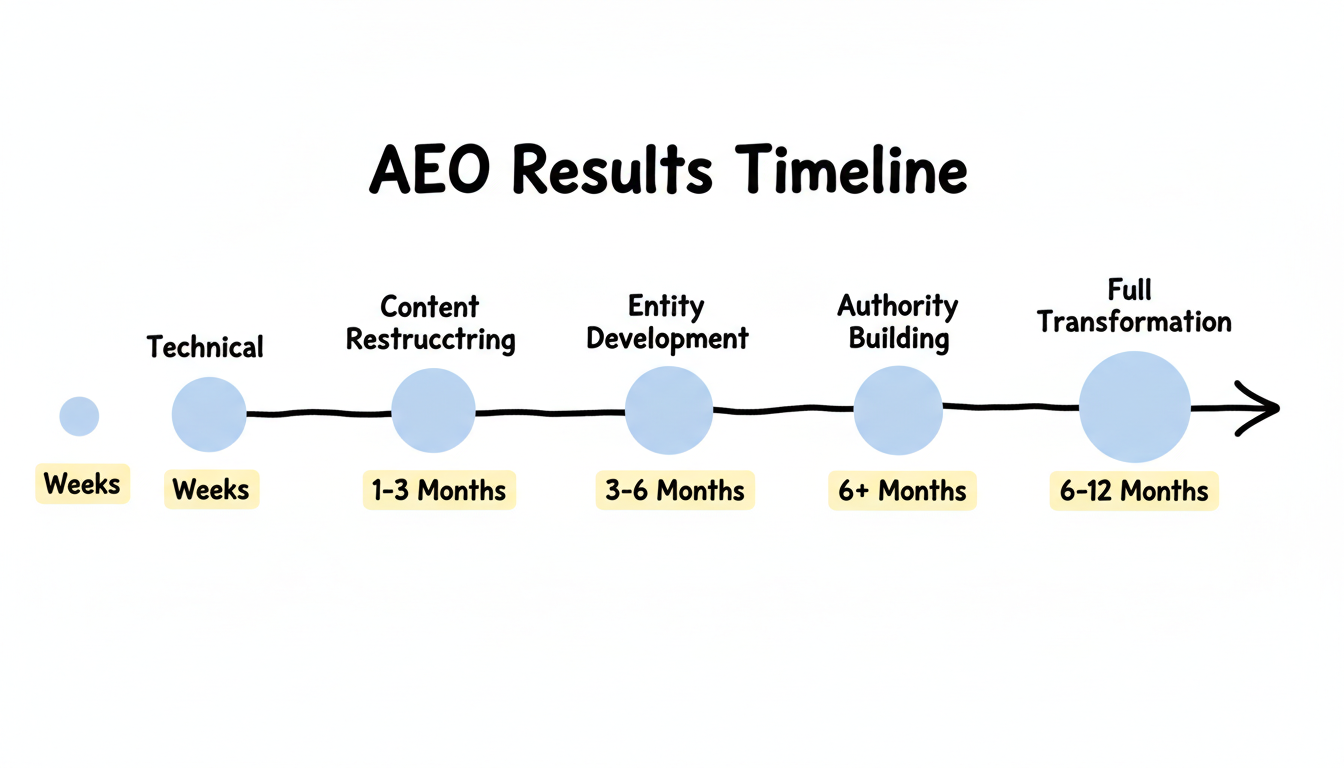
Set appropriate expectations for AEO services. Implementing AI SEO best practices in 2026 requires patience as different optimization layers take effect at varying speeds:
Service Area | Typical Timeline |
Technical implementation | Weeks |
Content restructuring | 1-3 months for visible impact |
Entity development | 3-6 months |
Authority building | 6+ months |
Full visibility transformation | 6-12 months |
Key Takeaways
AEO services address real visibility gaps. As AI search grows, brands not appearing in AI responses lose ground to competitors who do.
Comprehensive services span multiple areas. Effective AEO requires content optimization, technical implementation, entity building, and ongoing monitoring—not just one component.
Integration with SEO matters. AEO builds on SEO foundations. Services that ignore traditional search optimization deliver incomplete results. Learning how to do GEO SEO shows how generative engine optimization works alongside traditional approaches.
Measurement is essential. Without citation monitoring, neither you nor your provider can demonstrate results. Ensure any engagement includes AI-specific tracking.
FAQs
What Are AEO Services?
AEO services are specialized optimization services that help businesses appear in AI-generated answers across platforms like ChatGPT, Perplexity, Google AI Overviews, and voice assistants. They include content restructuring for AI extraction, schema markup implementation, entity authority building, citation monitoring, and ongoing optimization to ensure your brand is cited when AI systems answer relevant queries.
What Does AEO Stand For?
AEO stands for Answer Engine Optimization. It refers to the practice of optimizing content and digital presence so that AI-powered answer engines—such as ChatGPT, Google AI Overviews, Perplexity, and voice assistants—select and cite your content when generating responses to user queries.
Is AEO Replacing SEO?
AEO is not replacing SEO—the two disciplines are complementary. SEO builds the technical foundation, domain authority, and content quality that AI systems evaluate when selecting sources. AEO adds a layer of optimization specifically targeting how AI models extract, cite, and present your content. Brands achieve the best results when they integrate both into a unified strategy.
How Much Do AEO Services Cost?
AEO service costs range widely based on scope. Project-based engagements like audits run $2,000-$8,000, while content optimization sprints cost $5,000-$15,000. Monthly retainers range from $3,000-$6,000 for basic programs to $8,000-$20,000 for comprehensive services. Enterprise programs exceed $20,000 per month and include dedicated resources, custom monitoring, and integration with internal teams.
What'S Included in a Typical AEO Retainer?
Typical comprehensive retainers ($8,000-20,000/month) include: 15-25 pages optimized monthly, new content creation, citation monitoring with detailed reports, technical maintenance, entity development work, and ongoing strategy refinement. Basic retainers cover fewer pages with less frequent reporting.
How Is AEO Different from Regular SEO Services?
Traditional SEO services focus on rankings and organic traffic. AEO services add optimization for AI platforms—content restructuring for extraction, entity consistency, citation monitoring, and AI-specific technical implementation. Many providers now offer integrated programs covering both disciplines.
Do I Need Separate AEO Services or Can My SEO Agency Add Them?
Many SEO agencies have added AEO capabilities, but depth varies significantly. Evaluate whether your current provider has specific AI monitoring tools, demonstrated AEO results, and clear methodology for AI optimization—not just relabeled SEO services.
What Results Should I Expect from AEO Services?
Expect measurable improvements in: citation frequency across AI platforms, AI referral traffic, share of voice versus competitors, and citation accuracy. Technical improvements show results in weeks; content optimization in 1-3 months; authority building in 3-6+ months.