
Answer engine optimization has emerged as a distinct discipline requiring specialized expertise. As businesses evaluate AEO agencies, understanding exactly what services these agencies deliver—and what differentiates quality providers from those simply rebranding traditional SEO—becomes essential for making informed investment decisions.
AEO services—sometimes called GEO (Generative Engine Optimization) services when focused specifically on generative AI platforms—help brands appear in AI-generated answers across ChatGPT, Perplexity, Gemini, and voice assistants. This guide breaks down what AEO agencies actually deliver, how to evaluate their services, and the ROI benchmarks you should expect.
According to Nativz’s AEO services guide, AEO services focus on optimizing content so it gets featured in AI-powered search results and voice assistant responses. Unlike traditional SEO, which aims for ranking positions, AEO targets direct visibility in AI-generated answers across platforms like ChatGPT, Perplexity, Google AI Overviews, and voice assistants.
AEO vs SEO vs GEO: Which Services Cover What
Before evaluating specific AEO service categories, it helps to understand how AEO relates to SEO and the newer term GEO. These three disciplines overlap but target different outcomes and platforms.
SEO (Search Engine Optimization) optimizes content for traditional search engine rankings on Google, Bing, and similar platforms. AEO (Answer Engine Optimization) optimizes content for AI-generated answers across all answer-capable platforms—including AI chatbots, voice assistants, featured snippets, and AI Overviews. GEO (Generative Engine Optimization) is a subset of AEO focused specifically on generative AI outputs from systems like ChatGPT, Perplexity, and Gemini.
Dimension | SEO | AEO | GEO |
Primary goal | Rank in search results | Appear in AI-generated answers | Get cited by generative AI models |
Target platforms | Google, Bing | AI chatbots, voice assistants, featured snippets, AI Overviews | ChatGPT, Perplexity, Gemini, Copilot |
Key tactics | Backlinks, keyword optimization, technical SEO | Structured data, answer-first content, entity authority, schema markup | LLM-friendly formatting, citation optimization, brand entity development |
Success metrics | Rankings, organic traffic, CTR | Citation frequency, AI visibility share, answer inclusion rate | LLM citation count, generative share of voice |
Timeline to results | 3-6 months | 2-4 months for initial citations | 2-6 weeks for crawled platforms |
Overlap | Foundation for AEO and GEO | Includes GEO + voice + snippets | Subset of AEO |
AEO is the broadest umbrella term. It encompasses GEO (generative AI optimization), voice assistant optimization (Siri, Alexa, Google Assistant), featured snippet targeting, and People Also Ask optimization. Traditional SEO remains foundational—strong SEO signals like backlinks and E-E-A-T still influence which sources AI systems trust and cite.
When hiring an agency, verify whether their "AEO services" cover only GEO (generative models) or the full AEO spectrum including voice search and featured snippet optimization. Use this as a qualification criterion. For a deeper dive into these distinctions, see our AEO vs GEO vs SEO comparison guide.
Core AEO Service Categories
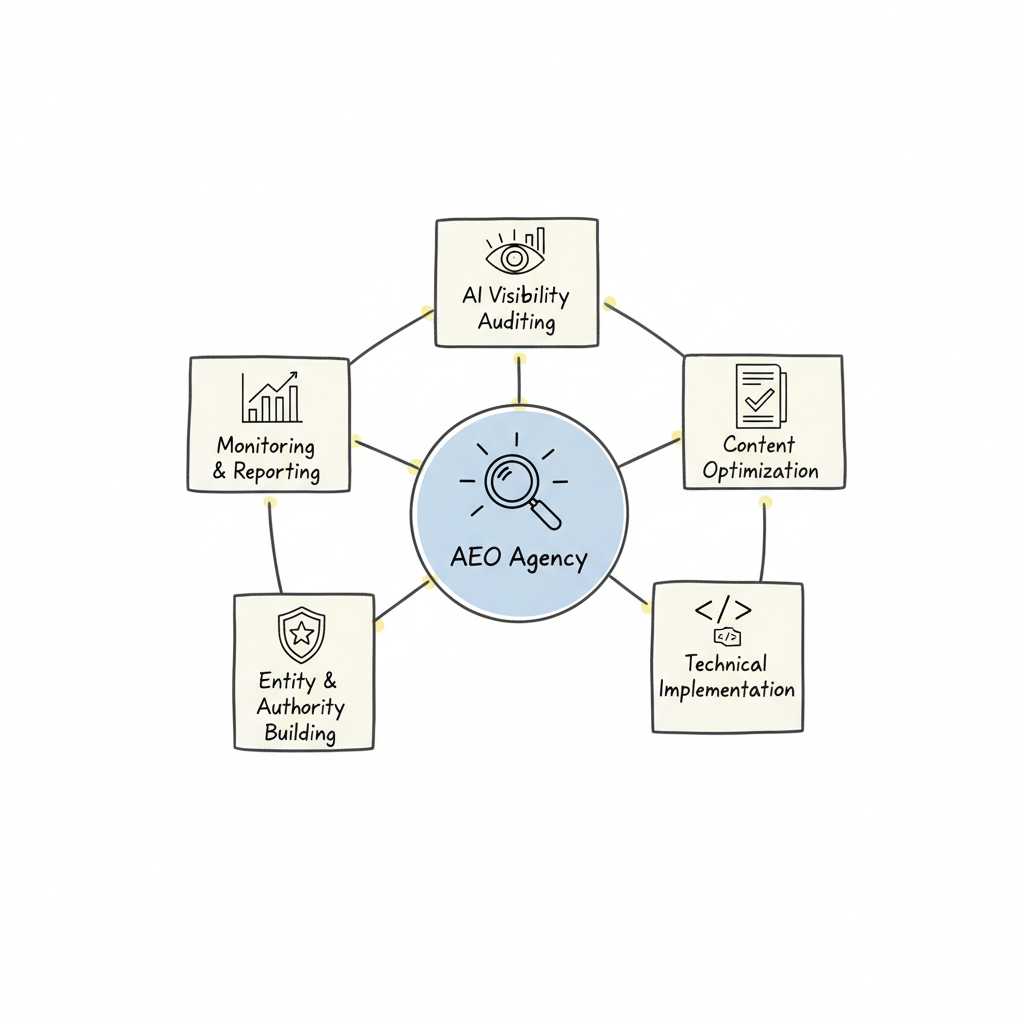
Professional AEO agencies structure their offerings around distinct service categories that address different aspects of AI search visibility.
According to Marketing Experts Hub’s agency ranking, the best AEO agencies in 2026 offer comprehensive services including content optimization for featured snippets, voice search optimization, structured data implementation, and AI visibility monitoring—each requiring specific expertise and methodologies.
Primary service categories:
Category | What It Includes | Outcome | AI Platforms Covered |
AI Visibility Auditing | Current citation analysis, competitive benchmarking | Baseline understanding | ChatGPT, Perplexity, Gemini, Copilot |
Content Optimization | Answer-first restructuring, schema implementation | Improved AI extraction | All AI platforms + featured snippets |
Entity Development | Brand authority building, expert positioning | Enhanced E-E-A-T signals | All AI platforms |
Technical Implementation | Schema markup, LLMS.txt, semantic HTML | Machine-readable content | All AI platforms + voice assistants |
Monitoring & Reporting | Citation tracking, share of voice analysis | Ongoing visibility measurement | ChatGPT, Perplexity, Gemini, Copilot |
Voice Search Optimization | Conversational keyword research, answer-first content blocks, local voice search schema | Spoken answer visibility | Siri, Alexa, Google Assistant |
According to Elsner Technologies’ AEO overview, professional AEO companies provide services ranging from content structuring and optimization to technical implementation and ongoing monitoring, with the best agencies offering integrated approaches that address all aspects of AI search visibility.
Platform-Specific AEO: ChatGPT, Perplexity, Gemini, and Copilot
Each AI platform has different content ingestion patterns, citation behaviors, and ranking signals. An agency treating all platforms identically is leaving visibility on the table.
ChatGPT / OpenAI: Draws from web browsing and trained data. Favors authoritative sources with clear entity markup. High conversion potential for product recommendations. Agencies should optimize for clear, structured answers that ChatGPT can extract and attribute.
Perplexity: Crawls the web in real-time and provides source citations with every response. Prioritizes recent, well-structured content with clear answers. Perplexity has the most transparent citation model of any AI platform, making it easier to track and optimize for visibility.
Google Gemini / AI Overviews: Integrated with Google Search index. Benefits from existing SEO signals including backlinks and E-E-A-T. Significant overlap with traditional featured snippet optimization, making this the easiest entry point for brands with strong existing SEO.
Microsoft Copilot: Powered by the Bing index combined with OpenAI models. Particularly strong for B2B queries. Benefits from Bing Webmaster Tools optimization and LinkedIn entity signals.
When evaluating agencies, ask which specific platforms they optimize for and whether they provide platform-specific visibility tracking rather than just aggregate "AI mentions." Agencies should reference specific AEO tools and software that track platform-level citation data to distinguish ChatGPT citations from Perplexity citations.
AI Visibility Auditing Services
Every AEO engagement begins with understanding current visibility status across AI platforms.
According to First Page Sage’s AEO analysis, leading AEO agencies conduct comprehensive audits that reveal how brands currently appear (or don’t appear) in AI-generated responses, establishing baselines for measuring improvement.
Audit deliverables typically include:
AI Visibility Audit Components
├── Citation Analysis
│   ├── Current mentions across AI platforms
│   ├── Citation context and accuracy
│   ├── Source attribution tracking
│   └── Competitor citation comparison
│
├── Content Assessment
│   ├── AI-extractability evaluation
│   ├── Schema markup review
│   ├── Content structure analysis
│   └── E-E-A-T signal inventory
│
├── Technical Review
│   ├── Crawlability for AI systems
│   ├── Structured data validation
│   ├── Semantic HTML assessment
│   └── AI-specific configurations
│
└── Competitive Landscape
    ├── Share of voice benchmarking
    ├── Competitor strategy analysis
    ├── Gap identification
    └── Opportunity mapping
According to Cornerstone Content’s agency guide, quality AEO audits go beyond surface-level analysis to provide actionable insights with prioritized recommendations based on potential impact and implementation complexity.
Content Optimization Services
Content optimization forms the core of most AEO engagements, transforming existing content and creating new material optimized for AI extraction.
According to SEOProfy’s agency analysis, effective AEO content services focus on making content directly answerable—structuring information so AI systems can easily extract, verify, and cite it in generated responses. This approach aligns with broader aeo optimization checklist best practices that prioritize answer-first content structure.
Content optimization deliverables:
Service | Description | Typical Scope |
Answer-first restructuring | Reorganize content to lead with direct answers | Existing key pages |
FAQ development | Create structured Q&A content matching user queries | 10-50 FAQ pages |
Schema implementation | Add appropriate JSON-LD markup to content | Site-wide |
Table and list conversion | Convert narrative content to extractable formats | High-priority content |
Citation preparation | Add verifiable claims and source references | All new content |
According to DW Media’s AEO trends report, citation dominance has become a primary focus in 2026, with agencies prioritizing content that AI systems can confidently cite—emphasizing factual integrity scoring and verifiable claims.
Content creation services typically include:
- Pillar page development - Comprehensive topic coverage establishing authority
- Cluster content creation - Supporting content addressing related queries
- FAQ and how-to content - Structured answers targeting specific questions
- Expert positioning content - Author pages and credential documentation
- Original research - Data-driven content creating citable sources
Voice Search and Zero-Click AEO Services
Voice search AEO focuses on optimizing content to be the spoken answer from Siri, Alexa, and Google Assistant. Voice queries are conversational and question-based, requiring different content structuring than text-based AI answers. A user asking Alexa "what do AEO agencies do" expects a concise, direct spoken response—not a list of ten blue links.
Specific service deliverables agencies provide for voice search AEO include conversational keyword research targeting natural-language queries, FAQ-formatted content blocks with direct answers of 40-60 words, local voice search optimization for "near me" and location-based queries, and answer-first content formatting guidelines that prioritize the response before the explanation.
Zero-click optimization addresses a related challenge: strategies designed to win brand visibility even when the user never clicks through to your site. In AI-generated answers and featured snippets, the brand mention itself is the conversion—driving awareness and authority even without a traditional website visit.
Service Component | What the Agency Does | Deliverable Example |
Voice Query Research | Identify conversational long-tail queries users speak to assistants | Voice keyword map with 200+ queries |
Answer-First Formatting | Restructure content so direct answers appear in first 40-60 words | Reformatted FAQ and how-to pages |
Zero-Click Brand Positioning | Optimize for brand mentions in AI answers and featured snippets | Brand visibility audit + optimization plan |
Featured Snippet Targeting | Structure content for paragraph, list, and table snippets | Snippet optimization for top 50 target queries |
Agencies offering voice search AEO should demonstrate expertise with People Also Ask optimization, since PAA boxes are a primary source for both voice answers and AI-generated responses.
Technical Implementation Services
Technical AEO services ensure content infrastructure supports AI discovery and extraction.
According to Nativz, technical AEO implementation includes structured data markup, semantic HTML optimization, and emerging standards like LLMS.txt that explicitly communicate with AI crawlers about content permissions and structure.
Technical service components:
Technical AEO Implementation
├── Schema Markup
│   ├── Article schema for all content pages
│   ├── FAQPage schema for Q&A content
│   ├── HowTo schema for procedural content
│   ├── Organization and Person schema
│   └── Custom schema for industry-specific needs
│
├── Semantic Structure
│   ├── HTML5 semantic element optimization
│   ├── Heading hierarchy correction
│   ├── Content relationship mapping
│   └── Internal linking optimization
│
├── AI-Specific Configuration
│   ├── LLMS.txt implementation
│   ├── robots.txt AI crawler allowances
│   ├── Sitemap optimization for AI
│   └── Crawl budget allocation
│
└── Performance Optimization
    ├── Page speed for AI crawling
    ├── Mobile optimization
    ├── JavaScript rendering solutions
    └── CDN configuration
According to NoGood’s AEO tools analysis, technical implementation quality significantly impacts whether AI systems can effectively access and process content—making technical services essential rather than optional. For comprehensive visibility monitoring, many agencies integrate aeo checker tools to validate technical implementations.
Entity and Authority Building Services
Beyond content and technical optimization, AEO agencies build the authority signals AI systems use to evaluate source trustworthiness.
According to Search Party’s SaaS AEO guide, the best AEO agencies understand that AI visibility depends heavily on entity recognition and authority signals—factors that require systematic development beyond traditional link building.
Authority building services:
Service | Activities | Impact |
Expert positioning | Author pages, credential documentation, byline optimization | E-E-A-T signals |
Brand entity development | Knowledge panel optimization, Wikipedia strategy | Entity recognition |
Cross-platform consistency | Profile alignment, messaging synchronization | Trust signals |
Digital PR | Expert placements, industry mentions | Third-party validation |
Review and testimonial strategy | Reputation management across platforms | Social proof |
According to Grow and Convert’s AI SEO agency guide, authority building has become increasingly important as AI systems prioritize sources they can cross-reference and validate across multiple platforms.
Monitoring and Reporting Services
Ongoing monitoring services track visibility changes and measure engagement effectiveness.
According to Marketing Experts Hub, professional AEO agencies provide regular reporting on AI visibility metrics including citation frequency, share of voice, sentiment accuracy, and platform coverage—metrics traditional SEO tools don’t track. Agencies often deploy specialized aeo checker platforms to continuously monitor these AI-specific metrics.
Standard monitoring deliverables:
Metric | Frequency | Report Type |
Citation frequency | Weekly | Dashboard + alerts |
Share of voice | Monthly | Competitive analysis |
Citation context/sentiment | Monthly | Brand perception report |
Platform coverage | Monthly | Cross-platform analysis |
AI referral traffic | Weekly | Analytics integration |
Content performance | Monthly | Page-level analysis |
Reporting capabilities vary by agency:
- Basic: Monthly summary reports with key metrics
- Standard: Weekly dashboards plus monthly strategic reviews
- Premium: Real-time monitoring with immediate alerts and quarterly deep-dives
- Enterprise: Custom analytics integration with business intelligence platforms
AEO ROI: Conversion Benchmarks and AI-Referred Traffic Data
Before evaluating AEO agency pricing, understanding the ROI potential of AEO services helps frame the investment. AI-referred traffic from platforms like ChatGPT converts at significantly higher rates than traditional organic search.
According to industry benchmarks reported by AdVenture PPC, ChatGPT referral traffic converts at approximately 15.9% compared to 1.8% for Google organic traffic. This dramatic difference exists because users asking AI for recommendations have higher purchase intent, and AI citations function as implicit endorsements—the AI platform has effectively pre-qualified the recommendation.
AI-referred traffic analytics has become a core service component for leading AEO agencies. Agencies should set up GA4 tracking for AI referral sources (perplexity.ai, chat.openai.com, copilot.microsoft.com), establish baseline metrics, and report on AI traffic growth monthly.
Metric | Google Organic (Benchmark) | AI-Referred Traffic (Benchmark) |
Avg Conversion Rate | 1.8% | 10-16% |
Avg Session Duration | 1-2 minutes | 3-5 minutes |
Bounce Rate | 45-55% | 25-35% |
Brand Trust Signal | Organic listing | AI endorsement / citation |
Brand representation analysis is another critical service: top agencies audit how LLMs currently describe and recommend your brand, identifying misrepresentations or gaps in AI-generated answers. This audit is the starting point for any AEO engagement. Readers interested in conducting a preliminary self-audit can explore AEO checker tools and AI citation tracking tools to understand their current baseline.
When evaluating agencies, ask for their methodology for tracking and attributing AI-referred conversions. Agencies without a clear attribution framework cannot demonstrate ROI. For documented proof of AEO outcomes across different industries, see our collection of AEO case studies with real results.
AEO Agency Pricing Models
Understanding pricing structures helps set realistic budget expectations.
Before evaluating cost, consider that AI-referred traffic converts at 5-8x the rate of traditional organic traffic (see the ROI section above), which shifts the cost-per-acquisition math significantly in favor of AEO investment.
According to Cornerstone Content, AEO agency pricing typically ranges from $3,000 to $15,000 per month for ongoing services, with project-based engagements and enterprise packages priced separately based on scope.
Common pricing structures:
Model | Typical Range | Best For |
Monthly retainer | $3,000-$15,000/month | Ongoing optimization |
Project-based | $10,000-$75,000 | Specific initiatives |
Performance-based | Base + results bonus | Risk-sharing arrangements |
Enterprise | $15,000-$50,000+/month | Large organizations |
According to Pepperland Marketing’s AEO packages, comprehensive AEO service packages range from $12,000 to $68,000 depending on scope, with pricing influenced by content volume, technical complexity, and competitive landscape. For detailed pricing breakdowns, see our guide to aeo services pricing.
Agencies offering platform-specific optimization (ChatGPT + Perplexity + Gemini individually) typically charge 20-30% more than those treating AI search as a single channel. The premium reflects the additional monitoring, content adaptation, and reporting required for each platform.
Factors affecting pricing:
- Industry competitiveness - Highly competitive niches require more resources
- Current visibility baseline - Starting from zero costs more than optimization
- Content volume - More pages mean more optimization work
- Technical complexity - Legacy systems require more implementation effort
- Geographic scope - Multi-language and multi-region campaigns cost more
- Reporting depth - Enterprise-grade analytics increase costs
Engagement Structures and Timelines
AEO engagements follow different structures based on organizational needs.
According to First Page Sage, most AEO agencies recommend minimum 6-month engagements to demonstrate meaningful results, with enterprise clients typically committing to 12-month programs.
Typical engagement structures:
Engagement Timeline Options
├── Quick-Start (2-3 months)
│   ├── Audit and strategy
│   ├── Priority optimizations
│   ├── Initial monitoring setup
│   └── Platforms: 1-2 (typically ChatGPT + Perplexity)
│
├── Foundation (6 months)
│   ├── Comprehensive audit
│   ├── Technical implementation
│   ├── Content optimization (25-50 pages)
│   ├── Authority building initiation
│   ├── Ongoing monitoring
│   └── Platforms: 3-4 (ChatGPT, Perplexity, Gemini + voice)
│
├── Growth (12 months)
│   ├── Full foundation package
│   ├── Expanded content program
│   ├── Sustained authority building
│   ├── Continuous optimization
│   ├── Strategic quarterly reviews
│   └── Platforms: All major platforms + voice assistants
│
└── Enterprise (12+ months)
    ├── Multi-brand management
    ├── Custom tool integration
    ├── Dedicated account team
    ├── Executive reporting
    ├── Ongoing innovation
    └── Platforms: All platforms + custom tracking + sentiment monitoring
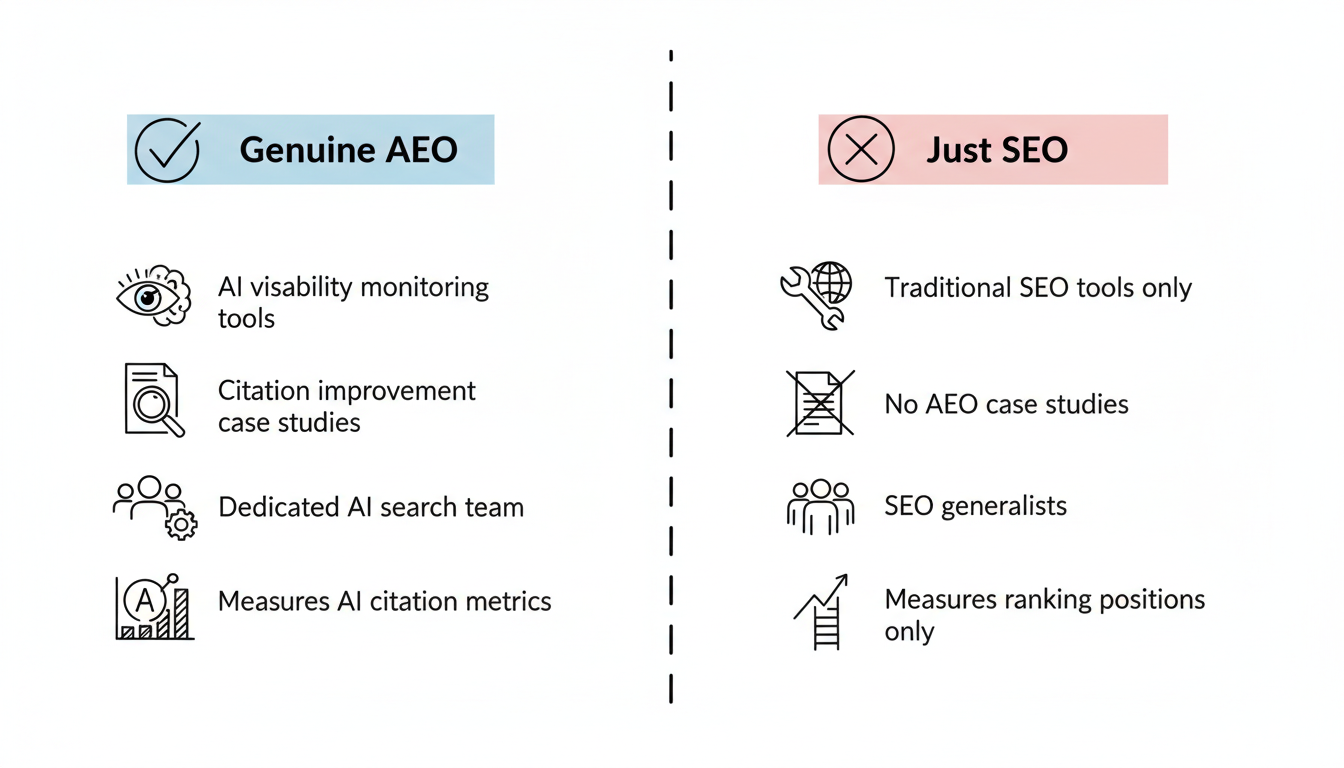
Not all agencies claiming AEO expertise deliver equal value.
According to Elsner Technologies, evaluating AEO agencies requires assessing their actual AI search expertise—not just traditional SEO credentials with AEO branding applied. Before hiring, run through our AEO optimization checklist to understand what technical and content standards to verify.
Quality evaluation criteria:
Factor | What to Look For | Red Flags |
AI-specific expertise | Dedicated AI search team, case studies | Only traditional SEO experience |
Tool stack | AI visibility monitoring tools | Only traditional SEO tools |
Methodology | Documented AEO processes | Vague "proprietary methods" |
Results evidence | Citation improvements, AI referral traffic | Only ranking improvements |
Team credentials | AI search specialists | SEO generalists |
Industry experience | Relevant vertical experience | No relevant case studies |
Platform-Specific Tracking | Tracks visibility per AI platform (ChatGPT, Perplexity, Gemini) separately | Only aggregate AI metrics |
AI Traffic Attribution | GA4 or equivalent tracking for AI-referred traffic with conversion reporting | No AI referral tracking setup |
Questions to ask potential agencies:
- What AI visibility tools do you use for monitoring?
- Can you show citation improvement case studies?
- How do you measure AEO success differently from SEO?
- What is your schema markup implementation process?
- How do you approach entity and authority building?
- What reporting do you provide on AI-specific metrics?
- How long before clients typically see citation improvements?
Additional red flag to watch for: an agency that cannot name specific AI platforms they optimize for or tools they use for tracking is likely rebranding general SEO services as AEO.
What Quality AEO Agencies Don'T Do
Understanding what quality agencies avoid helps identify those simply rebranding traditional services.
According to DW Media, the AEO landscape in 2026 has seen significant consolidation as agencies that failed to develop genuine AI search expertise have exited or pivoted back to traditional SEO.
Warning signs of inadequate AEO services:
- Promising specific citation counts or AI ranking positions
- Using only traditional SEO tools without AI visibility platforms
- Unable to explain differences between AEO and traditional SEO
- No case studies showing AI citation improvements
- Pricing significantly below market rates
- Generic methodology without AI-specific processes
- Focus only on Google with no attention to other AI platforms
Integrating AEO with Existing Marketing
AEO services work best when integrated with broader marketing strategy.
According to Grow and Convert, the most effective AEO engagements coordinate with content marketing, PR, and traditional SEO rather than operating in isolation—creating synergies that amplify results across channels.
Integration considerations:
Marketing Function | AEO Integration Point | Coordination Benefit |
Content marketing | Answer-first structure | Dual-purpose content |
Public relations | Expert positioning | Authority amplification |
Traditional SEO | Technical foundation | Shared infrastructure |
Social media | Brand consistency | Entity signal alignment |
Product marketing | Feature documentation | AI-extractable specs |
Frequently Asked Questions
What Is the Difference Between AEO and GEO Services?
AEO (Answer Engine Optimization) covers optimization for all answer-providing platforms, including AI chatbots like ChatGPT and Perplexity, voice assistants like Siri and Alexa, and traditional featured snippets. GEO (Generative Engine Optimization) is a subset focused specifically on generative AI outputs. Most agencies use the terms interchangeably, but ask whether their services include voice search and featured snippet optimization or only generative AI platforms.
How Do AEO Agencies Measure ROI and Track AI-Referred Traffic?
Leading AEO agencies track ROI by monitoring AI-referred traffic in GA4, measuring conversion rates from AI platform referrals (e.g., perplexity.ai, chat.openai.com), and tracking brand citation frequency across major LLMs. Key metrics include AI visibility share (how often your brand appears in relevant AI answers), citation accuracy, and AI-referred conversion rate, which benchmarks show can be 5-8x higher than traditional organic search.
What Should an AEO Agency Deliver in the First 90 Days?
In the first 90 days, expect a brand representation audit across major AI platforms, a technical audit of structured data and schema markup, baseline AI visibility metrics, and an initial content optimization plan. Deliverables should include a platform-specific strategy covering ChatGPT, Perplexity, and Gemini at minimum, plus GA4 configuration for AI traffic attribution. Avoid agencies that skip the audit phase and jump directly to content changes.
Do AEO Agencies Also Handle Voice Search Optimization?
Not all of them. Voice search optimization for Siri, Alexa, and Google Assistant requires specific expertise in conversational query targeting, answer-first content formatting, and local search schema. Some AEO agencies focus exclusively on generative AI platforms like ChatGPT and Perplexity. When evaluating agencies, ask whether voice search is included or treated as a separate engagement, and whether they optimize for People Also Ask and featured snippets.
Key Takeaways
Understanding AEO agency services enables informed evaluation and engagement decisions:
- Distinct service categories - AEO agencies provide auditing, content optimization, technical implementation, authority building, and monitoring services
- Content is core - Content optimization for AI extraction forms the foundation of most engagements
- Technical implementation matters - Schema markup, semantic HTML, and AI-specific configurations require specialized expertise
- Authority building essential - Entity development and E-E-A-T signals significantly impact AI visibility
- Pricing varies widely - Monthly retainers range from $3,000 to $50,000+ based on scope and complexity
- Timeline expectations - Meaningful results typically require minimum 6-month engagements
- Quality evaluation critical - Genuine AEO expertise differs significantly from rebranded traditional SEO
According to Nativz, businesses investing in AEO services should expect agencies to demonstrate specific AI search expertise, use dedicated AI visibility tools, and measure success through citation metrics rather than traditional ranking positions alone.