
When evaluating AEO agencies, marketing claims tell one story while documented results tell another. Examining case studies published by specific agencies reveals what results are actually achievable, which methodologies produce outcomes, and how different agency approaches translate to client success.
This guide analyzes documented case studies from leading AEO service providers to help you evaluate agencies based on real performance rather than sales promises.
Why Agency Case Studies Matter for Selection
Case studies from specific agencies serve different purposes than general AEO success stories.
What agency case studies reveal:
Insight | Why It Matters |
Methodology consistency | Does the agency repeat success? |
Industry expertise | Do they have relevant experience? |
Result timelines | How long until clients see returns? |
Metric focus | What do they actually measure? |
Client retention | Do clients stay long-term? |
Agencies unwilling or unable to share detailed case studies may lack documented success or experience inconsistent results.
Nogood: Growth Marketing + AEO Integration
According to NoGood's documented work, their approach integrates answer engine optimization within broader growth marketing frameworks.
SteelSeries case study:
- Client type: Gaming accessories brand
- Challenge: Competition from larger brands in AI product recommendations
- Approach: AI search optimization combined with growth experimentation
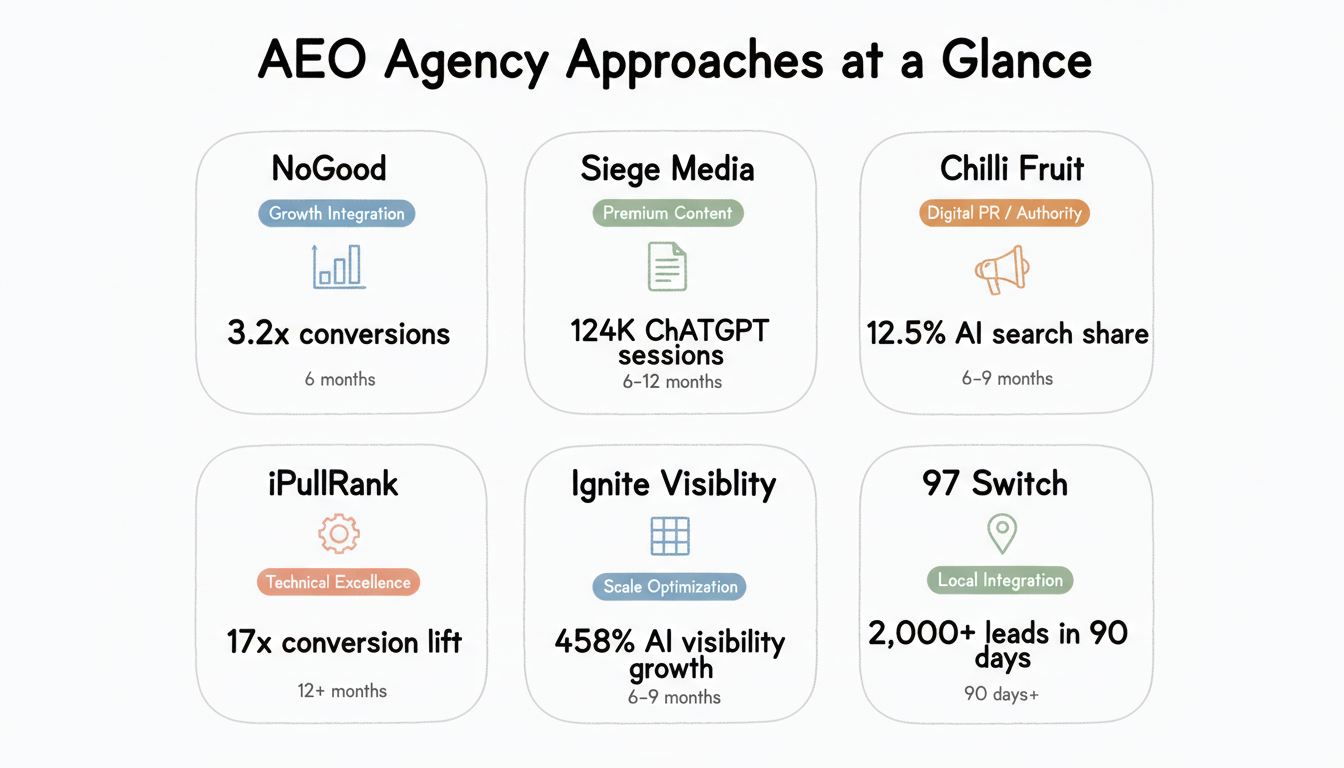
- Result: 3.2x increase in AI search conversions within 6 months
What this reveals about NoGood:
NoGood's methodology connects AEO to conversion outcomes, not just visibility metrics. The 3.2x conversion improvement demonstrates their focus on business results rather than vanity metrics. Their approach targets visibility across ChatGPT and Perplexity product recommendation queries, with platform-specific conversion tracking for each AI channel.
Best for: Companies seeking integrated growth marketing with AEO as one component of broader optimization strategy.
Siege Media: Content-Led GEO Results
According to Siege Media's documented outcomes, their content-first approach generates measurable AI visibility.
Mentimeter case study:
- Client type: Presentation software SaaS
- Challenge: Establishing AI search presence for competitive software queries
- Approach: Design-heavy content, digital PR, strategic optimization
- Result: 124,000+ ChatGPT sessions, 3,000+ conversions from AI traffic
What this reveals about Siege Media:
Siege Media tracks actual sessions and conversions from AI platforms—demonstrating sophisticated attribution capabilities. The 3,000+ conversions show direct revenue impact measurement. Their attribution model isolates ChatGPT referral traffic specifically, setting a benchmark for platform-level measurement that most agencies have yet to adopt.
Best for: Content-first brands prioritizing premium content quality and measurable AI referral traffic.
Chilli Fruit: Digital PR-Driven Authority Building
According to Marketing Experts Hub's agency analysis, Chilli Fruit specializes in authority-building approaches.
Future Processing case study:
- Client type: Technology services company
- Challenge: Competing with Deloitte and Amazon in AI citations
- Approach: PR strategies, backlink profiles, authority signals
- Result: 12.5% share of AI search coverage, outranking enterprise competitors
Brand24 case study:
- Client type: Social listening platform
- Challenge: Establishing topical authority for AI citations
- Approach: Comprehensive coverage building, authority expansion
- Result: Significantly expanded traffic and improved AI citations
What this reveals about Chilli Fruit:
Chilli Fruit demonstrates that smaller companies can displace enterprise brands through strategic authority building. Their competitive positioning results show effectiveness in high-competition markets, similar to strategies used in generative engine optimization. Chilli Fruit measures visibility across ChatGPT, Perplexity, and Gemini individually, reporting competitive share metrics for each platform rather than treating AI search as a monolith.
Best for: Companies competing against larger established players who need authority-driven strategies.
Ipullrank: Technical Excellence at Scale
According to iPullRank's case studies, their technical focus produces large-scale results.
Fintech platform case study:
- Client type: B2B financial services
- Challenge: AI Overviews capturing informational queries
- Approach: Content restructuring, schema implementation, technical optimization
- Result: 52.6% organic traffic increase, 17x conversion improvement over 12 months
Telecom case study:
- Client type: Major telecommunications company
- Challenge: Scaling AI Overview visibility
- Approach: Technical optimization at enterprise scale
- Result: 1.41 million AI Overview impressions monthly, 253% YoY growth
E-commerce marketplace case study:
- Client type: Large online marketplace
- Challenge: Product visibility in AI shopping recommendations
- Approach: Schema optimization at scale, category restructuring
- Result: 175% YoY visibility growth, $290 million revenue attribution
What this reveals about iPullRank:
iPullRank handles enterprise-scale implementations with documented multi-million dollar revenue impacts. Their 17x conversion improvement shows they optimize for business outcomes, not just visibility. iPullRank's technical methodology spans AI Overviews, ChatGPT, and Copilot, with structured data governance as a core differentiator in their enterprise implementations.
Best for: Enterprise organizations requiring technical depth and large-scale implementation capability.
Ignite Visibility: Multi-Location Expertise
According to Marketing Experts Hub, Ignite Visibility achieves strong results for multi-location businesses.
Home services franchise case study:
- Client type: Multi-location home services
- Challenge: AI visibility across 5,000+ pages
- Approach: Structured data at scale, local optimization, blog optimization
- Result: 458% AI visibility growth across blog content
What this reveals about Ignite Visibility:
Ignite handles high-volume implementations effectively. The 5,000+ page optimization demonstrates scalable methodology suitable for franchise and multi-location operations. Their structured data deployment across thousands of pages targets visibility in ChatGPT, Gemini, and Copilot local recommendation queries simultaneously.
Best for: Multi-location businesses, franchises, and companies with large content portfolios requiring systematic optimization.
97 Switch: Local Business Results
According to 97 Switch's case studies, their approach delivers measurable local business outcomes.
The Albert restaurant case study:
- Client type: Local restaurant
- Challenge: Local dining recommendations in AI search
- Approach: Local SEO + AEO integration
- Result: 7,200 website visits, 520 form submissions
444Social real estate case study:
- Client type: Property management
- Challenge: Rental property leads
- Approach: Property listing optimization, reputation management
- Result: 100% occupancy across managed properties
SideGigster case study:
- Client type: Lead generation platform
- Challenge: Gig economy query visibility
- Approach: Content optimization, authority building
- Result: 2,000+ leads generated in 90 days
What this reveals about 97 Switch:
97 Switch tracks direct business outcomes (reservations, occupancy, leads) rather than just visibility metrics. Their 90-day results demonstrate faster timelines than enterprise-focused agencies. Their local AEO approach prioritizes ChatGPT and Google Gemini local recommendation visibility, where the majority of AI-driven local discovery currently occurs.
Best for: Local businesses, restaurants, real estate, and service providers seeking quick, measurable results.
Comparing Agency Approaches
Different agencies produce results through different methodologies, and understanding the differences between SEO vs AEO strategies helps explain their varying approaches. Some agencies also offer white-label AEO services for reseller and agency partnership models.
Methodology comparison:
Agency | Primary Approach | Best Metric Type | Typical Timeline | AI Platforms Tracked | Revenue Attribution |
NoGood | Growth integration | Conversion improvement | 6 months | ChatGPT, Perplexity | Conversion-based |
Siege Media | Premium content | AI sessions/conversions | 6-12 months | ChatGPT | Session + conversion |
Chilli Fruit | Digital PR/authority | Competitive share | 6-9 months | ChatGPT, Perplexity, Gemini | Share-based |
iPullRank | Technical excellence | Traffic/revenue at scale | 12+ months | AI Overviews, ChatGPT, Copilot | $290M revenue documented |
Ignite Visibility | Scale optimization | Visibility percentage | 6-9 months | ChatGPT, Gemini, Copilot | Visibility-based |
97 Switch | Local integration | Direct conversions | 90 days+ | ChatGPT, Gemini | Lead/conversion-based |
Technical Methodologies Behind AEO Case Study Results
The agencies profiled above achieve results through specific technical methodologies that distinguish professional AEO services from basic SEO adjustments. Understanding these methodologies helps evaluate whether an agency's approach matches your technical requirements.
Schema Governance and Structured Data
Top-performing agencies implement structured data for AI search as a core methodology rather than a one-time setup task. Schema governance involves auditing, maintaining, and iterating on structured data markup at scale. This includes FAQ schema for question-targeting, HowTo schema for process content, and Product schema for e-commerce visibility. Agencies like iPullRank and Ignite Visibility treat schema governance as an ongoing discipline, regularly auditing markup validity, expanding coverage to new page types, and aligning structured data with evolving AI platform requirements. Without systematic schema governance, structured data degrades over time as content changes outpace markup updates.
Llms.Txt Optimization
An emerging methodology gaining traction across leading agencies is the deployment of llms.txt files to signal priority content to LLM crawlers. Similar to how robots.txt guides traditional search crawlers, llms.txt provides explicit instructions to AI crawlers like GPTBot, ClaudeBot, and PerplexityBot about which content to prioritize. Early adopters report faster indexing by AI platforms and more accurate citation of key pages. This practice is becoming table stakes for agencies serious about AI visibility, and its absence in an agency's methodology should prompt questions about their technical depth.
Entity-First Topical Mapping
Rather than building content strategies around keyword lists, advanced AEO agencies map content to entity relationships that align with knowledge graph optimization structures. Entity-first topical mapping identifies the concepts, relationships, and attributes that LLMs associate with a topic, then creates content that reinforces those connections. This approach improves AI citation probability because LLMs retrieve information based on entity relationships rather than keyword matching. Agencies using entity mapping typically achieve higher citation accuracy and more consistent AI visibility across multiple platforms.
How Agencies Measure AEO Success: LLM Traffic & Attribution
Measurement methodology separates sophisticated AEO agencies from those repackaging traditional SEO services. The agencies in this analysis use distinct approaches to quantify AI-driven results, and understanding these methods helps you evaluate what level of reporting to expect.
GA4 AI Traffic Segmentation
Leading agencies segment AI-referred traffic in GA4 by isolating ChatGPT, Perplexity, Gemini, Claude, and Copilot as distinct referral sources. This requires custom channel groupings because GA4's default attribution models do not recognize most AI platforms. The attribution challenge is significant: many AI-referred visits appear as direct traffic or generic referrals without clear source identification. Agencies with mature measurement practices use UTM parameters, referrer header analysis, and server log correlation to build more complete attribution pictures. For a deeper look at measurement approaches, see our guide on tracking AI overview performance.
AI-Assisted Conversion Rate Tracking
Beyond traffic volume, the most compelling case study metrics tie AI visibility to revenue. SE Ranking's analysis of the Netpeak case study documented a 6.4% AI-assisted conversion rate, while AEO Engine reported $549K in lifetime value attributed to AI-referred customers. These figures represent the frontier of AEO measurement: connecting AI platform visibility directly to pipeline and revenue rather than treating AI traffic as a top-of-funnel vanity metric. Agencies that can demonstrate revenue attribution from AI channels provide substantially more actionable reporting than those reporting only visibility scores.
Multi-AI Platform Visibility Scoring
Rather than treating AI search as a single channel, leading agencies quantify brand visibility across ChatGPT, Perplexity, Gemini, Claude, Copilot, and Grok individually. Visibility scoring frameworks measure how frequently and prominently a brand appears in AI-generated answers for target queries across each platform. This platform-level granularity matters because visibility can vary dramatically across AI platforms based on each model's training data, retrieval methods, and content preferences. Agencies using multi-platform scoring can identify platform-specific opportunities and allocate optimization effort where it will have the most impact.
Emerging AEO Tactics Used by Leading Agencies
Beyond established methodologies, the agencies producing the strongest case study results are adopting newer tactics that reflect the rapidly evolving AI search landscape. These emerging approaches differentiate agencies operating at the frontier from those relying on 2024-era playbooks.
GEO Prompt Research
Agencies like TrioSEO have pioneered GEO prompt research: systematically researching the exact prompts and questions users ask LLMs to reverse-engineer content optimization. This methodology involves querying AI platforms with hundreds of variations of target prompts, analyzing which sources are cited, and identifying the content patterns that earn citations. Using generative engine optimization tools for prompt research enables agencies to build data-driven content strategies rather than relying on assumptions about what AI platforms surface.
Content Distribution and Listicle Strategy
LLMs weigh third-party validation heavily when selecting sources to cite. Leading agencies build these trust signals through self-referencing brand listicles, Reddit and Quora seeding, and syndication across authoritative platforms. AEO Engine's community seeding approach exemplifies this tactic: creating authentic presence on platforms that LLMs actively crawl and reference, thereby increasing the probability of citation in AI-generated answers. This distribution-first mindset represents a shift from traditional SEO's focus on on-page optimization toward building the broader web presence that AI models evaluate.
E-E-A-T Signals for AI Citation
Experience, Expertise, Authoritativeness, and Trustworthiness (E-E-A-T) directly influence which sources LLMs choose to cite. Agencies optimizing for AI citation strengthen E-E-A-T signals through detailed author bios with verifiable credentials, original research and proprietary data, expert quotes from recognized industry figures, and transparent methodology documentation. These signals matter even more for AI citation than for traditional search because LLMs evaluate source credibility as part of their retrieval and generation process. Content lacking strong E-E-A-T signals is systematically deprioritized in AI-generated answers regardless of keyword optimization.
Red Flags in Agency Case Studies
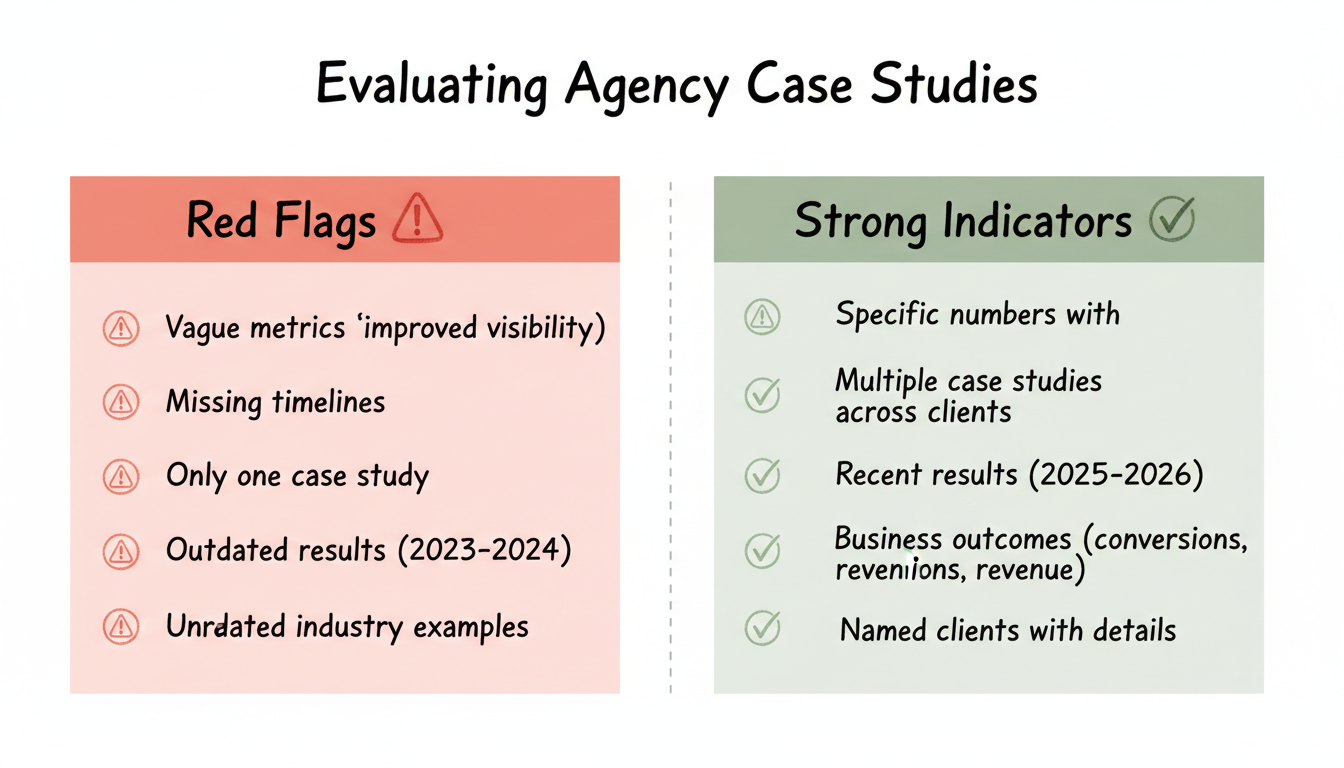
Watch for these warning signs when evaluating agency case studies.
Concerning patterns:
- Vague metrics: "Improved visibility" without specific numbers
- Missing timelines: No indication of how long results took
- Single case study: Only one documented success raises questions
- Outdated results: Case studies from 2023-2024 may not reflect current capabilities
- Different industry: Great results in unrelated sectors may not transfer
- Reports only aggregate "AI traffic" without breaking down by platform: Agencies should show platform-specific results for ChatGPT, Perplexity, Gemini, and other AI channels individually
- No structured data or schema methodology in their approach: Schema governance is a baseline competency for any agency claiming AEO expertise
Strong case study indicators:
- Specific numbers with clear baseline comparisons
- Multiple case studies across different clients
- Recent results (2025-2026)
- Business outcome metrics (conversions, revenue) not just visibility
- Client names and details (not anonymous)
Using Case Studies in Agency Evaluation
Incorporate case study analysis systematically into your agency selection process.
Evaluation framework:
- Request case studies relevant to your industry and company size
- Verify specifics by asking about methodology and timelines
- Ask about failures - agencies with only successes may be selectively sharing
- Request references to speak directly with case study clients
- Compare methodology alignment with your business needs
Questions to ask about case studies:
- "What was the starting point before your engagement?"
- "How long did it take to see these results?"
- "What would you do differently now?"
- "Can I speak with this client?"
- "What would you project for my situation?"
- "Do they implement llms.txt and structured data governance as part of their methodology?"
- "Can they show GA4 AI traffic segmentation with platform-level attribution?"
Understanding AI SEO agency pricing also helps contextualize the investment required to achieve results comparable to these case studies.
Key Takeaways
Use agency case studies effectively in your selection process:
- Methodology varies - Some agencies focus on content, others on technical, others on PR
- Timeline expectations differ - Enterprise results take 12+ months; local can achieve results in 90 days
- Metrics matter - Prefer agencies tracking business outcomes over visibility metrics alone
- Industry relevance counts - Results in your sector are more predictive than general success
- Multiple case studies indicate repeatable process, not one-time luck
- Verify with references - Speak directly with clients to validate published results
Documented agency case studies provide evidence for selection decisions. Prioritize agencies whose case studies demonstrate relevant expertise, appropriate methodology, and measurable business outcomes matching your goals.
Frequently Asked Questions About AEO Services
What Metrics Should I Expect from an AEO Agency?
Look for agencies that report LLM-specific metrics, not just organic traffic. Key indicators include AI referral sessions (from ChatGPT, Perplexity, Gemini), AI-assisted conversion rates, multi-platform visibility scores, and revenue attribution from AI channels. Top agencies track visibility across at least 4-5 AI platforms individually and can show month-over-month trending.
How Long Do AEO Services Take to Show Results?
Most agencies report measurable AI visibility improvements within 60-90 days, with significant traffic impact at the 4-6 month mark. Technical foundations like schema governance and llms.txt can produce faster wins (30-60 days). Enterprise-scale campaigns with thousands of pages typically need 6-12 months for full rollout and compounding returns. Understanding AI SEO agency pricing helps set realistic expectations for investment timelines.
What Is the Difference Between AEO Services and Traditional SEO Services?
AEO services focus on getting your content cited by AI platforms like ChatGPT, Perplexity, and Gemini, while traditional SEO targets Google's organic search results. AEO agencies use specialized tactics including structured data governance, llms.txt optimization, GEO prompt research, and entity-first content mapping that go beyond standard keyword optimization.
How Do AEO Agencies Track AI Search Visibility?
Leading agencies use GA4 AI traffic segmentation to isolate referrals from each AI platform, combined with proprietary visibility scoring tools that measure how frequently and prominently your brand appears in AI-generated answers. Some agencies also monitor LLM crawler activity (GPTBot, ClaudeBot, PerplexityBot) in server logs to track indexing.