
The initial consultation with an AEO agency determines whether you'll find the right partner or waste months with the wrong fit. Preparation transforms these meetings from sales presentations into substantive evaluations. Knowing what to bring, what to ask, and how to interpret responses helps you select an agency that can actually deliver AI visibility results.
According to Elsner Technologies' AEO companies guide, the best AEO partnership requires collaboration, not just execution. Assessing communication style, technical expertise, and methodology during initial consultations reveals whether an agency can deliver on their promises.
Why Zero-Click Experiences Make AEO Consultations Essential
The way users find information has fundamentally changed. Zero-click experiences -- searches where the answer is delivered directly in the SERP or AI interface without requiring a click-through -- now dominate how people interact with search engines and AI platforms. Google AI Overviews, featured snippets, Google Gemini, Microsoft Copilot, and ChatGPT all serve answers inline, meaning the majority of searches end without a traditional website visit. Google AI Mode, the newest zero-click surface, accelerates this trend further by providing conversational answers directly within the search experience.
This shift makes an AEO consultation far more than optional SEO upkeep. It is a strategic response to the zero-click reality. If your brand is not the cited answer in these AI-generated responses, you are effectively invisible to a growing share of your audience. Understanding the differences between optimization approaches is critical -- our guide on AEO vs GEO vs SEO breaks down how each strategy addresses different aspects of modern search visibility. The consultation is your opportunity to assess whether an agency truly understands this landscape and can position your brand as the authoritative answer across every AI platform.
Before the Consultation: What to Prepare
Arriving prepared enables meaningful conversation instead of generic pitches.
Pre-consultation checklist:
Item | Why It Matters |
Current visibility data | Baseline for measuring improvement |
Competitor list | Context for competitive positioning |
Priority keywords/topics | Focus areas for agency strategy |
Business goals | Success metrics alignment |
Budget range | Practical scope definition |
According to Crossway Consulting's AEO/GEO guide, you should audit your content for AI-readiness before consultations. Query major AI platforms with questions your content should answer, identify gaps where competitors appear but you don't, and assess whether existing content is structured for AI comprehension.
Run Prompt Tests Across AI Platforms
Before your consultation, conduct prompt testing (also called AI visibility auditing) to establish a concrete baseline of where your brand stands. Open ChatGPT, Perplexity, Google Gemini, Microsoft Copilot, and Google AI Overviews, then run queries your potential customers would actually use. Here are template prompts you can customize:
- "What are the best [your service category] companies in [your market]?"
- "Compare [your brand] vs [competitor] for [service]"
- "What should I look for when hiring a [your service category] agency?"
- "Who is the most trusted [your niche] provider?"
For each prompt, record four things: (a) whether your brand appears at all, (b) your position in any list, (c) the sentiment of the mention (positive, neutral, or negative), and (d) the accuracy of cited information. This exercise gives you a baseline LLM Share of Voice -- a measure of how often AI platforms cite your brand relative to competitors. Bringing this data to the consultation transforms the conversation from abstract to evidence-based, and lets you hold the agency accountable to measurable improvement. For tools that can automate this process, see our roundup of AEO tools and software.
Information to gather:
Pre-Consultation Preparation
├── Current State Analysis
│   ├── Test relevant queries in ChatGPT, Perplexity, Gemini, Copilot
│   ├── Document where competitors appear
│   ├── Note which topics show visibility gaps
│   └── Screenshot current AI citations (if any)
│
├── Business Context
│   ├── Revenue goals tied to digital visibility
│   ├── Timeline expectations
│   ├── Internal resources available
│   └── Previous SEO/content investments
│
└── Technical Readiness
    ├── CMS capabilities and limitations
    ├── Current schema implementation
    └── Development resource availability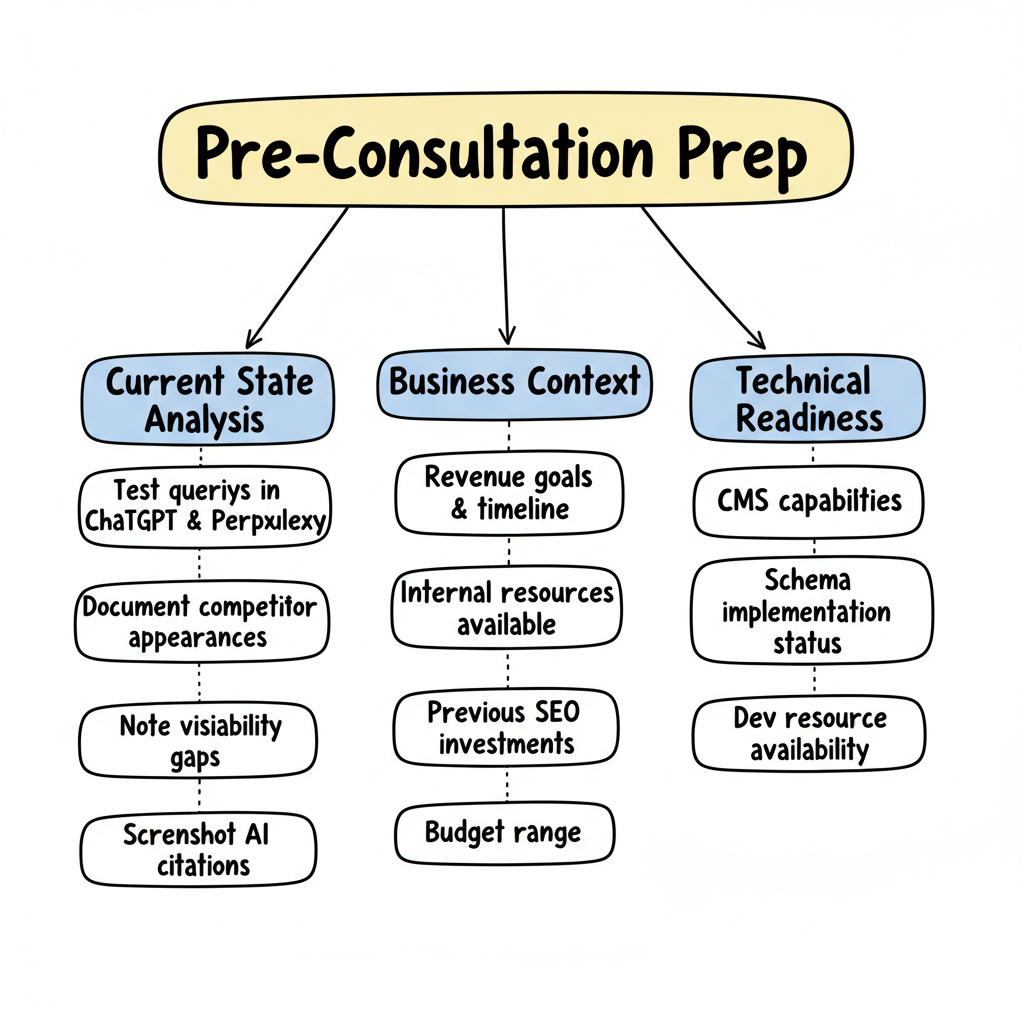
Essential Questions to Ask
Strategic questions reveal agency capabilities beyond marketing materials. Understanding whether AI search optimization services can deliver measurable results requires probing their methodology and proof of past performance.
According to NinjaPromo's AI SEO agency analysis, key evaluation criteria include documented success securing citations in ChatGPT, Perplexity, Google Gemini, Microsoft Copilot, and Google AI Overviews; technical capabilities including schema implementation and entity optimization; transparent reporting on citation frequency; and evidence of sustained client relationships.
Questions about methodology:
Question | What Good Answers Include |
"Which schema types do you implement?" | Specific types such as FAQ schema, HowTo schema, Organization schema, Product schema, and Service schema, with prioritization logic tailored to your site |
"How do you track AI visibility?" | Tool names, tracking frequency, metrics tracked |
"Show me client results in AI Overviews" | Screenshots, data, specific improvement percentages |
"How do you build authority signals?" | PR strategy, citation development, entity optimization |
"What is our current LLM Share of Voice, and what is your target improvement over 90 days?" | A clear explanation that LLM Share of Voice measures how often your brand is cited in AI-generated responses compared to competitors, with a specific target percentage increase |
According to Elsner Technologies, good AEO companies explain technical details clearly. Vague answers signal weak expertise. Ask about their schema strategy -- specifically which types among FAQ, HowTo, Organization, Product, and Service schema they prioritize -- which tools validate structured data for AI search, and request examples of complex schema implementations.
Questions About Schema, Entity Clarity & Technical Readiness
Beyond methodology and results, probe the agency's technical depth with these specific questions:
Question | What a Good Answer Sounds Like |
"Which specific schema types will you implement -- FAQ, HowTo, Organization, Product, Service?" | They name specific types matched to your content architecture, not a generic list |
"How will you improve our entity clarity and entity relationships in knowledge graphs?" | They describe a process for auditing and strengthening how your brand and topics connect in knowledge graph structures |
"Do you audit JavaScript rendering and crawl clarity for AI bot accessibility?" | They confirm they test how AI crawlers render your pages and identify content hidden behind JS that LLMs cannot access |
"What is your approach to building topical authority across our content?" | They outline a content clustering strategy that establishes your brand as the definitive source on key topics |
"How do you handle brand citation consistency across AI platforms?" | They describe monitoring and correcting how your brand name, facts, and claims appear across ChatGPT, Gemini, Copilot, and Perplexity |
Agencies with an answer-first content methodology -- structuring content to directly answer the questions AI platforms process -- tend to produce better AEO outcomes. For a deeper dive into which schema types matter most, see our guide on AEO schema markup priorities.
Questions about proof and results:
- "Can you show screenshots of clients appearing in ChatGPT responses?"
- "What's your average citation increase percentage for clients in our industry?"
- "How do you separate AI visibility gains from normal SEO lift?"
- "What happens if we don't see results in 6 months?"
Evaluating Agency Responses
Response quality reveals whether capabilities match claims.
According to Wellows' AI SEO agency rankings, their evaluation rubric weights AI search strategy clarity at 20%, proof of execution at 20%, technical SEO depth at 15%, content systems at 15%, authority building at 15%, measurement at 10%, and transparency at 5%.
Response evaluation framework:
Evaluating Agency Consultation Responses
├── Specificity Test
│   ├── Do they cite specific tools by name?
│   ├── Can they explain methodology step-by-step?
│   └── Red flag: Generic claims without details
│
├── Proof Test
│   ├── Do they show real client examples?
│   ├── Are metrics verifiable?
│   └── Red flag: "Trust us" without evidence
│
├── Industry Fit Test
│   ├── Do they have relevant vertical experience?
│   ├── Do they understand your compliance needs?
│   └── Red flag: One-size-fits-all approach
│
└── Communication Test
    ├── Do they listen or just pitch?
    ├── Are they educational vs. salesy?
    └── Red flag: Unable to explain technical concepts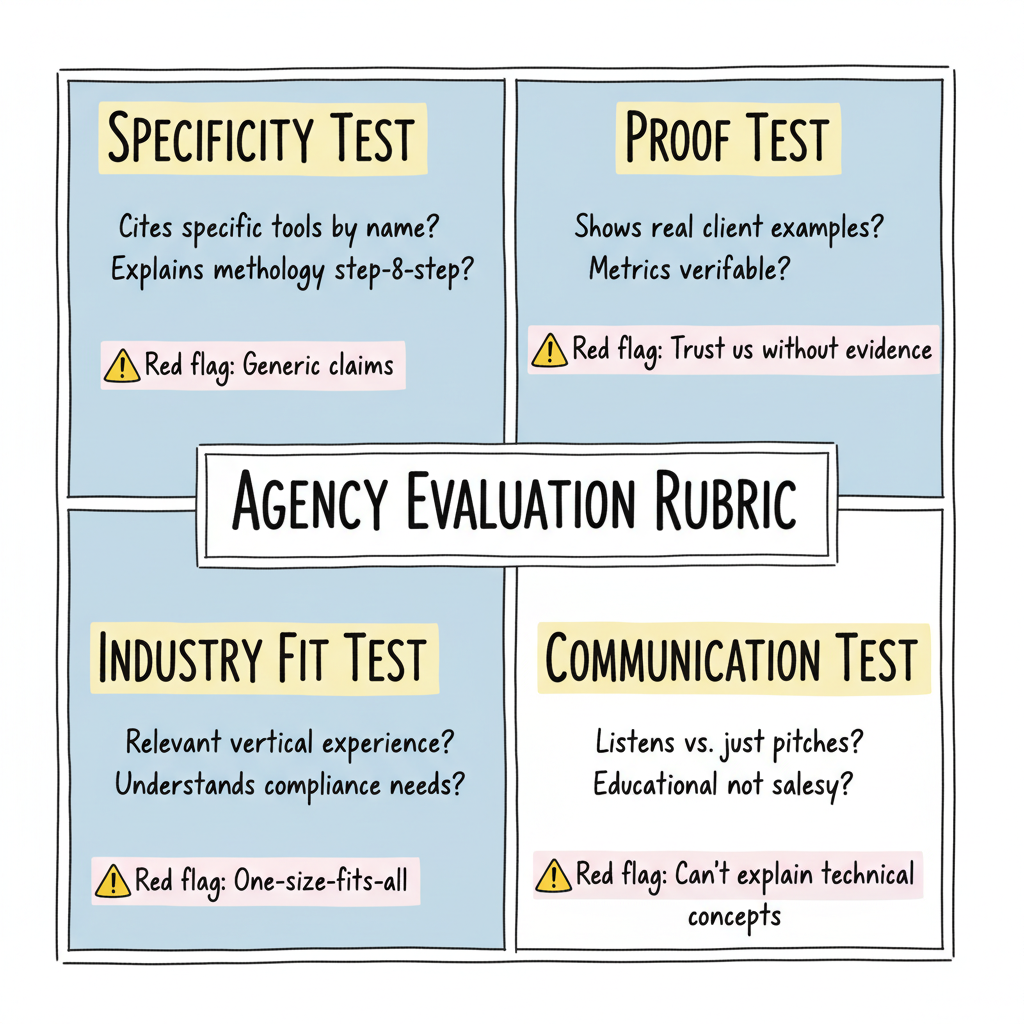
Red Flags During Consultations
Certain responses indicate agencies to avoid.
According to Passionfruit's agency selection guide, ask agencies to show their playbook, explain their measurement approach, and demonstrate how they handle scale. Agencies that can't answer these questions concretely may lack systematic processes. Whether you're evaluating enterprise AEO services or smaller providers, the principles remain the same.
Warning signs:
Red Flag | What It Indicates |
Guarantees specific rankings | Overpromising (impossible to guarantee) |
No AI visibility proof | May not have real AEO experience |
Won't explain methodology | Hiding lack of process |
Pricing before understanding needs | Cookie-cutter approach |
No questions about your business | Not focused on your specific goals |
Cannot explain citation and sentiment monitoring process | Lacks the infrastructure to track whether optimizations are working across AI platforms |
No multimedia content strategy | Missing video, podcast, and UGC optimization for AI -- all of which feed into how LLMs build brand understanding |
Post-Consultation Evaluation
Structured comparison enables objective decision-making.
According to ThinkPod Agency's SEO state analysis, ask each agency for proof links, a first-60-days plan, and a sample report. Then score them on strategy clarity, technical depth, content systems, measurement, and communication. The best fit can explain what they'll change, why it matters, and how it will be tracked.
Demand a 90-Day Roadmap and Measurable Milestones
Top AEO agencies deliver a first-90-days roadmap after the consultation, broken into three clear phases:
Phase | Timeline | Key Deliverables |
Discovery & Audit | Weeks 1-2 | AI visibility audit, prompt testing baseline, competitive citation analysis, structured data review |
Implementation Sprint | Weeks 3-8 | Schema deployment (FAQ, HowTo, Organization, Product, Service), content optimization for answer-first formatting, entity clarity improvements |
Measurement & Iteration | Weeks 9-12 | LLM Share of Voice tracking, citation and sentiment monitoring, quarterly milestone check-ins |
If an agency cannot articulate a phased timeline with specific deliverables, that is a serious red flag. Ask for quantified case studies -- top agencies can show 8x to 10x AI visibility improvements within six months. For detailed guidance on structuring your implementation phases, see our AEO implementation roadmap. You can also track progress against industry benchmarks using the right AEO metrics and KPIs.
Comparison scorecard:
Evaluation Factor | Agency A | Agency B | Agency C |
AI visibility proof (1-5) | |||
Technical depth (1-5) | |||
Industry experience (1-5) | |||
Communication quality (1-5) | |||
Pricing fit (1-5) | |||
90-day roadmap quality (1-5) | |||
Total Score |
Key Takeaways
Effective AEO consultations require preparation and strategic questioning:
- Prepare before meeting - Audit current AI visibility, identify competitors, define goals
- Run prompt tests - Establish your baseline LLM Share of Voice across ChatGPT, Gemini, Copilot, and Perplexity
- Ask specific questions - Request schema strategies, tool details, and proof of results
- Evaluate response quality - Specificity, proof, industry fit, and communication style
- Watch for red flags - Guarantees, vague methodology, no AI visibility evidence, no citation monitoring
- Demand a 90-day roadmap - Phased timeline with measurable milestones and quantified case studies
- Score systematically - Use consistent criteria to compare agencies objectively
According to Elsner Technologies, most top AEO service providers offer initial assessments showing current AI visibility and improvement opportunities. Request these assessments from multiple agencies to compare their analytical approaches alongside their consultation quality. Deploying effective AEO optimization software requires the right agency partner to maximize results.
Frequently Asked Questions About AEO Consultations
What Should I Prepare Before an AEO Services Consultation?
Before your consultation, run prompt tests across ChatGPT, Google Gemini, Perplexity, and Microsoft Copilot using queries your customers would ask. Record whether your brand appears, its position, and the accuracy of citations. Gather your current schema markup inventory, Google Search Console data, and a list of your top three competitors. This preparation gives you a baseline LLM Share of Voice to discuss with the agency.
What Is LLM Share of Voice and Why Should I Ask About It?
LLM Share of Voice measures how frequently AI platforms like ChatGPT, Gemini, and Copilot cite your brand compared to competitors when answering relevant queries. It is the AEO equivalent of traditional search visibility. During a consultation, ask the agency how they measure and track this metric, because it is the clearest indicator of whether their optimization efforts are actually improving your AI visibility.
How Long Does It Take to See Results from AEO Services?
Most reputable AEO agencies structure engagements around a 90-day roadmap. The first two weeks focus on auditing your AI visibility and competitive citations. Weeks three through eight involve implementing schema markup, optimizing content for answer-first formatting, and improving entity clarity. Results typically become measurable by weeks nine through twelve, with top agencies reporting 8x to 10x improvements in AI citation frequency within six months.
What Specific Schema Types Should an AEO Agency Implement?
A capable AEO agency should implement FAQ schema for question-based content, HowTo schema for process and tutorial pages, Organization schema to strengthen your knowledge graph presence, and Product or Service schema for commercial pages. Ask the agency which types they prioritize and why -- the answer reveals whether their approach is templated or tailored to your content architecture and business model. For more detail, see our guide on structured data for AI search.