
Hiring an Answer Engine Optimization (AEO) agency requires a clear contract that defines expectations, deliverables, and success metrics. Unlike traditional SEO contracts with established norms, AEO agreements cover newer services with different measurement approaches. This guide helps you understand what to expect and how to negotiate an AEO services contract that protects your interests.
Why AEO Contracts Differ from Traditional SEO Agreements
The landscape of search has shifted dramatically. Over 58% of Google searches now end without a click — these zero-click searches mean users get answers directly from search results or AI-generated responses. This fundamental change reshapes what agencies must deliver. If you are new to this space, our answer engine optimization guide provides a comprehensive overview of AEO principles.
Voice search platforms like Alexa, Siri, and Google Assistant serve single-answer responses, making citation placement — not just ranking — the primary goal. AEO agencies must optimize for the knowledge graph, building entity relationships that AI systems use to select authoritative sources for their answers.
Traditional SEO contracts focus on deliverables like keyword rankings and organic traffic growth. AEO contracts, by contrast, must define deliverables around citation rate, entity recognition, knowledge graph presence, and AI platform coverage. Standard SEO contract templates are insufficient for AEO engagements because the success metrics, tooling, and optimization techniques are fundamentally different.
Standard AEO Contract Components
A comprehensive AEO services contract should include several essential sections.
Scope of Services
The scope defines exactly what the agency will deliver. For AEO services, expect coverage of:
AI visibility auditing — Initial assessment of your brand's current presence across ChatGPT, Perplexity, Google AI Overviews, and other AI platforms
Content optimization — Restructuring existing content for AI extraction and citation
Entity optimization — Improving how AI systems recognize and understand your brand
Schema implementation — Adding structured data markup that helps AI systems process your content
Content Volume and Production Expectations
AEO agencies must produce content at higher velocity than traditional SEO to build topical authority across AI training data. Top AEO agencies produce 20 or more optimized articles per month for mid-tier clients, while enterprise clients may require 40 or more pieces monthly.
Content production should include pillar articles, supporting cluster content, FAQ expansions, and structured data annotations. Content optimization for AI also involves content clustering — grouping related topics so AI systems recognize comprehensive coverage of a subject area, which strengthens entity signals.
Your contract should specify monthly content volume, who provides subject matter expertise, and revision cycles. Without clear content production terms, agencies may under-deliver on the volume needed to build the topical authority that AI systems reward with citations.
Citation building — Developing strategies to earn mentions from authoritative sources
Monitoring and reporting — Tracking AI citation frequency and brand mentions across platforms
Ensure the contract specifies which AI platforms are covered. Some agencies focus only on Google AI Overviews while others include ChatGPT, Perplexity, Claude, Bing Copilot, and voice search assistants like Alexa and Google Assistant. Voice search optimization is particularly important because voice assistants typically deliver a single answer, making citation placement critical.
Deliverables and Timelines
Clear deliverables prevent scope disputes. Standard AEO deliverables include:
Deliverable | Typical Timeline |
AI visibility audit report | Month 1 |
Optimization roadmap | Month 1 |
Schema implementation | Months 1-2 |
Content optimization (priority pages) | Months 2-4 |
Monthly performance reports | Ongoing |
Quarterly strategy reviews | Every 3 months |
Contracts should specify deliverable format—written reports, spreadsheet audits, or dashboard access—and how deliverables will be submitted. Before signing, consider conducting an AEO technical audit to understand your baseline visibility.
Performance Metrics
AEO metrics differ from traditional SEO. The contract should define:
Citation tracking — How will the agency measure AI mentions? Which tools or methods will they use?
Platform coverage — Which AI platforms will be monitored?
Baseline establishment — How will current visibility be documented before optimization begins?
Success criteria — What constitutes meaningful improvement?
Share of voice tracking — Your contract should define how the agency measures your brand's share of voice across AI platforms. Share of voice quantifies the percentage of AI-generated responses in your category that mention your brand versus competitors. Require monthly share-of-voice benchmarks with quarter-over-quarter improvement targets. For a deeper look at which AI visibility metrics to track, see our dedicated guide.
Featured snippet capture rate — Track how many featured snippets your content holds, as these directly feed AI answer engines. Contracts should set targets for featured snippet acquisition in your priority keyword categories.
Because AEO measurement tools are still maturing, expect less precision than traditional SEO contracts. Agencies should explain their methodology clearly rather than promising exact metrics.
Pricing Models for AEO Services
AEO pricing varies by agency size, service depth, and market positioning.
Monthly Retainer
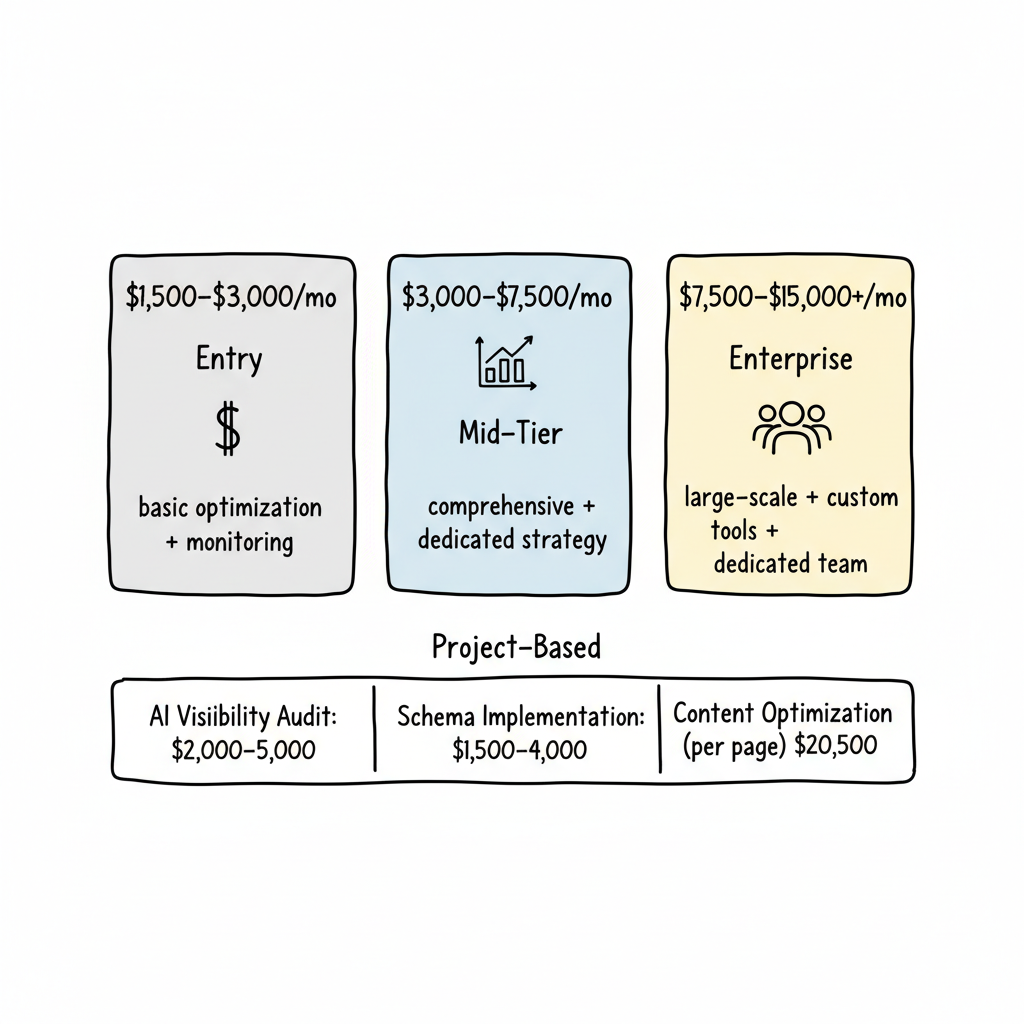
Most AEO agencies use monthly retainer pricing. Expect these ranges:
- Entry-level packages: $1,500-$3,000/month for basic optimization and monitoring
- Mid-tier packages: $3,000-$7,500/month for comprehensive optimization with dedicated strategy
- Enterprise packages: $7,500-$15,000+/month for large-scale optimization with custom tools and dedicated teams
Retainers typically require 6-12 month minimum commitments because AEO results take time to materialize as AI systems update their training data.
Project-Based Pricing
Some agencies offer project-based AEO work:
- AI visibility audit: $2,000-$5,000
- Schema implementation: $1,500-$4,000
- Content optimization (per page): $200-$500
Project pricing works for specific needs but limits ongoing optimization benefits.
Performance-Based Elements
Some contracts include performance incentives tied to citation improvements. Approach these carefully—AEO results depend on factors outside agency control, and measurement remains imprecise.
Setup Fees and Onboarding Costs
Most AEO agencies charge one-time setup fees separate from monthly retainers. For SMB engagements, expect setup fees in the $2,500-$5,000 range. Enterprise accounts typically pay $5,000-$12,000 or more for onboarding. See our AEO pricing benchmarks for detailed comparisons across agency tiers.
Setup fees typically cover an initial content audit, AI visibility baseline assessment, schema audit, competitive analysis, and strategy development. Ask whether setup fees are credited toward the first month's retainer or billed separately — this is a common negotiation point. Some agencies waive setup fees entirely for clients who commit to 12-month engagements, which can be an effective negotiation lever.
Key Terms to Negotiate
Several contract terms deserve careful attention.
Contract Duration and Termination
Minimum commitment: 6-12 months is standard, but negotiate flexibility. Some agencies accept 90-day trial periods before longer commitments.
Termination clauses: Look for reasonable exit terms—30-60 days notice with prorated refunds for prepaid services. Avoid contracts requiring payment through the entire term if you terminate early.
Auto-renewal: Ensure contracts require written consent for renewal rather than automatic continuation.
Intellectual Property and Data
Content ownership: Confirm you own all content the agency creates or modifies. This includes optimized content, schema markup, and documentation.
Data access: Ensure you retain access to all tracking data, reports, and analytics even after the contract ends.
Tool access: If the agency uses proprietary tools, clarify whether you get continued access to data generated by those tools.
Reporting and Communication
Report frequency: Monthly reports are standard. Ensure reports include methodology explanations, not just data.
Meeting cadence: Establish regular check-ins—monthly for most engagements, more frequently during active implementation phases.
Response times: Define expected response times for questions and requests.
Liability and Guarantees
Realistic expectations: No agency can guarantee specific AI citation results. AI systems operate independently, and no optimization strategy controls their recommendations.
Avoid guarantees: Be skeptical of agencies promising specific citation counts or ranking improvements. These claims suggest either inexperience or dishonesty.
Liability limits: Standard contracts limit agency liability to fees paid. This is reasonable given AEO's experimental nature.
Red Flags to Avoid
Watch for warning signs in AEO contracts:
Guaranteed results — No agency controls AI system behavior. Promises of specific citation counts or "first position" in AI responses indicate unrealistic expectations.
Vague deliverables — Contracts listing only "AEO services" without specifics leave room for disputes. Require detailed deliverable descriptions.
No measurement methodology — If the agency cannot explain how they'll track results, they may not have robust processes. Look for agencies that use proven AI search optimization tools for tracking and measurement.
Excessive lock-in — Multi-year commitments or harsh termination penalties suggest the agency relies on contractual constraints rather than results to retain clients.
Hidden costs — Ensure tool costs, content creation fees, setup fees, and additional services are included or clearly disclosed as separate charges. Ask for a complete fee schedule that itemizes onboarding costs, content production overages, and any platform-specific tool licensing. Some agencies quote low retainers but charge $5,000+ in undisclosed setup fees.
AEO Contract Considerations for B2B Buyers
For AEO for B2B companies, contract terms require additional scrutiny because B2B and B2B SaaS sales cycles depend heavily on AI-assisted research by procurement teams and decision-makers.
Compliance requirements matter in regulated industries. Healthcare, finance, and legal buyers need contracts that specify HIPAA, SOC 2, or industry-specific data handling requirements for any content the agency produces or optimizes on their behalf.
Scalability clauses are essential. Your contract should define how services scale up during product launches or scale down during budget cuts, with pre-agreed rate adjustments for each scenario.
B2B buyers should also require core web vitals as a technical deliverable — AI crawlers favor technically performant sites, and poor site speed can undermine even the best content optimization efforts.
Finally, backlink and citation-building deliverables should appear as separate line items in B2B contracts. Authority signals carry disproportionate weight in niche B2B categories where fewer authoritative sources compete for AI citations.
Questions to Ask Before Signing
Before finalizing an AEO contract, get clear answers to:
- What AI platforms do you monitor and optimize for?
- How will you establish my current AI visibility baseline?
- What tools do you use for citation tracking?
- What specific deliverables will I receive each month?
- How long should I expect before seeing measurable improvements?
- What happens to my data and content if we end the engagement?
- Can you share results from similar clients (with permission)?
- Can you share case studies from clients in a similar industry, including before-and-after AI visibility metrics?
- What is your monthly content production volume, and how do you determine the right volume for my category?
- How do you build topical authority and what backlink acquisition strategies do you include in the standard engagement?
Reputable agencies answer these questions directly with specific details rather than vague assurances. Understanding the history of AEO can also help you evaluate whether agencies have genuine expertise in this evolving field.
Sample Contract Structure
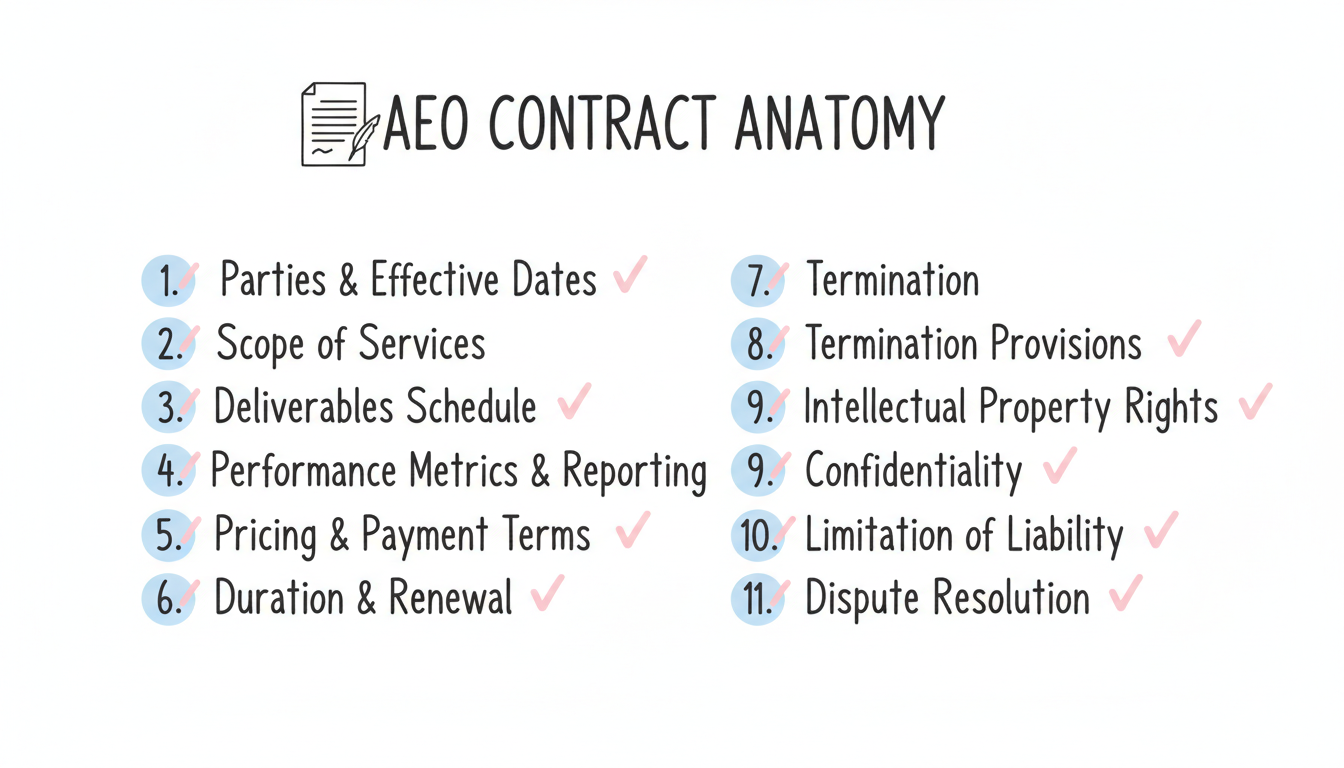
A well-organized AEO contract follows this structure:
- Parties and effective dates
- Scope of services (detailed list of covered activities)
- Deliverables schedule (specific items with timelines)
- Performance metrics and reporting (measurement methodology)
- Pricing and payment terms (amounts, schedule, late payment terms)
- Contract duration and renewal terms
- Termination provisions
- Intellectual property rights
- Confidentiality obligations
- Limitation of liability
- Dispute resolution process
- Scalability and change-order provisions (how services expand or contract based on business needs, with pre-agreed rate adjustments)
Review each section carefully. If anything seems unclear, request clarification before signing. Consider how AEO agency selection criteria align with contract terms.
FAQs
Should I Hire an AEO-Only Agency or One That Offers SEO and AEO Together?
Integrated agencies often provide better value because strong SEO foundations support AEO success. However, some specialized AEO agencies bring deeper expertise in AI systems. Evaluate based on your existing SEO situation and the agency's demonstrated capabilities.
What'S a Reasonable Trial Period for AEO Services?
Three to six months provides enough time to implement optimizations and observe initial results. Shorter periods may not allow sufficient time for AI systems to incorporate changes.
How Often Should AEO Contracts Be Renegotiated?
Review and potentially renegotiate annually. AEO practices evolve rapidly as AI platforms change, so contracts should adapt to reflect current best practices and measurement capabilities.
What Are Zero-Click Searches and Why Do They Matter for AEO Contracts?
Zero-click searches occur when users get answers directly from search results or AI responses without clicking through to a website. Over 58% of Google searches now end this way. AEO contracts must account for this shift by defining success metrics around citation visibility and brand mentions rather than traditional click-through rates. Ensure your contract measures AI-generated answer presence, not just organic traffic.
How Much Should I Expect to Pay in AEO Setup Fees?
AEO setup fees typically range from $2,500 for small business engagements to $12,000 or more for enterprise accounts. These one-time costs cover initial content audits, AI visibility baselines, competitive analysis, and strategy development. Negotiate whether setup fees apply toward your first month's retainer. Some agencies waive them entirely for longer commitments of 12 months or more.
What Content Volume Should an AEO Contract Specify?
Leading AEO agencies produce 20 or more optimized articles per month for mid-tier clients, with enterprise engagements requiring even higher output. Your contract should specify monthly content volume, content types such as pillar articles and FAQ pages, revision cycles, and who provides subject matter expertise. Higher content production velocity builds the topical authority that AI systems reward with citations.
What Is Share of Voice in AEO and How Should Contracts Define It?
Share of voice in AEO measures the percentage of AI-generated responses in your industry category that reference your brand compared to competitors. Contracts should require monthly share-of-voice reporting with clear measurement methodology, baseline documentation, and quarterly improvement targets. This metric is more meaningful than raw citation counts because it contextualizes your visibility relative to the competitive landscape.