
With zero-click searches now dominating the search landscape, what your AEO agency delivers each month directly determines whether your brand appears in those AI-generated answers. Understanding what monthly deliverables to expect from your AEO agency prevents misaligned expectations and helps evaluate whether you're receiving fair value. This guide details what should arrive in your inbox each month, what quality looks like, and how to hold agencies accountable for consistent delivery.
Monthly Report Components
Every AEO engagement should include monthly reporting that tracks progress and demonstrates value.
Essential monthly report elements:
Component | What It Shows | Why It Matters |
Citation tracking | Where you appeared in AI responses | Core visibility metric |
Platform coverage | ChatGPT, Perplexity, AI Overviews, Google Gemini, Microsoft Copilot, Google AI Mode status | Multi-platform performance |
Competitive comparison | Your share vs. competitors | Relative positioning |
Content performance | Which pages drove citations | Optimization priorities |
E-E-A-T signal tracking | Author authority, backlink quality, trust signals | Source credibility metrics |
Entity optimization progress | Entity mentions, associations, disambiguation fixes | AI entity recognition |
Recommendations | Next month's priorities | Forward momentum |
Reports missing any of these elements indicate incomplete monitoring or reporting shortcuts. Track AEO metrics and KPIs to track to ensure your reporting covers all critical dimensions of AI visibility performance.
What Quality Reports Look Like
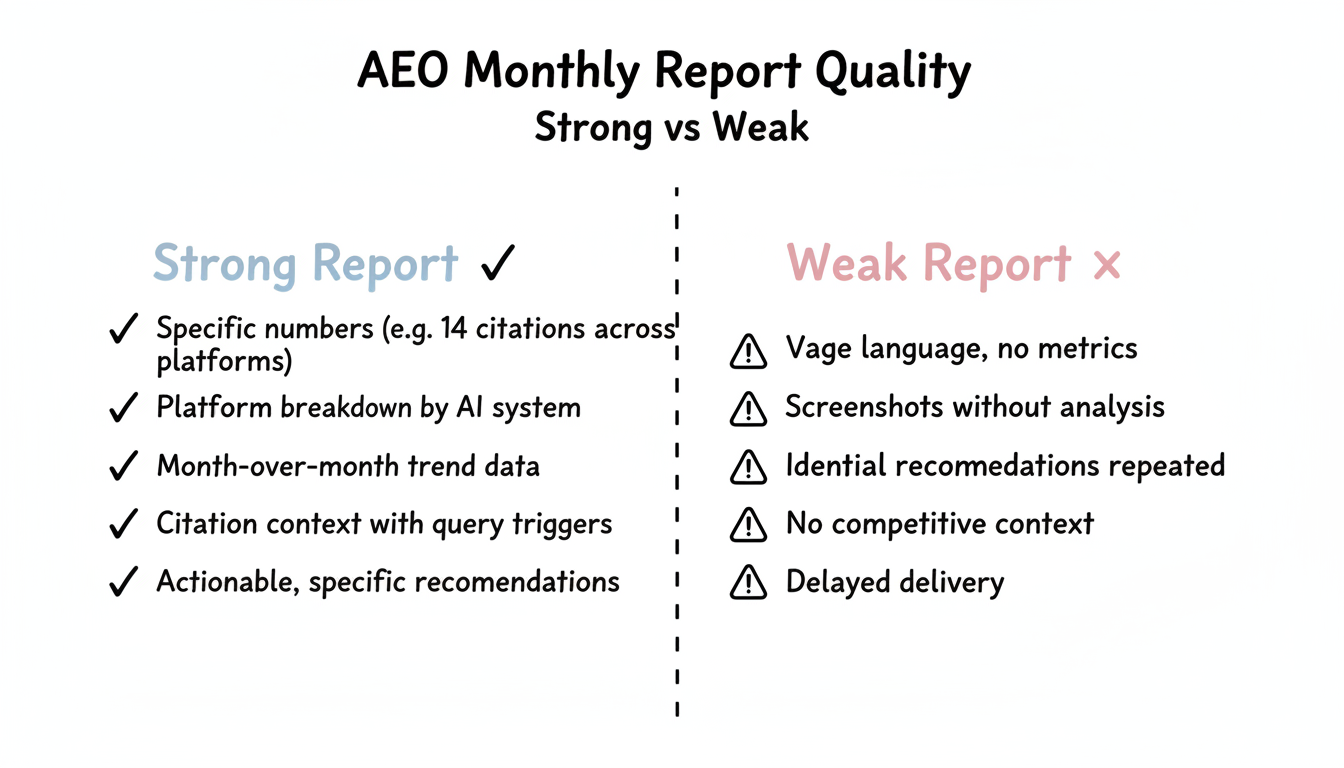
Not all reports deliver equal value. Quality indicators separate thorough reporting from surface-level summaries.
Strong report characteristics:
- Specific numbers: "14 citations across ChatGPT and Perplexity" not "improved visibility"
- Platform breakdown: Results separated by AI system, not aggregated
- Trend data: Month-over-month comparisons showing direction
- Citation context: What queries triggered citations, not just counts
- Actionable insights: Specific recommendations, not generic advice
Weak report indicators:
- Vague language without specific metrics
- Screenshots without analysis
- Identical recommendations month after month
- No competitive context
- Delivery delays beyond the agreed schedule
Monthly Optimization Work
Beyond reporting, monthly retainers should include active optimization work. For agencies following an aeo-implementation-roadmap, expect structured phases with measurable milestones.
Standard monthly optimization deliverables:
Tier Level | Typical Monthly Optimizations |
Starter ($2K-$5K) | 3-5 pages optimized, basic schema updates (FAQPage, Organization JSON-LD) |
Growth ($5K-$10K) | 6-10 pages, technical fixes, FAQ additions, HowTo schema implementation |
Enterprise ($10K+) | 15+ pages, custom implementations, content creation, full JSON-LD schema suite |
What "page optimization" should include:
- Answer-first content restructuring
- Schema markup implementation or updates using JSON-LD format (including FAQPage, Organization, and HowTo schema types)
- Heading hierarchy improvements
- FAQ or structured content additions
- Internal linking adjustments
Ask your agency to itemize which pages were touched each month. Vague claims of "ongoing optimization" without specifics suggest limited actual work.
Entity Optimization Deliverables Your Agency Should Report On
Entity optimization in the AEO context means making your brand, people, and products recognizable entities to AI systems. This goes beyond traditional SEO keywords -- it is about ensuring AI answer engines can identify your brand as a distinct entity within knowledge graphs and understand how it relates to other entities in your industry.
The connection between Google Knowledge Graph, Wikidata, and AI answer engines is direct: when these systems cannot resolve your entity, they will never cite you. AI models like ChatGPT, Gemini, and Perplexity pull entity data from knowledge graphs to verify source authority and relevance before generating answers.
Specific monthly entity optimization deliverables your agency should provide:
- Entity clarity audit: Are your brand entities disambiguated across platforms? Your agency should verify that AI systems do not confuse your brand with similarly named entities.
- Knowledge graph monitoring: Tracking your brand's presence and any changes in Google Knowledge Graph, including new associations, removed entries, or incorrect attributes.
- Entity relationship mapping: Documenting how your brand connects to related entities in your vertical -- industry terms, competitor brands, product categories, and key people. Understanding entity-based SEO and topical authority is essential for building these relationships effectively.
- NLP entity extraction checks: Verifying that AI models correctly identify and categorize your brand entities using natural language processing analysis of your content.
Monthly report line items should include: entity mentions tracked across AI platforms, new entity associations created through content and PR efforts, entity disambiguation fixes completed, and knowledge graph changes detected. AI answer engines that cannot resolve your entity will never cite you -- making this one of the most critical AEO deliverables to monitor.
Structured Data and Schema Markup Deliverables to Expect
Structured data implementation goes beyond generic "schema markup" -- your agency should work specifically with JSON-LD format, which is the standard for AEO-relevant structured data that AI answer engines consume most effectively. Understanding how structured data for AI search works is fundamental to evaluating your agency's technical deliverables.
The specific schema types an AEO agency should implement and maintain monthly include:
- FAQPage schema for question-targeting pages that directly address queries AI systems field
- HowTo schema for process and tutorial content that answer engines frequently cite
- Organization and LocalBusiness schema for entity signals that help AI models identify your brand
- Product and Service schema for commercial pages where AI shopping and recommendation features pull data
- Article and BlogPosting schema with author markup for E-E-A-T signal reinforcement
The monthly structured data audit cycle should cover: validation checks on existing markup, new page markup implementation, schema error monitoring via Google Search Console and rich result testing tools, and rich result tracking to measure how many pages earn enhanced displays.
Structured data directly feeds AI answer engines with machine-readable context, significantly increasing the probability your content gets cited. When an AI system can parse your FAQ schema, it is far more likely to pull your answers than from unstructured content covering the same topic.
A note on E-E-A-T signal reinforcement: author schema with credentials, review schema with aggregate ratings, and trust indicators like organization founding date and industry awards all feed signals that AI models weigh when evaluating whether to cite a source in generated answers.
Digital PR and Authority Building as Monthly AEO Deliverables
Digital PR is an AEO deliverable, not just an SEO tactic. AI answer engines heavily weight authoritative third-party mentions when selecting sources to cite. A brand with extensive coverage in industry publications and authoritative platforms will consistently outperform competitors who rely solely on on-site optimization.
Monthly authority building deliverables your agency should provide:
- Link acquisition: New links from high-authority, topically relevant publications. Your agency should report domain authority of linking sites and topical relevance scores. Effective AEO link building strategies go beyond volume to focus on the sources AI models actually trust.
- Strategic platform presence: Activity on community platforms like Reddit, Quora, and LinkedIn where AI models scrape training and retrieval data. These platforms directly feed the knowledge base answer engines draw from.
- Expert commentary placements: Industry publication guest contributions and expert quotes that establish your brand's thought leadership in AI training data.
- Brand mention monitoring: Tracking both linked and unlinked mentions, with reclamation campaigns to convert unlinked mentions into backlinks.
Topical authority mapping should feed the PR strategy: identifying topic gaps where your brand needs external validation to be considered authoritative by AI systems. Content clustering strategy supports this by creating semantic content clusters that reinforce topical authority signals -- when AI models see consistent, deep coverage of a topic from your brand across multiple authoritative sources, citation probability increases substantially.
Monthly deliverable format should include: new links acquired with domain authority scores, platform mentions tracked, content cluster expansion progress, and competitive authority gap analysis.
Voice Search and Multi-Platform AI Tracking
Your agency's platform tracking should extend well beyond ChatGPT, Perplexity, and AI Overviews. A comprehensive AEO monitoring program covers Google Gemini, Microsoft Copilot, Google AI Mode, and voice assistants including Siri, Alexa, and Google Assistant. Refer to a complete guide to AEO tools for the monitoring platforms that enable multi-surface citation tracking.
Voice search optimization is a critical AEO subset because voice queries are inherently conversational and answer-seeking, making them the purest form of answer engine interaction. When someone asks their smart speaker or phone assistant a question, the response is drawn from the same AI systems and knowledge sources that power text-based answer engines.
Monthly voice search deliverables should include:
- Conversational query targeting: Identifying and optimizing for natural language queries that voice users actually speak, not just type.
- Voice search result monitoring: Tracking which of your content surfaces across voice assistants and how frequently.
- Featured snippet and position-zero tracking: Voice assistants pull heavily from featured snippets, making position-zero monitoring essential for voice visibility.
In a zero-click search landscape, visibility inside AI answers and voice responses is becoming the primary traffic driver. As users increasingly receive answers directly from AI systems without clicking through to websites, your monthly reports should include platform-by-platform citation tracking across all seven or more AI surfaces, voice query ranking snapshots, and trending conversational queries in your vertical.
Communication Expectations
Regular communication beyond reports maintains alignment and allows course correction.
Reasonable communication cadence by tier:
Tier | Meeting Frequency | Response Time |
Starter | Monthly call (30-60 min) | 24-48 business hours |
Growth | Bi-weekly calls | 24 business hours |
Enterprise | Weekly calls | Same-day response |
Meeting content should include:
- Review of recent performance
- Discussion of completed work
- Upcoming priorities and approval
- Strategy questions and adjustments
- Issue identification and resolution
Meetings that only review reports waste time. Quality agencies come prepared with recommendations and seek input on priorities.
What to Expect by Month
Deliverables should follow a progression as the engagement matures.
Month 1 deliverables:
- Full AI visibility audit completed -- evaluating your brand's presence across ChatGPT, Perplexity, Google Gemini, Microsoft Copilot, AI Overviews, and Google AI Mode. This is the baseline that all future progress is measured against. For details on what this assessment covers, see comprehensive AEO audit services.
- Topical authority mapping delivered: a complete map of topics, questions, and keyword opportunities in your target space, including semantic keyword structuring for content planning.
- Baseline metrics documented across all AI platforms
- Strategy and roadmap delivered
- Priority pages identified
- Technical review findings including structured data gaps
Months 2-3 deliverables:
- First round of optimizations complete
- Schema markup implemented using JSON-LD format
- Initial citation tracking established across all major AI platforms
- First substantive report delivered
- Baseline competitive analysis
Months 4-6 deliverables:
- Regular optimization cadence established
- Measurable citation improvements
- Refined strategy based on results
- Expanded content coverage
- Authority building activities initiated
Months 7-12 deliverables:
- Sustained citation growth
- Competitive positioning improvements
- Advanced optimization techniques
- Strategic expansion opportunities
- ROI documentation
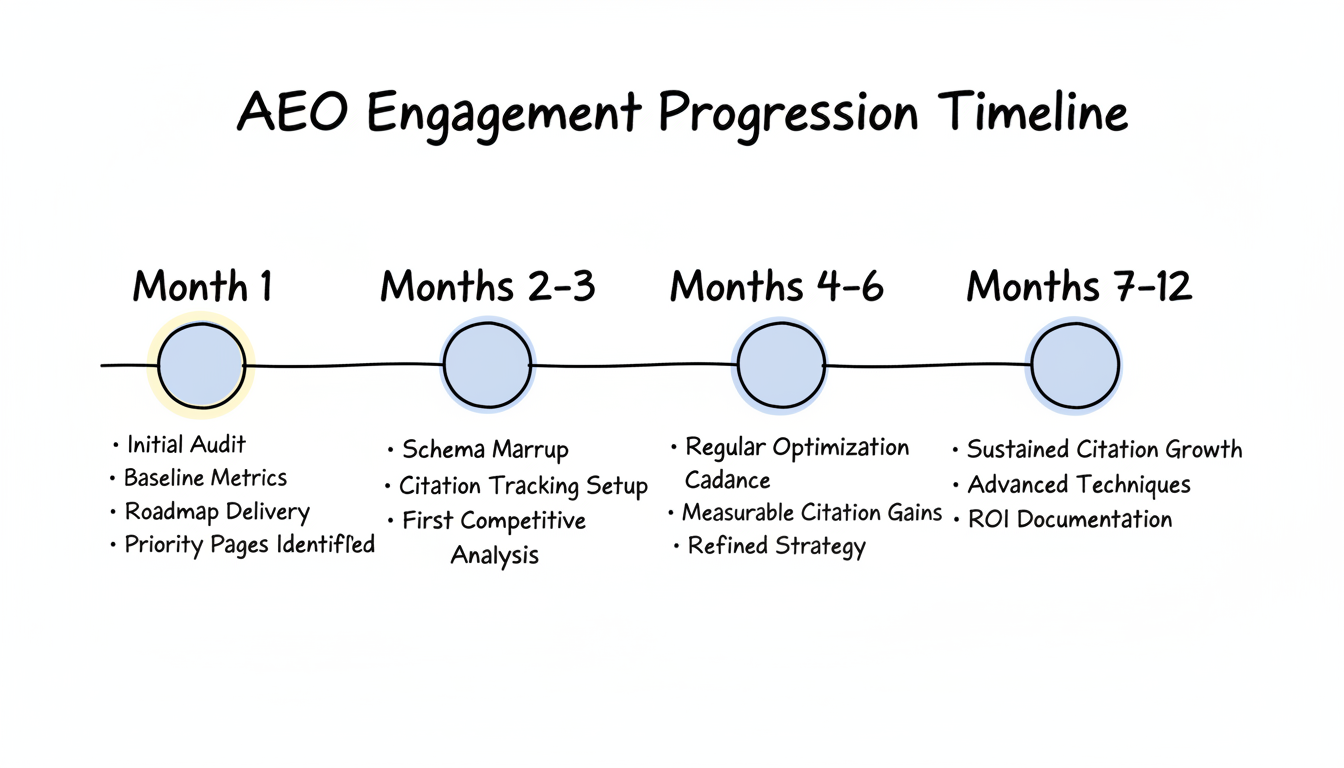
Agencies that can't show progress against these milestones may lack the expertise or resources to deliver results. Effective aeo-training programs ensure team members understand these progression markers and can deliver consistent quality.
Holding Agencies Accountable
Use deliverable expectations to maintain accountability. Agencies leveraging proper aeo-tools can provide transparent tracking and detailed performance reporting.
Monthly accountability checkpoints:
- Did the report arrive on time? - Consistent delays indicate resource problems
- Does the report contain specifics? - Vague reporting suggests measurement gaps
- Were promised optimizations completed? - Request page-by-page confirmation
- Were recommendations actionable? - Generic advice indicates phoned-in work
- Did communication meet expectations? - Missed meetings signal deprioritization
When to raise concerns:
- Two consecutive months of missed deliverables
- Reports lacking specificity despite requests
- No visible progress after 90 days
- Declining responsiveness to communications
- Inability to explain work completed
Red Flags in Monthly Delivery
Certain patterns indicate service quality problems.
Warning signs:
- Report recycling: Nearly identical reports month after month
- Metric inflation: Focusing on vanity metrics rather than citations
- Deflection: Blaming AI platforms for lack of results without evidence
- Scope creep excuses: Claiming work is "in progress" indefinitely
- Communication avoidance: Rescheduled meetings, delayed responses
Appropriate responses:
- Document concerns in writing
- Request specific explanations
- Ask for itemized work logs
- Compare against contractual commitments
- Consider contract review if patterns persist
Getting More from Monthly Deliverables
Maximize value from monthly work through active engagement. Understanding the differences outlined in aeo-vs-seo-vs-geo helps you evaluate whether your agency is focusing on the right optimization strategies.
Client responsibilities:
- Provide timely feedback on reports
- Approve recommendations promptly
- Attend scheduled meetings
- Share internal changes affecting AEO
- Communicate priority shifts
Questions to ask in monthly reviews:
- "What specific pages were optimized this month?"
- "Which optimizations drove the most citation improvements?"
- "What's different about this month's strategy?"
- "Where do competitors have advantages we should address?"
- "What would you do differently with more resources?"
Engaged clients typically receive better service than passive ones.
Documenting Delivery Over Time
Keep records to evaluate long-term agency performance.
Track monthly:
- Report delivery dates
- Citation counts by platform
- Pages optimized (with specifics)
- Meeting attendance
- Recommendation implementation
Quarterly, assess:
- Overall citation trend
- Deliverable consistency
- Communication quality
- ROI trajectory
- Continued fit
Documentation provides evidence for contract renewals, expansions, or difficult conversations about underperformance.
Frequently Asked Questions About AEO Services Deliverables
What Is Included in an AI Visibility Audit?
An AI visibility audit evaluates how your brand appears across all major answer engines including ChatGPT, Google Gemini, Perplexity, Microsoft Copilot, and AI Overviews. It assesses entity recognition, citation frequency, structured data implementation, and content eligibility for AI-generated answers. The audit establishes a baseline for tracking improvements and identifies the highest-impact gaps between your current AI presence and competitor visibility.
How Does Entity Optimization Improve AEO Performance?
Entity optimization ensures AI systems recognize your brand, products, and people as distinct entities in knowledge graphs. When answer engines can clearly identify and disambiguate your entities, they are far more likely to cite you as a source. Monthly entity optimization work includes knowledge graph monitoring, entity relationship mapping, and NLP verification to confirm AI models correctly categorize your brand across platforms.
What Structured Data Types Matter Most for Answer Engine Optimization?
The most impactful structured data types for AEO are FAQPage schema for question-targeted content, Organization and LocalBusiness schema for entity signals, HowTo schema for instructional content, and Product or Service schema for commercial pages. All should use JSON-LD format. Article schema with author markup also reinforces E-E-A-T signals that AI models use to evaluate source trustworthiness when generating answers.
Should AEO Services Include Digital PR and Link Building?
Yes. Digital PR and authoritative link building are essential AEO deliverables because AI answer engines heavily weight third-party validation when selecting sources to cite. Monthly deliverables should include link acquisition from relevant publications, strategic presence on platforms like Reddit and Quora where AI models source information, and brand mention monitoring. Authority building directly influences whether AI systems consider your content trustworthy enough to reference.
Key Takeaways
Know what monthly deliverables to expect and hold agencies accountable:
- Reports should include specifics - Citation counts, platform breakdowns, trends, and actionable recommendations
- Optimization work should be itemized - Specific pages touched, specific changes made
- Communication cadence should match tier - Monthly calls minimum, more frequent at higher tiers
- Progress should follow a trajectory - Month 1 audits, Month 2-3 first results, Month 4+ sustained improvement
- Hold agencies accountable - Document delivery, raise concerns early, compare against commitments
Understanding what should arrive in your inbox each month helps distinguish agencies delivering value from those collecting retainers without corresponding work.