
AEO agency packages vary significantly in what's included versus what costs extra. Understanding the standard package structure helps buyers compare offerings accurately and avoid unexpected costs. This guide decodes typical answer engine optimization services package components so you know exactly what you're purchasing. AEO packages optimize your visibility across ChatGPT, Google AI Overviews, Perplexity, Gemini, and other large language models (LLMs) that are replacing traditional search for millions of users.
Standard AEO Package Tiers
Most agencies structure AEO services into three or four tiers with escalating deliverables and pricing.
Common tier structure:
Tier | Monthly Range | Primary Audience | Platform Coverage | Entity Optimization | Authority Building |
Starter/Basic | $2,000-$5,000 | SMBs, single-domain focus | ChatGPT, Google AI Overviews, Perplexity | Basic entity audit | None |
Growth/Standard | $5,000-$10,000 | Growing companies, multi-platform | ChatGPT, AI Overviews, Perplexity, Gemini | Entity audit + gap analysis | Basic brand mention strategy |
Enterprise/Premium | $10,000-$20,000+ | Large organizations, complex needs | All 6: ChatGPT, AI Overviews, Perplexity, Gemini, Microsoft Copilot, Claude | Full entity architecture + topical authority mapping | Full off-page authority strategy |
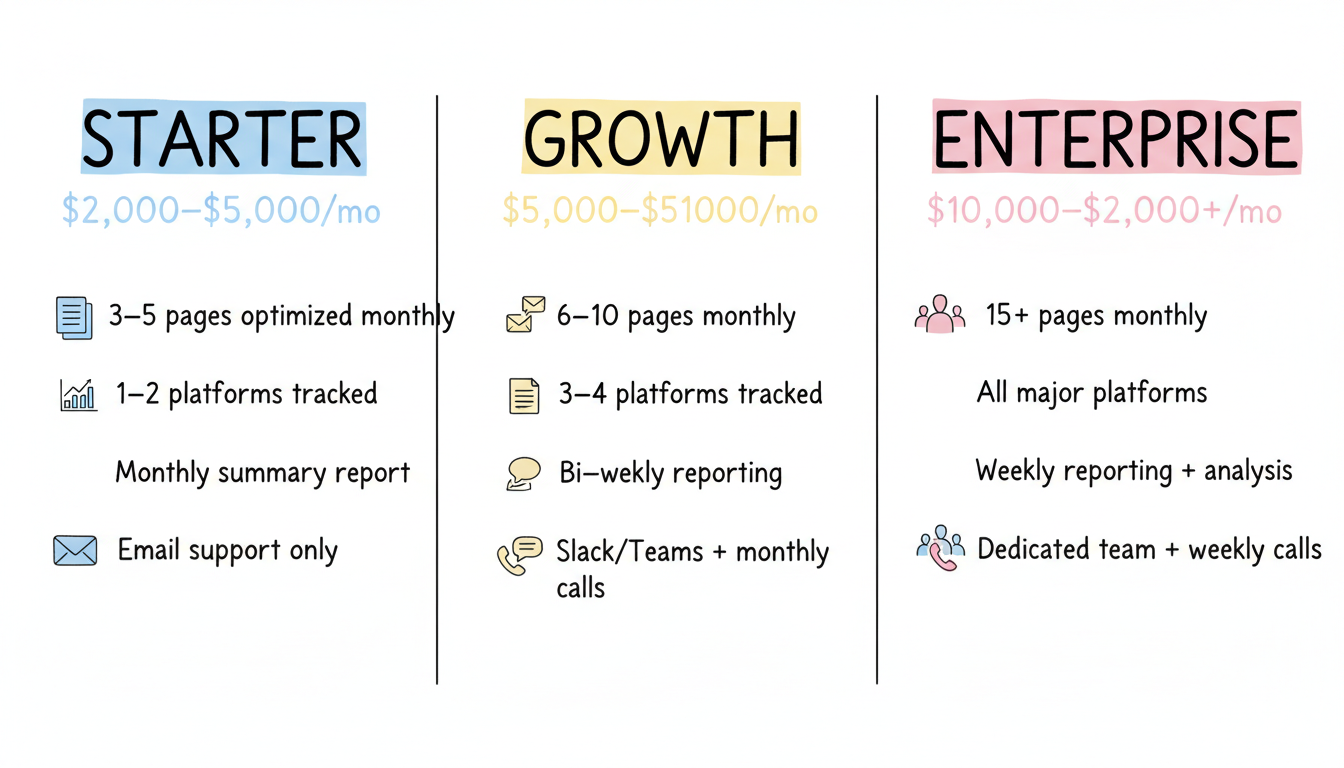
Each tier includes specific deliverables, with some components standard across all tiers and others exclusive to higher packages.
Which AI Platforms Should AEO Packages Cover?
AEO is not one-size-fits-all. Different AI platforms surface answers differently, and your package should reflect the platforms most relevant to your audience. Here are the six major platforms any comprehensive AEO strategy should address.
ChatGPT (OpenAI) is the largest conversational AI platform by user base. Its browsing mode retrieves and cites web sources in real time, making citation optimization critical. Google AI Overviews are integrated directly into Google Search results and carry enormous volume. These overviews weight E-E-A-T signals heavily, making structured data and authority especially important. Perplexity AI uses retrieval-augmented generation (RAG) to pull real-time sources and is the most transparent about citation linking, making it a valuable platform for tracking AEO effectiveness.
Google Gemini offers conversational AI with deep Google Search integration, blending traditional search ranking signals with generative output. Microsoft Copilot is powered by Bing's index and is seeing rapid enterprise adoption, making it particularly relevant for B2B brands. Claude (Anthropic) is growing in adoption among researchers and professionals, representing an increasingly important surface for thought leadership content.
At minimum, starter AEO packages should cover ChatGPT, Perplexity, and Google AI Overviews. Enterprise packages should span all six platforms to ensure comprehensive AI visibility across every major large language model surface.
What'S Typically Included in Every Package
Certain deliverables appear in virtually all AEO packages regardless of tier.
Standard inclusions:
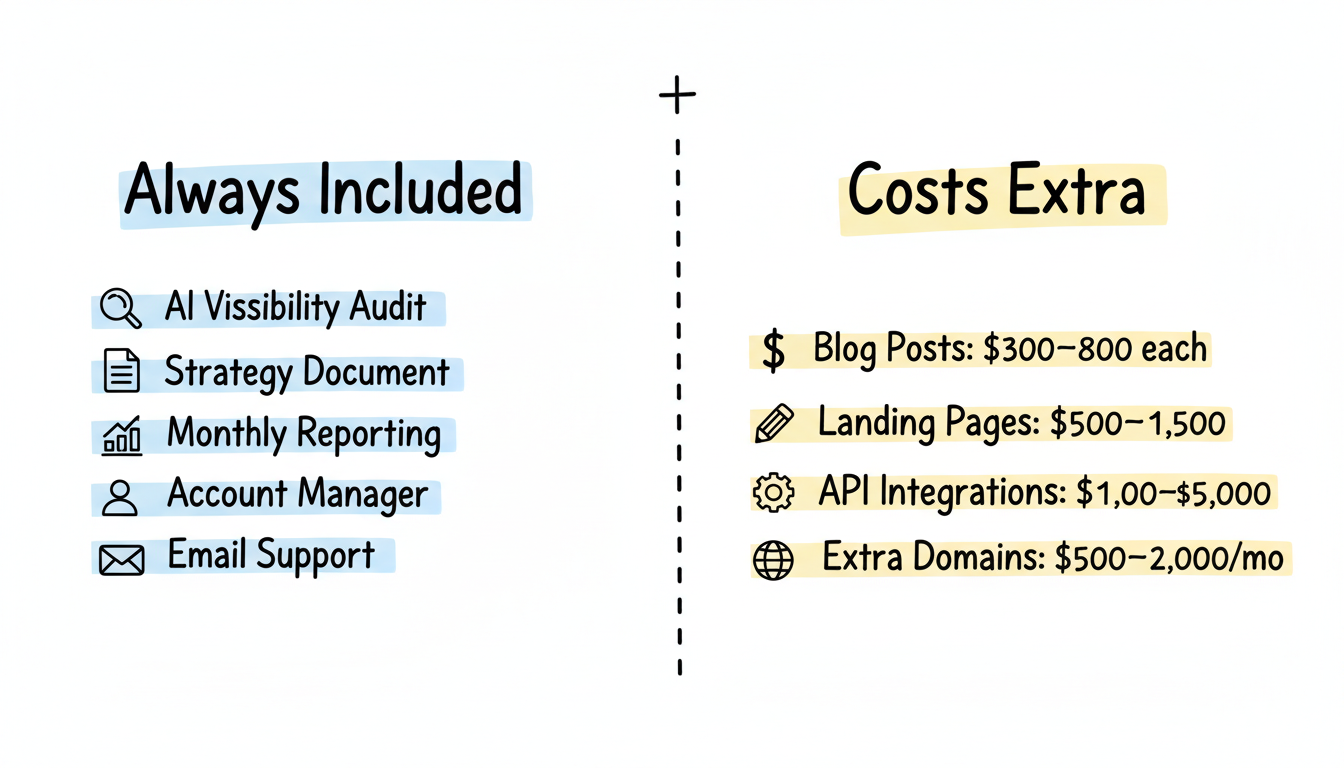
Deliverable | What You Get | Frequency |
AI Visibility Audit | Baseline assessment across platforms | One-time (at start) |
Strategy Document | Prioritized optimization roadmap | One-time + updates |
Basic Reporting | Citation tracking summary | Monthly |
Email Support | Questions answered via email | Ongoing |
Account Management | Dedicated contact person | Ongoing |
These fundamentals establish the baseline. Any package missing these basics should raise concerns about service quality.
Tier-Specific Inclusions
Higher tiers add deliverables that lower packages exclude.
Starter Tier Typically Includes
Content optimization:
- 3-5 pages optimized monthly
- Basic schema markup for optimized pages
- Heading and structure recommendations
Technical:
- robots.txt AI crawler configuration
- Basic technical audit findings
Reporting:
- Monthly summary report
- 1-2 platform coverage
Growth Tier Adds
Content optimization:
- 6-10 pages monthly
- FAQ schema implementation
- HowTo schema for procedural content
- Content briefs for new pages
Technical:
- Comprehensive schema audit
- Site-wide technical recommendations
- XML sitemap optimization
Reporting:
- Bi-weekly reporting
- 3-4 platform coverage
- Competitive tracking (2-3 competitors)
Support:
- Monthly strategy calls
- Slack or Teams channel access
Enterprise Tier Adds
Content optimization:
- 15+ pages monthly
- Custom schema types
- Full content calendar planning
- Expert author positioning strategy
Technical:
- Complete technical implementation
- Advanced structured data testing
- Performance optimization
Reporting:
- Weekly reporting with analysis
- All major platform coverage
- Comprehensive competitive intelligence
Support:
- Weekly strategy calls
- Dedicated team (not shared resources)
- Priority response times
Common Add-Ons (Not Included)
Certain services frequently appear as add-ons across all tiers—even enterprise packages.
Content creation: Most packages cover optimization of existing content. When evaluating AEO optimization techniques for conversion, new content creation typically costs extra.
Add-On | Typical Cost |
Blog posts (1,000+ words) | $300-$800 per article |
Landing pages | $500-$1,500 per page |
FAQ content creation | $150-$400 per FAQ set |
Video script optimization | $200-$500 per script |
Advanced technical work:
- Custom API integrations: $1,000-$5,000+ (project-based)
- CMS migration support: $2,000-$10,000 (project-based)
- Multi-site implementations: Per-site pricing additions
Expanded scope:
- Additional domains: $500-$2,000+ monthly per domain
- International markets: 25-50% increase per market
- E-commerce product optimization: Per-SKU or category pricing
Strategic services:
- Competitive deep-dives: $1,500-$5,000 per analysis
- PR/third-party mention campaigns: $3,000-$10,000+ monthly
- Executive positioning: $2,000-$5,000+ monthly
Additional add-ons to consider:
- Authority Building Add-On: Reddit, Quora, and LinkedIn presence management with strategic brand mention placement. Estimated cost: $2,000-$6,000/month depending on volume and platforms covered.
- AI Visibility Monitoring Add-On: Citation tracking dashboards using tools like Search Atlas, scrunchai.com, or AITrustSignals that monitor when and where AI platforms cite your brand. Estimated cost: $500-$2,000/month.
Entity Optimization: The Core AEO Deliverable Most Agencies Miss
Entity optimization ensures your brand, products, and key concepts are recognized as distinct entities by large language models. While many agencies focus narrowly on schema markup, entity optimization is the broader strategy that makes schema effective.
Entity clarity means ensuring unambiguous naming and consistent descriptions across all your web properties. When LLMs encounter your brand, they should have no confusion about what you represent. Entity linking connects your content to authoritative knowledge bases and structured data for AI search, reinforcing your topical relevance. Entity-based content architecture organizes your site content around topical entities rather than just keywords, building the kind of coherent knowledge structure that AI platforms prefer to cite.
Schema markup is the technical foundation of entity optimization—it tells AI platforms exactly what your content represents. But buyers should expect packages to go beyond FAQ and HowTo schema to include Organization, Product, Service, and Breadcrumb schema types. A strong AEO package includes entity audits, entity gap analysis, and topical authority mapping as core deliverables, not afterthoughts.
When evaluating packages, ask whether the agency distinguishes between schema implementation (the technical layer) and entity optimization (the strategic layer). The agencies delivering the best AEO results address both.
AEO vs GEO: Should Your Package Include Both?
GEO (generative engine optimization) is optimization specifically for generative AI outputs. Understanding how GEO relates to AEO helps buyers evaluate whether their package addresses the full landscape.
AEO is the umbrella term for optimizing across all answer engines. GEO focuses specifically on generative and LLM outputs—the AI-written answers that platforms like ChatGPT and Perplexity produce. The overlap is significant: both target AI-generated answers, and both require structured content and entity clarity.
Where they differ is in the details. GEO may include prompt engineering research to understand how LLMs process and retrieve your content, LLM-specific content formatting optimized for how generative models parse information, and monitoring AI-generated citations for accuracy. Answer-first formatting—structuring content in 40-60 word answer blocks with direct question-answer pairs and Q&A formatting—is a core GEO methodology that should appear in any modern AEO package.
As zero-click experiences grow and AI answers reduce traditional click-through rates, optimizing for citation and visibility within the answer itself becomes critical. Most modern AEO packages implicitly include GEO tactics, but buyers should ask agencies directly whether their package addresses generative outputs specifically or only traditional answer box optimization.
Hidden Costs to Watch For
Some costs appear after contract signing. Ask specifically about these.
Setup fees: Many agencies charge one-time setup fees ($1,000-$5,000) covering initial audit and onboarding. Sometimes waived for longer contracts.
Tool costs: Some packages require you to purchase separate tool subscriptions. Clarify whether tools are included or additional.
Overage charges: Packages often cap deliverables. Additional pages or requests beyond cap incur per-item charges.
Minimum commitments: Many require 6-12 month minimums. Early termination fees can reach 2-3 months of service costs.
Revision limits: Content revisions may be limited. Excessive rounds cost extra.
Questions to Ask Before Signing
Clarify package specifics with these questions:
Scope questions:
- Exactly how many pages are included monthly?
- What happens if I need more pages optimized?
- Which AI platforms do you track and report on?
- Which specific AI platforms does your package optimize for?
- Does your package include entity optimization beyond schema markup?
Cost questions:
- Are there setup or onboarding fees?
- What tool subscriptions are required beyond the retainer?
- What are overage rates for exceeding package limits?
Support questions:
- How many strategy calls are included?
- What's the typical response time for support requests?
- Who specifically works on my account (seniors or juniors)?
Measurement questions:
- How do you measure and report on AI visibility and citation tracking?
Contract questions:
- What's the minimum commitment period?
- What's the cancellation process and any fees?
- Are there annual rate increases built in?
Reading Between Package Lines
Agency packages sometimes obscure value differences. Look for these signals.
Positive indicators:
- Clear deliverable quantities (not vague "optimization services")
- Named platforms included in tracking
- Specific meeting cadence committed
- Transparent add-on pricing
Warning signs:
- "Unlimited" claims (nothing is truly unlimited)
- No clear distinction between tiers
- Deliverables described only in general terms
- Resistance to itemizing what's included
Authority Building and ROI: What Premium AEO Packages Deliver
Premium AEO packages go beyond on-site optimization to build the off-page authority signals that LLMs increasingly rely on for source selection.
Off-page authority building includes establishing and maintaining your brand presence on platforms that AI models actively crawl for training data: Reddit, Quora, LinkedIn, and YouTube. LLMs weight brand mentions on these AI-crawled platforms because they serve as training data sources. A deliberate brand mention strategy—including executive positioning and thought leadership content on third-party platforms—directly influences how AI platforms perceive and cite your brand.
AI visibility monitoring uses specialized tools and dashboards to track when and where AI platforms cite your brand. Tools like AEO tools and software such as Search Atlas, scrunchai.com, and AITrustSignals provide citation tracking across multiple platforms. These dashboards form the foundation of AEO ROI measurement.
ROI measurement for AEO should include a clear framework: AI-sourced traffic attribution using GA4 LLM referral filtering, citation frequency tracking across platforms, and revenue attribution from AI-sourced leads. Industry benchmarks suggest competitors see 3-9x ROI on AI-sourced traffic conversion compared to traditional organic. By tier, expect starter packages to include basic monitoring, growth packages to include active authority building, and enterprise packages to deliver a full attribution dashboard with competitive intelligence.
Frequently Asked Questions About AEO Services Packages
What Are AEO Services and How Do They Differ from Traditional SEO?
AEO (Answer Engine Optimization) services optimize your content to appear as cited sources in AI-generated answers from platforms like ChatGPT, Google AI Overviews, and Perplexity. Unlike traditional SEO, which targets blue-link rankings, AEO focuses on entity clarity, structured data, answer-first content formatting, and authority signals that large language models use to select and cite sources in their responses.
Is AEO Worth the Investment for My Business?
AEO is increasingly worth it as AI-powered search grows rapidly. Agencies report that AI-sourced traffic converts 3-9x higher than traditional organic traffic because users receive pre-qualified, intent-matched answers. Businesses in competitive B2B, SaaS, ecommerce, and professional services verticals see the strongest returns. Start with a basic AEO audit services assessment to evaluate your current AI visibility before committing to a full package.
What Should an AEO Services Package Include at Minimum?
A minimum viable AEO package should include an AI visibility audit, schema markup implementation (FAQ, HowTo, Organization), entity optimization, answer-first content restructuring, and monthly AI citation monitoring across ChatGPT, Google AI Overviews, and Perplexity. Avoid packages that only offer schema markup without entity optimization or that cannot name the specific AI platforms they target.
How Long Does It Take to See Results from AEO Services?
Most AEO campaigns show initial improvements in AI citation frequency within 60-90 days, with meaningful traffic and conversion impact at 4-6 months. Schema markup and structured data changes can influence AI Overviews within weeks, while entity optimization and authority building require sustained effort over 3-6 months. Enterprise packages with aggressive content production and off-page authority building typically see faster results.
Key Takeaways
Navigate AEO package structures effectively:
- Basic components (audit, strategy, reporting, support) should appear in every tier
- Tier differences primarily involve volume (pages optimized) and depth (platform coverage, support access)
- Content creation is almost always extra—packages cover optimization, not creation
- Ask about hidden costs including setup fees, tool costs, overages, and minimums
- Get specifics in writing before signing—vague package descriptions lead to disappointment
Understanding package structures prevents surprises and ensures you're comparing equivalent offerings when evaluating generative engine content strategy providers, reviewing AEO agency pricing and costs, and studying AEO case studies from different agencies.