
Answer engine optimization (AEO) has emerged as one of the fastest-growing disciplines in digital marketing, driven by the rise of AI-powered search experiences. A well-structured AEO services proposal differentiates your agency from competitors while setting clear expectations with prospective clients. Whether you're adding AEO to existing SEO services or launching a dedicated practice, a professional proposal template accelerates client acquisition.
This guide provides a comprehensive AEO proposal framework agencies can adapt for their needs.
Why Zero-Click Search Makes Answer Engine Optimization Services Essential
The search landscape has fundamentally shifted. Research consistently shows that 58% or more of Google searches now end without a click to any website -- a phenomenon known as zero-click search. For brands relying on organic traffic, this trend represents both a threat and an opportunity.
This shift creates urgency for answer engine optimization services as a critical digital marketing discipline. When AI-powered search engines like Google's AI Overviews, ChatGPT, and Perplexity synthesize answers directly in the search interface, the brands being cited in those answers capture visibility even when users never click through. Brands that do not optimize for AI-generated answers lose visibility in these zero-click environments, watching competitors claim the answer box real estate they could have owned.
For agencies, this presents a compelling differentiation opportunity. Traditional SEO proposals miss the zero-click angle entirely, focusing on rankings and click-through rates that tell an increasingly incomplete story. An AEO services proposal that leads with the zero-click search problem immediately positions your agency as forward-thinking. It communicates to prospects that you understand where digital marketing is heading -- not just where it has been. The proposal becomes the vehicle for communicating this urgency and framing your agency as the solution.
Essential Proposal Sections
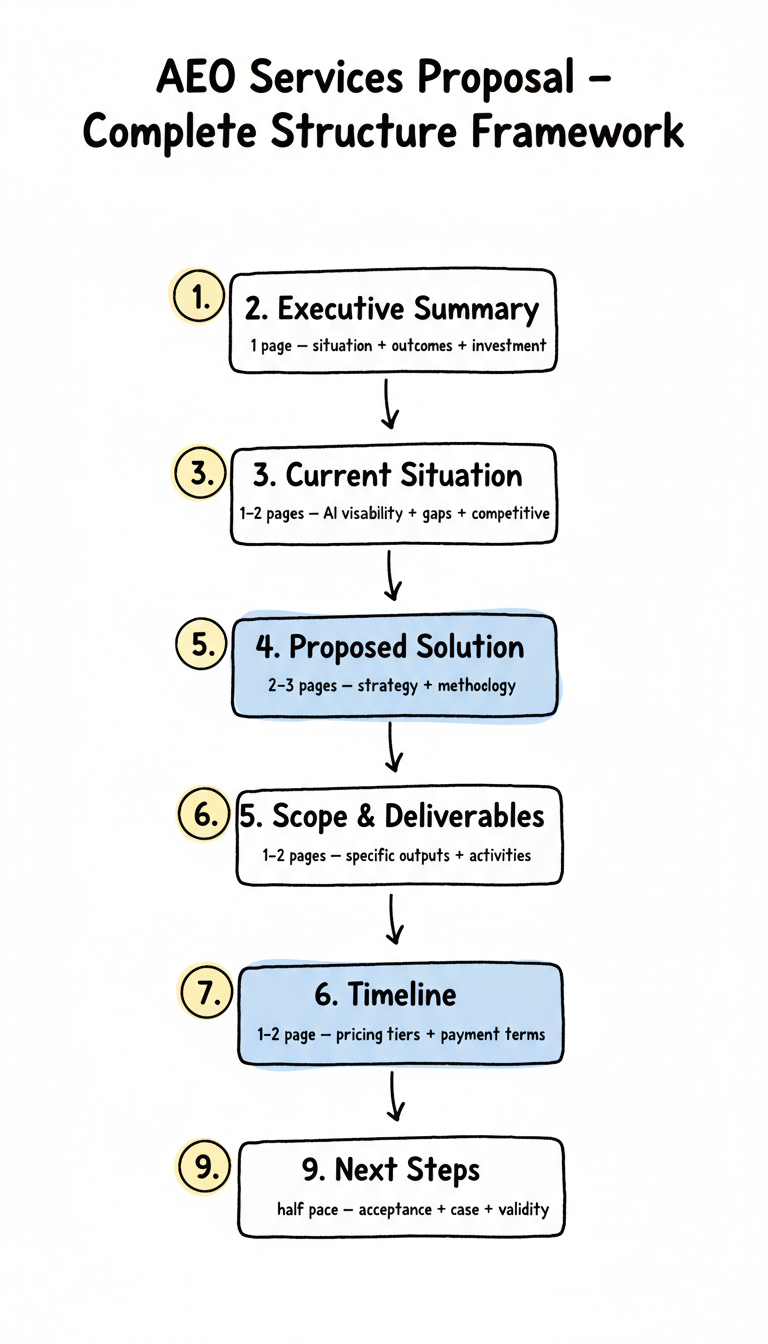
Effective AEO proposals include specific sections that address prospect concerns and demonstrate expertise.
Executive Summary
Open with a brief overview tailored to the prospect's situation.
Your executive summary should lead with the zero-click search problem -- the fact that a growing majority of searches now resolve without a click to any website. This frames answer engine optimization as a revenue-protection strategy, not just a visibility play.
Include:
- Understanding of their current AI visibility challenges
- How your approach addresses their specific needs
- Expected outcomes from engagement
- Investment summary
Keep executive summaries under one page—busy executives read this section first and may skip detailed sections.
Current Situation Analysis
Demonstrate understanding by summarizing the prospect's current position.
Analysis elements:
- Current AI visibility assessment (based on discovery calls or preliminary audit)
- Identified opportunities and gaps
- Competitive positioning in AI search
- Technical barriers affecting visibility
This section proves you've done homework rather than sending a generic template. Before proposing solutions, consider conducting an AEO competitor analysis to identify specific gaps in their current AI search positioning.
Proposed Solution
Detail what you'll deliver to address their challenges.
Solution components:
Strategy development: Outline discovery, audit, and planning phases establishing the foundation.
Technical optimization: Describe infrastructure work enabling AI crawler access and content processing.
Content optimization: Explain how you'll restructure existing content and develop new AEO-focused material. For comprehensive guidance on this process, reference our SearchGPT optimization guide.
Authority building: Detail activities strengthening their entity recognition and credibility.
Monitoring and reporting: Describe ongoing tracking and communication cadence.
Beyond ChatGPT and SearchGPT, ensure your proposal scope covers Microsoft Copilot, Google Gemini, and Perplexity -- the five platforms that collectively represent the majority of AI-powered search traffic.
SERP Features Your AEO Proposal Should Target
An effective AEO proposal must specify which SERP features the engagement will target. Vague references to "improving AI visibility" do not inspire confidence -- prospects want to see that your agency understands the specific formats where AI-sourced answers appear.
Featured snippets are the primary real estate for AI-sourced answers. When Google or another search engine pulls a direct answer from a webpage and displays it above organic results, that is a featured snippet. Your proposal's deliverables section should explicitly reference featured snippet capture as a goal, and your KPIs should include featured snippet win rates for target queries.
People Also Ask (PAA) boxes represent another high-value AEO target. These expandable question-and-answer sections appear in the majority of search results and feed directly into AI answer systems. Agencies should include PAA capture rate as a proposal metric, tracking how many PAA boxes feature the client's content for target queries.
FAQ schema markup is the single most impactful structured data type for AEO because it directly feeds AI answer engines and voice search results. Unlike generic schema markup references, FAQ schema specifically signals question-and-answer content to search engines, increasing the likelihood of being selected as an AI-sourced answer. Your proposal should call out FAQ schema implementation as a dedicated deliverable. For a deeper look at which markup types to prioritize, see our guide on AEO schema markup priorities.
Voice search optimization is a natural extension of AEO deliverables. Voice assistants pull from the same featured snippet and FAQ schema data that powers text-based AI answers. Including voice search optimization in your proposal demonstrates a holistic understanding of how answer engines work across modalities.
Agencies can use this checklist in their proposal's deliverables section:
- Featured snippet optimization for top 20 target queries
- People Also Ask monitoring and content targeting
- FAQ schema implementation across priority pages
- Voice search readiness audit and optimization
- Monthly SERP feature capture reporting
Agencies adding AEO to their service mix should also consider an AEO audit services phase as a precursor to the full engagement, helping prospects understand their current SERP feature footprint before committing to ongoing optimization.
Scope and Deliverables
Provide specific, measurable deliverables prospects can evaluate.
Deliverable examples:
- Comprehensive AEO audit with prioritized recommendations (Week 2)
- Technical implementation plan with schema specifications (Week 3)
- Monthly content optimization of X priority pages
- Bi-weekly visibility monitoring reports
- Quarterly strategy reviews and planning sessions
Specific deliverables justify pricing and create accountability for both parties. Implementation should include knowledge graph SEO implementation to strengthen entity recognition across AI platforms.
Timeline
Visualize the engagement progression.
Typical AEO timeline phases:
Phase 1 (Weeks 1-4): Discovery, audit, and strategy development
Phase 2 (Weeks 5-8): Technical implementation and content optimization foundations
Phase 3 (Ongoing): Continuous optimization, monitoring, and authority building
Include realistic expectations—meaningful AI visibility improvements typically require 2-4 months. Set up proper tracking early using Google Analytics 4 for AI search tracking to measure progress accurately.
Investment
Present pricing clearly with justification.
Pricing presentation options:
- Single comprehensive package
- Tiered options (good/better/best)
- Modular services with add-on pricing
Include:
- What's included at each price point
- Payment terms and schedule
- Additional services pricing if applicable
- Contract duration and renewal terms
About Your Agency
Build credibility with relevant background.
Credibility elements:
- AEO-specific experience and results
- Team credentials and expertise
- Relevant case studies or client results
- Industry recognition or certifications
Focus on AEO expertise specifically rather than general agency capabilities.
Proposal Customization Tips
Generic proposals lose to customized approaches.
Research Before Proposing
Conduct preliminary research before drafting.
Pre-proposal activities:
- Query AI platforms for their brand mentions
- Review their current content structure
- Assess technical AEO readiness
- Identify competitor visibility
This research enables specific recommendations rather than generic promises.
Address Stated Concerns
Reference specific concerns from discovery conversations.
Example: If the prospect mentioned losing traffic to AI-powered search, address that concern directly with your solution approach.
Match Communication Style
Adapt proposal tone to prospect culture.
- Enterprise prospects expect formal, comprehensive proposals
- Startups may prefer concise, action-oriented documents
- Technical buyers want methodology details
- Business buyers focus on outcomes and ROI
Include Relevant Examples
Select case studies matching the prospect's situation.
Relevance factors:
- Similar industry or market
- Comparable company size
- Related challenges addressed
- Applicable results achieved
Proposal Template Outline
Use this structure as your starting framework.
1. Cover Page
- Proposal title
- Client name and date
- Your agency contact information
2. Executive Summary (1 page)
- Situation overview
- Proposed approach
- Expected outcomes
- Investment summary
3. Current Situation (1-2 pages)
- AI visibility assessment
- Identified opportunities
- Competitive landscape
- Technical readiness
4. Proposed Solution (2-3 pages)
- Approach overview
- Strategy framework
- Optimization methodology
- Measurement approach
5. Scope and Deliverables (1-2 pages)
- Specific deliverables
- Activity descriptions
- Excluded items
6. Timeline (1 page)
- Phase breakdown
- Key milestones
- Delivery schedule
7. Investment (1 page)
- Pricing options
- Payment terms
- Additional services
8. About Us (1 page)
- Relevant experience
- Team overview
- Case studies
9. Next Steps (half page)
- Acceptance process
- Contact information
- Validity period
AEO, GEO, and SEO: Positioning Complementary Services in Your Proposal
As AI search matures, agencies need to clearly articulate how different optimization disciplines relate to each other within a single proposal. Prospects increasingly encounter the terms AEO, GEO, and SEO and want to understand what they are paying for.
Generative Engine Optimization (GEO) is the discipline focused on optimizing content for generative AI outputs -- platforms like ChatGPT, Microsoft Copilot, Perplexity, and Google Gemini that generate synthesized answers rather than returning a list of links. While AEO targets answer boxes and featured snippets within search engines, GEO targets these generative AI platforms directly. Both share technical foundations including structured data, entity optimization, and content chunking.
For a detailed breakdown of how these disciplines differ, see our comparison of GEO vs AEO differences.
Agencies should consider including an AI brand visibility audit as a discovery phase deliverable. This audit assesses how the client's brand currently appears across AI platforms -- what answers mention them, how accurately they are represented, and where competitors are cited instead. This audit creates a compelling baseline that justifies the ongoing engagement.
A practical packaging approach is to position AEO as the core service with GEO as an upsell tier. The base AEO engagement covers search engine answer features, while the GEO tier extends coverage to generative AI platforms. This bundling strategy not only provides a clear growth path for the client but also improves conversion rate optimization on the proposal itself -- prospects who see a logical tier structure are more likely to select the mid or upper tier than a single flat-rate option.
Tools and Measurement: What to Include in the Reporting Section
The reporting section of your AEO proposal is where you demonstrate measurement rigor. Prospects want to know exactly how you will track progress and justify continued investment. Here are the key elements to include.
Google Search Console is the foundational free tool for tracking AEO performance. Specifically, it provides search appearance data showing when your content appears as a featured snippet, click-through rates segmented by query type, and query intent patterns that reveal which informational queries are driving impressions. Your proposal should reference Google Search Console by name as the primary reporting data source.
Query intent research methodology should be specified in your proposal. AEO proposals should explain how you will classify queries by intent -- informational, navigational, and transactional -- to prioritize content optimization efforts. Informational queries are the primary AEO targets because they trigger answer features most frequently. Include this classification framework in your deliverables to show methodological depth. For tracking AEO metrics and KPIs, consider building dashboards that separate performance by intent category.
Content chunking strategy should appear as a technical deliverable in your proposal. Content chunking is the practice of structuring content into discrete, self-contained answer blocks that AI engines can extract cleanly. Rather than writing long-form prose, content is organized into question-answer pairs, definition blocks, and step-by-step segments that map directly to the formats answer engines prefer. Agencies should describe their chunking methodology in the proposal to demonstrate technical sophistication.
Long-tail keyword tracking deserves a dedicated mention in your reporting framework. AEO success often shows up first in long-tail keyword rankings because these specific, lower-volume queries are where answer features appear most frequently. Your proposal should set expectations accordingly -- early wins will come from long-tail queries before expanding to higher-volume head terms.
Mobile optimization must be accounted for in all AEO technical recommendations. Mobile-first indexing means that Google evaluates the mobile version of content for ranking and answer feature eligibility. Your proposal's technical audit section should include mobile rendering checks, page speed analysis, and responsive structured data validation to ensure AEO optimizations perform on mobile devices.
Common Proposal Mistakes
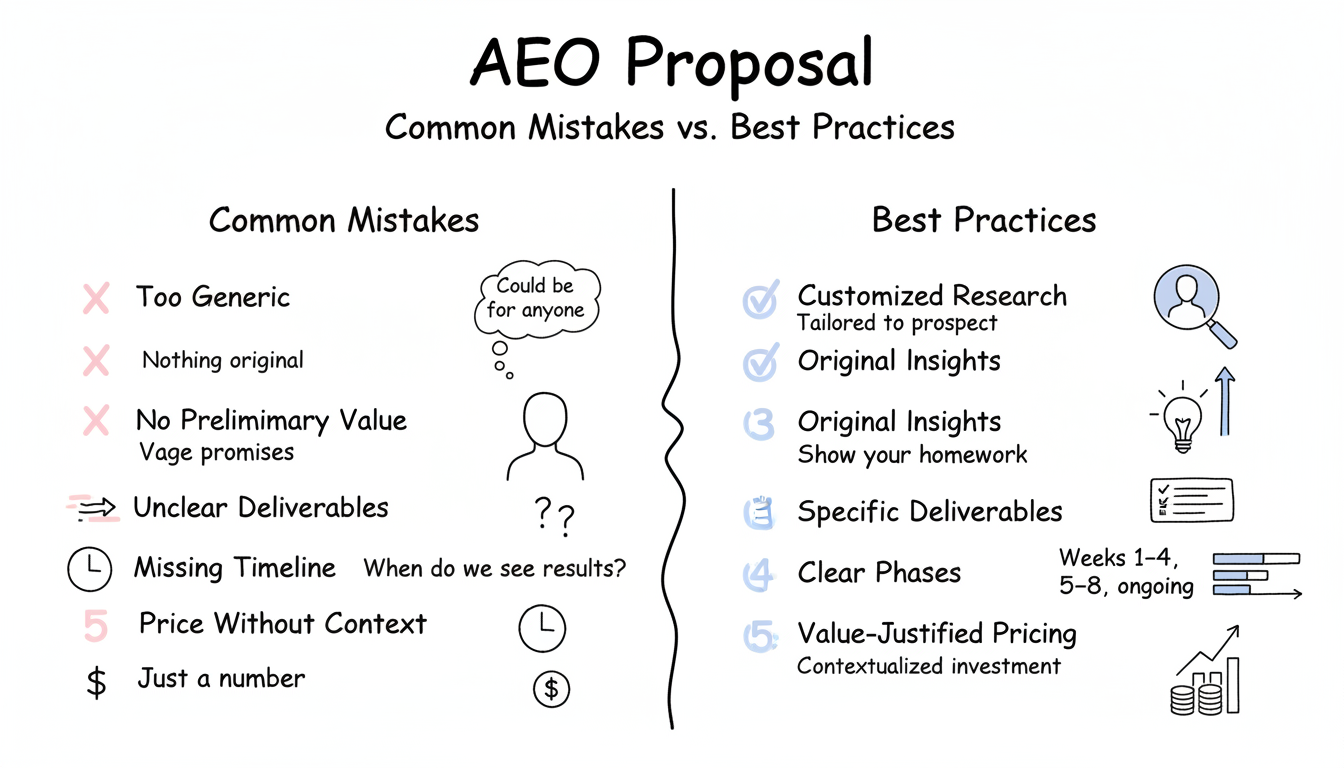
Avoid these errors that reduce win rates.
Too generic: Proposals that could apply to any client suggest lack of attention and expertise.
No preliminary value: Proposals lacking any original insight give prospects nothing they couldn't find elsewhere.
Unclear deliverables: Vague promises like "ongoing optimization" raise concerns about accountability.
Missing timeline: Prospects need to understand when they'll see results and deliverables.
Price without context: Numbers without justification invite price shopping rather than value comparison.
Schema Markup in Your AEO Proposal
While your proposal should mention structured data broadly, call out FAQ schema and How-To schema by name as the highest-impact markup types for AEO. FAQ schema in particular signals direct question-answer content to AI engines, making it the single most actionable structured data recommendation in any AEO proposal. For a comprehensive look at which markup types to prioritize, reference our guide on AEO schema markup priorities.
Frequently Asked Questions About AEO Service Proposals
What Should an Answer Engine Optimization Services Proposal Include?
A strong answer engine optimization services proposal should include an executive summary framing the zero-click search problem, a detailed scope covering featured snippets, People Also Ask optimization, and FAQ schema implementation, a timeline with milestones, pricing tiers, and a reporting plan built around Google Search Console data and AI brand visibility metrics. The proposal should also specify which AI platforms (ChatGPT, Microsoft Copilot, Perplexity) the engagement covers.
How Is an AEO Proposal Different from a Traditional SEO Proposal Template?
While an SEO proposal template focuses on rankings, backlinks, and organic traffic, an AEO proposal centers on AI visibility -- how often and how accurately a brand appears in AI-generated answers. AEO proposals include deliverables like content chunking, FAQ schema markup, and query intent research that traditional SEO proposals typically omit. The measurement framework also differs, tracking AI citation rates alongside conventional metrics.
Should Agencies Bundle AEO and GEO Services in the Same Proposal?
Many agencies find success offering AEO as the core service and generative engine optimization (GEO) as an add-on tier. AEO focuses on search engine answer features like featured snippets, while GEO targets generative AI platforms like ChatGPT and Microsoft Copilot directly. Bundling both in a single proposal demonstrates comprehensive AI search expertise and increases average deal value.
What Tools Should an AEO Proposal Recommend for Tracking Results?
At minimum, your AEO proposal should reference Google Search Console for search appearance tracking, a SERP monitoring tool for featured snippet and People Also Ask capture rates, and an AI visibility platform for tracking brand mentions across ChatGPT, Microsoft Copilot, and Perplexity. Include mobile optimization auditing tools as well, since mobile-first indexing directly affects AEO performance.
FAQs
How Long Should an AEO Proposal Be?
Eight to twelve pages typically balances thoroughness with readability. Enterprise proposals may run longer; smaller engagements may be shorter.
Should I Include Pricing Options?
Options (typically three tiers) increase close rates by giving prospects control while anchoring perception around your preferred option.
How Quickly Should I Send Proposals After Discovery Calls?
Within 48-72 hours while conversations remain fresh. Faster proposals demonstrate responsiveness and organization.
Consider noting in your proposal's next-steps section that generative engine optimization (GEO) services can be layered on as a Phase 2 engagement, giving the client a clear growth path beyond initial AEO implementation.