
When evaluating AEO agencies, marketing claims tell one story—client reviews tell another. Understanding where to find authentic AEO services reviews, what patterns indicate quality (or problems), and how to interpret feedback helps identify providers likely to deliver results. If you're also comparing top answer engine optimization companies, reviews are the essential counterbalance to marketing positioning.
This guide examines client experiences with AEO services and shows you how to use reviews effectively in your evaluation process. Note that some providers market these services as Generative Engine Optimization (GEO) rather than AEO—the review evaluation principles apply equally regardless of terminology.
Where to Find Authentic AEO Reviews
AEO-specific reviews remain less abundant than traditional SEO reviews because the discipline is newer. Knowing where to look increases your chances of finding relevant feedback.
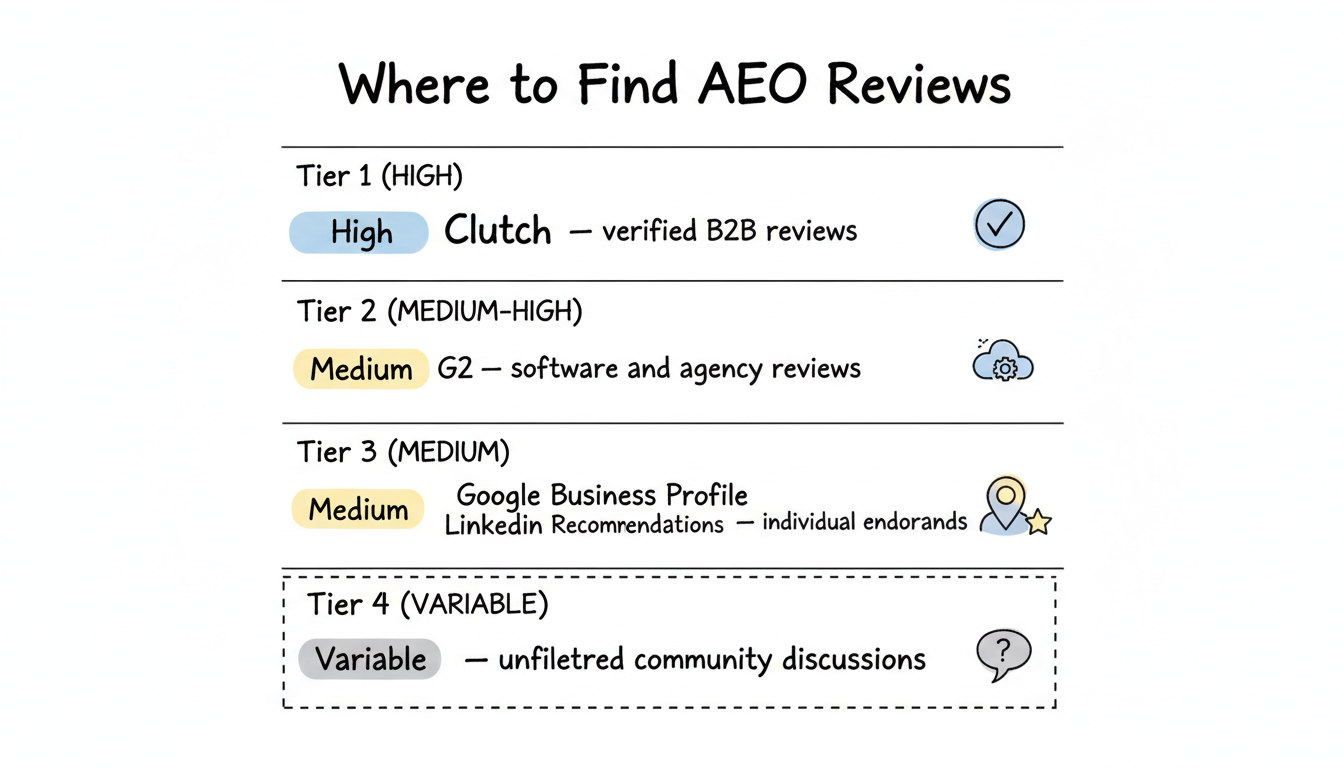
Primary review sources:
Platform | What You'll Find | Reliability |
Clutch | Verified B2B agency reviews with detailed feedback | High |
G2 | Software reviews (often include agency-like tools) | Medium-High |
Google Business Profile | Local agency reviews | Medium |
LinkedIn Recommendations | Individual practitioner endorsements | Medium |
Industry forums | Unfiltered community discussions | Variable |
Reddit (r/SEO, r/AskMarketing, r/bigseo) | Unfiltered community discussions with specific agency names | Variable—verify claims |
Trustpilot | Consumer-facing AEO tool and agency reviews | Medium-High |
Yelp | Local agency and business reviews | Medium |
Quora | Q&A threads about AEO agency experiences | Variable |
AEO-specific considerations: Many agencies providing AEO services also offer traditional SEO. Reviews may reference overall agency quality without specifically mentioning AEO work. Look for mentions of “AI search,” “AI visibility,” “ChatGPT citations,” “Perplexity citations,” “Gemini visibility,” “Claude mentions,” “Bing Copilot,” “voice search,” “entity optimization,” “structured data,” or “AI Overviews” to identify AEO-relevant feedback. On platforms like Clutch and G2, filter for reviews mentioning AI-specific deliverables—agencies with AEO-tagged reviews are more likely to have dedicated expertise.
How AEO Reviews Differ Across AI Platforms
AEO service quality varies by platform—an agency excelling at ChatGPT visibility may underperform on Perplexity or Gemini. Reviewers increasingly specify which platforms they gained visibility on, and this distinction matters when evaluating agencies. Use AI citation tracking tools to verify claims made in reviews against actual platform performance.
ChatGPT: The most commonly cited platform in AEO reviews. Look for mentions of citation frequency, link placement in responses, and whether the agency tracked ChatGPT web-browsing citations versus training-data citations. Agencies distinguishing between these two citation types demonstrate deeper technical understanding.
Perplexity: Growing rapidly as a review benchmark. Perplexity surfaces source links prominently, so reviewers often mention “appearing as a cited source in Perplexity answers.” Agencies that track Perplexity citations separately demonstrate deeper AEO expertise and multi-platform sophistication.
Google AI Overviews (formerly SGE): Reviews referencing AI Overviews visibility indicate the agency optimizes for Google’s generative layer specifically. Structured data implementation, featured snippet positioning, and knowledge panel presence all feed into AI Overviews selection. This is where traditional SEO and AEO overlap most.
Gemini: Google’s standalone AI assistant. Agencies monitoring Gemini separately—not just AI Overviews—show multi-platform sophistication. Gemini citation tracking is still underrepresented in reviews but growing as more professionals use it for research.
Bing Copilot: Microsoft’s AI search assistant. Particularly relevant for B2B brands where Bing has higher market share. Look for reviews mentioning Copilot-specific citation tracking and Bing Webmaster Tools optimization.
Claude: Anthropic’s AI model, increasingly used in professional and enterprise contexts. Agencies tracking Claude citations demonstrate awareness of the full AI ecosystem beyond consumer search platforms.
Voice assistants (Siri, Alexa, Google Assistant): For local businesses, reviews mentioning voice search optimization alongside AEO indicate comprehensive coverage. NAP consistency and FAQ schema implementation are common signals reviewers reference for voice assistant visibility.
Platform | What to Look For in Reviews | Review Coverage Maturity |
ChatGPT | Citation frequency, link placement, browsing vs. training-data distinction | High |
Perplexity | Source link appearances, citation tracking specificity | Medium |
Google AI Overviews | Structured data depth, featured snippet positioning | High |
Gemini | Separate tracking from AI Overviews, research query visibility | Emerging |
Bing Copilot | Copilot-specific citations, Bing Webmaster optimization | Emerging |
Claude | Enterprise context citations, professional use tracking | Emerging |
Voice Assistants | NAP consistency, FAQ schema, local search results | Medium |
Top AEO Agencies Clients Actually Review
Most AEO agencies are traditional SEO or digital PR firms that added AEO services. A few have built dedicated AEO practices with reviewable track records. Understanding review patterns across these agencies helps calibrate expectations.
First Page Sage: One of the earliest agencies to publish AEO-specific methodologies. Reviews on Clutch reference their content authority approach and long-term engagement model. Known for topical authority building and thought leadership content strategies that feed AI citation.
iPullRank: Technical SEO and entity optimization focus. Reviews highlight their data-driven methodology and structured data implementation. Strong for enterprise clients needing entity-level optimization and knowledge graph alignment.
Avenue Z: Digital PR and brand visibility focus. Reviews emphasize their third-party mention strategy and media placement for AI citation building. A strong fit for brands prioritizing authority signals and earned media as AEO inputs.
51Blocks: White-label AEO services for agencies. Reviews come from both end-clients and agency partners, making them useful for understanding the white-label AEO fulfillment landscape.
A caveat: review volume for any single AEO agency remains low compared to traditional SEO agencies. Cross-reference case studies with independent reviews for a fuller picture. Stackmatix’s approach to AEO services emphasizes multi-platform citation tracking and transparent reporting—client feedback directly shapes methodology refinement.
What Satisfied AEO Clients Typically Say
Patterns emerge in positive AEO reviews that indicate genuine service quality.
Results-Focused Feedback
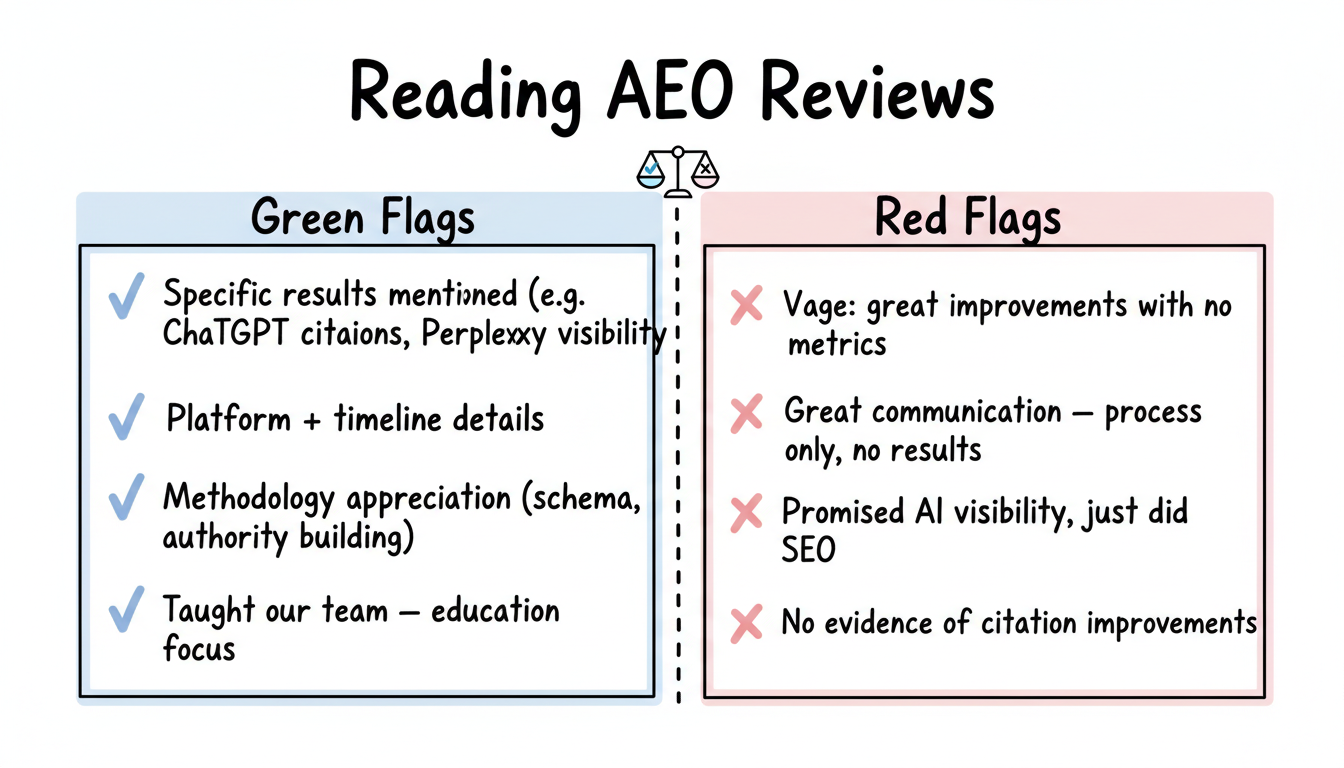
Strong AEO providers generate reviews mentioning specific outcomes:
Common positive themes:
- “Started appearing in ChatGPT responses within 3 months”
- “Increased Perplexity citations from 0 to regular visibility”
- “Now included in AI Overviews for our key terms”
- “Measurable improvement in AI referral traffic”
Red flag: Reviews discussing only process (“great communication”) without mentioning results may indicate the agency prioritizes relationship management over outcomes.
Methodology Appreciation
Clients of quality AEO agencies often mention specific approaches, similar to what you’d find in a comprehensive answer engine optimization complete guide:
Typical methodology mentions:
- Content restructuring for AI extraction
- Schema markup implementation
- Authority building through third-party mentions
- Multi-platform monitoring and optimization
- Entity optimization and knowledge graph alignment
- Digital PR campaigns for third-party citations
- FAQ and HowTo schema implementation
- Topical authority cluster building
Reviews praising clear methodologies suggest the agency has developed genuine AEO expertise rather than applying generic SEO tactics. Reviews that reference these specific techniques—rather than generic “SEO work”—indicate the agency has genuine AEO specialization versus rebranded traditional SEO services.
Technical AEO Signals Savvy Reviewers Mention
Sophisticated AEO clients reference specific technical approaches in their reviews. These mentions indicate the agency goes beyond surface-level optimization and delivers work that matters for structured data for AI search visibility.
Entity optimization: Reviews mentioning “entity optimization” or “knowledge graph” work indicate the agency understands how AI models identify and associate brands with topics. This is a core AEO differentiator versus generic SEO—AI models use entity relationships to determine which sources to cite.
Structured data depth: Look for reviews that go beyond “added schema markup” to mention specific types: FAQ schema, HowTo schema, LocalBusiness schema, Organization schema. Agencies implementing comprehensive structured data give AI platforms clear signals about content meaning and authority.
E-E-A-T signals: Reviews mentioning author credentials, original research, or first-hand experience indicate the agency focuses on Experience, Expertise, Authoritativeness, and Trustworthiness—factors that influence whether LLMs cite content as authoritative.
Topical authority building: Reviewers praising “content clusters” or “pillar page strategies” indicate the agency builds topical depth, which AI models use to determine domain expertise on specific subjects.
Featured snippets and knowledge panels: Reviews citing visibility gains in featured snippets or knowledge panels suggest the agency understands the SERP features that feed directly into AI Overviews and generative responses.
NAP consistency (local AEO): For local businesses, reviews mentioning Name-Address-Phone consistency across directories indicate the agency handles the foundational signals voice assistants and local AI results depend on.
Transparency and Education
Satisfied clients frequently mention learning from their agency:
Education-focused feedback:
- “Explained how AI citation works, not just what they were doing”
- “Monthly reports showed exactly which platforms were citing us”
- “Taught our team to create AEO-friendly content”
Agencies investing in client education typically have confidence in their approach. If you’re looking to build internal expertise, understanding the AI search team structure roles can help you evaluate whether an agency is training your team effectively.
Warning Signs in AEO Reviews
Negative patterns and concerning themes help identify agencies to avoid.
Vague Results Claims
Problem indicators:
- “They improved our visibility” (without specifics)
- “Great improvements” (but no metrics)
- Reviews that read like marketing copy
Genuine client reviews include specifics. Vague testimonials may be manufactured or reflect clients who didn’t track actual results.
Process Without Outcomes
Watch for:
- “Excellent communication” as the primary positive
- Detailed process descriptions but no result mentions
- Focus on deliverables completed rather than impact achieved
Good process matters, but it should produce measurable outcomes. Process-only reviews suggest clients didn’t see meaningful results.
Promised vs. Delivered Gaps
Red flags in negative reviews:
- “Promised AI visibility but just did regular SEO”
- “No evidence of actual AI citation improvements”
- “Couldn’t explain how their work connected to AI search”
These patterns indicate agencies that added “AEO” to their service menu without developing genuine expertise. Understanding the fundamental differences in an AEO vs SEO Google official position article can help you identify agencies that truly understand the distinction.
Reading Between the Lines
Some review patterns reveal important information indirectly.
Timeline Mentions
How long clients worked with agencies before seeing results indicates realistic expectations:
Typical healthy timelines:
- First citations: 2-4 months
- Consistent visibility: 4-6 months
- Competitive positioning: 6-12 months
Reviews mentioning results in “weeks” may involve easy wins or unrealistic expectations. Reviews mentioning “still waiting after a year” suggest problems.
Scope Discussions
How clients describe scope reveals service quality:
Positive scope indicators:
- Multi-platform coverage mentioned
- Content + technical + authority work described
- Ongoing optimization and refinement discussed
Negative scope indicators:
- Single platform focus only
- “Just added some schema markup”
- One-time project with no follow-through
Communication Patterns
Communication quality often predicts results quality:
Strong patterns:
- Regular reporting mentioned
- Strategic discussions described
- Proactive recommendations noted
Weak patterns:
- Difficulty getting updates
- Generic reports without insights
- Reactive only, no proactive guidance
Case Study Evaluation vs. Reviews
Agencies prominently feature case studies, but reviews offer different value. For a deeper look at what successful engagements produce, explore AEO success stories and case studies alongside the review patterns discussed here.
Case studies provide:
- Best-case scenarios
- Agency-controlled narrative
- Detailed methodology explanations
- Results agencies want you to see
Reviews provide:
- Typical client experiences
- Uncontrolled feedback
- Problems agencies don’t publicize
- Range of outcomes across clients
Use both: case studies show what’s possible, reviews show what’s likely.
Measuring AEO ROI: What Review Metrics Reveal
The most useful AEO reviews quantify results. Vague “improved visibility” claims are less meaningful than specific metrics. When evaluating reviews, look for these categories of measurement—and use AEO tools and software to independently verify reported outcomes.
Citation counts: How many times the brand appears in AI responses for target queries. Reviews mentioning specific numbers—“appeared in 40% of relevant Perplexity queries”—indicate the agency tracks this systematically rather than relying on anecdotal observations.
AI referral traffic: Direct traffic from AI platforms (perplexity.ai referrals, chatgpt.com clicks). Reviews mentioning GA4 tracking of AI referral sources indicate the agency connects AEO work to measurable traffic, not just visibility claims.
Revenue attribution: The gold standard. Reviews that connect AEO work to pipeline or revenue—“AI-sourced leads increased 25%”—indicate the agency builds attribution models, not just visibility reports. This level of measurement sophistication separates advanced agencies from basic providers.
Share of voice: What percentage of relevant AI queries feature the brand versus competitors. Agencies providing competitive share-of-voice data in their reporting earn more specific, metric-rich reviews from clients.
AEO vs. GEO framing: Some agencies position their work as Generative Engine Optimization (GEO) rather than AEO. GEO focuses specifically on generative AI platforms (ChatGPT, Perplexity, Gemini), while AEO also encompasses voice assistants and traditional answer features like featured snippets. Reviews using either term may describe similar services—evaluate based on deliverables, not labels.
Metric | Basic Agency | Advanced Agency | What Reviews Should Mention |
Citation Counts | Anecdotal mentions | Systematic tracking with percentages | Specific numbers and query coverage |
AI Referral Traffic | Not tracked | GA4 AI referral source reporting | Platform-specific traffic data |
Revenue Attribution | None | Pipeline and conversion tracking | ROI percentages or revenue figures |
Share of Voice | Not measured | Competitive comparison dashboards | Brand vs. competitor citation rates |
Questions to Ask Based on Reviews
Reviews should generate specific questions for agency conversations. If you need a broader framework for evaluating agencies, see our guide on how to choose an AEO agency.
If reviews mention slow results: “What timeline should we expect for initial citations, and what factors typically delay results?”
If reviews praise methodology: “Can you walk me through your specific approach to [content/technical/authority] optimization?”
If reviews mention communication issues: “How often do you report, and what does a typical report include?”
If reviews lack result specifics: “What specific metrics do you track and report on, and can you show me a sample report?” Consider asking if they use an AI search analytics dashboard for transparent reporting.
Building Your Own Review Research Process
Systematic review research yields better insights than casual browsing.
Step-by-step process:
- Identify agency shortlist (3-5 candidates)
- Search multiple platforms for each agency:
- Clutch profile
- Google Business reviews
- LinkedIn company page recommendations
- Industry forum mentions
- Reddit discussions (search “[agency name] review”)
- Document patterns:
- Common positives
- Common negatives
- Timeline mentions
- Scope descriptions
- Cross-reference with claims:
- Do reviews support marketing claims?
- Are case study results typical or exceptional?
- Generate specific questions for agency conversations based on review patterns
When Reviews Aren'T Available
Newer or smaller agencies may have limited review presence.
Alternative evaluation approaches:
- Request client references directly
- Ask for multiple contacts (not just their best client)
- Look for individual team member reviews/recommendations
- Evaluate their own AI visibility as proof of capability
- Start with a smaller project before larger commitment
Key Takeaways
Using reviews effectively in AEO agency evaluation:
- Search multiple platforms - Clutch, G2, Google, LinkedIn, and industry forums each reveal different perspectives
- Look for specifics - Quality reviews mention platforms, timelines, and measurable results
- Watch for patterns - Consistent themes across reviews reveal typical experiences
- Question vague praise - “Great communication” without results mentions is a red flag
- Cross-reference claims - Compare review experiences against marketing materials and case studies
- Generate questions - Use review patterns to create specific questions for agency conversations
Client reviews provide unfiltered perspective that marketing materials cannot. Systematic review research identifies agencies likely to deliver results and helps avoid those that underperform their promises.
Frequently Asked Questions
How Do I Find Reviews Specifically About AEO Services Rather Than General SEO?
Search review platforms like Clutch, G2, and Reddit using terms such as “AI visibility,” “ChatGPT citations,” “Perplexity optimization,” and “answer engine optimization.” Filter agency profiles for reviews that mention specific AI platforms by name. Agencies with AEO-specific case studies alongside third-party reviews demonstrate deeper specialization than those with only generic SEO testimonials.
Which AI Platforms Should an AEO Agency Track in Their Client Reporting?
A competent AEO agency should track visibility across at least ChatGPT, Perplexity, Google AI Overviews, and Gemini. Advanced agencies also monitor Bing Copilot, Claude, and voice assistants like Siri and Alexa. Look for reviews mentioning multi-platform tracking rather than single-platform focus. Agencies that report citation counts, AI referral traffic in GA4, and competitive share of voice across these platforms deliver the most actionable client reporting.
What Is the Difference Between AEO and GEO When Evaluating Agency Reviews?
AEO (Answer Engine Optimization) covers all answer-providing platforms including voice assistants and featured snippets. GEO (Generative Engine Optimization) focuses specifically on generative AI systems like ChatGPT, Perplexity, and Gemini. Many agencies use these terms interchangeably. When reading reviews, evaluate the actual deliverables and platforms covered rather than the label used.
How Long Before an AEO Agency Should Show Measurable Results?
Based on patterns in client reviews, expect initial AI citations within two to four months, consistent visibility across multiple platforms within four to six months, and competitive positioning within six to twelve months. Reviews claiming results in weeks typically involve easy wins or low-competition queries. If an agency has not demonstrated measurable citation improvements after six months, reviews suggest this is a red flag worth investigating.