
Measuring return on investment from answer engine optimization services requires different frameworks than traditional SEO. When AI systems cite your content without always generating clicks, standard traffic-based ROI calculations miss significant value. Organizations that establish proper AEO measurement frameworks can accurately evaluate agency performance and justify continued investment in AI visibility programs.
According to ALM Corp's 2026 SEO budget guide, content, SEO, and AEO programs typically deliver ROI between 5:1 and 10:1 when properly executed. Content marketing alone produces 3x more leads per dollar than traditional advertising while costing 62% less—making measurement frameworks critical for capturing this value.
Why Traditional ROI Metrics Fall Short
Standard digital marketing ROI calculations rely heavily on click-through traffic. AEO generates value differently.
Over 60% of Google searches now result in zero-click outcomes, meaning users get answers directly on the results page. AI Overviews and answer engines accelerate this trend—when ChatGPT or Gemini cite your brand, the value is delivered without a traditional click. This is why traffic-based ROI models systematically undercount AEO impact.
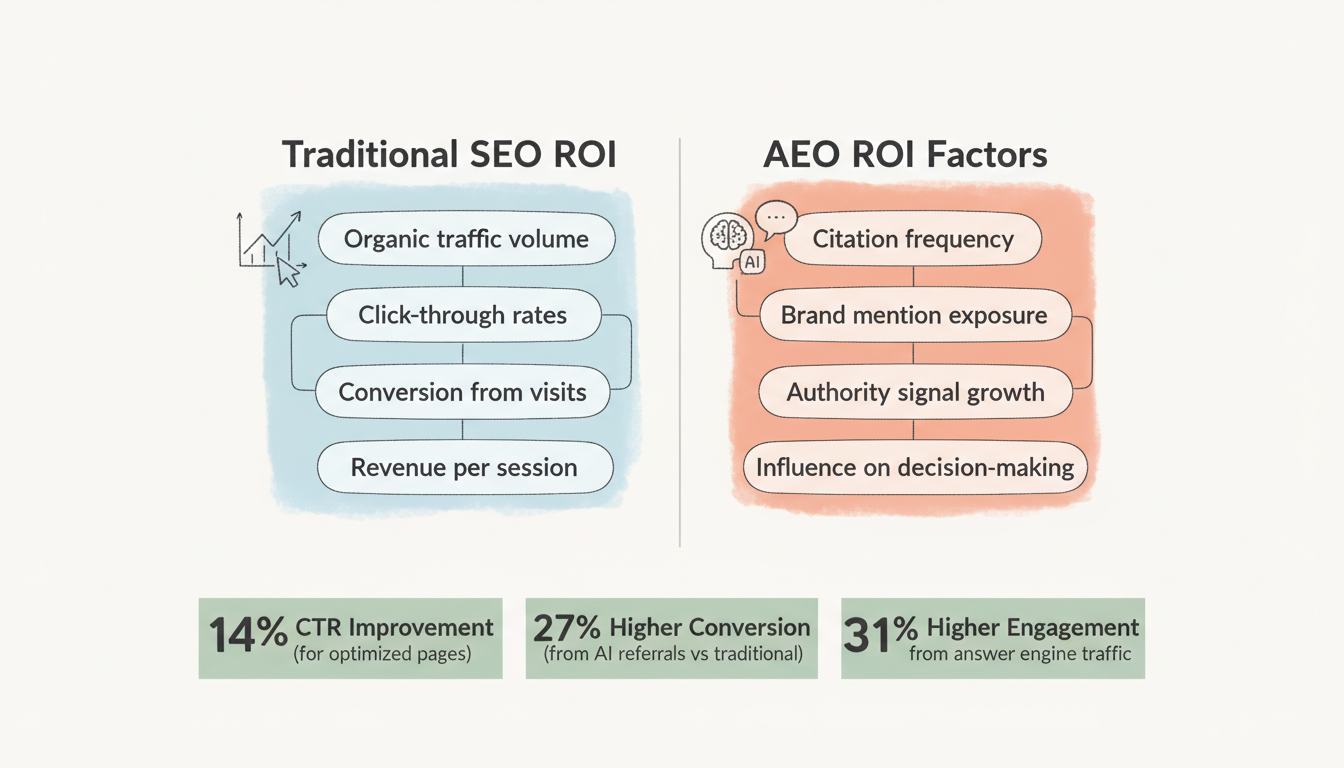
According to SpearPoint Marketing's AEO guide, documented AEO results show 14% click-through rate improvements for optimized pages, conversion rates 27% higher from answer engine referrals versus traditional search, and engagement metrics 31% higher from answer engine traffic.
Traditional vs. AEO ROI factors:
Traditional SEO ROI | AEO ROI Factors |
Organic traffic volume | Citation frequency |
Click-through rates | Brand mention exposure |
Conversion from visits | Authority signal growth |
Revenue per session | Influence on decision-making |
Key AEO Performance Metrics
Effective agency evaluation requires tracking metrics specific to AI visibility outcomes.
According to Marketing Experts Hub's agency analysis, agencies should be evaluated on their ability to increase citations across AI platforms, track brand mentions in AI-generated answers, measure share of voice in answer engine responses, and demonstrate visibility improvements over time.
Essential AEO metrics for ROI calculation:
AEO ROI Measurement Framework
├── Visibility Metrics
│   ├── Citation frequency (mentions per month)
│   ├── Brand appearance rate in AI answers
│   ├── Share of voice vs. competitors
│   └── Platform coverage (ChatGPT, Perplexity, Claude, Gemini, Bing Copilot)
│
├── Engagement Metrics
│   ├── AI referral traffic (when available)
│   ├── Conversion rate from AI traffic
│   ├── Time on site from AI visitors
│   └── Pages per session
│
├── Authority Metrics
│   ├── Expert attribution frequency
│   ├── Source quality improvements
│   └── Trust signal development
│
└── Business Impact
    ├── Lead quality from AI channels
    ├── Sales influenced by AI visibility
    └── Brand awareness lift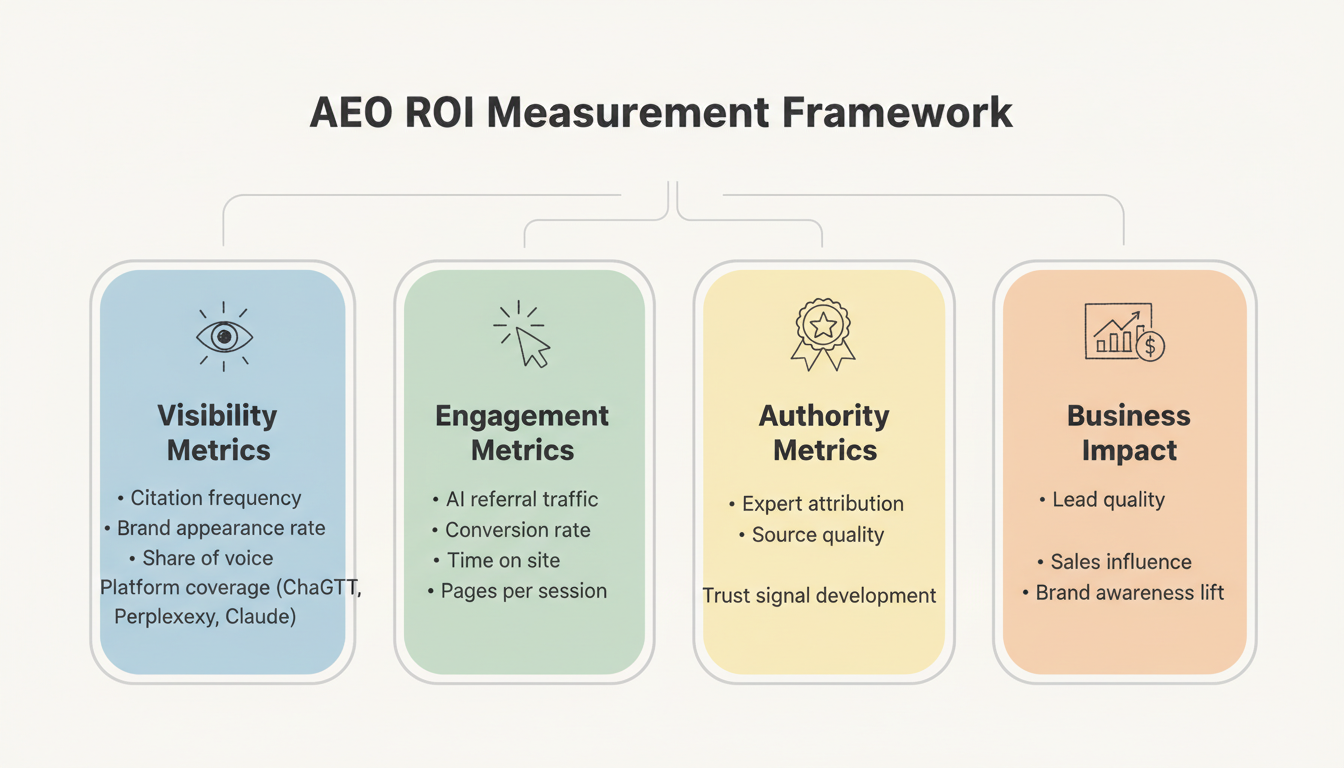
How to Track AEO Performance in Google Analytics 4
Google Analytics 4 (GA4) is essential for AEO measurement because zero-click searches make traditional analytics incomplete. While AI platforms like ChatGPT, Perplexity, Gemini, and Bing Copilot may cite your brand without generating a trackable click, GA4 can still capture the traffic that does arrive—and attribute it correctly when configured properly.
To segment AI referral traffic, create a custom GA4 exploration that filters sessions by source. Set up a custom channel group for AI traffic using consistent UTM parameter conventions across all tracked URLs: use utm_source=chatgpt, utm_source=perplexity, utm_source=copilot, or utm_source=gemini with utm_medium=ai-referral as the standard medium. This enables clean segmentation in GA4 reports and cross-platform comparison.
For a detailed walkthrough on configuring these channel groups and attribution settings, see the full AEO analytics setup guide.
Note that client-side GA4 tracking misses AI bot crawling traffic entirely. Server-side tagging captures bot requests that client-side JavaScript cannot detect, providing a more complete picture of how AI platforms interact with your content. Organizations serious about AEO measurement should implement server-side tagging as a complement to standard GA4.
Sample UTM structure for agency reporting:
https://example.com/page?utm_source=chatgpt&utm_medium=ai-referral&utm_campaign=aeo-q1
https://example.com/page?utm_source=perplexity&utm_medium=ai-referral&utm_campaign=aeo-q1
https://example.com/page?utm_source=gemini&utm_medium=ai-referral&utm_campaign=aeo-q1
https://example.com/page?utm_source=copilot&utm_medium=ai-referral&utm_campaign=aeo-q1
Defining Named AEO Kpis for Agency Accountability
Generic reporting on "visibility improvements" is insufficient for holding agencies accountable. Organizations need named, trackable KPIs with clear formulas that map directly to agency deliverables and contract milestones. For a deeper exploration of these metrics and how they interconnect, see the full guide on AEO metrics and KPIs.
Answer Capture Rate (ACR): The percentage of target queries where your brand appears in AI-generated answers. Calculate by dividing the number of monitored queries returning your brand citation by the total number of monitored queries. An ACR above 30% for core branded queries indicates strong AI visibility.
Entity Authority Score (EAS): A composite metric combining citation frequency, source ranking position, and sentiment across AI platforms. Weight each component (e.g., 40% citation frequency, 30% ranking position, 30% sentiment) to produce a 0-100 score that tracks authority growth over time.
Return on Content Investment (ROCI): Calculated as (revenue attributed to content / total content production cost). ROCI bridges the gap between content spend and AEO outcomes by measuring whether content assets are generating returns through AI citations, not just traditional organic traffic.
Branded Search Traffic Lift: The percentage increase in branded search queries attributable to AI visibility exposure. When AI platforms consistently cite your brand, branded search volume rises as users seek out your site directly after encountering your name in AI answers.
These KPIs ladder up to customer acquisition cost (CAC) reduction—the executive-level outcome that justifies AEO investment. Agencies should tie contract milestones to specific ACR and ROCI targets, with AEO Conversion Velocity (ACV) measuring how quickly AI-sourced leads move through the funnel. For strategic context on how these KPIs align with broader optimization goals, review the AEO strategy framework.
Agency Performance Evaluation Framework
Structured evaluation frameworks enable consistent agency assessment. Understanding the relationship between SEO, AEO, and GEO helps organizations build comprehensive measurement systems that capture value across all AI-driven search channels.
According to First Page Sage's agency rankings methodology, comprehensive agency evaluation uses weighted criteria including AI Visibility Score (25% weight), Average Review Score (30% weight), Client Retention Rate (20% weight), and Years of SEO/GEO Experience (10% weight).
Agency performance scorecard:
Evaluation Criteria | Weight | What to Measure |
Citation results | 25% | Documented citation increases |
Client satisfaction | 30% | Reviews, testimonials, references |
Client retention | 20% | Renewal rates, long-term relationships |
Methodology quality | 15% | Process rigor, reporting frequency |
Experience level | 10% | Years in AEO/GEO specifically |
High-performing agencies distinguish themselves through tactical execution: implementing FAQ schema markup across target pages to increase AI citation eligibility, building content clusters with pillar pages to strengthen topical authority signals, and actively optimizing Knowledge Panel presence to reinforce entity recognition. These deliverables should appear explicitly in the "Methodology quality" evaluation row of any agency scorecard.
Calculating AEO Investment Returns
ROI calculation requires attribution modeling adapted for AI visibility. Organizations implementing AI search conversion funnel optimization can better attribute revenue to AEO efforts by tracking the complete customer journey from AI platform exposure through conversion.
According to ALM Corp, content, SEO, and AEO should receive 25-30% of digital marketing budgets based on typical returns. Organizations investing appropriately in these channels see compound growth in organic visibility and authority over time.
AEO ROI calculation approach:
AEO ROI = (Value Generated - Investment) / Investment × 100

Where Value Generated includes:
├── Direct Value
│   ├── Revenue from AI referral traffic
│   ├── Leads generated via AI channels
│   └── Conversions attributed to AI visibility
│
├── Indirect Value
│   ├── Brand awareness lift (survey-based)
│   ├── Reduced paid media dependency
│   ├── Authority signal appreciation
│   └── Influence on buying decisions
│
└── Attribution Considerations
    ├── AI visibility touchpoints in journey
    ├── Assist conversions from AI exposure
    └── Long-term brand recall effects
Multi-touch attribution is critical for capturing the full value of AEO investments. Use GA4's data-driven attribution model to identify AEO-assisted conversions—cases where AI visibility was a touchpoint in the buyer journey but not the last click before conversion. Research consistently shows that assisted conversions represent 2-3x the value of last-click conversions for AEO programs, meaning organizations that rely solely on last-click attribution systematically undervalue their AI visibility investments.
Understanding benchmark investment levels contextualizes agency costs.
According to eMarketer's 2025 marketing budget research, 12% of digital marketing budgets were dedicated to GEO/AEO in 2025, with 94% of organizations planning to increase spending in 2026. This represents significant growth in AEO investment as AI search adoption accelerates.
Investment benchmarks by company size:
Company Size | Monthly AEO Investment | Expected ROI Timeline |
Startup | $1,000-$3,000 | 6-9 months |
SMB | $3,000-$8,000 | 4-6 months |
Mid-market | $8,000-$20,000 | 3-5 months |
Enterprise | $20,000+ | 2-4 months |
According to Vertu's GEO guide, measuring AI visibility ROI requires patience—like SEO, AEO results compound over time. Early investment builds authority signals that continue generating returns months after initial optimization.
AEO Services Pricing & Agency Economics
Understanding agency pricing structures helps organizations evaluate whether their investment aligns with market rates and expected outcomes. AEO service pricing generally falls into three tiers:
Service Tier | Monthly Cost | Typical Inclusions |
Audit-only | $2,000-$5,000 | AI visibility audit, competitor analysis, recommendations report |
Managed optimization | $5,000-$15,000/mo | Content clusters, pillar page optimization, FAQ schema implementation, monthly reporting |
Enterprise full-service | $15,000-$40,000+/mo | Full AEO program, Knowledge Panel optimization, multi-platform tracking, dedicated strategist |
For agencies offering white-label AEO services, typical fulfillment costs range from $1,500-$2,000 per client against retail pricing of $3,000-$4,500, yielding 35-50% margins. This model enables marketing agencies to add AEO capabilities without building in-house expertise.
When evaluating cost versus value, tie pricing to ACR and ROCI targets rather than deliverable volume. An agency delivering measurable Answer Capture Rate improvements at $8,000/month provides better value than one producing more content at $12,000/month with no citation tracking. For detailed cost benchmarking data, see the AEO ROI calculator.
A frequently overlooked ROI factor for B2B organizations is sales cycle acceleration. Companies with strong AI visibility report 18-42% improvement in sales cycle length, as prospects who encounter brand citations in AI answers arrive more informed and closer to purchase decisions.
Red Flags in Agency Performance
Certain indicators suggest underperformance requiring attention. When evaluating agencies, reference comprehensive AEO checker tools to verify their reported metrics and validate citation tracking capabilities.
According to SpearPoint Marketing, agencies should provide clear metrics including featured snippet increases, AI Overview appearance rates, voice search inclusion percentages, and citation frequency data. Agencies that cannot provide specific metrics may not have rigorous measurement processes.
Performance warning signs:
Red Flag | What It Indicates |
No baseline measurements | Can't demonstrate improvement |
Traffic-only reporting | Missing AI visibility metrics |
Vague "visibility improvements" | Lack of specific data |
No competitive benchmarking | Missing context for results |
Inconsistent reporting | Process or capability issues |
Building Long-Term Measurement Systems
Sustainable ROI tracking requires systematic approaches. Organizations that understand AI Overview impact analysis can better attribute business outcomes to their answer engine optimization investments and demonstrate clear ROI to stakeholders.
According to Conductor's 2026 AEO/GEO Benchmarks Report, organizations must measure AI visibility as rigorously as SEO visibility—tracking citations and mentions as core KPIs. Having informed, data-driven KPIs for both SEO and AEO enables digital teams to measure total search visibility.
Long-term measurement recommendations:
- Establish baseline metrics before agency engagement
- Set quarterly milestones for citation growth
- Track competitive share of voice trends
- Correlate AI visibility with business outcomes
- Review and adjust attribution models annually
- Monitor Core Web Vitals as a baseline technical health requirement—AI platforms preferentially cite fast, accessible, well-structured pages
Multi-Platform Visibility Tracking
AI answer engines do not behave uniformly. Each platform—ChatGPT, Perplexity, Claude, Gemini, and Bing Copilot—has different citation behaviors, content preferences, and source selection criteria. A comprehensive AEO platform comparison reveals that optimizing for one platform does not guarantee visibility on others.
Platform-specific tracking considerations: Bing Copilot integrates with Bing Webmaster Tools, providing direct visibility into how Copilot surfaces your content. Gemini citations appear in Google Search Console under AI Overviews, offering a native tracking path for Google's ecosystem. For platforms without native webmaster tools (ChatGPT, Perplexity, Claude), third-party monitoring and manual citation audits remain necessary. For a comprehensive tracking methodology, see the full guide on AEO measurement and tracking.
Beyond citation quantity, implement sentiment analysis across platforms to measure citation quality. A brand mentioned dismissively or as a counterexample provides negative value compared to authoritative citations. Track content waste and asset utilization rate to identify which content assets are actively earning AI citations versus sitting unused—this metric directly informs content investment decisions and helps agencies demonstrate ROCI.
Key Takeaways
Measuring AEO services ROI requires adapted frameworks and appropriate expectations:
- Traditional metrics insufficient - Citation frequency and brand mentions matter as much as traffic
- Weighted evaluation works - Use scorecards balancing results, satisfaction, and methodology
- 5:1 to 10:1 ROI achievable - Properly executed programs deliver strong returns
- Investment growing industry-wide - 94% plan to increase AEO spending in 2026
- Red flags identifiable - Lack of specific metrics indicates measurement gaps
Frequently Asked Questions
What Is a Good ROI for AEO Services in 2026?
Well-executed AEO programs typically deliver 5:1 to 10:1 ROI, though timelines vary by company size and competitive landscape. Startups may wait 6-9 months for measurable returns, while enterprise organizations often see results in 2-4 months. The key metric is not just traffic—track Answer Capture Rate across ChatGPT, Perplexity, Gemini, and Bing Copilot to measure true AI visibility ROI beyond traditional clicks.
How Do You Measure AEO Performance in Google Analytics 4?
Set up custom channel groups in GA4 to segment AI referral traffic from platforms like ChatGPT and Perplexity. Use consistent UTM parameters (utm_source=chatgpt, utm_medium=ai-referral) across tracked URLs. Enable GA4's data-driven attribution model to capture assisted conversions where AI visibility influenced the buyer journey but was not the final click before conversion.
What Is the Difference Between AEO ROI and Traditional SEO ROI?
Traditional SEO ROI relies on organic traffic volume, click-through rates, and revenue per session. AEO ROI must also capture zero-click value—brand citations, entity authority growth, and influence on purchasing decisions that occur without a trackable click. Metrics like Answer Capture Rate, branded search traffic lift, and Return on Content Investment bridge this measurement gap between clicks and citations.
How Much Should AEO Services Cost per Month?
AEO service pricing varies by scope: audit-only engagements run $2,000-$5,000, managed optimization ranges from $5,000-$15,000 per month, and enterprise full-service programs start at $15,000-$40,000 or more monthly. Evaluate cost against specific KPI targets like Answer Capture Rate and customer acquisition cost reduction rather than deliverable volume alone. Agencies offering white-label AEO typically price at $3,000-$4,500 retail.
According to ALM Corp, organizations that treat AEO measurement with the same rigor as other marketing channels position themselves to capture compound returns as AI search adoption continues accelerating.