
Last Updated: March 2026
Answer engine optimization software helps businesses monitor and improve their visibility in AI-generated answers. As AI search platforms grow in importance, dedicated AEO software has emerged to address needs that traditional SEO tools don't cover. This guide explores the AEO software landscape and helps you select the right platforms for your organization.
What AEO Software Does
AEO software provides capabilities specifically designed for AI search optimization.
Core Capabilities
Citation Monitoring Track when and where AI platforms cite your content. Without this visibility, you cannot measure AEO success or identify improvement opportunities.
Competitive Analysis Compare your AI visibility against competitors. Understanding share of voice helps prioritize opportunities and measure progress, similar to competitive AI search benchmarking strategies used by leading brands.
Content Optimization Get recommendations for structuring content so AI systems can extract and cite it more effectively.
Performance Trending Monitor visibility over time to understand whether optimization efforts are working and identify concerning declines.
Alert Systems Receive notifications when visibility changes significantly—either improvements to celebrate or problems requiring attention.
Sentiment Analysis Advanced AEO platforms analyze not just whether you are cited, but how you are portrayed. Sentiment analysis detects negative framing, inaccuracies, or competitor-favorable language in AI responses about your brand. Tracking AEO metrics and KPIs including sentiment scores helps quantify brand perception across AI engines.
Content Gap Detection Identifies topics and queries where competitors get cited but you do not. Content gap analysis prioritizes which new content or optimizations will close the biggest visibility gaps, directing resources toward the highest-impact opportunities.
Why Traditional SEO Software Falls Short
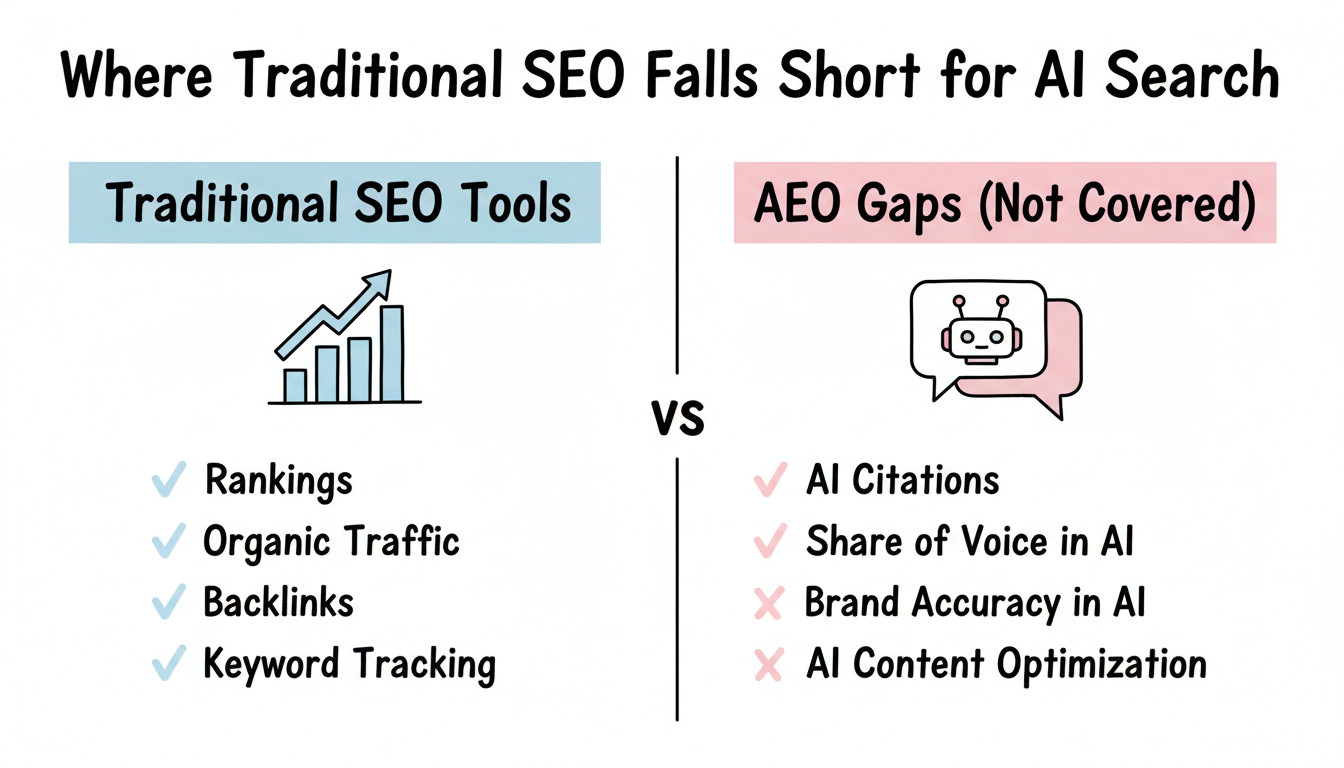
Standard SEO platforms excel at tracking rankings and organic traffic but weren't designed for AI search:
- They don't monitor AI platform citations
- They can't measure share of voice in AI responses
- They lack AI-specific content optimization guidance
- They don't track brand accuracy in AI answers
AEO software fills these gaps. For a deeper look at how AEO differs from traditional search optimization approaches, see our guide on AEO vs SEO vs GEO differences explained.
Categories of AEO Software
AEO software spans several categories, each addressing different needs.
Citation Monitoring Platforms
These focus primarily on tracking your presence across AI answer platforms.
Key features:
- Multi-platform citation tracking (ChatGPT, Perplexity, AI Overviews)
- Historical trending
- Query-level detail
- Basic competitive comparison
Best for: Organizations starting their AEO programs who need visibility data before sophisticated optimization.
Representative options: SE Visible, Otterly.AI, Scrunch AI
Comprehensive AEO Suites
These combine monitoring with competitive analysis, optimization recommendations, and workflow features.
Key features:
- Deep citation analytics
- Competitive share of voice
- Content optimization guidance
- Integration with content workflows
- Team collaboration features
Best for: Organizations with established AEO programs needing sophisticated analysis and action capabilities. These platforms align with the best generative engine optimization strategy for enterprise teams.
Representative options: Ahrefs Brand Radar, Conductor, Profound
Newer comprehensive suites like Goodie AI and Evertune are challenging incumbents with broader AI engine coverage and built-in funnel attribution. Buyers should evaluate whether the suite covers the full marketing funnel from awareness through citation monitoring to conversion via traffic attribution with GA4 integration.
AI-Integrated SEO Platforms
Traditional SEO platforms that have added significant AI visibility capabilities.
Key features:
- Unified SEO and AEO data
- Integrated reporting
- Existing workflow compatibility
- Combined analytics
Best for: Teams already invested in major SEO platforms who want unified visibility.
Representative options: Semrush AI features, Ahrefs AI monitoring
Content Optimization Software
These focus on helping create and structure content for AI extraction.
Key features:
- Extractability analysis
- Content structure recommendations
- FAQ and schema guidance
- AI-readiness scoring
Best for: Teams focused on content production who need optimization guidance.
Representative options: AirOps, Jasper AI optimization features
Technical AEO: Structured Data and AI Crawlability
Structured data plays a critical role in AEO because AI engines rely on schema.org markup to extract factual claims, product details, and FAQ answers from your content. Implementing the right structured data types—including FAQPage, HowTo, Article, Product, and Organization JSON-LD schemas—significantly increases your chances of being cited accurately.
Beyond schema markup, consider LLMs.txt and robots.txt configurations that signal AI crawlers about content availability. Server-side rendering is also important, as many AI crawlers struggle with client-side JavaScript rendering. For a detailed breakdown of which schemas matter most, see our guide on AEO schema markup priorities for AI search.
AEO software evaluates technical readiness through extractability scores, schema validation, and crawl audits. Tools like Conductor and AirOps, along with newer entrants in the space, offer technical AEO analysis capabilities. The rise of zero-click searches makes structured data even more critical—proper markup helps you win citations and brand visibility even when users never click through to your site.
Evaluating AEO Software
Consider these factors when selecting AEO software.
Platform Coverage
Which AI systems does the software monitor?
Essential:
- ChatGPT (largest AI search platform)
- Perplexity (leading AI-native search)
- Google AI Overviews (appears in Google results)
Valuable additions:
- Claude
- Microsoft Copilot
- Gemini (Google's standalone AI, growing rapidly)
- Grok (X/Twitter integration with real-time data)
- Google AI Mode (newer conversational search feature)
- Voice assistants
Broader coverage provides more complete visibility picture. Leading platforms now monitor 10 or more AI engines simultaneously. Understanding differences between platforms helps inform your monitoring approach—for example, Perplexity vs ChatGPT SEO reveals distinct citation patterns worth tracking separately.
AI Engines Your AEO Software Should Monitor
The AI search landscape has expanded rapidly, and your AEO software needs to keep pace. Here is a tiered framework for evaluating engine coverage.
Tier 1 (Must-Have): ChatGPT remains the largest AI search platform by user base. Google AI Overviews integrates directly into the highest-volume search engine. Perplexity leads the AI-native search category with robust citation practices.
Tier 2 (High Priority): Gemini, Google's standalone AI assistant, is growing rapidly across consumer and enterprise use cases. Claude from Anthropic is increasingly used by professionals and researchers. Microsoft Copilot has deep enterprise penetration through Office 365 integration.
Tier 3 (Emerging): Grok, integrated with X/Twitter, offers real-time data access. Google AI Mode provides a newer conversational search experience. Meta AI is expanding across social media platforms. Amazon Rufus handles ecommerce-specific AI search queries. DeepSeek, an open-source AI model, is gaining traction in technical communities.
Top-tier AEO software like Goodie AI and AthenaHQ now monitor ten or more engines simultaneously, providing comprehensive visibility across the entire AI search landscape. For a detailed AEO platform comparison across ChatGPT, Perplexity, Gemini and more, see our dedicated analysis. The rise of agentic commerce is also driving the need to monitor shopping-specific AI engines like Amazon Rufus.
Monitoring Depth
How detailed is the tracking?
Basic: Summary statistics on citation frequency Advanced: Query-level analysis with citation context, sentiment, and accuracy assessment
Deeper monitoring enables more sophisticated optimization.
Competitive Capabilities
Can you benchmark against competitors?
Understanding relative performance helps prioritize. Software showing share of voice and competitive gaps provides actionable intelligence.
Integration Options
How does the software connect with existing tools?
Consider:
- Data export formats
- API availability
- Reporting tool integration
- CMS connections
Isolated software limits practical value.
Reporting Features
Can you communicate results effectively?
Look for:
- Executive dashboards
- Exportable reports
- Customizable views
- White-label options (for agencies)
Reporting capabilities affect whether insights reach decision-makers.
AEO Software Comparison
Understanding how options differ helps selection.
Entry-Level Options
SE Visible
- Straightforward LLM presence tracking
- Historical trend analysis
- Accessible pricing
- Good starting point for new programs
Otterly.AI
- Practical citation monitoring
- Alert systems for visibility changes
- Clean interface
- Focused on essentials
Scrunch AI
- Prompt-level monitoring
- Topic clustering insights
- Competitive benchmarking
- Growing feature set
Mid-Market Platforms
Profound
- Detailed citation analysis
- Brand sentiment tracking
- Competitive share of voice
- Enterprise-oriented features
AirOps
- Content creation and optimization focus
- AI visibility insights
- Workflow integration
- Scale-friendly
Enterprise Solutions
Ahrefs Brand Radar
- Comprehensive AI monitoring
- Unified with traditional SEO data
- Established brand reputation
- Enterprise support
Conductor
- Enterprise-grade capabilities
- Marketing intelligence integration
- Content workflow connection
- Global organization support
Enterprise buyers should also evaluate Evertune, an enterprise AEO suite with multi-market support, and Bluefish, purpose-built for regulated industries needing compliance-aware AI monitoring. Both platforms offer advanced competitive analysis capabilities suited to large organizations.
Emerging AEO Platforms You Should Know in 2026
The AEO tool market is expanding rapidly alongside the broader LLM market, now valued at over $8.3 billion with significant VC funding flowing into AEO-focused startups. Here are the platforms gaining traction.
Goodie AI positions itself as an industry leader in multi-engine monitoring, covering ChatGPT, Perplexity, Gemini, and Grok simultaneously. The platform offers content gap analysis and sentiment analysis features that help brands understand not just whether they are cited, but how they are portrayed across AI engines.
AthenaHQ is a YC-funded platform focused on blind spot detection and buyer journey mapping across the full marketing funnel. Its GA4 integration enables teams to connect AI visibility data directly with website analytics for attribution.
Peec AI offers an accessible entry point for AI answer monitoring at affordable pricing tiers. The platform tracks brand mentions across major AI engines, making it a practical starting option for small and mid-sized businesses.
Gauge combines an AI assistant with content creation capabilities, providing an optimization hub approach that bridges monitoring and action.
Evertune delivers an enterprise-grade AEO suite with advanced competitive analysis and multi-market support for global organizations.
XFunnel takes a conversion-focused approach to AEO, offering funnel attribution that connects AI-driven traffic to actual revenue outcomes.
Bluefish, backed by Bloomberg Beta, is purpose-built for regulated industries including finance and healthcare, where compliance-aware AI monitoring is essential.
Writesonic extends its AI writing platform with integrated AEO optimization features, combining content generation and visibility monitoring in one tool.
Other emerging players worth evaluating include AIclicks, Rank Prompt, Cairrot, and HumanizeAI, each bringing unique angles to the AEO software market.
AEO Grader Tools: Free Auditing Options
For organizations exploring AEO for the first time, free grading tools provide a useful starting diagnostic. The HubSpot AEO Grader is among the most popular, scoring your page's AEO readiness across multiple criteria including content structure, schema markup, and citation likelihood.
Other free AEO audit options typically check content extractability, structured data implementation, and basic AI search compatibility. While these tools offer valuable initial insights, they are limited to point-in-time snapshots rather than ongoing monitoring.
The key distinction: AEO graders diagnose your current state, while full AEO software platforms treat issues and monitor progress continuously. Most organizations benefit from starting with a free grader audit to identify gaps, then investing in paid AEO software for sustained visibility management. For a structured approach to addressing grader findings, follow a complete AEO optimization checklist to prioritize your improvements.
Building Your AEO Software Stack
Most organizations need multiple solutions working together.
Recommended Approach
- Start with monitoring: Understand current visibility before optimizing
- Add competitive intelligence: Benchmark against competitors to prioritize
- Include content tools: Support teams creating AEO-optimized content
- Maintain SEO platform: Continue traditional search alongside AEO
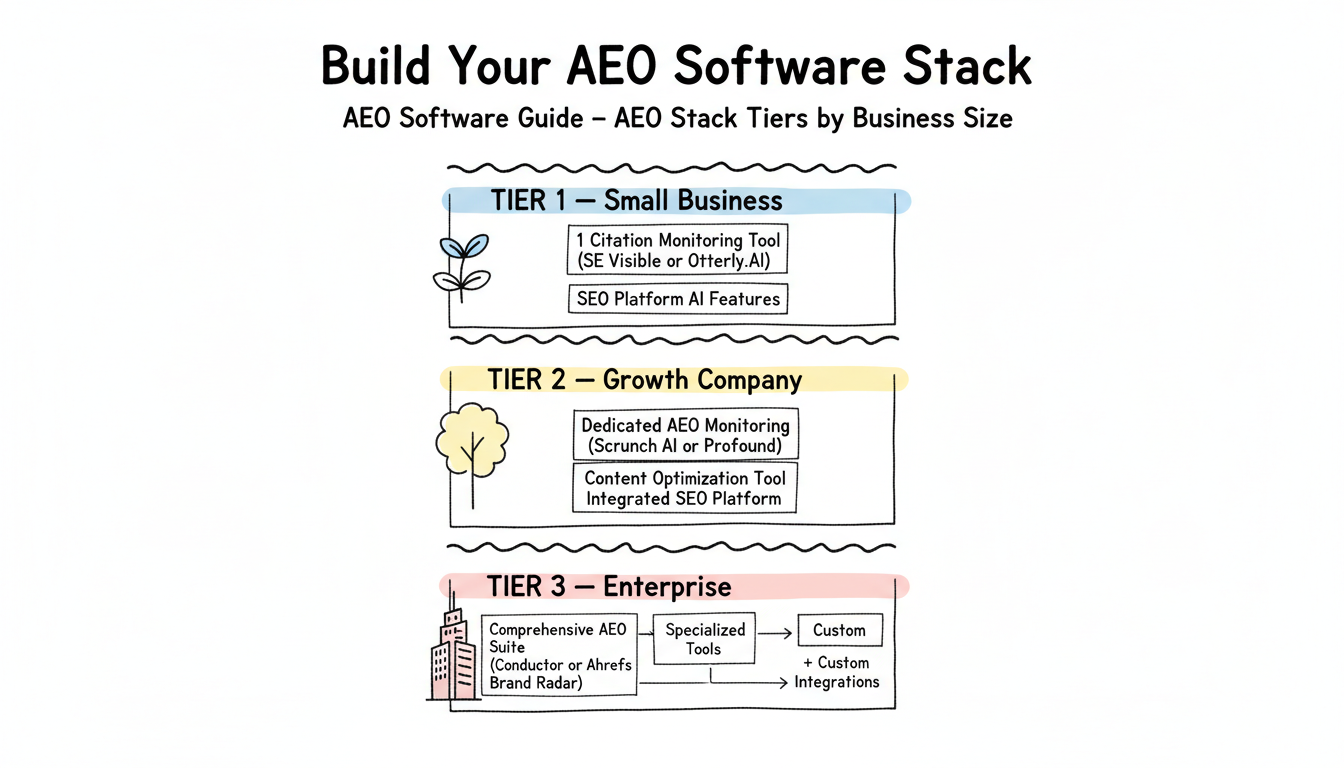
Common Stack Configurations
Small business stack:
- One citation monitoring tool (SE Visible or Otterly.AI)
- Existing SEO platform's AI features
Growth company stack:
- Dedicated AEO monitoring (Scrunch AI or Profound)
- Content optimization tool
- Integrated SEO platform
Enterprise stack:
- Comprehensive AEO suite (Conductor or Ahrefs Brand Radar)
- Multiple specialized tools for specific needs
- Custom integrations with marketing systems
AEO + Agentic Commerce stack: For ecommerce brands, add AI shopping engine monitoring covering Amazon Rufus and Google AI Mode alongside conversion-focused platforms like XFunnel. This configuration tracks the full funnel from zero-click AI citations through purchase attribution, measuring true revenue impact of AEO for ecommerce product visibility.
Understanding resource allocation multi-platform AI search helps optimize your software investments across different AI platforms.
Avoiding Common Mistakes
Don't overbuy early: Start with essential monitoring before purchasing comprehensive suites
Don't create silos: Ensure AEO software data connects with broader marketing analytics
Don't duplicate coverage: Multiple tools monitoring the same things waste budget
Don't neglect adoption: Unused software provides no value—ensure teams can and will use selected tools
AEO Software Pricing
Costs vary significantly across the market.
Tier | Typical Monthly Cost | Features |
Entry-level | $50-150 | Basic monitoring, limited queries |
Mid-market | $200-500 | Competitive analysis, deeper monitoring |
Enterprise | $500-2,000+ | Full capabilities, custom integrations |
Most platforms offer free trials—evaluate before committing to annual contracts.
ROI Considerations
AEO software delivers value through:
- Time savings versus manual monitoring
- Competitive intelligence informing strategy
- Optimization guidance improving performance
- Risk identification preventing visibility losses
Quantify these benefits when evaluating cost justification.
Key Takeaways
AEO software addresses gaps in traditional tools. Standard SEO platforms don't track AI citations. Dedicated AEO software fills this need.
Multiple categories serve different purposes. Monitor first, then add competitive and optimization capabilities as programs mature.
Selection depends on specific needs. Coverage, depth, integration, and budget all influence the right choice for your organization.
Build incrementally. Start with focused tools and expand as you validate value and identify additional needs.
FAQs
Do I Need AEO Software If I Have Good SEO Tools?
Likely yes. Even excellent SEO platforms have limited AI visibility features. Dedicated AEO software provides depth of monitoring and AI-specific capabilities that general SEO tools lack. At minimum, supplement SEO platforms with basic AEO citation monitoring.
Which AEO Software Is Best for Agencies?
Agencies benefit from platforms with multi-client management, white-label reporting, and competitive analysis features. Profound and Ahrefs Brand Radar offer agency-friendly configurations. Evaluate white-label options carefully—client presentation capabilities matter.
How Quickly Should AEO Software Show Results?
Software shows visibility data immediately—you'll understand current performance right away. Improvements from optimization take longer. Expect to see structural changes (like monitoring setup) produce insights within days, while visibility improvements from optimization typically appear over weeks to months.
What Is the Difference Between AEO Software and an AEO Grader?
An AEO grader like HubSpot's free tool provides a one-time diagnostic score of your page's readiness for AI search engines. AEO software platforms offer ongoing monitoring, competitive analysis, and optimization capabilities. Think of graders as a health checkup and AEO software as a continuous fitness tracker. Most organizations start with a free grader audit, then invest in full AEO software for sustained visibility management.
Which AI Engines Should AEO Software Monitor in 2026?
At minimum, AEO software should monitor ChatGPT, Google AI Overviews, and Perplexity. Strong platforms also cover Gemini, Claude, Microsoft Copilot, and Grok. Emerging engines like Google AI Mode, Meta AI, and Amazon Rufus are increasingly important for brands in ecommerce and social media. The best AEO platforms like Goodie AI and AthenaHQ now track ten or more engines simultaneously, giving comprehensive visibility across the entire AI search landscape.
How Does Structured Data Improve AEO Software Performance?
Structured data using JSON-LD and schema.org markup helps AI engines extract accurate information from your content. AEO software evaluates your structured data implementation and identifies gaps. Pages with proper FAQPage, Article, and Organization schema tend to receive more AI citations. Implementing structured data is one of the highest-impact technical optimizations for answer engine visibility alongside content quality improvements.
What Is Agentic Commerce and Why Does It Matter for AEO?
Agentic commerce refers to AI systems that research, compare, and recommend purchases on behalf of users. As AI assistants like Amazon Rufus and Google AI Mode handle more shopping queries, brands need AEO software that monitors product visibility in these AI-driven purchasing flows. Conversion-focused AEO platforms like XFunnel track the full funnel from AI citation through purchase, measuring true revenue impact of AI search optimization.