
Answer Engine Optimization requires new measurement capabilities that traditional SEO tools weren't designed to provide. When AI systems like ChatGPT, Perplexity, and Google AI Overviews generate responses, you need specialized software to track citations, measure visibility, and optimize content for AI comprehension.
This guide covers the AEO software landscape in 2026—from AI visibility tracking platforms to content optimization tools—helping you build the right tech stack for AI search success.
What AEO Software Does
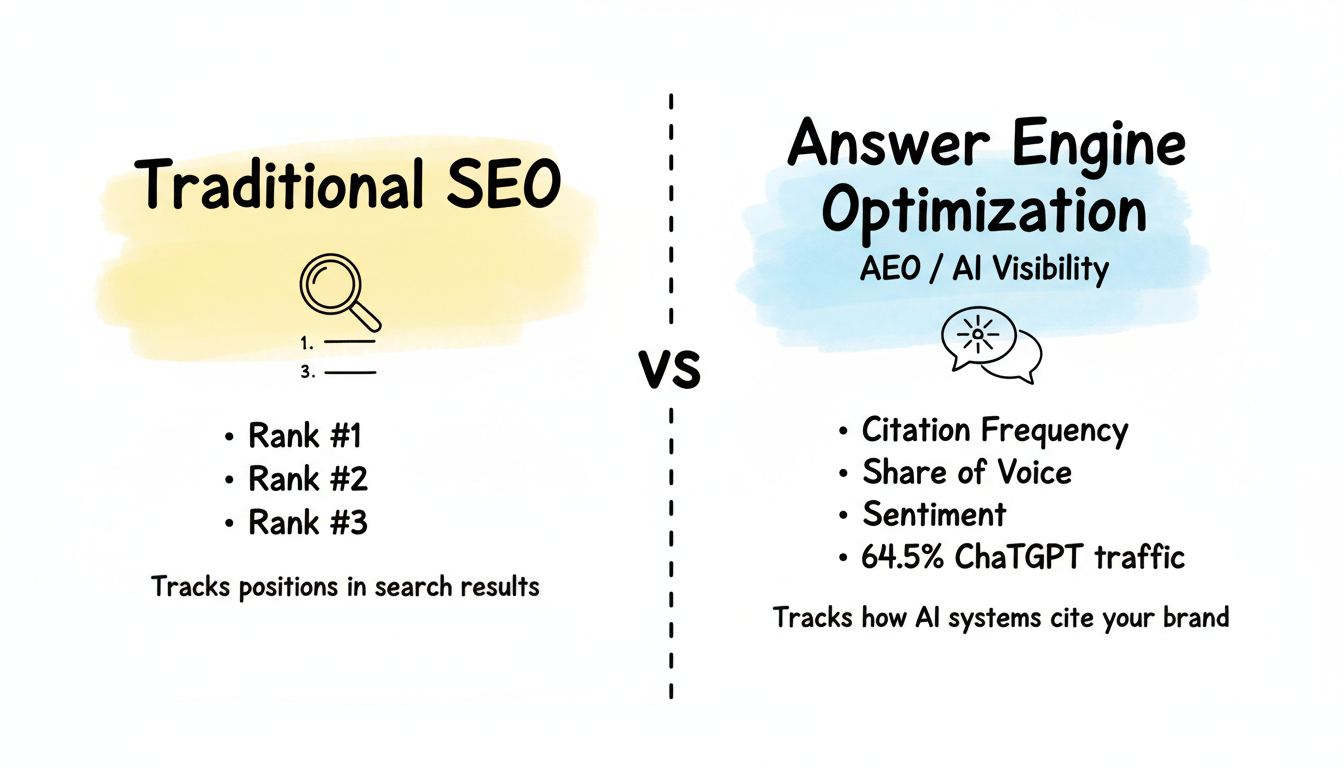
AEO software differs fundamentally from traditional SEO tools. While SEO platforms track rankings in search results, AEO tools analyze how AI systems generate answers and what influences visibility in those contexts.
Core Capabilities
Modern AEO platforms provide several essential functions:
AI visibility tracking – Monitor how frequently your brand appears in AI-generated responses across ChatGPT, Perplexity, Claude, Google AI Overviews, and Gemini.
Citation analysis – Track which of your pages get cited, in what context, and how citation patterns change over time.
Prompt-level monitoring – See exactly which user prompts trigger mentions of your brand versus competitors.
Sentiment tracking – Understand whether AI systems present your brand positively, neutrally, or negatively.
Competitive benchmarking – Compare your AI visibility against competitors for specific topics and queries.
Why Traditional SEO Tools Fall Short
Traditional SEO tools track rankings—position 1, 2, 3 in search results. AI visibility works differently. Your brand might appear in ChatGPT's response without any "ranking" to measure. AI systems synthesize information from multiple sources, cite selectively, and generate unique responses for each query.
This requires new metrics: citation frequency, mention accuracy, share of voice in AI responses, and sentiment analysis. Purpose-built AEO software addresses these measurement challenges.
With 69% of Google searches resulting in zero clicks as of 2025, traditional click-based SEO metrics miss the majority of how users now find answers. AEO software fills this gap by tracking citations, brand mentions, and AI-generated answer inclusions across platforms.
How Answer Engines Evaluate Your Content
Understanding how answer engines process and select content is essential for choosing the right AEO software. The shift toward zero-click searches—69% of Google searches in 2025 resulted in zero clicks—means answer engines are now the primary way users consume information. This fundamentally changes what optimization looks like.
At the core of answer engine evaluation is a sophisticated NLP pipeline. Models like BERT and MUM parse your content for semantic understanding, extracting entities, identifying relationships between concepts, and matching content to user intent. These models don't just look for keyword matches—they understand meaning, context, and topical authority. What this means for your content strategy: surface-level keyword optimization is no longer sufficient. Your content needs to demonstrate deep topical coverage with clearly defined entities and relationships.
Large language models like GPT-5 take this further by synthesizing answers from multiple sources simultaneously. When generating a response, these models weight several signals: source authority and trustworthiness, content freshness and recency, the presence and quality of structured data, and how well content directly addresses the user's specific question. The model then constructs a unified answer, often citing the most authoritative and well-structured sources.
The Google Knowledge Graph plays a critical role in entity validation. Answer engines cross-reference claims in your content against the Knowledge Graph to verify factual accuracy and entity relationships. Content that aligns with established Knowledge Graph entities—and helps establish new ones—earns higher trust scores. If you're looking to strengthen your entity presence, understanding how to get a Google Knowledge Panel provides a strong foundation for answer engine visibility.
This technical understanding directly informs what to look for in AEO software: tools that analyze entity coverage, measure semantic depth, validate structured data, and track how AI models interpret your content across different query contexts.
Categories of AEO Tools
The AEO software market has evolved into distinct categories serving different needs.
AI Visibility Tracking Platforms
These platforms run automated queries across multiple AI engines and track brand mentions over time.
Key players:
- SE Visible – Comprehensive AI visibility tracking across major LLMs with citation trend analysis
- Ahrefs Brand Radar – AI brand visibility tracking integrated with traditional SEO data
- Profound – Enterprise-grade platform with log-level AI crawler data and SOC 2 compliance
- Scrunch AI – Multi-engine monitoring with prompt-level visibility insights
These tools run queries on LLM chatbots instead of you, maintaining records of how often and in what contexts your brand gets referenced. Most track ChatGPT, Perplexity, Claude, Google Gemini, and Google AI Overviews.
Content Optimization Tools
These platforms help optimize content specifically for AI comprehension and citation likelihood.
Key capabilities:
- Structured content recommendations for AI extraction
- Schema markup validation and suggestions
- E-E-A-T signal analysis
- Citation gap identification
Tools like Surfer SEO have added AI-specific features, while newer platforms like Goodie AI and Quattr focus specifically on GEO optimization and AEO content optimization.
Writesonic and Athena round out the content optimization category with AI-native approaches. Writesonic generates answer-optimized content at scale, while Athena provides enterprise-grade semantic entity tracking and featured snippet prediction.
AEO Graders and Checker Tools
A growing category of AEO software focuses specifically on scoring and grading content for answer engine readiness. An AEO grader evaluates your content against key criteria—conciseness, entity coverage, schema markup presence, and question-targeting alignment—then provides an actionable score with specific improvement recommendations.
HubSpot AEO Grader is a free tool that scores pages on AI visibility factors including content structure, entity coverage, and schema implementation. It integrates directly with HubSpot CMS, making it particularly useful for teams already in the HubSpot ecosystem. The grader provides a clear readiness score and prioritized recommendations for improving answer engine visibility.
Mangools AI Search Grader evaluates content for featured snippet and AI overview eligibility. It pairs with Mangools' keyword research suite to identify which queries offer the best opportunities for answer engine placement. The tool analyzes content structure, keyword targeting, and competitive positioning to surface quick-win optimizations.
Writesonic combines AI content generation with built-in AEO scoring. It's particularly useful for teams creating answer-optimized content at scale, as it scores content for answer engine readiness during the creation process rather than as an afterthought.
Athena is an enterprise AEO platform with proprietary scoring algorithms, semantic entity tracking, and featured snippet prediction. It provides the deepest analysis of how answer engines interpret content but comes at a higher price point suited for larger organizations.
Tool | Free/Paid | Key Strength | Best For |
HubSpot AEO Grader | Free | CMS integration, accessibility | HubSpot users, beginners |
Mangools AI Search Grader | Paid | Keyword research integration | SEO teams, snippet targeting |
Writesonic | Freemium | Content generation + scoring | Content teams at scale |
Athena | Paid | Deep semantic analysis | Enterprise organizations |
When deciding between a grader and a full AEO platform, consider your workflow. Graders provide fast, focused feedback on individual pages—ideal for content teams optimizing existing articles. Full platforms offer broader visibility tracking and competitive intelligence better suited for strategic planning.
Monitoring and Alerting Tools
Some platforms specialize in alerting when AI mentions change or competitors gain visibility.
Peec AI focuses on tracking brand mention activity across AI answer engines with prompt-level visibility and competitor comparison. Otterly AI provides citation tracking with brand mention accuracy monitoring.
These tools help teams respond quickly when AI visibility shifts—whether gaining new citations or losing ground to competitors.
Enterprise AEO Platforms
Large organizations require platforms that integrate AEO with existing marketing operations.
Conductor supports answer engine optimization alongside traditional SEO, tracking brand visibility across AI search engines while unifying content creation, monitoring, and analytics. Semrush AI Toolkit extends the familiar SEO platform with AI visibility tracking across ChatGPT, Google AI, Gemini, and Perplexity.
Enterprise platforms prioritize integration, compliance, and team collaboration over standalone functionality.
Evaluating AEO Software
When selecting AEO tools, consider these evaluation criteria.
Platform Coverage
Not all tools track all AI engines. Verify coverage for:
Platform | Priority Level | Notes |
ChatGPT | Essential | 64.5% of AI search traffic |
Google AI Overviews | Essential | Appears on 39%+ of queries |
Perplexity | High | Research-focused audience |
Claude | Medium | Growing professional usage |
Gemini | Medium | Google ecosystem integration |
Some tools track 3-4 engines, others track 10+. Choose based on where your audience actually searches.
Beyond the major AI platforms, evaluate whether your AEO software tracks visibility across voice assistants (Alexa, Siri, Google Assistant) and emerging search interfaces like DuckDuckGo Instant Answers and Bing Copilot.
Data Accuracy
AI visibility data quality varies significantly. Some platforms run queries infrequently or with limited prompt variation, missing how responses change across contexts.
Look for:
- Query frequency (daily vs. weekly vs. monthly)
- Prompt diversity (same question phrased multiple ways)
- Historical data depth
- Citation verification processes
Actionable Insights
Tracking visibility means little without optimization guidance. Evaluate whether platforms provide:
- Specific content recommendations
- Citation gap analysis
- Competitor content comparison
- Optimization prioritization
The best tools connect visibility data to action—not just dashboards showing what happened, but guidance on what to do next.
Schema Markup Support
Effective AEO software validates implementation of specific schema types that answer engines prioritize: FAQPage for question-answer pairs, HowTo for step-by-step instructions, Speakable for voice assistant eligibility, Article for news and blog content, and LocalBusiness for location-based queries. The best tools also check for AI crawler access by auditing your robots.txt configuration to ensure LLM crawlers like GPTBot and ClaudeBot are not inadvertently blocked. Look for tools that provide structured data for AI search validation as a core feature.
Integration Capabilities
AEO tools should fit existing workflows. Consider:
- API availability for custom integrations
- Export formats for reporting
- Connections to content management systems
- Compatibility with traditional SEO tools
Standalone tools create data silos. Integrated platforms enable unified visibility strategies.
Voice Search and AEO Software
Voice commerce is projected to reach $80 billion, making voice search a critical channel for answer engine optimization that your AEO software must address. Voice queries differ fundamentally from text-based searches: they use conversational phrasing, tend to be longer and more specific, and carry a strong local intent bias. A user typing "best AEO tools" might voice-search "what are the best tools for answer engine optimization near me."
Several AEO platforms now include dedicated voice search features: voice query simulation that tests how AI assistants respond to spoken queries, conversational keyword tracking that monitors long-tail voice phrases, and voice SERP position monitoring that tracks where your content appears in spoken results.
The three major voice assistants—Alexa, Siri, and Google Assistant—each pull from different answer sources. Alexa relies primarily on Bing and Amazon's own data. Siri draws from Apple's partnerships and web search. Google Assistant uses Google's Knowledge Graph and AI Overviews. Your AEO software should track visibility across all three to ensure comprehensive coverage.
When evaluating AEO tools for voice readiness, look for support for Speakable schema validation, question-answer format scoring, and local business optimization features. For a deeper dive into this growing channel, see our voice search optimization guide.
Building Your AEO Tech Stack
The right tool combination depends on your resources and priorities.
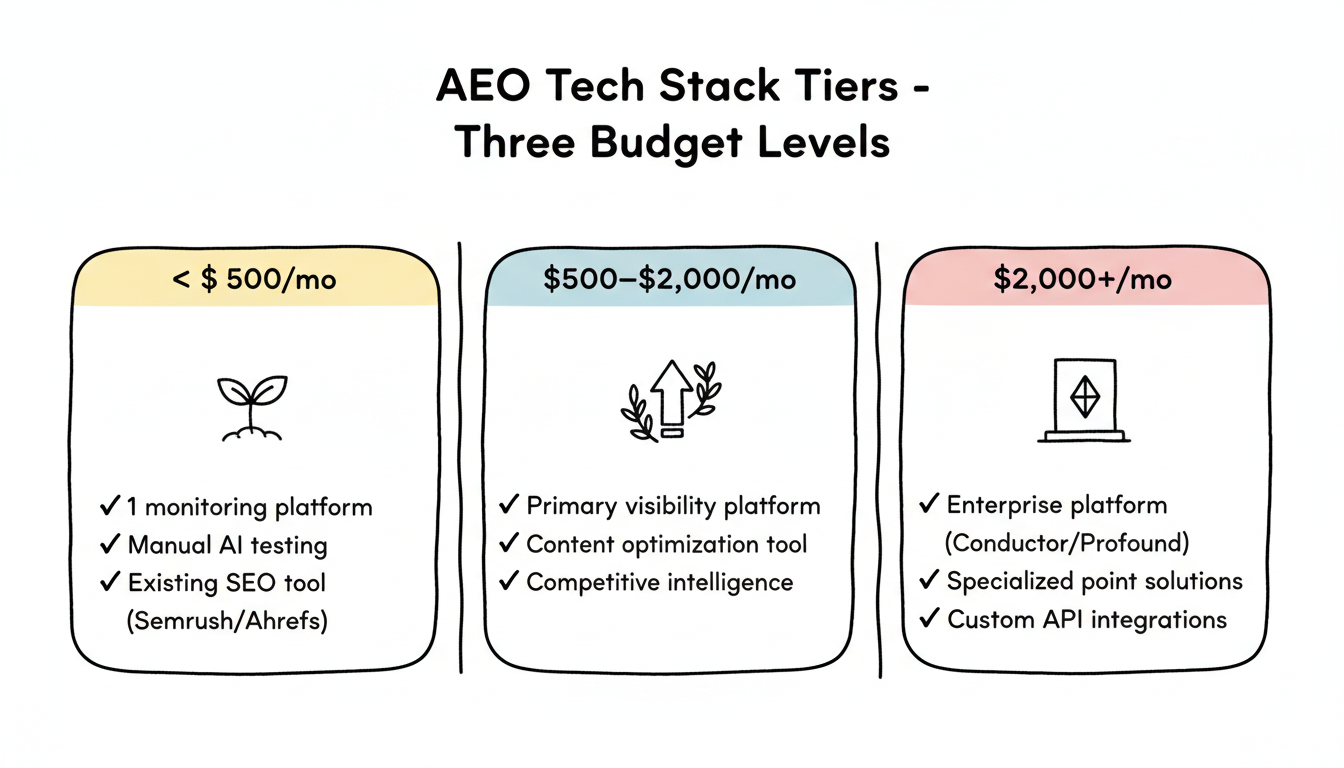
Starter Stack (Under $500/Month)
For teams beginning AEO optimization:
Visibility tracking: Choose one monitoring platform (SE Visible, Scrunch AI, or Otterly AI) for baseline measurement.
Manual testing: Supplement with direct queries to AI platforms to understand response patterns.
Traditional SEO tool: Leverage existing Semrush or Ahrefs investment—both have added AI visibility features.
This approach provides essential measurement without significant new investment.
Growth Stack ($500-2000/Month)
For teams scaling AEO efforts:
Primary visibility platform: One comprehensive tool with multi-engine coverage and historical data.
Content optimization: Add a platform focused on AI-optimized content creation and analysis.
Competitive intelligence: Tools providing detailed competitor visibility comparison.
This combination enables both measurement and optimization execution.
Enterprise Stack ($2000+/Month)
For organizations with mature AI visibility programs:
Enterprise platform: Conductor, Profound, or similar platforms with compliance, team features, and integration capabilities.
Specialized tools: Point solutions for specific needs (deep Reddit analysis, voice search optimization, etc.).
Custom integrations: API connections linking AEO data to business intelligence systems.
Enterprise stacks prioritize scale, governance, and cross-functional visibility.
Enterprise platforms increasingly offer MCP server integrations, enabling direct API connections between AEO tools and LLMs for real-time content optimization feedback.
Tool Selection Considerations
Pricing Models
AEO tool pricing varies significantly:
- Per-domain pricing: Cost scales with domains tracked
- Per-query pricing: Cost based on monitoring volume
- Tiered plans: Feature access varies by plan level
- Custom enterprise: Negotiated based on needs
Many tools offer free trials or freemium tiers for initial evaluation. Test before committing to annual contracts.
Implementation Reality
Research indicates most companies spend $500-2000/month on best AEO tools but see minimal results because they don't know how to act on the data. Tools alone don't create AI visibility—they measure it.
Before investing in sophisticated software, ensure your team has:
- Content optimized for AI extraction
- Strong E-E-A-T signals
- Technical foundation (schema, crawler access)
- Process for acting on visibility insights
Tools amplify strategy—they don't replace it.
Emerging Capabilities
The AEO software market evolves rapidly. Watch for:
AI-generated optimization suggestions – Platforms using AI to analyze what makes content get cited and recommending specific changes.
Predictive visibility – Tools forecasting which content will earn citations before publishing.
Real-time monitoring – Instant alerts when AI response patterns change.
Cross-platform attribution – Connecting AI visibility to business outcomes like leads and revenue.
Today's leading tools may be displaced by better solutions within months. Stay flexible.
AEO Software in Action: Case Studies
Understanding how organizations have leveraged AEO software provides concrete evidence of what these tools can accomplish. For a broader collection of AEO success stories and case studies, see our dedicated analysis.
NerdWallet: Revenue Growth Despite Traffic Decline
NerdWallet restructured its content specifically for answer engine consumption, implementing comprehensive schema markup, concise answer-formatted sections, and entity-rich content across its financial guides. The result: 35% revenue growth despite a 20% decline in traditional organic traffic. The key lesson is that AEO shifts value from raw clicks to citations and brand visibility. When AI systems consistently cite your content as authoritative, the business impact flows through brand recognition and trust rather than click volume alone.
Stack Overflow: A Cautionary Tale
Stack Overflow represents the risks of not adapting to answer engines. AI models trained extensively on Stack Overflow's data now answer coding questions directly, causing significant traffic decline as developers get answers without visiting the site. AEO software helps detect and respond to these "citation without click" patterns early. The lesson: monitoring how AI systems use your content—even when they don't link to it—is as important as tracking direct citations.
Mangools: Featured Snippet Capture
Mangools used their own AI Search Grader to systematically identify featured snippet opportunities across their target keywords. By optimizing content structure, adding concise answer paragraphs, and implementing FAQPage schema, they captured position zero for several competitive search terms. The lesson: AEO checker tools provide actionable, quick-win optimizations that compound over time.
The through-line across these cases is clear: organizations that proactively adopt AEO software and act on its insights outperform those that react after visibility has already shifted. A proactive AEO strategy—supported by the right tools—turns AI search disruption into a competitive advantage.
Free and Low-Cost Options
Not every organization needs expensive platforms immediately.
Manual Testing
Direct queries to ChatGPT, Perplexity, and Claude cost nothing and provide immediate visibility insights. Systematic manual testing—tracking which queries surface your brand and competitors—builds baseline understanding.
Freemium Tools
Several platforms offer free tiers with limited functionality:
- Basic visibility snapshots
- Limited query tracking
- Single-engine monitoring
These provide starting points before investing in comprehensive solutions.
Traditional SEO Tool Extensions
If you already pay for Semrush, Ahrefs, or similar platforms, explore their AI visibility features before adding new tools. These integrations may provide adequate functionality without incremental cost.
Getting Started
Begin with these steps:
- Audit current visibility – Run manual queries across AI platforms to establish baseline awareness
- Evaluate tool trials – Test 2-3 platforms to understand data quality and usability
- Define success metrics – Determine which AI visibility measurements matter for your business
- Start small – Begin with one tool, learn its capabilities, then expand
AEO software provides essential measurement infrastructure for answer engine optimization. But tools follow strategy—invest in optimization fundamentals before scaling software investment.
FAQs
Do I Need AEO Software If I Already Have SEO Tools?
Yes, for comprehensive AI visibility measurement. Traditional SEO tools track rankings in search results—they don't measure AI citation frequency, sentiment, or share of voice in generated responses. Most major SEO platforms now include AI visibility features, so check your existing tools first.
How Much Should I Budget for AEO Software?
Start with free trials and freemium tiers to understand your needs. Effective AEO programs typically spend $500-2000/month on tools, though enterprise organizations invest significantly more. Tools only deliver value when paired with optimization strategy.
What Is an AEO Grader and How Does It Work?
An AEO grader is a tool that scores your content against answer-engine-readiness criteria. It evaluates factors like conciseness, entity coverage, schema markup presence, and question-targeting alignment. Popular options include the HubSpot AEO Grader (free, integrates with HubSpot CMS) and the Mangools AI Search Grader (evaluates featured snippet eligibility). These tools provide actionable scores and recommendations to improve your content's chances of appearing in AI-generated answers.
What Is the Difference Between AEO, GEO, and SEO?
SEO optimizes content for traditional search engine rankings based on links, keywords, and technical factors. AEO (Answer Engine Optimization) focuses on getting your content cited in AI-generated answers from platforms like ChatGPT, Perplexity, and Google AI Overviews. GEO (Generative Engine Optimization) is a subset of AEO specifically targeting generative AI outputs. In practice, a strong AEO strategy encompasses GEO tactics while also addressing voice search and featured snippets. For a detailed breakdown, see our AEO vs GEO vs SEO comparison.
Do AEO Tools Support Voice Search Optimization?
Yes, several AEO platforms include voice search features. Voice queries account for a growing share of answer engine interactions through Alexa, Siri, and Google Assistant. Look for AEO tools that support Speakable schema validation, conversational keyword tracking, and voice SERP monitoring. Voice commerce is projected to reach $80 billion, making voice optimization a critical component of any AEO software evaluation.
Are There Free AEO Checker Tools Available?
Yes. The HubSpot AEO Grader offers free content scoring for AI search readiness. Several platforms also provide free tiers or trial periods, including basic AI visibility checks. For comprehensive analysis, paid AEO checker tools like Mangools AI Search Grader, Otterly AI, and Scrunch AI offer deeper insights including citation tracking, competitor benchmarking, and multi-platform monitoring starting around $49 per month. For a detailed comparison, see our guide on free vs paid AEO tools.