
Last Updated: March 2026
Developing an AEO strategy—a systematic approach to Answer Engine Optimization—determines whether your brand becomes a cited source in AI-generated responses or remains invisible to the growing audience using AI search platforms.
This guide provides a practical framework for building an AEO strategy that earns citations across ChatGPT, Perplexity, Google AI Overviews, and other AI-powered search systems.
What Is an AEO Strategy?
An AEO strategy is a documented plan for optimizing your digital presence to earn citations in AI-generated answers. Unlike SEO strategy focused on rankings, AEO strategy focuses on becoming the source AI systems quote, reference, and summarize when answering user queries. For a foundational overview, see our guide on what is answer engine optimization.
The distinction matters because AI answer engines evaluate content differently than traditional search algorithms. Backlinks and domain authority—core SEO signals—are relatively weak predictors of AI citation. Instead, answer engines prioritize content that provides direct, extractable answers with clear authority signals.
A comprehensive AEO strategy addresses:
- Which queries to target for AI citation
- How to structure content for AI comprehension
- Where to establish brand authority beyond your website
- What metrics to track for AEO success
- How to integrate AEO with existing SEO efforts
Why AEO Matters Now: The Zero-Click, Generative AI Shift
The urgency behind AEO strategy has never been greater. According to SparkToro and Datos research, 69% of Google searches in 2025 ended without a click—so-called zero-click searches. For brands relying on organic traffic as a primary acquisition channel, this represents a fundamental shift in how audiences find and consume information.
Generative AI platforms are accelerating this trend. Google Gemini now powers AI Overviews and AI Mode across billions of queries. ChatGPT has surpassed 800 million weekly active users. Perplexity and Microsoft Copilot are carving out significant market share among knowledge workers and researchers. These large language models (LLMs) don't just link to sources—they synthesize, summarize, and cite, often eliminating the need for users to visit the original page.
Gartner predicts that 25% of organic search traffic will shift to AI chatbots by end of 2026. The implication is clear: brands that only optimize for AI search engines at the page level without a comprehensive AEO strategy risk losing a quarter of their discovery pipeline. This is why a deliberate AEO strategy—not just traditional SEO—is now a revenue-critical investment.
Core Components of AEO Strategy
1. Query and Topic Targeting
Identify the questions your audience asks AI systems. These often differ from traditional keyword searches:
Traditional SEO Queries: "best project management software" AI Search Queries: "What project management software works best for remote teams under 50 people?"
AEO targeting requires understanding conversational query patterns and the specific questions where your expertise provides unique value.
Approach:
- Survey customers about questions they ask AI assistants
- Test queries in ChatGPT, Perplexity, and Google AI Overviews
- Identify topics where you have authoritative information AI currently lacks
- Document competitive gaps where no brand consistently earns citations
2. Content Structure Optimization
Answer engines select sources they can easily parse and extract. Content structure directly impacts citation likelihood.
Structural Elements That Earn Citations:
- Clear headings formatted as questions users actually ask
- Direct answers in the first paragraph of each section
- Supporting details that validate the initial answer
- Structured data (schema markup) that explicitly defines content elements
- Scannable formatting with lists, tables, and clear hierarchies
Research shows answer engines often evaluate only the first portion of content before deciding whether to cite it. Front-load the most important information. Understanding how to optimize for AI search engines requires mastering these structural elements.
Content structured with clear Q&A pairs, numbered lists, and concise definitions is also more likely to win featured snippets—and featured snippet content is frequently the source LLMs pull from when generating AI answers. Optimizing for featured snippets and AI citations is therefore a convergent effort: the same structural discipline that earns a position-zero result in traditional search increases the likelihood of being cited in generative AI responses.
3. Content Freshness Strategy
Recency strongly influences AI citation. Content published or substantially updated within the last 13 weeks is approximately 50% more likely to be cited by answer engines compared to older content.
Freshness Tactics:
- Establish a content refresh schedule for priority pages
- Display clear publication and update dates
- Add new information as topics evolve
- Remove or update outdated statistics and examples
- Monitor when competitors update their content
4. Authority Signal Development
AI systems evaluate expertise and trustworthiness differently than traditional algorithms. Building authority for AEO requires:
On-Site Signals:
- Author credentials with demonstrated expertise (Person schema)
- Clear organizational credentials (Organization schema)
- Transparent sourcing and methodology
- E-E-A-T signals throughout content
Off-Site Authority:
- Presence on platforms AI systems trust (Reddit, industry publications, news coverage)
- Verified accounts on social and professional platforms
- Citations from recognized authoritative sources
- Consistent brand information across the web
Distributing optimized content through Google's preferred sources, verified Reddit accounts, and industry publications demonstrates expertise AI systems recognize. Many organizations partner with AI SEO companies to accelerate this multi-platform authority development.
Customer reviews and testimonials on third-party platforms—G2, Trustpilot, Google Business Profile—also serve as authority signals for AI answer engines. Forrester research indicates that peer validation is increasingly weighted by AI systems when selecting authoritative sources, making review management an essential component of AEO authority building.
5. Multi-Platform Visibility
Answer engines pull from diverse sources beyond your website. Effective AEO strategy includes presence where AI systems find authoritative information:
- Reddit: Active participation in relevant communities
- Industry publications: Guest content on recognized sites
- News coverage: PR efforts that generate citations
- Professional platforms: Complete LinkedIn company and personal profiles
- Structured databases: Wikidata, Crunchbase, industry directories
This distributed presence creates multiple opportunities for AI systems to recognize your brand as authoritative on topics.
6. Voice Search and Conversational Query Optimization
Over 50% of US adults now use voice search daily, according to Edison Research. Voice queries tend to be longer, question-phrased, and conversational—exactly the format AI answer engines prefer. This makes voice search optimization and AEO naturally convergent disciplines.
Voice assistants like Siri, Alexa, and Google Assistant increasingly pull answers from the same LLM-powered layer that drives ChatGPT and Gemini responses. Content optimized for AI citation is therefore simultaneously optimized for voice search results.
Practical voice search optimization tactics:
- Write in natural, conversational language that mirrors how people speak
- Target question-form queries: "how do I...", "what is the best...", "why does..."
- Use Speakable structured data to signal voice-ready content sections
- Keep answers concise—voice responses typically pull 40-60 word excerpts
Natural language processing (NLP) models parse content for semantic relevance, so matching the conversational intent of voice queries improves AI citation likelihood across both voice and text-based answer engines. For multi-format visibility strategies, see how YouTube SEO for AI search extends these principles to video content.
AEO Strategy Framework
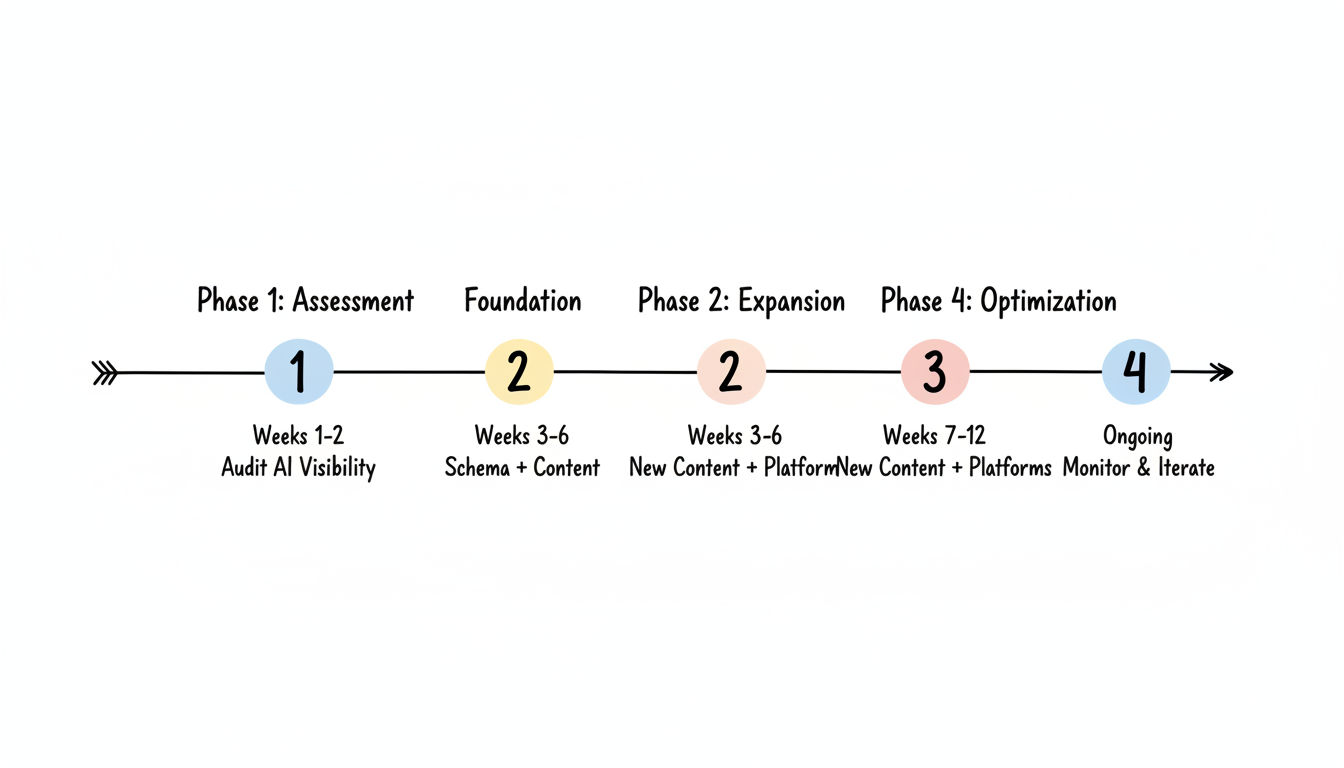
Phase 1: Assessment (Weeks 1-2)
Audit current AI visibility:
- Search brand and key topics across AI platforms
- Document where you're cited vs. where competitors appear
- Identify high-value citation opportunities
Evaluate content readiness:
- Review content structure against AEO requirements
- Check freshness of priority content
- Assess authority signals and E-E-A-T indicators
Conduct AEO-specific keyword research: identify question-form queries, "what is" and "how to" patterns, and conversational long-tail keywords that AI engines surface. Tools like AlsoAsked, AnswerThePublic, and Google's "People Also Ask" feature provide starting points for discovering the queries AI platforms most frequently answer.
Phase 2: Foundation (Weeks 3-6)
Implement technical requirements:
- Add comprehensive schema markup (Organization, Person, Article, FAQ)
- Implement HowTo schema for tutorial and process content to improve rich-result eligibility
- Add Speakable schema to voice-search-ready sections
- Ensure proper date display and freshness signals
- Optimize page structure for AI parsing
Verify AI crawler access in your robots.txt. Ensure that GPTBot, Google-Extended, ClaudeBot, and PerplexityBot are not blocked:
User-agent: GPTBotAllow: /
Using schema validation for AI search tools ensures your structured data meets the standards AI systems expect.
Optimize existing content:
- Restructure top pages for question-based format
- Add direct answers to section beginnings
- Update outdated information
Phase 3: Expansion (Weeks 7-12)
Create citation-optimized content:
- Develop content targeting identified opportunity queries
- Build comprehensive topic coverage demonstrating expertise
- Publish with AEO-optimized structure from the start
Expand platform presence:
- Establish or optimize presence on authority platforms
- Begin strategic participation in relevant communities
- Pursue PR and publication opportunities
Phase 4: Optimization (Ongoing)
Monitor and measure:
- Track citation frequency across AI platforms
- Monitor brand mention patterns
- Measure conversion from AI-referred traffic
Iterate based on data:
- Double down on content earning citations
- Refresh content losing visibility
- Adapt strategy as AI platforms evolve
AEO Metrics to Track
Traditional SEO metrics don't capture AEO success. Key metrics include:
Metric | Description | Target |
Citation frequency | How often AI platforms cite your content | Increasing trend |
AI brand score | Share of voice in AI responses for target topics | Higher than competitors |
Response accuracy | Whether AI accurately represents your information | High accuracy |
Click-through rate | Traffic from AI citations to your site | Industry benchmark+ |
Conversion rate | Business outcomes from AI-referred visitors | Comparable to organic |
Several tools now track AI visibility: Rankscale, Peec AI, Advanced Web Ranking, and Keyword.com offer citation monitoring across platforms. For comprehensive monitoring guidance, explore AEO checker tools guide.
Integrating AEO with SEO Strategy
AEO doesn't replace SEO—they work together. Strong SEO foundations help AI systems discover and crawl your content; AEO optimization ensures that content earns citations once discovered.
Complementary elements:
- Technical SEO enables AI crawling and understanding
- Content quality serves both ranking and citation
- Authority building benefits traditional and AI search
- Topical expertise signals work across both systems
Distinct requirements:
- AEO prioritizes structure over keyword density
- AEO emphasizes freshness more than traditional SEO
- AEO requires multi-platform presence beyond your website
- AEO metrics measure citation, not just ranking
AEO vs GEO: How Answer Engine Optimization Compares
As the AI search landscape matures, two related terms have emerged: AEO (Answer Engine Optimization) and GEO (Generative Engine Optimization). Understanding the distinction helps teams allocate resources effectively.
GEO is a subset of AEO focused specifically on optimizing for generative AI outputs—Google AI Overviews, Gemini responses, ChatGPT answers, and similar LLM-generated content. AEO is the broader umbrella strategy encompassing all answer engines, including voice assistants, featured snippets, knowledge panels, and generative AI platforms.
Dimension | AEO | GEO |
Scope | All answer engines (voice, snippets, AI overviews, chatbots) | Generative AI outputs only |
Primary Goal | Earn citations across all answer formats | Appear in AI-generated responses |
Key Tactics | Schema, authority, freshness, multi-platform presence | Prompt-aligned content, LLM-friendly structure |
Measurement | Citation frequency across all platforms | Visibility in generative AI responses |
A mature AEO strategy naturally encompasses GEO, but understanding the distinction helps teams prioritize resource allocation. Organizations needing expert guidance on navigating this landscape often work with specialized AI SEO companies to develop integrated strategies.
Frequently Asked Questions About AEO Strategy
What Is the Difference Between AEO and SEO?
SEO focuses on ranking in traditional search engine results pages, while AEO (Answer Engine Optimization) focuses on earning citations and visibility in AI-generated answers from platforms like ChatGPT, Google Gemini, and Perplexity. AEO prioritizes structured, authoritative content that LLMs can extract and cite directly, whereas SEO emphasizes link building and keyword rankings. The two strategies are complementary—strong SEO foundations support AEO performance.
How Long Does It Take to See Results from an AEO Strategy?
Most organizations begin seeing measurable improvements in AI citation frequency within 8-12 weeks of implementing a structured AEO framework. Early wins like schema markup and content restructuring can produce results in weeks 3-6, while authority signal development and multi-platform visibility are longer-term investments that compound over months. Consistent content freshness (updating every 13 weeks or sooner) is critical for sustained visibility.
What Tools Can I Use to Measure AEO Performance?
Dedicated AEO tracking tools include Rankscale, Peec AI, and Advanced Web Ranking for monitoring AI citation frequency. HubSpot's AEO Grader provides a quick visibility audit. For broader measurement, track featured snippet ownership in Google Search Console, monitor brand mentions across AI platforms, and measure referral traffic from ChatGPT and Perplexity using UTM parameters or server log analysis. For a detailed comparison, see our AEO checker tools guide.
Does AEO Work for Local Businesses or Only Enterprise Brands?
AEO benefits businesses of all sizes. Local businesses can optimize for voice search queries ("best plumber near me"), earn citations in AI-powered local recommendations, and build authority through Google Business Profile reviews and local structured data. The zero-click search trend affects local queries heavily—over 65% of local searches result in no click—making AEO especially valuable for local visibility.
The Bottom Line
The ROI case for AEO is already clear. Consider NerdWallet: despite experiencing a 20% decline in organic traffic following the rollout of AI Overviews, NerdWallet grew revenue by 35% by optimizing for AI citation and direct answer visibility. This demonstrates that AEO is not just a defensive play against traffic loss—it is an active revenue growth lever for brands willing to invest in becoming the source AI systems trust.
An effective AEO strategy positions your brand as the authoritative source AI systems cite when answering questions in your domain. The brands building this strategic foundation now gain compounding advantages as AI-powered search continues growing.
Start with assessment, build technical and content foundations, then expand and optimize based on citation data. The goal isn't just visibility—it's becoming the trusted answer AI systems consistently recommend.