
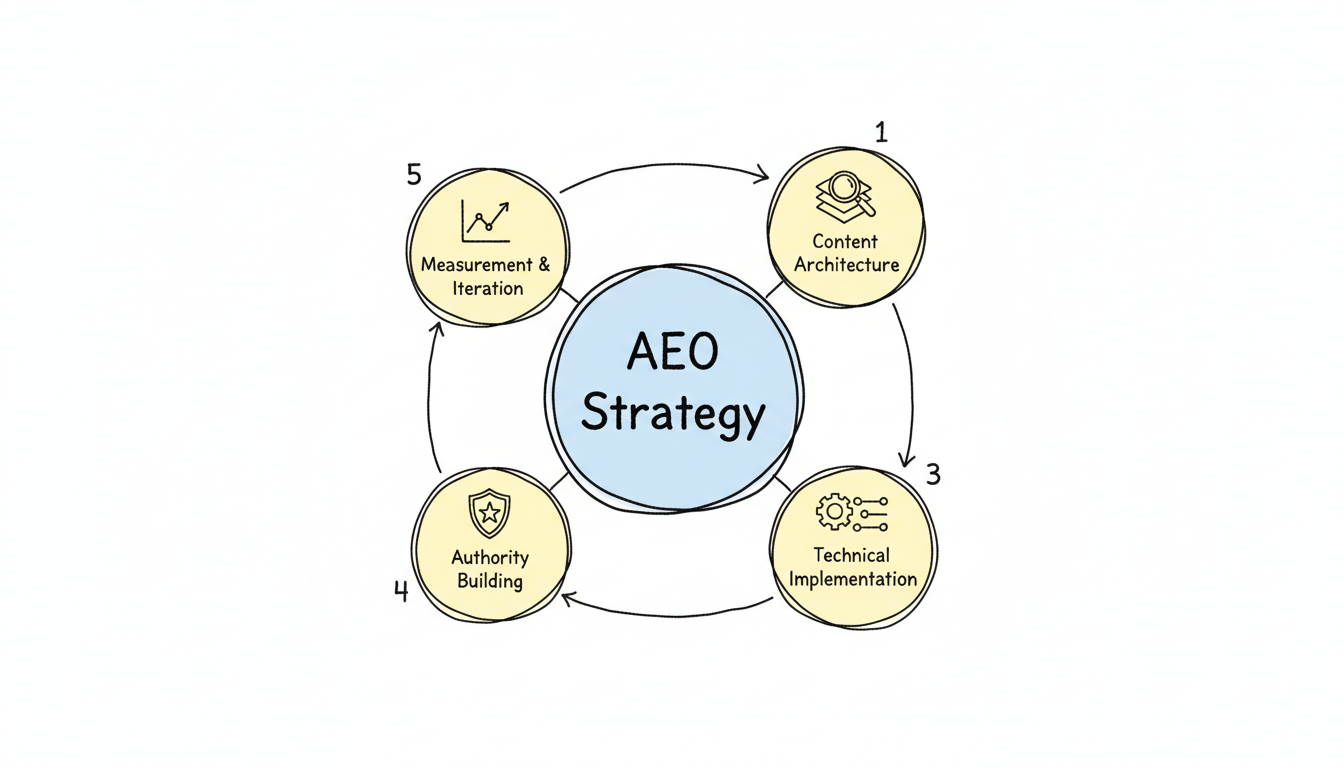
Answer Engine Optimization (AEO) in 2026 is no longer a siloed SEO task—it requires a unified framework that connects content, technical implementation, authority building, and measurement. Organizations that approach AEO strategically rather than tactically capture significantly more AI-generated citations and the high-converting traffic they deliver.
This guide provides a comprehensive AEO strategy framework to plan, implement, and optimize your visibility across ChatGPT, Perplexity, Google AI Overviews, and other AI-powered search platforms.
The Strategic Shift: From Rankings to Citations
According to DW Media's analysis of AEO trends for 2026, success is no longer measured by blue links, but by “citation dominance”—your brand's ability to be the primary source of truth for AI agents. This fundamental shift requires marketers to move beyond keyword density to focus on structured proof blocks, persona-led answer nodes, and maintaining high factual integrity across the decentralized web.
Why a strategic framework matters:
- AI search engines like Perplexity, Gemini, and SearchGPT handle 70% of informational queries
- Citation opportunities emerge from multiple touchpoints across your digital presence
- Tactical, one-off optimizations yield diminishing returns
- Coordinated efforts across content, technical, and authority building compound over time
AEO in the Zero-Click Search Era
The rise of zero-click searches has fundamentally changed how users interact with search results. According to SparkToro and Search Engine Journal data, 69% of Google searches in 2025 ended without a click—users found their answers directly in featured snippets, knowledge panels, or AI-generated summaries without ever visiting a website. Gartner has predicted a 25% drop in traditional search volume by 2026 as AI-powered answer engines continue to absorb informational queries.
This shift means that traditional SEO metrics like click-through rate and organic sessions no longer capture the full picture of your brand's search visibility. Featured snippets, which once represented the pinnacle of organic optimization, have evolved into AI Overviews—longer, more comprehensive AI-generated answers that synthesize information from multiple sources. AEO is the natural next step in this evolution, focusing on earning citations within these AI-generated responses rather than competing solely for blue-link clicks.
The business case for zero-click optimization is already proven. NerdWallet reported 35% revenue growth despite a 20% drop in organic traffic, demonstrating that visibility within AI answers—even without direct clicks—drives brand awareness, trust, and downstream conversions. For organizations building an AEO strategy, this means measuring success not just by referral traffic but by citation presence and brand mention frequency across AI platforms. The ROI of AEO comes from being the trusted source that AI repeatedly references, positioning your brand as the authority in your space.
Framework Component 1: Discovery and Baseline Assessment
Every AEO strategy begins with understanding your current visibility landscape.
AI Visibility Audit
According to ALM Corp's guide to ranking on AI search engines, your first week should focus on audit and baseline establishment:
Week 1 audit activities:
- Test current AI visibility across ChatGPT vs Perplexity, Google AI Mode, Claude, and Gemini
- Document which queries return your content and where competitors appear instead
- Analyze your top 20 pages using AI-optimization checklists (structure, schema, freshness)
- Install analytics tracking for AI referral traffic
- Verify AI crawlers can access your site (check robots.txt)
Competitive Citation Analysis
Map where competitors get cited and identify gaps in your coverage.
Analysis framework:
Query Category | Your Citations | Competitor A | Competitor B | Gap Priority |
Product/Service | Count | Count | Count | High/Med/Low |
How-to | Count | Count | Count | High/Med/Low |
Comparison | Count | Count | Count | High/Med/Low |
Industry definitions | Count | Count | Count | High/Med/Low |
Intent Mapping
According to ABM Agency's B2B website structure guide, AEO success requires targeting the right query types. Research shows that Google AI Overviews appear in 88% of informational search intent queries.
Priority query categories:
- “What is” definitional queries
- “How to” instructional queries
- “Best [solution] for [use case]” comparison queries
- “[Solution A] vs. [Solution B]” evaluation queries
Framework Component 2: Content Architecture
Content structure determines whether AI systems can extract, cite, and trust your information.
The Answer-First Content Model
According to Shopify's AEO optimization guide, AI citations connect to snippable, machine-digestible portions of text. Structure content to balance human narrative with machine extractability.
Content structure requirements:
- Question-based headings that match how people ask AI assistants
- Direct answers within the first 40-60 words of each section
- Atomic answers that make sense when extracted standalone
- Clear heading hierarchy (H1 → H2 → H3) showing topic relationships
Structured Dialogue Optimization
According to DW Media's analysis, 2026 AEO focuses on “conversational paths”—anticipating the 2nd, 3rd, and 4th follow-up questions a buyer will ask an AI agent and providing answers within a single, interconnected content system.
Conversational path planning:
- Identify the primary question for each content piece
- Map 3-5 logical follow-up questions users might ask
- Structure content to answer the full conversation flow
- Link related content pieces for comprehensive coverage
Voice Search and Conversational AI Optimization
Voice search optimization is an increasingly important component of any AEO strategy. Voice assistants like Alexa, Google Assistant, and Siri pull answers from the same structured data and featured snippets that AI search engines use, making voice optimization a natural extension of your answer engine efforts.
Voice queries tend to be longer, more conversational, and almost always question-based—users ask “What is the best AEO strategy for small businesses?” rather than typing “AEO strategy small business.” This natural language pattern aligns directly with the Q&A format optimization that drives AI citations. To maximize extractability for voice results, format your content with explicit question-and-answer pairs using bullet points and concise, direct responses.
Schema types that are especially high-value for voice search results include HowTo schema for instructional content and FAQ schema for question-answer pairs. Voice assistants prioritize content that can be read aloud naturally, so keep individual answers under 30 seconds of speaking time (roughly 40-60 words). By optimizing for voice search alongside text-based AI platforms, you create content that performs across the full spectrum of answer engines.
Information Density Optimization
According to insights on AI content optimization, AI doesn’t reward effort—it rewards clarity. Content must be understood in seconds or AI will skip it. Understanding platform-specific content strategies and format structure is essential for maximizing citation potential.
Density optimization tactics:
- Replace verbose explanations with precise statements
- Use tables and comparison formats for complex information
- Create scannable formats with bullets and numbered lists
- Front-load key information in every section
Framework Component 3: Technical Implementation
Technical foundations enable AI systems to access, understand, and trust your content.
Schema Markup Priority
Schema markup (also called structured data) tells AI systems exactly what your content means. According to ALM Corp's implementation guide, Week 2 should focus on technical implementation. For a deeper dive into implementation specifics, see our guide on AEO schema markup priorities.
Technical priorities:
- Implement priority schema markup (Article, FAQ, HowTo, Organization)
- Validate all schema using Google’s Rich Results Test
- Audit page speed and Core Web Vitals, addressing critical issues
- Ensure server-side rendering or static generation for content pages
- Optimize URL structure for semantic clarity
- Implement HowTo schema for instructional content and FAQ schema for question-answer pairs
Entity Optimization
AI systems understand content through entities—the people, places, things, and concepts mentioned. This is where knowledge graph SEO implementation becomes critical.
Entity optimization approach:
- Consistently reference your brand entity with full context
- Link to authoritative external entities (Wikipedia, industry bodies)
- Build internal entity relationships through consistent terminology
- Use schema to explicitly define entity relationships
Freshness Signals
According to DW Media’s trends analysis, AI scrapers now use “provenance verification” to rank content. Implement visible freshness signals:
Freshness implementation:
- Display “Last Updated” dates prominently
- Implement LastModified schema markup
- Establish regular content refresh schedules
- Archive or redirect severely outdated content
Agentic AI and Multimodal Optimization
Agentic AI search represents the next frontier of answer engines. Unlike traditional AI search where users ask a single question and receive a single response, agentic AI systems autonomously research, compare, and recommend on behalf of users—conducting multi-step investigations across dozens of sources before synthesizing a final answer.
These agentic systems rely heavily on RAG (retrieval-augmented generation) and contextual RAG to pull relevant information from multiple sources in real time. This makes structured data and entity clarity even more critical than in standard AI search, because agentic systems must quickly determine which content is authoritative, relevant, and trustworthy across a broader retrieval pipeline.
Multimodal optimization is equally important as AI systems increasingly process images, videos, and audio alongside text. Ensure all images have descriptive alt text that conveys the full context of the visual, videos include transcripts or detailed descriptions, and diagrams are accompanied by text equivalents so AI can process all content types. The trend toward hyper-personalization—where AI agents tailor answers based on individual user context, location, and history—means your content must cover multiple angles, use cases, and audience segments to remain relevant across personalized AI responses.
Framework Component 4: Authority Building
Authority determines whether AI systems trust your content enough to cite it.
E-E-A-T Signal Development
According to ABM Agency's research, AI engines value E-E-A-T (Experience, Expertise, Authoritativeness, and Trustworthiness) signals that demonstrate deep knowledge.
Authority signal priorities:
- Named authors with credentials and expertise signals
- First-party data and original research
- Case studies with specific metrics
- Industry certifications and recognition
- Build quality backlinks from authoritative domains through original research, data studies, and expert commentary—backlinks remain a core trust signal for both traditional and AI search engines. For proven tactics, explore our guide to AEO link building strategies
Verified Origin Tags
According to DW Media's analysis, implement digital signatures or schema that proves your content was created by a human expert. In a sea of synthetic content, “human-verified” signals are becoming a ranking factor for answer engines. This connects to broader AI search citation strategies across platforms.
Multi-Platform Presence
Distribute optimized content across platforms where AI systems look for validation. An omnichannel strategy ensures your brand is present wherever AI systems gather corroborating evidence:
Platform priorities:
Platform | Content Type | Authority Signal |
Industry publications | Guest posts, contributed articles | Third-party validation |
Community participation | User consensus signals | |
YouTube | Video content | Multi-format expertise |
Professional content | Professional authority | |
Quora | Q&A participation | Direct answer authority |
TikTok | Short-form video | Emerging discovery platform |
People Also Ask | Optimized FAQ content | Google SERP visibility |
Framework Component 5: Measurement and Iteration
Measurement enables continuous improvement and demonstrates ROI.
AEO Metrics Framework
According to Spearpoint's AEO guide, manual query testing remains necessary as standardized measurement tools continue developing. Establishing comprehensive AEO optimization metrics is essential for tracking progress.
Core metrics:
- Citation frequency: How often you’re cited across AI platforms
- Citation position: Primary citation vs. supporting source
- Share of voice: Your citations vs. competitors for target queries
- Referral traffic: Visitors from AI platform citations
- Citation conversion rate: Conversions from AI-referred traffic
ROI attribution remains the biggest challenge in AEO measurement. Unlike traditional SEO where click-through and conversion paths are well-established, AI search attribution often lacks direct referral data. Use tools like Semrush, Ahrefs, and dedicated AEO platforms to triangulate citation visibility with traffic and revenue impact. Track AEO keyword research for AI search insights to identify which queries drive the most valuable AI citations. For a comprehensive approach to tracking returns, see our guide on AEO marketing ROI measurement.
Tracking Implementation
According to Spearpoint's analytics guidance, Google Analytics 4 Custom Channel Groups can separate answer engine traffic from traditional sources.
Tracking setup:
- Configure GA4 to identify AI referral sources
- Set up automated alerts for traffic pattern changes
- Create dashboards for AEO-specific metrics
- Establish monthly reporting cadence
Iteration Process
Monthly review questions:
- Which content pieces earned new citations?
- Which queries show declining visibility?
- What competitor content is capturing citations we want?
- Which technical implementations need refinement?
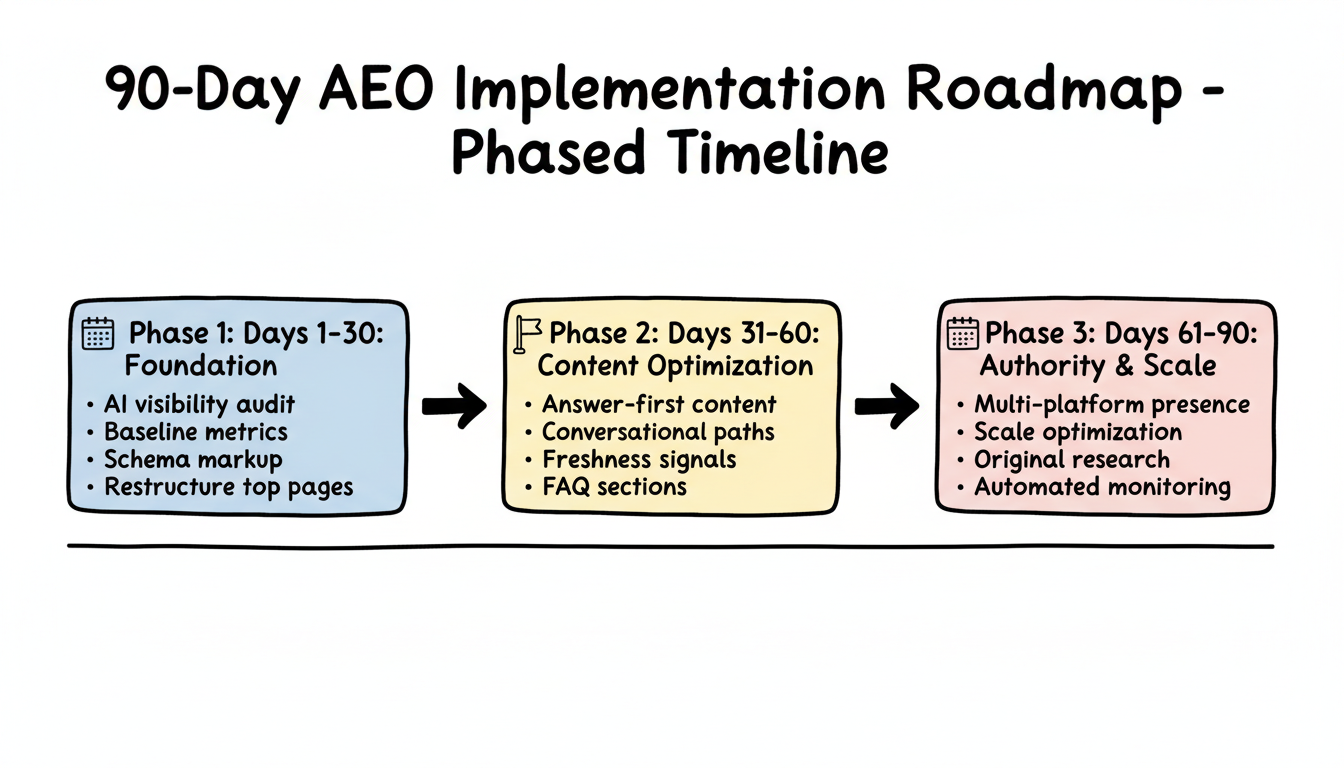
90-Day AEO Strategy Implementation
According to Search Engine Land's AI-driven search playbook, a phased approach ensures sustainable implementation.
Days 1-30: Foundation
Focus areas:
- Complete comprehensive AI visibility audit
- Document baseline citation metrics
- Implement priority schema markup
- Restructure 5-10 high-traffic pages for AI extractability
- Establish measurement infrastructure
Days 31-60: Content Optimization
Focus areas:
- Create answer-first content for priority queries
- Build conversational path content clusters
- Implement freshness signals across priority content
- Develop FAQ sections optimized for AI extraction
- Test and refine content structure based on early results
Understanding how to optimize content for generative AI will accelerate this phase significantly.
Days 61-90: Authority and Scale
Focus areas:
- Launch multi-platform authority building initiatives
- Scale content optimization to additional pages
- Develop original research or data assets
- Build automated monitoring processes
- Document playbooks for ongoing optimization
Common AEO Strategy Mistakes
Mistake 1: Treating AEO as Separate from SEO
According to Connect Media Agency's AEO guide, AEO complements SEO rather than replacing it—strong SEO gets content discovered while AEO ensures AI can understand and use it. Understanding the relationship between SEO and generative AI prevents this mistake.
Mistake 2: Optimizing Without Measurement
Without baseline metrics and ongoing tracking, you can’t identify what’s working or justify continued investment. Start measurement from day one.
Mistake 3: Focusing Only on Content
Technical implementation and authority building are equally important. A comprehensive framework addresses all three pillars. Many organizations benefit from working with specialized answer engine optimization services to ensure proper implementation.
Mistake 4: Expecting Immediate Results
According to Spearpoint's implementation guidance, the biggest barrier to AEO success is often organizational—securing budget allocation and internal buy-in. Present AEO as complementary investment requiring strategic fund reallocation rather than separate budget.
AEO vs GEO vs SEO: Understanding the Differences
As AI-powered search matures, three distinct optimization disciplines have emerged—and understanding the AEO vs SEO vs GEO differences is essential for building a complete strategy.
GEO (Generative Engine Optimization) focuses specifically on optimizing content for LLM-generated responses. While AEO targets answer engines like Perplexity, Google AI Overviews, and ChatGPT—platforms that cite sources and provide direct answers—GEO addresses the broader category of generative AI outputs from platforms like Gemini, Claude, and other large language models where responses are synthesized without always providing explicit citations.
Here is a quick comparison of each discipline:
Discipline | Primary Platforms | Success Metric | Core Focus |
SEO | Google organic, Bing | Rankings, clicks, traffic | Blue-link visibility |
AEO | ChatGPT, Perplexity, AI Overviews | Citations, brand mentions | Answer engine citations |
GEO | Gemini, Claude, LLM outputs | Inclusion in generated responses | LLM training and retrieval |
A complete 2026 strategy integrates all three disciplines. The framework in this post covers the AEO pillar—optimizing for citation-driven answer engines—while the principles of structured data, entity clarity, and authority building apply equally across SEO and GEO. Organizations that treat these as complementary rather than competing approaches will capture the widest visibility across the evolving search landscape.
Key Takeaways
Building a comprehensive AEO strategy framework requires coordinated effort across five components:
- Discovery and baseline assessment - Audit current AI visibility, analyze competitor citations, and map priority query intents before optimization
- Content architecture - Structure content for AI extraction with answer-first formats, conversational paths, and optimized information density
- Technical implementation - Implement schema markup, optimize entities, and establish freshness signals that help AI systems understand and trust content
- Authority building - Develop E-E-A-T signals, verified origin tags, and multi-platform presence that position your brand as a trusted source
- Measurement and iteration - Track citation frequency, referral traffic, and conversion rates to continuously improve and demonstrate ROI
The 90-day implementation roadmap provides a realistic timeline for organizations building AEO capabilities. Start with quick wins—schema markup, answer capsules on priority pages, and content refresh schedules—while building toward comprehensive optimization. Looking at AEO optimization examples from successful implementations can guide your approach.
According to ALM Corp's research, the opportunity window remains wide open. Most businesses haven’t yet prioritized AI optimization, creating first-mover advantages for those who act now.
Frequently Asked Questions About AEO Strategy
What Is an AEO Strategy?
An AEO (Answer Engine Optimization) strategy is a structured plan for increasing your brand’s visibility across AI-powered search platforms like ChatGPT, Perplexity, Google AI Overviews, and Gemini. It combines content architecture, structured data implementation, authority building through backlinks and E-E-A-T signals, and citation measurement into a coordinated framework. Unlike one-off SEO tactics, an AEO strategy addresses the full pipeline from discovery through ROI attribution.
How Is AEO Different from SEO and GEO?
SEO optimizes for traditional search engine rankings and blue-link clicks. AEO optimizes for citations in answer engines like Perplexity and AI Overviews, where users get direct answers. GEO (Generative Engine Optimization) targets LLM-generated responses from platforms like Gemini and Claude. A complete 2026 strategy integrates all three, using structured data and Q&A format content that performs across each channel.
What Tools Should I Use to Measure AEO Performance?
Start with Google Analytics 4 to track AI referral traffic, then layer in Semrush or Ahrefs for keyword research and backlink monitoring. Dedicated AEO tools like OmniSEO, Profound, and HubSpot’s AEO Grader can measure citation frequency across AI platforms—see our roundup of the best AEO tools for visibility tracking. Manual query testing across ChatGPT, Perplexity, and Gemini remains essential since automated tracking for AI citations is still maturing.
How Long Does It Take to See Results from an AEO Strategy?
Most organizations see initial citation improvements within 30-60 days of implementing structured data, schema markup, and answer-first content restructuring. Full ROI from authority building and multi-platform presence typically takes 60-90 days. The key is starting measurement from day one so you can track incremental gains. Zero-click visibility often improves before direct referral traffic does.