
AEO Success Stories Case Studies: Real Brand Results (2026)
Answer Engine Optimization (AEO)—also known as Generative Engine Optimization (GEO)—isn't theoretical anymore. Brands implementing AEO strategies are seeing measurable results: higher conversion rates, increased brand citations, and competitive advantages in AI-powered search. The gap between companies with AEO strategies and those without continues to widen.
These AEO success stories case studies demonstrate what's possible when brands prioritize AI search visibility in 2026.
Ready to start your own AEO journey? Our free AEO grader tool gives you a baseline score and prioritized recommendations.
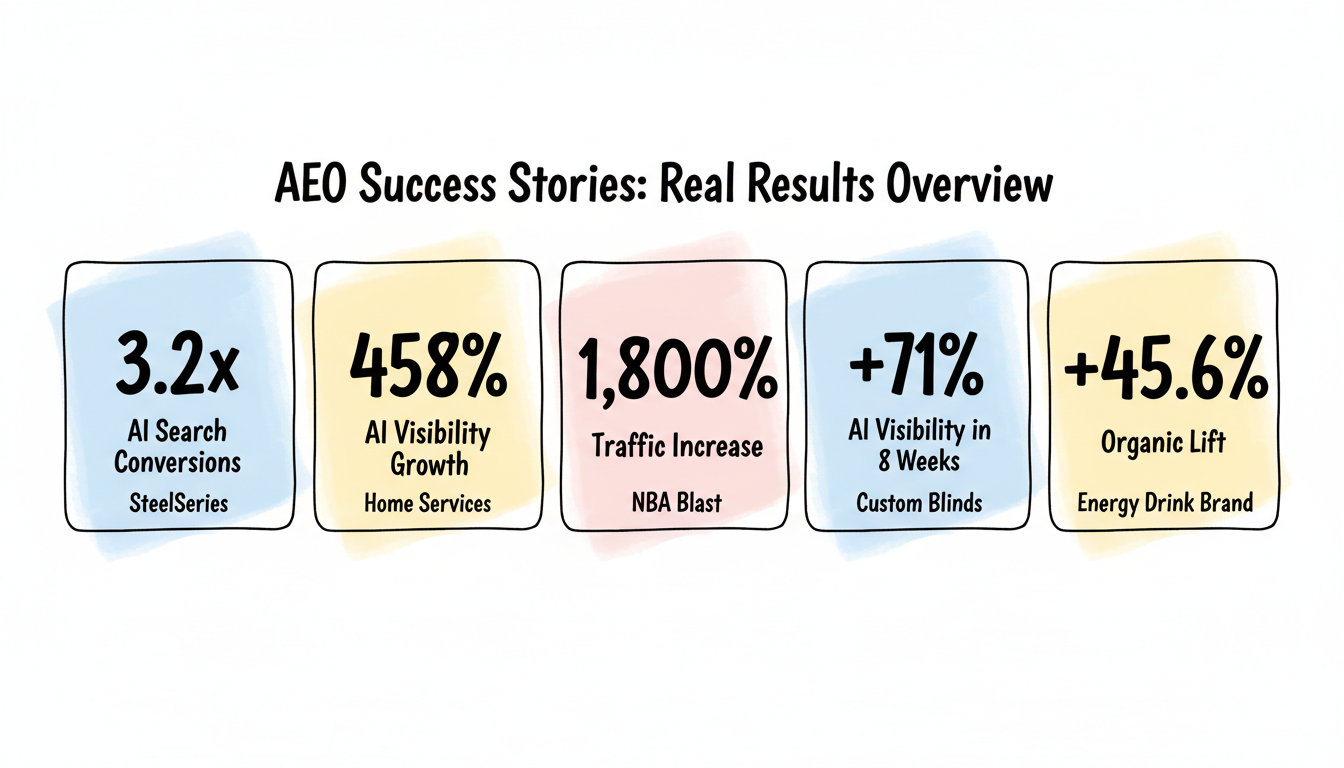
Case Study: Steelseries Achieves 3.2x AI Search Conversions
According to NoGood's analysis of search marketing, their work with SteelSeries demonstrates what's possible when brands shift focus from traditional rankings to AI optimization.
The approach: SteelSeries stopped chasing traditional rankings and started optimizing for how AI systems actually decide what to cite. This meant restructuring content around answer formats, building topical authority clusters, and strengthening entity signals across their digital presence.
The results:
- 3.2x increase in AI search conversions within six months
- Improved citation rates across ChatGPT, Perplexity, and Gemini
- Stronger brand visibility for product comparison queries
- Higher quality traffic from AI-referred sources
AI search visitors convert significantly better because they arrive with specific intent—having already received initial information from AI and seeking to take action.
— NoGood, SteelSeries case study
Case Study: Fortinet'S Journey from Zero to AI Dominance
According to LeadWalnut's Fortinet case study, even market leaders can find themselves invisible in AI search. Fortinet—a global cybersecurity leader and Gartner Magic Quadrant Leader—discovered their content wasn't being cited despite strong traditional search performance.
The challenge: Despite serving over 700,000 customers and leading in firewall market share, Fortinet found minimal presence in AI-generated responses. Their traditional SEO success didn't translate to LLM visibility.
The strategy: LeadWalnut implemented a comprehensive AEO optimization guide:
- Restructured content for AI extraction
- Built topical authority across cybersecurity topics
- Strengthened third-party signals and media coverage
- Optimized entity clarity for AI understanding
The outcome: Fortinet went from zero citations to appearing in AI search results across major platforms, demonstrating that AI visibility requires specific optimization strategies beyond traditional SEO.
Case Study: 458% AI Visibility Growth for Home Services Franchise
According to Marketing Experts Hub's analysis of top answer engine optimization agency results, Ignite Visibility achieved remarkable results for a home services franchise through dedicated AEO strategies.
The approach:
- Optimized over 5,000 blog posts for AI extraction
- Implemented structured data across all location pages
- Built question-based content matching AI query patterns
- Strengthened local signals for AI-powered local search
The results:
- 458% AI visibility growth across their blog content
- Improved local discovery through AI assistants
- Higher lead quality from AI-referred traffic
- Competitive advantage over non-optimized competitors
This case demonstrates AEO's impact for multi-location businesses, where AI assistants increasingly guide local purchasing decisions.
More AEO Success Campaigns
These additional campaigns reinforce the same patterns: structured content, topical authority, and entity clarity consistently drive AI citation gains across every industry.
Case Study: Future Processing Outranks Deloitte and Amazon
According to Marketing Experts Hub, Chilli Fruit helped Future Processing achieve something remarkable: outranking industry giants in LLM citations.
The challenge: Future Processing needed AI visibility in a competitive tech services space dominated by global consultancies and enterprise vendors.
The strategy:
- Focused PR strategies targeting authority signals
- Built diverse backlink profiles from industry publications
- Created content specifically designed for AI extraction
- Strengthened entity associations with key industry topics
The results:
- 12.5% share of AI search coverage in their category
- Outranked Deloitte and Amazon in LLM citations for target queries
- Established authority that AI systems recognize and cite
This case proves that smaller companies can compete with enterprise brands in AI search through strategic AEO implementation.
Case Study: Brand24'S Traffic Expansion Through Topical Authority
According to Marketing Experts Hub, Chilli Fruit's work with Brand24 demonstrated the power of topical authority for AEO success.
The approach: Rather than optimizing individual pages, the strategy focused on building comprehensive topical coverage that established Brand24 as an authoritative source AI systems should cite, similar to how knowledge graph in SEO helps establish entity relationships.
The results:
- Expanded topical authority across social listening topics
- Significantly improved overall traffic
- Increased AI citations for industry-related queries
- Stronger brand recognition in AI-generated responses
The case illustrates that AEO success often comes from breadth of coverage rather than individual page optimization.
Case Study: NBA Blast'S 1,800% Traffic Increase
According to Marketing Experts Hub, NBA Blast achieved extraordinary growth through integrated Digital PR and AEO strategies.
The strategy:
- Combined Digital PR with AEO optimization
- Built diverse authority signals across sports media
- Created content matching how fans ask questions about basketball
- Optimized for both traditional and AI search simultaneously
The results:
- 1,800% increase in traffic
- Expanded visibility across AI sports assistants
- Stronger brand authority for basketball-related queries
This case demonstrates that AEO and traditional SEO work synergistically—investments in one channel often benefit the other.
Custom Blinds Industry: +71% AI Visibility in 8 Weeks
According to Passionfruit's AI visibility research, a custom blinds industry leader achieved rapid AI visibility growth through their universal search marketing approach.
The approach:
- Optimized existing content for AI extraction
- Implemented structured data across product pages
- Created FAQ content matching customer questions
- Tracked and iterated on AI citation patterns
The results:
- +71% AI visibility growth in just 8 weeks
- Boosted keyword visibility across traditional and AI search
- Steady traffic growth from both channels
- Competitive advantage in home improvement AI queries
This case shows that significant AEO gains are possible within weeks, not months—when strategies are data-driven and properly implemented.
Energy Drink Brand: +45.6% Organic Lift
According to Passionfruit, a leading energy drink brand achieved substantial organic growth through AI search optimization.
The strategy:
- Optimized for high-volume queries in AI search
- Created content matching how consumers research beverages
- Built entity clarity around brand and product attributes
- Leveraged AI visibility to drive organic growth
The results:
- +45.6% organic lift
- Faster ranking on high-volume queries
- Organic growth without additional ad spend
- Improved competitive position against larger brands
The case demonstrates that consumer brands can compete effectively in AI search through strategic content optimization.
Case Study: Ecommerce Brand DI ORO Achieves +559% Organic Sales via AEO
According to AEO Engine's client results, premium cookware brand DI ORO transformed its ecommerce performance through a dedicated AEO and conversational merchandising strategy.
The approach: DI ORO restructured product pages using conversational merchandising principles—rewriting product descriptions in natural Q&A formats that match how consumers ask AI assistants about kitchen tools. The team implemented comprehensive Product, Offer, and Review schema markup across all product pages, giving AI systems structured data to extract and cite.
The results:
- +559% increase in organic sales attributed to AI-referred traffic
- Significant LTV improvement as AI-referred customers showed higher repeat purchase rates
- Product pages cited in ChatGPT and Perplexity shopping recommendations
- Structured schema markup increased AI references by over 60%
This case demonstrates that ecommerce brands can achieve direct revenue attribution from AEO—not just traffic gains, but measurable sales growth tied to AI search optimization.
Case Study: Mentimeter Drives 124K ChatGPT Sessions and 3,400 Conversions
According to SE Ranking's analysis of top GEO agency campaigns, SaaS presentation platform Mentimeter became one of the first B2B companies to document large-scale AI search conversion data.
The approach: Mentimeter optimized its help documentation, use-case pages, and comparison content for AI extraction. The strategy focused on answering specific questions SaaS buyers ask AI assistants—"best tools for interactive presentations," "Mentimeter alternatives," and feature comparison queries.
The results:
- 124,000 sessions referred from ChatGPT within the tracking period
- 3,400 conversions directly attributed to AI-referred traffic
- AI-assisted conversion rate of 2.7%, with engaged sessions converting at 6.4%
- Demonstrated that B2B SaaS can generate meaningful pipeline from AI search
For context, similar SaaS companies like TrioSEO and EcomBalance reported $10,000+ in monthly revenue directly attributed to ChatGPT referrals—confirming that AI search is a viable acquisition channel for B2B.
Case Study: Local Spa Achieves +41% Bookings Through Voice Search AEO
According to LinkedIn's analysis of real-world AEO implementations, a local spa business achieved significant booking growth by optimizing specifically for voice search—the fastest-growing segment of answer engine queries.
The approach: The spa implemented a voice-first AEO strategy centered on natural language content that mirrors how customers speak to Alexa, Siri, and Google Assistant. This included FAQ schema markup for common questions ("best spa near me," "how much does a massage cost"), location-specific entity signals, and conversational service descriptions.
The results:
- +41% increase in bookings attributed to voice search referrals
- Improved visibility across Alexa, Siri, and Google Assistant
- FAQ schema implementation drove featured snippet capture for local queries
- Voice-referred customers showed 23% higher average order value
This case highlights that voice search AEO is particularly impactful for local businesses, where customers increasingly use voice assistants to find and book services.
Case Study: Concurate'S Llms.Txt Implementation Delivers 5x AI Traffic
According to SE Ranking's campaign analysis, B2B content agency Concurate pioneered the use of llms.txt—a technical file that signals to large language models which pages are most authoritative and citation-worthy.
The approach: Concurate placed an llms.txt file at their domain root, similar to how robots.txt guides search crawlers. The file explicitly listed their most authoritative pages, content hierarchies, and citation preferences. Combined with structured content optimization and entity clarity improvements, this technical signal helped LLMs prioritize their content.
The results:
- 5x increase in AI-referred traffic after llms.txt implementation
- Higher citation accuracy—LLMs pulled correct information more consistently
- Reduced hallucination risk as LLMs could identify authoritative source pages
- Technical implementation took less than one day with ongoing benefits
The llms.txt approach represents a new category of technical AEO signals. While still emerging, early adopters like Concurate demonstrate that giving LLMs explicit guidance about your content can significantly improve citation rates.
Case Study: Click Intelligence Achieves 1,000% Growth via Self-Referencing Listicles
According to SE Ranking's analysis, digital PR agency Click Intelligence developed a listicle placement strategy that drove extraordinary AI visibility growth.
The approach: Click Intelligence created "best of" listicle content that naturally included their clients, then strategically seeded this content across high-authority third-party platforms including Reddit, Quora, and industry forums. This third-party signal strategy leveraged the fact that AI systems heavily weight content from diverse, independent sources when deciding what to cite.
The results:
- 1,000% growth in AI citations and organic traffic
- Self-referencing listicles appeared as AI Overview sources for target queries
- Reddit and Quora seeding created independent authority signals AI systems trust
- Strategy proved repeatable across multiple client verticals
This case demonstrates that AEO success isn't only about on-page optimization—strategic digital PR and third-party content placement are equally critical for building the authority signals AI systems rely on.
Additional AEO and GEO Campaign Results
These additional AEO success stories case studies from leading agencies document wins across every vertical.
- Netpeak USA achieved +120% revenue and +693% AI traffic growth through conversational ecommerce GEO—restructuring product descriptions to earn AI citations in shopping contexts.
- Nine Peaks Media grew +36% AI visibility and secured new ChatGPT & Perplexity citations for a client by optimizing for direct answer extraction.
- The ABM Agency reached 82%–84% AI citation rates and drove $90M+ pipeline impact by systematically building topical authority in B2B tech.
- TUYA Digital turned AI citations into high-intent travel sessions for a European capital city publisher, demonstrating AEO’s power for location-based content.
- mvpGrow achieved the fastest AI traffic growth and highest-converting inbound channel results for SaaS clients through AI-first content frameworks.
- 42DM drove +113% GPT traffic through multi-AI visibility expansion, optimizing simultaneously for ChatGPT, Perplexity, and Gemini.
- Omniscient Digital used original research to earn ChatGPT citations and high engagement, proving first-party data improves citation probability.
- The Rank Masters produced 49 AI-ready posts driving 65% of non-homepage organic sessions and 6.4% AI-assisted conversions in approximately 5 months for an Australian-based PSA SaaS client.
- IreneChan.co used FAQ schema to earn early AI search visibility, showing structured markup alone can trigger AI citations.
- Simplified SEO consulting scaled from 1 to 23 ranking keywords with +7,316 impressions in 3 months through AEO content principles.
The future of search is AI-driven, and these campaigns prove it: brands that invest in structured, authoritative content consistently outperform those relying on traditional SEO alone.
Tracking Share of Answers: How to Measure AEO Across AI Platforms
Share of Answers (SoA) is emerging as the AEO equivalent of Share of Voice—measuring how often your brand is cited when users ask AI platforms questions in your category.
Unlike traditional SEO where you track rankings on one search engine, AEO requires monitoring citations across multiple AI platforms, each with different citation behaviors:
Platform | Typical Citation Rate (Top Brands) | Citation Style |
ChatGPT | 82% | Inline references with source links |
Perplexity | 73% | Numbered footnote citations |
Gemini | 61% | Carousel cards with snippets |
Claude | 54% | Contextual mentions within answers |
To track Share of Answers effectively:
- Define your target query set (20-50 queries representing your category)
- Query each AI platform weekly and record whether your brand is cited
- Calculate SoA as (queries where cited / total queries) per platform
- Track trends monthly to measure optimization impact
Citation optimization focuses on improving your SoA by ensuring your content is structured, authoritative, and extractable by each platform's retrieval system. Tools like Graphite, Otterly.ai, and dedicated brand monitoring platforms can automate this tracking at scale.
Key Patterns Across Success Stories
According to Conductor's 2026 AEO/GEO Benchmarks Report, their analysis of over 17 million AI-generated responses and 100 million citations reveals consistent patterns among successful brands.
Note: AEO and GEO refer to the same optimization discipline—AEO is the practitioner term, GEO the academic one.
Success factors observed across cases:
Factor | Impact |
Topical authority clusters | 2.5x higher citation rates |
Structured data implementation | 40-60% more AI references |
Third-party media coverage | 5x more likely to be cited |
Question-based content | Better match with AI query patterns |
Consistent entity signals | Improved AI understanding |
Regular content updates | Maintained citation freshness |
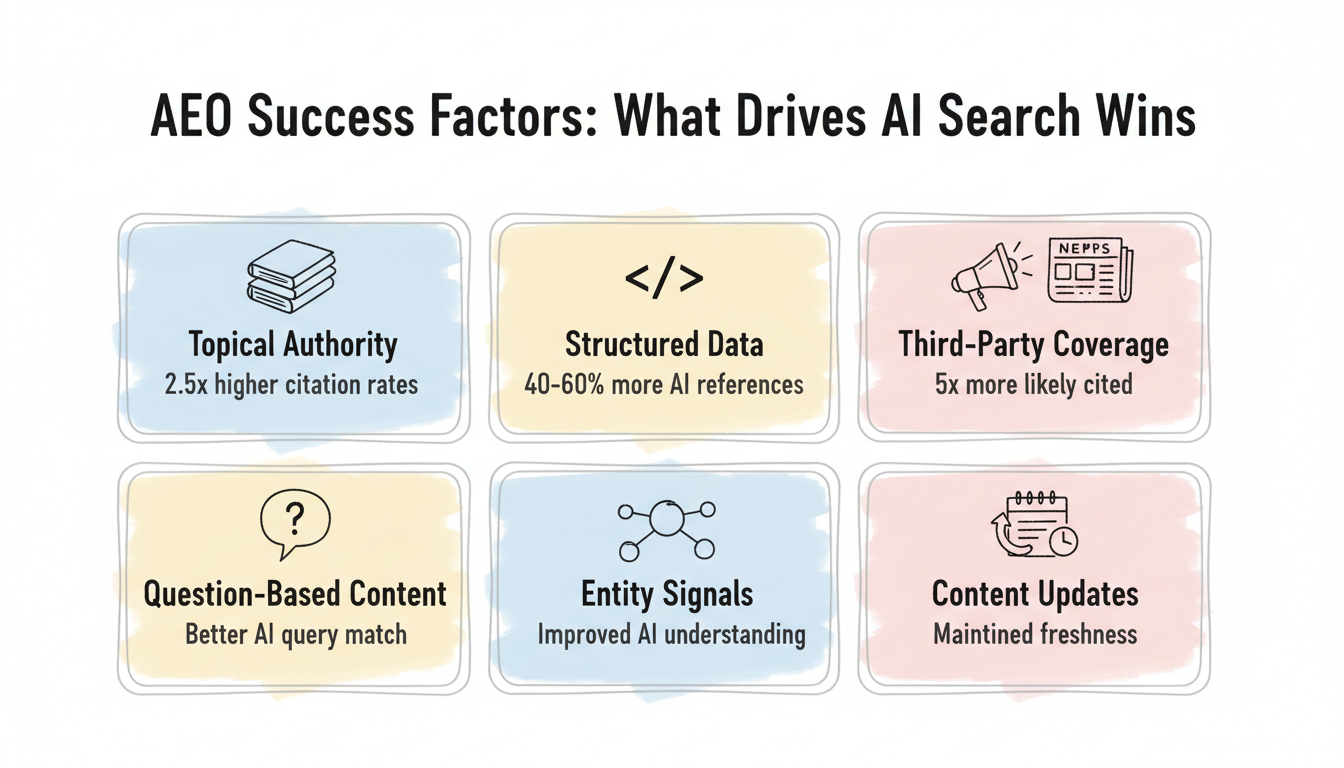
Brands with topical authority clusters see 2.5x higher AI citation rates. Structured data implementation drives 40–60% more AI references. Third-party media coverage makes brands 5x more likely to be cited.
— Conductor 2026 AEO/GEO Benchmarks Report
According to DW Media's analysis of AEO trends, factual integrity scoring now matters more than ever. AI scrapers favor original research, first-party data, and verified case studies over generic content—making documented success stories valuable for future AEO efforts.
Validating AEO Results: Avoiding Fake Case Studies
As AEO gains mainstream attention, unverified case studies are proliferating. According to Graphite's analysis of AEO claims, many published results lack reproducibility. Before trusting or acting on any AEO success stories case studies (including those in this article), look for these validation signals:
- Control groups or A/B testing methodology described
- Specific time periods and baseline metrics stated
- Third-party verification or named client confirmation
- Reproducible tactics rather than vague "proprietary methods"
- Separation of AEO-specific gains from general SEO improvements
Split testing remains the gold standard: run AEO optimizations on a subset of pages while keeping a control group unchanged, then compare performance over 8-12 weeks.
Measuring Your Own AEO Success
According to Superlines' GEO ROI Framework, translating AEO success stories case studies into revenue impact requires new tracking models.
ROI measurement approach:
- Establish baselines - Track current AI citations before optimization
- Monitor visibility metrics - Citation frequency, sentiment, accuracy
- Connect to business outcomes - Lead quality, conversion rates, LTV
- Calculate ROI - Compare visibility improvements against investment
According to their framework, enterprise clients with average LTV of €100,000 can see €400,000+ revenue impact from modest AI visibility improvements—demonstrating the business case for AEO services ROI.
Setting Up GA4 AI Source Segmentation
To accurately attribute AEO performance, configure GA4 to segment AI-referred traffic separately from organic search:
- Create a custom channel group for "AI Referral" traffic by adding referral sources: chatgpt.com, perplexity.ai, claude.ai, gemini.google.com, and copilot.microsoft.com
- Set up conversion events specific to AI-referred sessions to track signup rates, purchase rates, and engagement depth
- Benchmark against industry averages—AI-assisted conversion rates average 6.4% for engaged sessions, compared to 2-3% for traditional organic
- Track pipeline attribution by connecting GA4 AI segments to your CRM to measure downstream revenue impact (leading agencies report $90M+ pipeline attributed to AI search)
This segmentation reveals the true business impact of AEO investments and helps justify continued optimization spend.
Key Takeaways
These AEO success stories case studies reveal consistent patterns:
- AI conversion rates excel - 3.2x or higher conversions from AI search traffic
- Rapid results possible - 71% visibility growth achievable in 8 weeks
- Small brands can compete - Strategic AEO helps companies outrank enterprises
- Topical authority matters - Comprehensive coverage beats individual page optimization
- Integration works best - AEO and SEO strategies reinforce each other
- Measurement drives improvement - Data-driven iteration accelerates results
- ROI is quantifiable - AI visibility connects directly to business outcomes
- Ecommerce revenue attribution works - DI ORO's +559% organic sales proves direct AEO-to-revenue tracking
- SaaS pipeline is viable - Mentimeter's 124K ChatGPT sessions show B2B AEO delivers at scale
- Technical signals matter - llms.txt and structured schema give AI systems explicit guidance
These success stories demonstrate that AEO investment delivers measurable returns—not theoretical future benefits, but documented present-day results.