
Before optimizing content for AI search, technical foundations must be solid. AI systems can't cite content they can't access, parse, or understand. A comprehensive technical audit identifies barriers preventing AI visibility and prioritizes fixes by impact.
This checklist covers every technical factor affecting how AI crawlers discover, process, and evaluate your website.
Section 1: AI Crawler Access Audit
AI systems use dedicated crawlers with specific behaviors. Standard SEO crawler audits miss AI-specific issues.
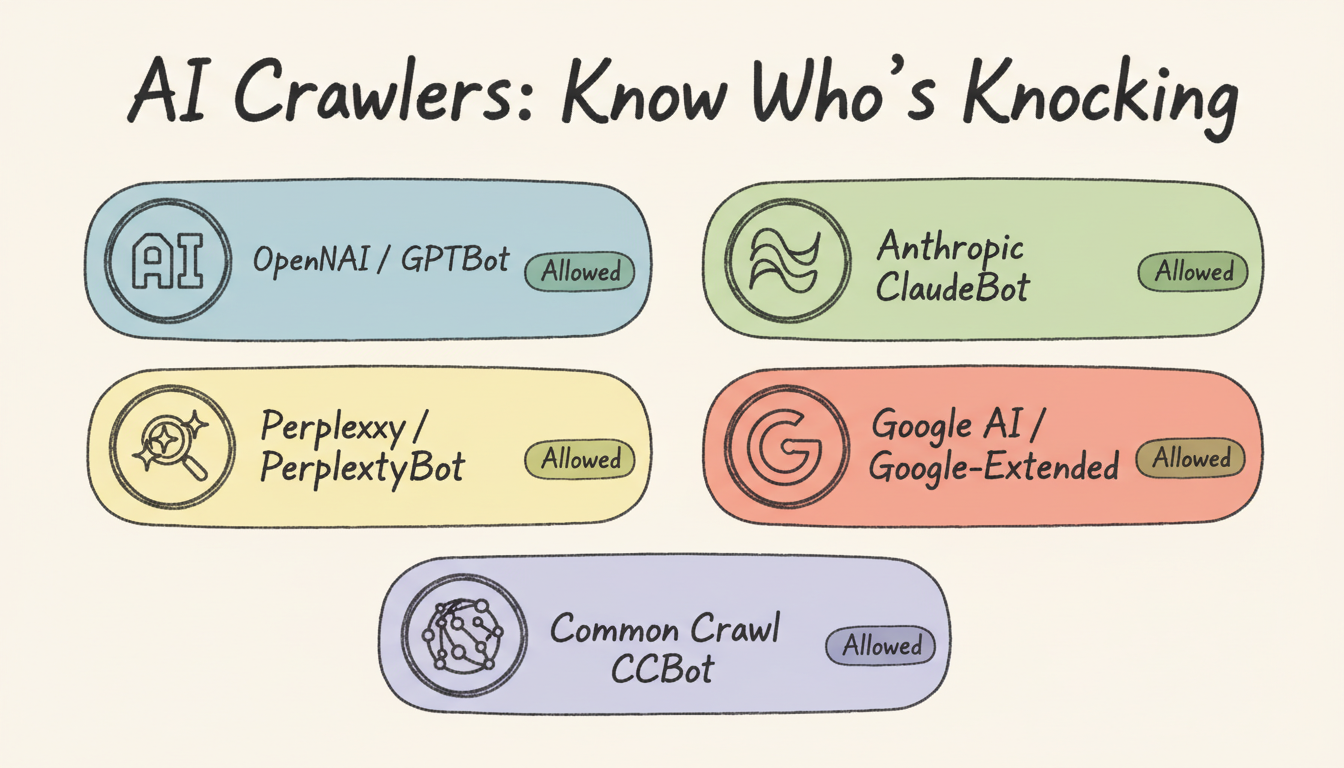
Robots.Txt Analysis
Check for each AI crawler:
Crawler | User-Agent | Check Status |
OpenAI | GPTBot | Allowed / Blocked / Missing |
Anthropic | ClaudeBot | Allowed / Blocked / Missing |
Perplexity | PerplexityBot | Allowed / Blocked / Missing |
Google AI | Google-Extended | Allowed / Blocked / Missing |
Common Crawl | CCBot | Allowed / Blocked / Missing |
Audit steps:
- Access robots.txt directly at domain.com/robots.txt
- Search for each AI user-agent
- Verify Allow/Disallow directives
- Check for wildcards affecting AI crawlers
- Test with robots.txt testing tools
Common issues found:
- Blanket Disallow blocking all bots
- Legacy rules inherited from outdated templates
- Conflicting directives (both Allow and Disallow for same paths)
- Missing AI crawlers entirely (neither allowed nor blocked)
Server Response Testing
AI crawlers may receive different responses than browsers.
Test methodology:
curl -A GPTBot -I https://yourdomain.com/target-page
curl -A ClaudeBot -I https://yourdomain.com/target-page
curl -A PerplexityBot -I https://yourdomain.com/target-page
Response codes to check:
Code | Meaning | Action Required |
200 | Success | None |
301/302 | Redirect | Verify destination accessible |
403 | Forbidden | Check WAF/security rules |
429 | Rate limited | Adjust rate limiting |
5xx | Server error | Investigate server issues |
Security system audit:
- Web application firewall (WAF) rules
- CDN bot detection settings
- Rate limiting thresholds
- Geographic restrictions
- User-agent filtering
Crawl Budget Analysis
Evaluate how efficiently AI crawlers can access your content.
Factors to assess:
Factor | Good | Poor | Priority |
Average response time | Under 500ms | Over 2000ms | High |
Crawl depth to content | 1-3 clicks | 5+ clicks | Medium |
Internal linking density | Multiple paths | Orphan pages | High |
XML sitemap coverage | 100% indexed pages | Under 80% | High |
Section 2: Structured Data Audit
Schema markup provides machine-readable context AI systems use for extraction and citation. Understanding schema markup knowledge graph relationships is crucial for effective implementation.
Schema Implementation Check
Audit each page type:
Page Type | Required Schema | Optional Schema | Status |
Homepage | Organization | WebSite, BreadcrumbList | Check |
Blog posts | Article | FAQPage, HowTo, Speakable | Check |
Product pages | Product | Review, Offer | Check |
Service pages | Service | FAQPage, LocalBusiness | Check |
FAQ pages | FAQPage | - | Check |
Additionally, consider implementing Speakable schema markup on key content sections. Speakable schema identifies sections of a page best suited for text-to-speech playback, which is increasingly relevant as AI assistants deliver voice-based answers. Mark your most concise, direct-answer paragraphs as speakable to increase the likelihood of voice assistant citation.
Schema Validation Process
Testing sequence:
- Syntax validation - JSON-LD parses without errors
- Schema.org compliance - Types and properties match specification
- Google Rich Results - Eligible for enhancements
- Field completeness - Required and recommended fields populated
Common schema errors:
Error Type | Impact | Detection Method |
Invalid JSON syntax | Complete failure | JSON validator |
Wrong type | Misinterpretation | Schema validator |
Missing required fields | Reduced visibility | Rich Results Test |
Duplicate conflicting markup | Confusion | Manual inspection |
Incorrect nesting | Parsing errors | Structured data testing |
Schema Quality Assessment
Beyond syntax, evaluate semantic quality.
Quality factors:
- Accuracy: Schema content matches visible page content
- Completeness: All applicable fields populated
- Specificity: Most specific type used (not generic Thing)
- Freshness: dateModified reflects actual updates
- Authority: Author and publisher properly attributed
Section 3: Content Accessibility Audit
AI systems must access and parse your content directly.
Voice Search and Conversational Query Alignment
As AI assistants increasingly handle voice queries, your content must align with conversational search patterns. Audit your pages for natural language compatibility:
- Do your headings reflect how people naturally ask questions?
- Are direct answers provided within the first 40-60 words of each section?
- Do you address long-tail conversational queries?
- Is content structured to answer follow-up questions in logical sequence?
Voice search optimization overlaps significantly with AEO because AI assistants use the same underlying retrieval systems to source answers for both text and voice responses.
Javascript Rendering Analysis
Content hidden behind JavaScript may be invisible to AI crawlers.
Testing process:
- Disable JavaScript in browser
- View page source (not rendered DOM)
- Check if primary content appears
- Verify schema markup in source
JavaScript dependency matrix:
Content Element | Server-rendered | Client-rendered | Priority Fix |
Main body text | Required | High risk | High |
Headlines (H1-H6) | Required | High risk | High |
FAQ content | Required | Medium risk | Medium |
Navigation | Preferred | Lower risk | Low |
Comments | Optional | Acceptable | Low |
Content Parsing Test
Verify AI systems can extract meaningful content.
Manual extraction test:
- Copy page source HTML
- Strip all markup programmatically
- Assess remaining text coherence
- Identify content locked in images or PDFs
Accessibility factors:
Factor | Good Practice | Issues to Fix |
Text in HTML | Direct text content | Text in images |
Heading structure | Logical H1-H6 flow | Skipped levels, multiple H1s |
List formatting | Semantic lists | Visual-only formatting |
Table structure | Proper markup | Tables for layout |
Section 4: Site Architecture Audit
Information architecture affects how AI systems understand content relationships. When evaluating your technical foundation, consider the broader context of SEO vs AEO key differences in your overall strategy.
URL Structure Analysis
URL quality checklist:
Factor | Optimal | Suboptimal | Fix Priority |
Hierarchy | /category/subcategory/page | /p?id=12345 | High |
Keywords | /blog/aeo-optimization | /blog/post-123 | Medium |
Depth | 3-4 levels max | 6+ levels | Medium |
Parameters | Minimal | Multiple tracking params | Low |
Internal Linking Assessment
Internal links help AI systems discover and contextualize content.
Audit metrics:
Metric | Target | Action If Below |
Links to priority pages | 10+ internal links | Add contextual links |
Orphan pages | 0 | Connect to relevant content |
Link anchor text | Descriptive | Update generic anchors |
Broken internal links | 0 | Fix or remove |
Navigation and Hierarchy
Structure assessment:
- Primary navigation includes key AEO target pages
- Breadcrumbs present and schema-marked
- Category pages properly structured
- Related content links present on each page
Section 5: Performance Audit
Site speed affects both crawlability and user experience signals.
Core Web Vitals for AI
Benchmark assessment:
Metric | Good | Needs Work | Poor |
LCP (Largest Contentful Paint) | Under 2.5s | 2.5-4s | Over 4s |
FID (First Input Delay) | Under 100ms | 100-300ms | Over 300ms |
CLS (Cumulative Layout Shift) | Under 0.1 | 0.1-0.25 | Over 0.25 |
TTFB (Time to First Byte) | Under 200ms | 200-500ms | Over 500ms |
Server Performance
Infrastructure checks:
Component | Check | Impact on AI |
Server location | Geographic distribution | Crawl speed |
CDN configuration | Edge caching | Availability |
Compression | Gzip/Brotli enabled | Efficiency |
HTTP/2 or HTTP/3 | Protocol support | Connection handling |
Section 6: Security and Trust Signals
Technical security indicators contribute to authority assessment.
Security Audit Checklist
Factor | Required | Status |
HTTPS everywhere | Yes | Check |
Valid SSL certificate | Yes | Check |
HSTS enabled | Recommended | Check |
Mixed content issues | None | Check |
Security headers | Present | Check |
Audit Prioritization Framework
Not all issues require immediate attention. Prioritize by impact.
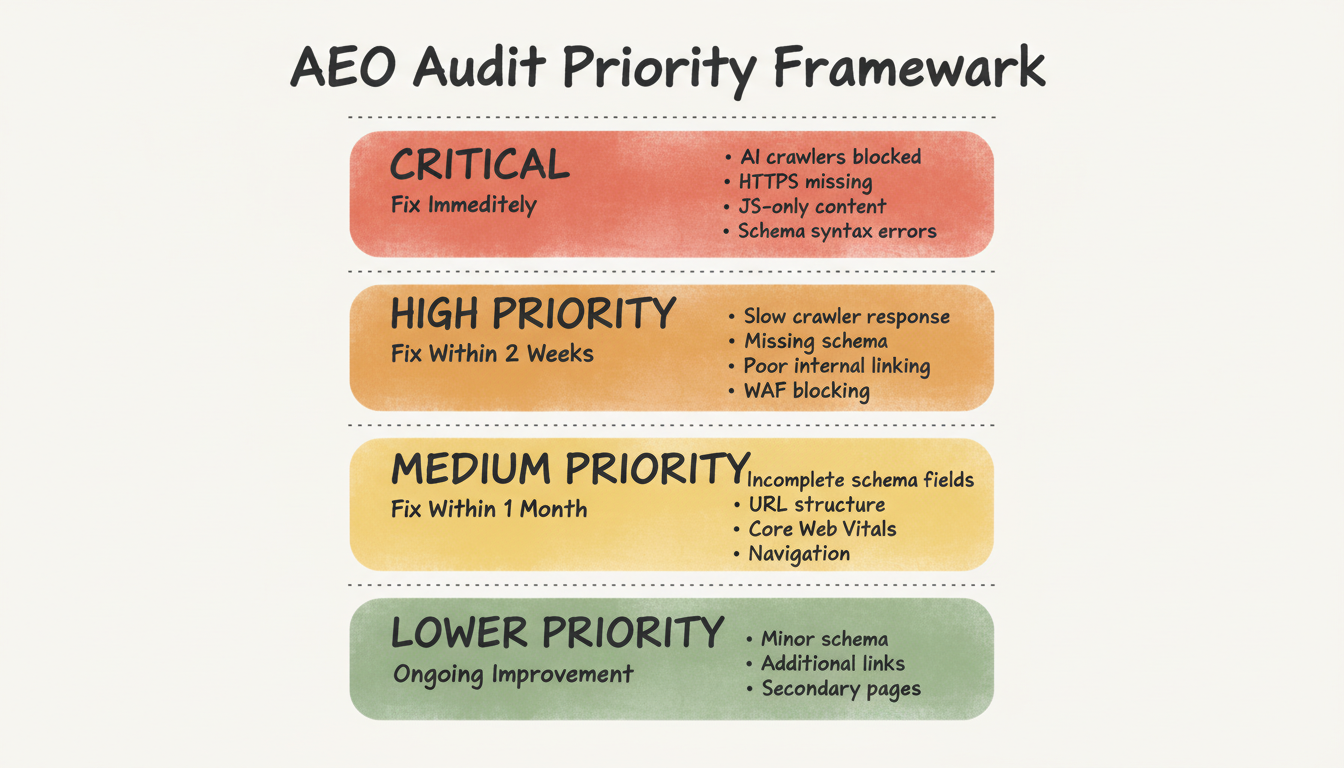
Critical (Fix Immediately)
- AI crawlers blocked entirely
- HTTPS not implemented
- Primary content requires JavaScript
- Schema has syntax errors
High Priority (Fix Within 2 Weeks)
- Slow server response to crawlers
- Missing schema on key page types
- Poor internal linking to priority content
- WAF blocking legitimate AI access
Medium Priority (Fix Within 1 Month)
- Incomplete schema fields
- URL structure improvements
- Core Web Vitals optimization
- Navigation enhancements
Lower Priority (Ongoing Improvement)
- Minor schema enhancements
- Additional internal linking
- Secondary page optimization
Post-Audit Action Plan
Convert audit findings into implementation roadmap. For comprehensive technical optimization guidance, review our AEO tools complete guide to select the right solutions for your needs.
Documentation template:
Issue: [Specific finding]
Impact: [Critical/High/Medium/Low]
Current State: [What is happening now]
Target State: [Desired outcome]
Implementation: [Specific steps]
Verification: [How to confirm fix]
Conduct thorough AEO technical audits:
- Test AI crawler access specifically - Robots.txt and server responses to AI user-agents
- Validate structured data comprehensively - Syntax, compliance, and semantic quality
- Verify content accessibility - JavaScript rendering, HTML parsing, content extraction
- Assess site architecture - URL structure, internal linking, navigation hierarchy
- Measure performance factors - Core Web Vitals, server response, infrastructure
- Prioritize by impact - Critical issues first, then systematic improvement
Technical audits reveal hidden barriers to AI visibility. Regular assessment ensures your site remains accessible as AI systems and your content evolve.
E-E-A-T Signals Audit
E-E-A-T (Experience, Expertise, Authoritativeness, Trustworthiness) signals are increasingly important for AI citation decisions. AI systems evaluate source credibility before including content in their responses, and E-E-A-T markers serve as key trust indicators during that evaluation.
Author Credentials Assessment
AI systems cross-reference author information to validate expertise. Audit these elements:
- Author bios on every article: Include credentials, relevant experience, and links to professional profiles
- Person schema markup: Implement structured data for authors with jobTitle, alumniOf, and sameAs properties linking to authoritative profiles
- Consistent author identity: Same name, headshot, and bio across your site and external platforms (LinkedIn, industry publications)
- Expert review signals: Medical, financial, or legal content should indicate expert review with reviewer credentials
Experience Signals
First-hand experience differentiates authoritative content from aggregated summaries:
- Original case studies with specific data points and outcomes
- Screenshots, proprietary research, or unique datasets
- Methodology descriptions showing how conclusions were reached
- Dated references indicating ongoing, current experience with the subject
Trust Signals Checklist
Signal | Where to Check | Priority |
HTTPS implementation | All pages | Critical |
Privacy policy | Footer link, accessible | High |
Contact information | Dedicated page, footer | High |
Physical address | Contact page, schema | Medium |
Customer reviews | On-site and third-party | Medium |
Editorial policy | About or dedicated page | Medium |
AI systems weigh these trust signals when deciding which sources to cite. A site with strong E-E-A-T signals across all dimensions is significantly more likely to appear in AI-generated responses than one with thin or absent credibility markers.
Entity Confidence and Knowledge Graph Validation
AI systems need to confirm that your brand or organization is a recognized entity before citing it confidently. Entity validation ensures AI models can match your content to a known, trustworthy source in their knowledge representations.
Google Knowledge Panel Verification
A Knowledge Panel signals that Google recognizes your brand as a distinct entity. To audit:
- Search your brand name in Google and check for a Knowledge Panel
- Verify all information is accurate (description, logo, social profiles, founding date)
- Claim and manage the panel through Google verification process
- Ensure consistency between Knowledge Panel data and your website Organization schema
Entity Database Presence
AI training data draws from multiple entity databases. Check your presence on:
Database | Why It Matters | Action |
Wikidata | Structured entity data used by multiple AI systems | Create or verify entry |
Wikipedia | 47.9% of ChatGPT references cite Wikipedia | Ensure notability criteria met |
Crunchbase | Business entity validation for B2B | Complete and update profile |
LinkedIn Company | Professional entity verification | Maintain active, complete page |
Brand Identity Consistency
AI systems build entity confidence through cross-platform consistency. Audit for:
- Name consistency: Exact same brand name across all platforms
- Description alignment: Core value proposition described consistently everywhere
- Visual identity: Same logo and branding across profiles
- NAP consistency: Name, Address, Phone matching across all directories and citations
When AI systems encounter consistent entity signals across multiple authoritative sources, they assign higher confidence scores to that entity, making citation more likely.
RAG Readiness Assessment
Retrieval-Augmented Generation (RAG) is the dominant architecture powering AI search responses. In RAG systems, AI models retrieve relevant content chunks from indexed sources and use them to generate answers. If your content is not structured for effective retrieval, it will be overlooked even when topically relevant.
Understanding RAG Retrieval
RAG systems work by:
- Converting your content into vector embeddings (numerical representations of meaning)
- Storing those embeddings in a searchable index
- Matching user queries to the most semantically relevant content chunks
- Feeding retrieved chunks to the language model for answer generation
This means your content competes at the chunk level, not the page level. A single well-structured section can win citation even if the rest of the page is average.
Content Chunking Optimization
Audit your content structure for chunk-friendliness:
- Self-contained sections: Each H2/H3 section should make sense independently without requiring context from other sections
- BLUF structure: Place the Bottom Line Up Front -- provide the direct answer in the first 40-60 words of each section, then elaborate
- Clear section headers: Use descriptive headings that match likely search queries, not clever or vague titles
- Consistent depth: Sections should be substantial enough to provide value (150-300 words per H2 section minimum) but not so long that key points get buried
RAG-Friendliness Testing
Test whether your content would perform well in a RAG pipeline:
- Isolation test: Copy any single section -- does it answer a specific question completely?
- Query match test: For each section, can you identify the exact question it answers?
- Summary test: Can each section be summarized in one sentence without losing critical information?
- Citation test: Ask AI systems (ChatGPT, Claude, Perplexity) questions your content answers -- do they cite you?
Content that passes all four tests is well-optimized for RAG retrieval. Content that fails multiple tests needs restructuring before it can compete in AI search results.
Measuring AEO Audit Success
An audit is only valuable if you can measure the impact of the fixes you implement. Establish baseline metrics before making changes, then track improvements systematically.
Citation Rate Tracking
Monitor how often AI systems cite your content in their responses:
- Run a set of target queries weekly across ChatGPT, Claude, Perplexity, and Google AI Overviews
- Record whether your brand or content is mentioned, linked, or paraphrased
- Track citation frequency over time to identify trends
- Note which specific pages or sections get cited most frequently
Share of Voice in AI Responses
Measure your visibility relative to competitors in AI-generated answers:
Metric | How to Measure | Target |
Brand mention rate | Queries mentioning your brand / total queries tested | Increase quarter-over-quarter |
Citation position | Where in the AI response your citation appears | Top 3 sources |
Competitor comparison | Your citations vs. competitor citations for same queries | Parity or above |
Topic coverage | Number of topic areas where you appear in AI responses | Expanding coverage |
Sentiment Analysis of AI Mentions
Track not just whether AI cites you, but how it characterizes your brand:
- Are AI descriptions of your brand accurate and positive?
- Do AI systems recommend your products/services or merely mention them?
- Are there any inaccurate or outdated claims about your brand in AI responses?
- How does AI sentiment compare to your intended brand positioning?
Monitoring Tools and Methodology
Establish a repeatable monitoring process:
- Query library: Maintain a list of 50-100 target queries representing your key topics
- Weekly snapshots: Run queries across multiple AI platforms and record results
- Monthly reports: Aggregate data into trend reports showing citation rates, share of voice, and sentiment
- Quarterly deep dives: Full re-audit comparing current state to previous quarter baseline
Multi-Platform Audit Consideration
Different AI platforms source and rank content differently. Your audit should test across all major platforms:
- ChatGPT: Relies heavily on training data and browsing; values Wikipedia and authoritative sources
- Claude: Strong emphasis on recency and direct content quality
- Perplexity: Real-time web search with heavy Reddit citation (46.7% of sources)
- Google AI Overviews: Integrates with existing search index; values traditional SEO signals plus structured data
An issue that blocks visibility on one platform may not affect another. Comprehensive audits test each platform independently.
Third-Party Validation Signals
AI systems do not rely solely on your website to evaluate credibility. Third-party mentions, reviews, and citations serve as independent validation signals that heavily influence whether AI models trust and cite your content.
Reddit and Community Presence
Reddit is a dominant source for AI citations. Research shows that 46.7% of Perplexity citations come from Reddit. To audit and improve your Reddit presence:
- Search Reddit for mentions of your brand, products, and key topics
- Assess the sentiment and accuracy of existing mentions
- Identify relevant subreddits where your expertise adds value
- Evaluate whether your brand participates authentically in discussions
- Check if community members organically recommend your resources
Review Platform Audit
B2B and SaaS companies should audit their presence on software review platforms:
Platform | Audit Check | Priority |
G2 | Profile completeness, review volume, rating | High |
Capterra | Listing accuracy, review recency | High |
TrustRadius | Verified reviews, TrustMap placement | Medium |
Trustpilot | Review volume, response rate | Medium |
Wikipedia and Authoritative Citations
Wikipedia is referenced in 47.9% of ChatGPT responses, making it one of the most influential sources for AI training and citation. Audit:
- Does your organization have a Wikipedia article? If not, does it meet notability criteria?
- Are existing Wikipedia mentions accurate and up to date?
- Is your content cited as a reference in relevant Wikipedia articles?
- Are there opportunities to contribute reliable, cited information to topic-relevant articles?
NAP Consistency Audit
Name, Address, and Phone (NAP) consistency across directories reinforces entity confidence for AI systems:
- Audit your NAP information across Google Business Profile, Yelp, Bing Places, Apple Maps, and industry-specific directories
- Flag any inconsistencies in business name spelling, address formatting, or phone numbers
- Update outdated listings and remove duplicate entries
- Ensure your website Contact page matches all directory listings exactly
Strong third-party validation creates a network of corroborating signals that AI systems use to determine source reliability. Sites with diverse, positive third-party mentions are cited more frequently and more favorably than those with thin or nonexistent external validation.
Competitive AI Audit Methodology
Understanding how competitors perform in AI search provides context for your own audit results and reveals opportunities for differentiation.
Side-By-Side Benchmarking
For each section of your AEO audit, run the same checks against your top 3-5 competitors:
- Compare robots.txt configurations -- which competitors allow or block AI crawlers?
- Evaluate schema markup depth and quality across competitor sites
- Test competitor pages for RAG readiness using the same criteria
- Track competitor citation rates across AI platforms for your target queries
Document findings in a comparison matrix to identify gaps where competitors outperform you and strengths you can leverage.
AEO vs. GEO Context
While this audit focuses on Answer Engine Optimization (AEO), it is worth noting the emerging distinction between AEO and Generative Engine Optimization (GEO). AEO centers on getting cited by AI systems that retrieve and present existing content. GEO goes further, optimizing for AI systems that generate novel responses by synthesizing multiple sources. A thorough technical audit supports both approaches, since the technical foundations -- crawler access, structured data, E-E-A-T signals -- are prerequisites for visibility in any AI-powered search experience.
Frequently Asked Questions
What Is an AEO Audit?
An AEO (Answer Engine Optimization) audit is a systematic assessment of your website technical readiness for AI search systems. It evaluates whether AI crawlers can access, parse, and understand your content, covering factors like crawler permissions, structured data quality, E-E-A-T signals, entity validation, and RAG readiness. Unlike a traditional SEO audit that focuses on search engine rankings, an AEO audit specifically targets the technical requirements that AI systems like ChatGPT, Claude, Perplexity, and Google AI Overviews use to select and cite sources.
How Is AEO Different Than SEO?
SEO focuses on ranking in traditional search engine results pages (SERPs), while AEO focuses on getting cited by AI systems. Key differences include: AEO requires allowing AI-specific crawlers (GPTBot, ClaudeBot, PerplexityBot) in your robots.txt; AEO emphasizes entity confidence in knowledge graphs rather than just backlink authority; content structure for AEO prioritizes direct answers and self-contained sections optimized for RAG retrieval; and AEO success is measured by citation rate and share of voice in AI responses rather than keyword rankings and organic traffic.
What Is a Technical Audit in the Context of AEO?
A technical audit in AEO context is a comprehensive review of your website infrastructure, structured data, content accessibility, and performance specifically through the lens of AI system requirements. It goes beyond traditional technical SEO by testing AI-specific crawlers, evaluating schema markup for machine readability, assessing whether content is structured for retrieval-augmented generation (RAG) systems, validating entity presence in knowledge databases, and checking E-E-A-T signals that influence AI citation decisions.
How Often Should You Run an AEO Audit?
Run a comprehensive AEO audit quarterly. AI search systems evolve rapidly, with new crawlers, changed behaviors, and updated ranking signals emerging regularly. Quarterly audits catch new issues before they significantly impact AI visibility. Between full audits, monitor key metrics monthly: track AI citation rates across platforms, check crawler access logs for new AI user-agents, and verify that structured data remains valid after content updates. If you make major site changes (migration, redesign, CMS switch), run an immediate audit regardless of schedule.