
The language of search has changed. AI platforms introduced an entirely new vocabulary, and the businesses fluent in these terms dominate visibility. Two years ago, marketers optimized for keywords and rankings. Today, they optimize for citations, answer boxes, and AI responses.
This glossary covers the essential terms defining how brands perform in AI search—organized by category for quick reference. With 45+ terms spanning core AEO, AI and machine learning foundations, search features, and strategy disciplines, this is the definitive AEO glossary for teams evaluating AEO vs SEO differences and building answer engine optimization into their workflows.
Core Optimization Terms
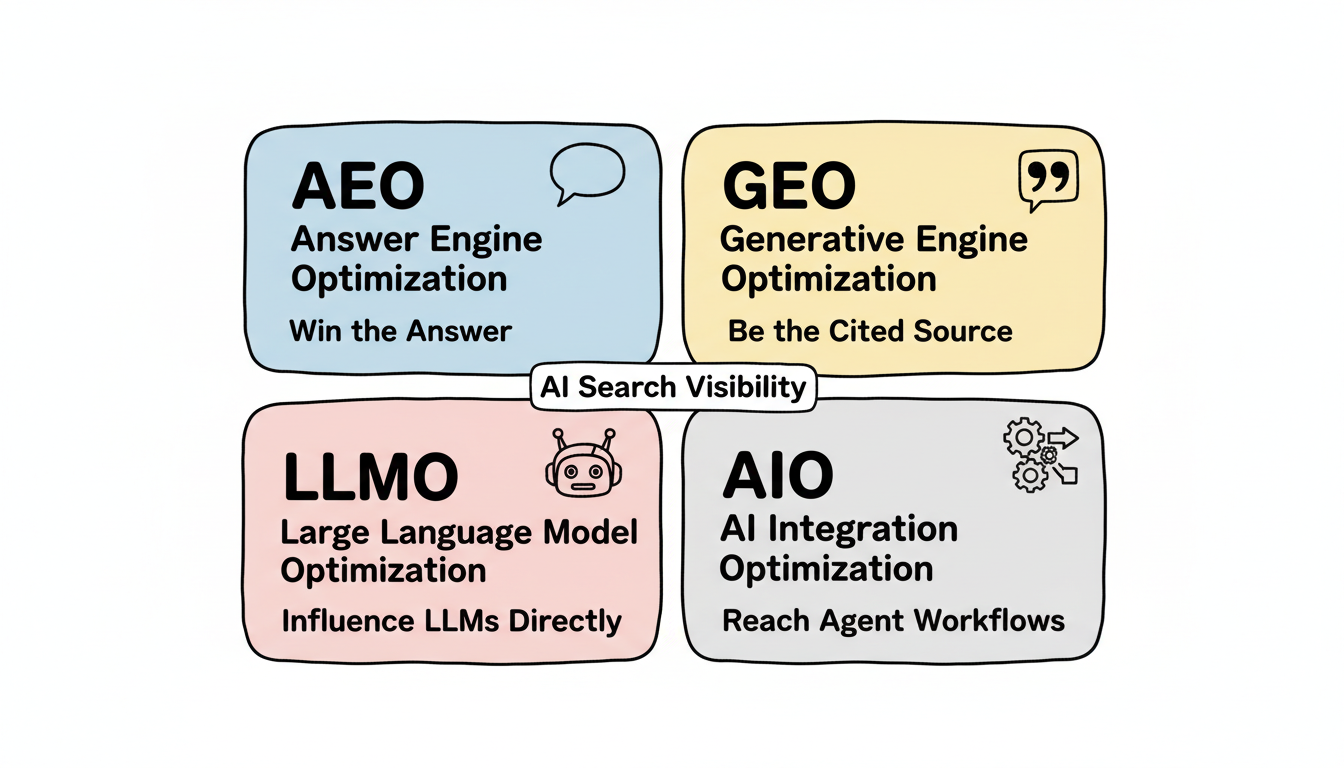
AEO (Answer Engine Optimization)
The practice of optimizing content to appear in AI-generated answers and direct response formats. AEO focuses on winning the answer—appearing in AI Overviews, featured snippets, and conversational AI responses rather than just ranking in traditional search results.
Why it matters: In 2026, most informational searches resolve instantly through AI summaries. Answer engine optimization ensures your content appears where decisions begin.
GEO (Generative Engine Optimization)
Structuring content so AI platforms can reference, cite, and synthesize it in generated responses. While AEO focuses on appearing as “the answer,” GEO emphasizes being cited as a trusted source within AI-generated content.
Why it matters: Research from Princeton and Georgia Tech found that GEO methods can boost visibility in AI responses by 30-40%. Content must be quotable for machines, not just readable for humans.
LLMO (Large Language Model Optimization)
Optimizing specifically for visibility within large language models like ChatGPT, Claude, and Gemini. LLMO encompasses tactics that influence how LLMs understand, reference, and recommend brands.
Why it matters: LLMs process queries differently than traditional search engines. LLMO addresses their specific requirements for authority, clarity, and factual consistency.
AIO (AI Integration Optimization)
Structuring content for integration into AI tools, applications, and agent workflows. AIO looks beyond individual AI platforms to how content functions within broader AI ecosystems.
Why it matters: As AI agents handle more tasks, visibility within agent workflows—not just chat interfaces—becomes critical for reach.
Technical Architecture Terms
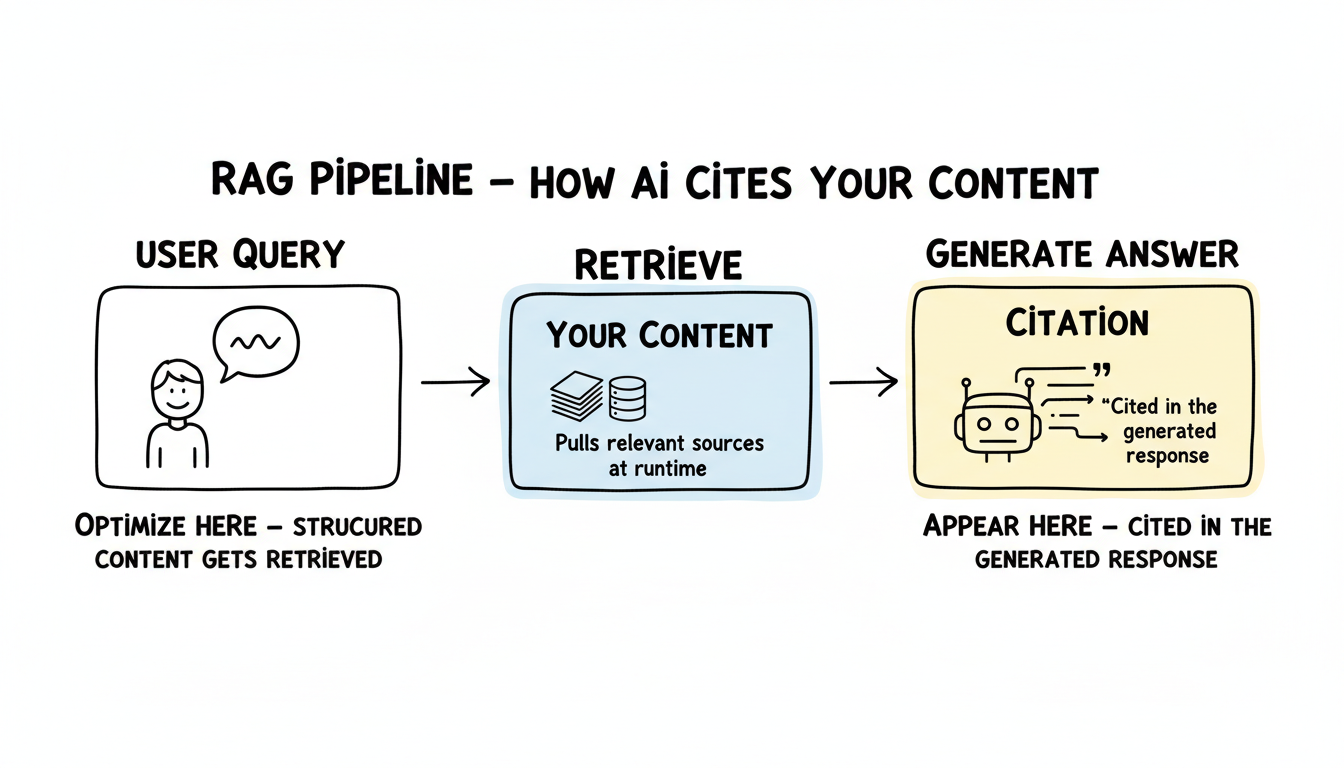
RAG (Retrieval-Augmented Generation)
The technical framework powering most answer engines. RAG combines information retrieval with AI text generation—when users ask questions, the system retrieves relevant documents, then generates responses grounded in that retrieved content. Modern RAG pipelines use vector embeddings for semantic retrieval alongside BM25 for keyword matching in hybrid approaches—see the AI & Machine Learning Foundation Terms section below for deeper definitions.
Why it matters: Understanding RAG explains why certain content gets cited. AI systems don’t just “know” things—they actively pull from external sources at runtime.
Parametric Memory
The knowledge embedded in an AI model’s training data. This is what the model “remembers” from training, as opposed to information it retrieves at query time.
Why it matters: ChatGPT relies heavily on parametric memory, while Perplexity prioritizes real-time retrieval. Different platforms require different optimization approaches.
Context Window
The amount of text an AI model can process in a single interaction. Larger context windows allow AI systems to consider more information when generating responses.
Why it matters: Content structure affects whether your key information fits within AI context windows. Answer-first formatting ensures critical information gets processed.
AI & Machine Learning Foundation Terms
LLM (Large Language Model)
A neural network trained on massive text datasets that can understand and generate human language. LLMs like GPT-4, Claude, and Gemini power the AI platforms where AEO visibility matters. Unlike LLMO—which is the practice of optimizing for these models—LLM refers to the models themselves and their architecture, training data, and inference capabilities.
Why it matters: Understanding how LLMs process and generate text helps marketers structure content that aligns with how these systems retrieve and synthesize information.
NLP (Natural Language Processing)
The branch of AI focused on enabling machines to understand, interpret, and manipulate human language. NLP powers how AI search platforms parse user queries, extract entities from content, and classify search intent—making it the foundational technology behind entity recognition and query understanding.
Why it matters: NLP determines how AI interprets your content. Strong semantic structure and clear entity signals make your content easier for NLP systems to process accurately.
NLG (Natural Language Generation)
The AI process of producing human-readable text from structured data or retrieved information. NLG is the output side of the RAG pipeline—once relevant documents are retrieved, NLG synthesizes them into coherent, conversational answers that AI platforms present to users.
Why it matters: Content that is well-structured and quotable gives NLG systems better raw material, increasing the likelihood of accurate citation in generated responses.
Vector Embedding / Vector Database
Vector embeddings convert text into numerical representations that capture semantic meaning, allowing AI systems to find content based on conceptual similarity rather than keyword matching. Vector databases store these embeddings and enable fast similarity search—the core retrieval mechanism in RAG systems that determines which content gets pulled into AI-generated answers.
Why it matters: Your content’s vector representation determines whether it gets retrieved for relevant queries. Semantically rich, well-structured content produces better embeddings.
Semantic Search
A search approach that matches queries to content based on meaning and intent rather than exact keyword matches. Semantic search uses vector embeddings to understand that “best way to get visible in AI answers” and “AEO strategy” are conceptually related, even without shared keywords. This is the retrieval mechanism powering AI search platforms.
Why it matters: Semantic search rewards topical depth and contextual relevance over keyword density. Content must demonstrate genuine expertise on a topic to rank in meaning-based retrieval.
AI Hallucination
When an AI model generates plausible-sounding but factually incorrect information—inventing statistics, misattributing quotes, or fabricating sources. Hallucinations occur when models generate text based on patterns rather than verified facts, particularly when relevant source material is unavailable or ambiguous.
Why it matters: Providing clear, verifiable content with structured proof blocks reduces the risk of AI hallucinating about your brand. Factual integrity and explicit data points give AI systems anchors that minimize fabrication.
Visibility and Measurement Terms
AI Visibility
How often and prominently your brand appears in AI-generated responses across platforms like ChatGPT, Perplexity, and Google AI Overviews. This extends beyond traditional search rankings to citation frequency in AI outputs.
Why it matters: Ranking #1 on Google doesn’t guarantee AI visibility. Brands need to measure and optimize for both traditional rankings and AI citations.
Citation Dominance
Your brand’s ability to be the primary source of truth for AI agents within your category. Citation dominance measures not just appearing in AI responses, but being the most-referenced source.
Why it matters: Multiple brands can appear in a single AI response. Citation dominance determines which brand users trust and remember.
Share of Voice (AI)
The percentage of AI-generated responses in your category that mention or cite your brand compared to competitors. This adapts traditional share of voice metrics for AI search contexts.
Why it matters: Share of voice tracking reveals competitive position in AI responses—visibility your traditional SEO tools miss.
Zero-Click Search
Queries answered directly on results pages without users clicking through to websites. AI Overviews and featured snippets satisfy user intent immediately, reducing website traffic even for high-ranking content.
Why it matters: Over 45% of searches in 2026 end without clicks. Zero-click optimization focuses on visibility and brand building within those answers. Google Search Console now tracks AI Overview impressions separately, giving marketers direct visibility into zero-click performance—see our AI search analytics setup guide for configuration details.
Content Structure Terms
Answer-First Formatting
Structuring content with direct answers positioned early, followed by supporting detail. AI systems extract content from the beginning of sections, making answer placement critical.
Why it matters: Research shows 40-60 word direct answers outperform 500-word narratives for citation probability. Position your key insight where AI systems scan first.
Structured Proof Blocks
Content sections that present verifiable claims with supporting evidence—statistics, citations, case studies—in machine-readable formats. Proof blocks help AI systems verify and trust your content.
Why it matters: AI systems increasingly evaluate “factual integrity” when selecting sources. Structured proof blocks demonstrate credibility.
Conversational Paths
Content systems that anticipate and answer follow-up questions a user might ask an AI agent. Beyond single FAQs, conversational paths address the 2nd, 3rd, and 4th questions in a topic sequence.
Why it matters: AI conversations are iterative. Content that addresses the entire conversation thread captures more citations than single-answer content.
Entity Recognition
How AI systems identify and understand brands, people, products, and concepts as distinct entities with relationships to other entities. Strong entity signals help AI systems accurately represent your brand. Entity recognition feeds directly into Knowledge Graph entries, and schema markup in JSON-LD provides explicit entity signals that complement natural language entity recognition.
Why it matters: If AI can’t identify your entity clearly, it can’t cite you accurately. Consistent entity information across the web improves recognition.
Platform-Specific Terms
AI Overview
Google’s AI-generated summary that appears at the top of search results for many queries. AI Overviews synthesize information from multiple sources, often reducing clicks to individual websites. AI Overviews evolved from SGE (Search Generative Experience), Google’s experimental AI search format tested throughout 2023-2024. Today, Featured Snippets and People Also Ask boxes feed into AI Overview generation, creating a unified answer layer across Google search.
Why it matters: AI Overviews now appear on millions of Google searches. Appearing in—or being cited by—AI Overviews is the new “position zero.”
Perplexity Pages
Shareable, article-like content created within Perplexity that synthesizes multiple sources. Pages represent how AI platforms are becoming content publishers, not just search tools.
Why it matters: Getting cited in Perplexity Pages provides lasting visibility as these pages get shared and discovered independently.
Search Feature & Discovery Terms
Featured Snippet
Google’s extracted answer box that appears above organic results, pulling a direct answer from a webpage. Featured snippet optimization overlaps significantly with AEO—the same answer-first formatting, concise definitions, and structured content that win snippets also improve citation probability in AI-generated responses.
Why it matters: Featured snippets remain a primary source for AI Overview generation. Winning the snippet often means winning the AI answer.
People Also Ask (PAA)
Dynamic question boxes in Google search results that expand to show answers from various sources. PAA queries map directly to the conversational paths users follow in AI search—each PAA question represents a follow-up query that AI platforms anticipate and answer in multi-turn conversations.
Why it matters: PAA questions reveal the exact follow-up queries AI systems address. Structuring content around PAA clusters captures more citation surface area.
SGE (Search Generative Experience)
Google’s experimental AI search format tested from 2023 through 2024, where generative AI summaries appeared at the top of search results. SGE was the precursor to AI Overviews—the concepts and optimization techniques remain identical, but Google rebranded and expanded the feature for general availability in 2025.
Why it matters: Understanding SGE history helps contextualize current AI Overview optimization. Many early AEO research papers reference SGE rather than AI Overviews.
Inline Citation
When an AI platform attributes a specific claim, statistic, or insight to a named source directly within its generated response. Earning inline citations—rather than appearing only in a references section—is the primary goal of AEO, as inline citations drive brand visibility and user trust within AI answers.
Why it matters: Inline citations are the highest-value placement in AI responses. Content with clear attribution, original data, and quotable statements earns more inline citations.
Conversational Search
Multi-turn query sessions where AI refines and deepens its answers based on user follow-ups. Unlike traditional single-query search, conversational search involves back-and-forth dialogue where context carries forward—connecting directly to the conversational paths content strategy that anticipates sequential questions.
Why it matters: Conversational search means a single user session can trigger multiple retrieval cycles. Content covering the full question sequence captures citations across the entire conversation.
Authority and Trust Terms
E-E-A-T (Experience, Expertise, Authoritativeness, Trustworthiness)
Google’s quality evaluation framework, increasingly applied by AI systems to determine source credibility. Content demonstrating genuine expertise receives higher citation probability.
Why it matters: AI systems evaluate the same trust signals as search engines. Building E-E-A-T benefits both traditional SEO and generative AI optimization.
Factual Integrity Score
An emerging metric describing how AI systems evaluate content accuracy and source reliability. Content with high factual integrity—original research, verified data, expert attribution—receives citation preference.
Why it matters: As AI platforms combat misinformation, factual integrity becomes a technical requirement, not just a quality preference.
Strategy & Structure Terms
Schema Markup / Structured Data
A machine-readable vocabulary, typically implemented in JSON-LD format, that helps AI systems understand your content type, entities, and relationships. Schema markup provides explicit signals about what your content is (Article, FAQ, HowTo), who created it, and how it connects to broader topics—directly supporting AI platforms’ ability to accurately retrieve and cite your content. See our guide on schema markup priority types for AI search for implementation details.
Why it matters: Structured data eliminates ambiguity for AI systems. Pages with proper schema markup receive more accurate entity recognition and higher citation rates in AI responses.
Knowledge Graph
Google’s massive entity database that connects people, places, brands, concepts, and their relationships into a structured network. Knowledge Graph entries power the information panels, entity cards, and factual claims that AI systems reference when generating responses. Strong entity signals—consistent NAP data, knowledge graph and entity SEO, authoritative mentions—feed Knowledge Graph entries.
Why it matters: Brands with Knowledge Graph presence receive preferential treatment in AI-generated answers. A clear Knowledge Graph entry signals to AI systems that your brand is a verified, authoritative entity.
Topic Cluster / Topical Authority
A hub-and-spoke content architecture where a central pillar page connects to detailed subtopic pages through strategic internal linking. Topic clusters signal deep expertise to AI systems by demonstrating comprehensive coverage of a subject area. This is the foundation of building citation authority—AI platforms prefer sources that cover topics thoroughly rather than superficially. See our AEO strategy framework for building effective topic clusters.
Why it matters: AI systems evaluate topical authority when selecting sources to cite. A well-structured topic cluster outranks isolated pages for citation probability.
Internal Linking
Strategic connections between related content pages that help both users and AI crawlers map topical relationships, content depth, and site structure. Internal links signal to AI systems which pages are most authoritative on specific topics and how different concepts within your content ecosystem relate to each other.
Why it matters: AI crawlers use internal link patterns to understand content hierarchies. Strong internal linking reinforces topical authority and helps AI systems discover your full content depth.
Content Gap Analysis
The systematic process of identifying topics, entities, and questions that competitors cover but your content does not. In AEO, content gap analysis extends beyond keywords to entity coverage—mapping which concepts AI systems associate with your category that your content fails to address.
Why it matters: Entity gaps directly reduce AI citation probability. Closing content gaps expands the range of queries where AI systems can retrieve and reference your content.
Prompt Engineering
The practice of crafting specific inputs to AI systems to produce optimal outputs. For AEO practitioners, prompt engineering is relevant for testing how AI platforms interpret, retrieve, and cite your content—running structured queries across ChatGPT, Perplexity, and Gemini to audit your AI visibility.
Why it matters: Prompt engineering enables systematic AEO auditing. Testing variations of category queries reveals how AI systems perceive your brand relative to competitors.
Emerging AEO Terms
The AEO landscape continues to evolve as AI capabilities expand. These emerging terms represent the next frontier of AI search optimization, from autonomous agents to new retrieval protocols. For a deeper look at how generative AI is reshaping search, see our generative engine optimization guide.
Agentic Search / AI Agents
Autonomous AI systems that execute multi-step research tasks, pulling from multiple sources, comparing information, and completing goals without human intervention at each step. Agentic search extends beyond single-query retrieval into complex workflows where AI agents plan, search, synthesize, and act—connecting directly to the AIO (AI Integration Optimization) discipline.
Why it matters: As AI agents handle more research and purchasing tasks, content must be optimized not just for chat interfaces but for autonomous agent workflows that may never surface a traditional search result.
MCP (Model Context Protocol)
A standardized protocol for connecting AI models to external tools, data sources, and APIs. MCP enables AI agents to access real-time information, execute actions, and integrate with enterprise systems—expanding what AI can do beyond simple question-answering into tool-augmented workflows.
Why it matters: MCP-enabled agents can pull structured data directly from your systems. Brands that expose content and data through standardized protocols gain visibility in agentic AI workflows.
Query Fan-Out
When AI systems decompose a single user query into multiple sub-queries, searching across different sources and perspectives before synthesizing a unified answer. Query fan-out means a single question can trigger retrieval from dozens of sources simultaneously, expanding the competitive landscape for any given query.
Why it matters: Query fan-out increases citation opportunities but also competition. Content must be authoritative enough to surface across multiple sub-query retrievals to earn prominent placement.
BM25 / Retrieval Scoring
A classic information retrieval algorithm that scores document relevance based on term frequency and document length. Despite the rise of vector search, BM25 remains widely used in hybrid RAG pipelines alongside semantic retrieval—meaning keyword optimization still matters for the retrieval stage of AI answer generation.
Why it matters: Hybrid retrieval systems combine BM25 keyword matching with vector similarity. Content needs both keyword precision and semantic depth to perform well across both retrieval methods.
Google Search Console
Google’s primary tool for monitoring search performance, indexation status, and—increasingly—AI Overview appearances. GSC provides data on which queries trigger AI Overviews featuring your content, impression counts for AI-generated results, and click-through rates from AI answer formats.
Why it matters: Google Search Console is the most accessible tool for measuring AEO performance in Google’s ecosystem. Tracking AI Overview impressions separately from organic results is essential for AEO measurement.
Frequently Asked Questions
What Is the Difference Between AEO and SEO?
SEO optimizes content for traditional search engine rankings using keywords, backlinks, and technical factors. AEO optimizes content for AI-generated answers across platforms like ChatGPT, Perplexity, and Google AI Overviews. While SEO targets click-through from blue links, AEO targets citation and visibility within AI responses. The two disciplines overlap in technical foundations but diverge in content structure, measurement, and success metrics. Most brands need both. For a detailed comparison, see our guide on AEO vs SEO differences.
What Structured Data Helps with Answer Engine Optimization?
Schema markup in JSON-LD format directly supports AEO by giving AI systems explicit entity signals. Priority types include Article/BlogPosting schema, FAQPage schema, Organization schema for knowledge graph entries, and HowTo schema for process content. Structured data helps AI platforms accurately identify your content type, author credentials, and topical relationships—all factors that influence citation probability in AI responses.
How Does AEO Relate to Generative Engine Optimization (GEO)?
AEO is the umbrella discipline focused on appearing in all AI-generated answers. GEO specifically targets generative AI platforms that synthesize and cite sources in their responses. Think of AEO as the strategy and GEO as a tactic within it. GEO emphasizes quotability, source attribution, and structured proof blocks that make content easy for generative models to reference.
Is AEO Replacing Traditional SEO in 2026?
AEO is not replacing SEO but expanding it. Traditional SEO remains essential for indexation, site authority, and organic traffic. However, as AI Overviews appear on over 30% of Google searches and platforms like ChatGPT handle millions of queries daily, AEO addresses a growing share of how users discover information. Forward-thinking teams integrate both into a unified search visibility strategy.